Articles / LORQAI
The Ancient Boats That Changed Philippine History
How the ancient Butuan balangay boats reveal sophisticated precolonial Philippine shipbuilding, maritime exchange, and an archaeological dating mystery.
Introduction
Buried beneath the wet soil of a Philippine city, archaeologists discovered the remains of wooden boats built long before European ships arrived. Their construction revealed an extraordinary maritime tradition. Their dates revealed an unexpected mystery.
Imagine digging a drainage channel and discovering pieces of a wooden boat beneath the ground.
At first, the remains might not seem extraordinary.
Wood rots. Rivers change course. Old vessels are abandoned and gradually forgotten.
But suppose the wooden planks were not remnants of an ordinary boat from the recent past.
Suppose they belonged to a shipbuilding tradition hundreds of years old, with carefully shaped boards, wooden pegs, and an ingenious system of bindings.
Now imagine finding more than one.
Beneath the waterlogged ground of Butuan, on the Philippine island of Mindanao, archaeologists encountered something remarkable: a concentration of ancient wooden boats.
Their remains became known as the Butuan boats, often called *balangay* or *balanghai*.
The discoveries provided physical evidence of sophisticated boatbuilding in the Philippine archipelago long before Spanish colonization.
And they raised a larger question.
What kind of maritime world existed here before Europeans arrived?
The Discovery Beneath the Mud
Butuan lies in northeastern Mindanao, near the Agusan River and its connection to Butuan Bay.
For generations, the surrounding waterways have shaped the region's geography and opportunities for transportation.
The area includes low-lying land, river channels, and sediments deposited as the landscape changed over time.
In the 1970s, drainage works and other ground disturbances revealed archaeological material beneath parts of the city.
Researchers found evidence of a settlement connected with an unexpectedly rich material culture.
There were ceramics, wooden remains, metal objects, and other artifacts.
Among the most important discoveries were sections of large wooden boats preserved in waterlogged sediments around Libertad, Butuan.
Excavations by the National Museum of the Philippines began in 1976.
Additional boat remains were identified during subsequent investigations.
The discoveries were extraordinary not simply because the vessels were old.
Wood is vulnerable to decay, especially in warm, humid environments.
When a boat is abandoned, its surviving parts normally deteriorate through biological activity, weathering, and physical disturbance.
But wood buried in saturated sediments with little available oxygen can sometimes survive for very long periods.
Under such conditions, some of the organisms responsible for breaking down wood cannot function as efficiently.
The wet ground that concealed the boats also helped preserve them.
What looked like an ordinary archaeological excavation had become a rare opportunity to study ancient Southeast Asian ship construction.
The Boats Were Built Without an Ordinary Framework of Nails
Consider the problem faced by an ancient boatbuilder.
A vessel intended to travel through rivers, coastal waters, or open sea needs a hull capable of holding together against moving water.
It must carry people or cargo.
It must remain sufficiently watertight.
And its structure must tolerate repeated movement, waves, and changing loads.
Modern observers might expect the builders to begin with a rigid internal skeleton and attach planks using large quantities of metal fasteners.
The Butuan boats reveal a different method.
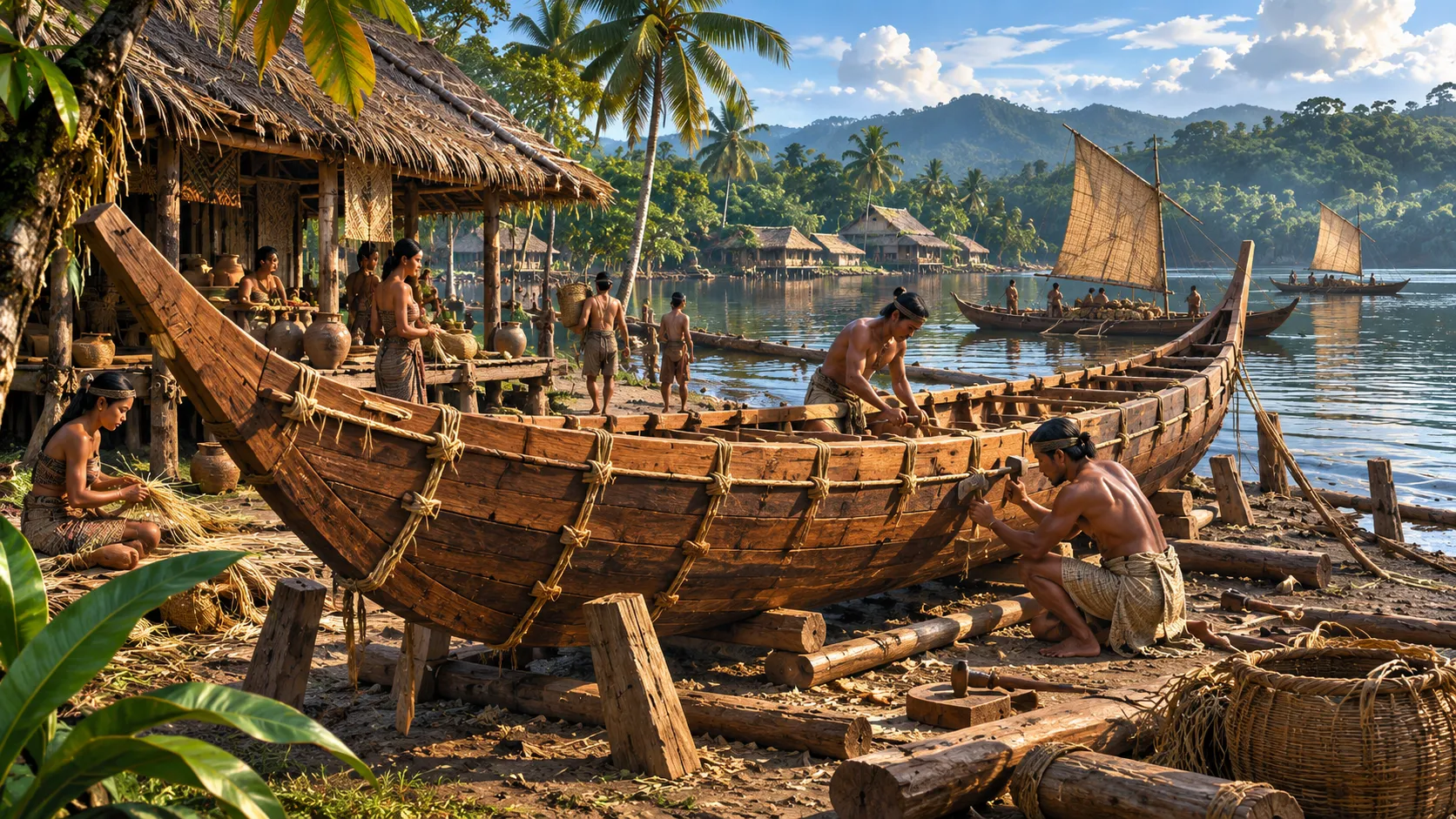
They belong to a Southeast Asian tradition known as **edge-joined, lashed-lug boat construction**.
The builders shaped long wooden planks to form the hull.
Adjacent planks were joined along their edges using wooden dowels or pegs.
On the inner surfaces of the planks, the builders carved protruding blocks known as *lugs*.
These were not separate pieces simply nailed into place.
They were carved as part of the wooden planks themselves.
Holes through the lugs allowed cords to secure internal structural components.
Archaeologists found evidence of cordage made from plant fibers, including fibers associated with the cabo negro palm.
The combination of carefully fitted planks, wooden fasteners, and lashings created a distinctive form of construction.
It required skill in selecting timber, shaping curved surfaces, fitting joints, and organizing the different structural elements of the hull.
It also reflected technological traditions shared across parts of maritime Southeast Asia.
The importance of the discovery was not that ancient Filipinos had somehow built boats without understanding engineering.
It was that they had developed and maintained an effective engineering tradition using materials and construction methods suited to their environment.
How Did the Wooden Planks Hold Together?
The secret lies in understanding that the hull was not simply a collection of boards tied together with rope.
The construction method involved several different connections, each performing a different function.
Wooden dowels aligned and secured adjoining planks along their edges.
The carved lugs provided attachment points inside the hull.
Bindings could connect those lugs to other components, including internal supports.
Together, the different joints helped maintain the shape and integrity of the vessel.
The system depended on accurate woodworking.
The boards had to fit together.
The openings for dowels needed to be carefully positioned.
The lugs had to be strong enough to withstand their intended loads.
And the lashings had to be applied in a way that held components in place.
The resulting structure was not primitive simply because it did not rely on metal nails.
It represented a different approach to marine construction.
Archaeological studies also show variation between individual Butuan boats.
Not every vessel used every structural detail in exactly the same way.
That variation is important.
It indicates that the technology was a practical tradition with choices and adaptations, rather than one unchanging design reproduced identically every time.
The surviving boats give archaeologists unusually direct evidence of how the builders solved real mechanical problems.
Why Are the Boats Called Balangay?
The name *balangay* is familiar in Philippine historical and cultural discussions.
Early European accounts recorded similar terms for boats used by communities in the archipelago.
Antonio Pigafetta, who accompanied Ferdinand Magellan's expedition in the early sixteenth century, described aspects of maritime life and the vessels encountered in the islands.
Later historical accounts also referred to boat types using related names and spellings.
Modern discussions frequently connect the ancient Butuan vessels with this broader tradition.
But there is a useful archaeological distinction.
A historical name is not automatically a precise technical classification.
Researchers examining the remains often prefer the expression *Butuan boats*, because it identifies the specific archaeological finds without assuming that every surviving hull fits one narrowly defined historical boat type.
The terms *balangay* and *balanghai* remain widely used, especially in cultural presentations.
Both refer to an important maritime heritage.
Yet for technical discussions, the construction method tells us more about the vessels than the name alone.
It is the preserved wood, joinery, and structural design that allow archaeologists to reconstruct how these boats were actually built.
An Unexpected Problem With Their Age
When the first Butuan boats were studied, radiocarbon dating produced results that seemed remarkable.
One early date for Boat 1 was interpreted as approximately 320 CE.
Other boats produced substantially later dates.
Boat 2, for example, was associated with an early result around 1250 CE, while Boat 5 was assigned dates near the end of the first millennium in some reports.
The enormous spread created a striking picture.
Had essentially similar boatbuilding techniques remained in use for nearly a thousand years?
It was possible.
Traditional technologies can persist across many generations.
But there was a problem.
The early results were inconsistent enough that archaeologists needed to investigate further.
A radiocarbon date does not directly tell us when a complete boat was assembled or launched.
It estimates the age of the carbon in a sampled material.
The result must be interpreted in relation to the sampled part of the vessel, laboratory procedures, calibration, and archaeological context.
Later studies provided more precise information.
Archaeologist Ligaya Lacsina and colleagues investigated the Butuan boats using additional archaeological evidence and accelerator mass spectrometry radiocarbon dating.
In a 2015 study, Lacsina reported calibrated dates for seven samples from five boats.
Their median dates clustered between the late eighth and early tenth centuries CE.
This more consistent pattern raised serious doubts about the much older and widely repeated dates from the earliest investigations.
The National Museum of the Philippines now commonly describes the Butuan boats as dating to the eighth through tenth centuries.
This does not mean every uncertainty has disappeared.
Different components, contexts, and dating methods can still require careful interpretation.
But the revised chronology is important because historical writing should reflect the strongest available evidence rather than repeat an attractive date simply because it is famous.
The story of the Butuan boats is therefore also a story about how archaeology corrects its own conclusions.
The boats did not become less important when their proposed age changed.
Their historical context became clearer.
A Maritime World Before European Arrival
If the boats belong largely to the eighth through tenth centuries, what kind of world surrounded them?
The answer is a region connected by waterways.
Southeast Asia is made up of islands, peninsulas, straits, rivers, and seas.
Long before European expeditions reached the area, communities had developed maritime technologies suited to moving between islands and along coasts.
Water did not simply separate settlements.
It connected them.
Boats carried people, tools, food, raw materials, and goods.
Rivers offered routes between inland resources and coastal communities.
Coastal navigation linked neighboring islands.
Longer-distance maritime exchanges connected parts of the Philippine archipelago with societies elsewhere in Asia.
The Butuan discoveries are particularly important because they provide physical evidence of the vessels themselves.
Written accounts can describe trade and travel.
Imported objects can reveal connections between communities.
But an excavated boat allows researchers to study the technology that made waterborne movement possible.
The wooden planks tell us something about timber selection and woodworking.
The dowels reveal approaches to joining materials.
The carved lugs and lashings demonstrate structural methods.
Together, they make an ancient maritime economy easier to understand.
These were not merely people living beside the water.
They possessed the knowledge required to build substantial vessels and use waterways as part of their lives.
What Was Butuan Trading?
Archaeological discoveries around Butuan include imported ceramics and other artifacts that connect the region with wider Asian exchange networks.
UNESCO's Tentative List description of the Butuan Archaeological Sites identifies pottery associated with different regions, including China and parts of Southeast Asia.
Some finds belong to periods later than the earliest boats.
This distinction matters.
The presence of a tenth-century ceramic object beside a settlement does not prove that it was transported aboard a particular excavated hull.
Similarly, the discovery of a boat does not tell us exactly where that individual vessel sailed.
Archaeology rarely provides such convenient answers.
Instead, investigators combine different categories of evidence.
Boats demonstrate shipbuilding capability.
Imported ceramics establish the movement of goods.
Manufacturing debris reveals local production.
Settlement remains and landscape studies help reconstruct where people lived and how they used the surrounding waterways.
Butuan also became known for evidence of goldworking.
Archaeological materials indicate the production and processing of gold objects alongside other crafts.
A study of Butuan's involvement in Southeast Asian maritime trade identified Chinese ceramics, glass beads, metal objects, and additional imported materials as evidence of international connections.
Together, these finds support the interpretation of Butuan as an important trading settlement, particularly during the late first and early second millennia CE.
Goods could move through a series of exchanges rather than along a single direct voyage.
A ceramic vessel manufactured far away might pass through several ports and traders before reaching its final destination.
That makes Butuan part of a regional network, not necessarily the endpoint of one simple route from a distant city.
And this is precisely why its archaeology matters.
It shows that the Philippine archipelago participated in complex Asian maritime relationships long before European colonization.
The River That Connected Land and Sea
The geographical position of Butuan was central to its history.
The Agusan River system connects extensive areas of northeastern Mindanao with coastal waters.
Rivers offer natural corridors through landscapes where overland movement can be difficult.
For settlements near navigable waterways, access to boats can transform the movement of both people and goods.
Forest products may be carried toward coastal markets.
Imported objects may move inland.
Food, building materials, tools, and other resources can circulate among communities.
But the exact shape of the ancient landscape was not identical to today's map.
Rivers can shift course.
Floodplains accumulate sediment.
Coastlines change as material is deposited or removed.
These processes can gradually transform the relationship between a settlement and nearby navigable water.
Research into Butuan's historical geography has shown the importance of reconstructing former river channels and coastal environments when interpreting archaeological sites.
A boat buried beneath modern land may once have stood much closer to an active waterway.
Its present location cannot always be understood by looking only at the modern city.
The landscape itself has a history.
And that history helps explain why the wooden boats came to rest where archaeologists eventually found them.
Why So Many Boats Were Found in One Area
Finding one ancient wooden boat is valuable.
Finding multiple vessels within a relatively concentrated archaeological landscape raises larger questions.
Did the area function as a place where boats were built?
Were some vessels abandoned after being damaged?
Did waterways change, leaving boats stranded or buried?
Were different areas used for mooring, repair, construction, or disposal?
These are reasonable archaeological questions.
But the existence of multiple boat remains does not automatically prove any single explanation.
The history of the site includes different excavations, reported discoveries, and incomplete recoveries.
Older inventories often refer to eleven identified boats.
Some later descriptions use different totals because researchers distinguish between confirmed vessels, previously reported remains, recovered sections, and incompletely investigated locations.
What is clear is that several substantial wooden vessels were identified in the Butuan area, and only some have been fully recovered and studied.
In 2025, researchers from the National Museum's Maritime and Underwater Cultural Heritage Division returned to investigate the reported location of Butuan Boat 3, whose excavation had been interrupted decades earlier.
The work demonstrated that the archaeological story was not closed.
Important questions remained even after nearly half a century of investigation.
And some of the most interesting evidence may still be beneath the ground.
Why Archaeologists Cannot Simply Dig Up Every Boat
An ancient wooden object preserved in wet sediment presents a conservation problem.
While the wood remains buried, its surrounding conditions may help protect it.
Excavating it changes those conditions.
Once waterlogged wood is exposed to air and begins to dry, its structure may deform, shrink, crack, or deteriorate.
The wood may be fragile even when it appears substantial.
Preserving it requires appropriate treatment, storage, documentation, and long-term care.
Large wooden hull sections present additional challenges because of their dimensions and structural condition.
Recovery is not simply a matter of lifting a boat onto a truck and placing it inside a museum.
The excavation must be carefully recorded.
Each component may need support.
The material must be conserved under controlled conditions.
And the institution responsible for the object must be able to preserve it after excavation.
In some circumstances, leaving archaeological remains protected in place is more responsible than recovering them without sufficient conservation resources.
That is one reason why not every known Butuan boat has been fully excavated.
The objective is not to remove every ancient object from the ground as quickly as possible.
It is to preserve the evidence while making it possible to learn from it.
The Boats That Became National Cultural Treasures
The significance of the Butuan finds was recognized nationally.
On March 9, 1987, Philippine President Corazon Aquino issued Proclamation No. 86.
The proclamation declared the balangays found in the vicinity of Butuan City to be National Cultural Treasures and identified their locations as archaeological sites.
The declaration emphasized their importance for understanding the country's technological capabilities and maritime contacts with Southeast Asia.
The exact age attributed to some boats in the 1987 proclamation reflects the archaeological information available at that time.
Later research refined the chronology.
But the cultural importance of the finds remains.
They demonstrate that sophisticated boatbuilding was part of Philippine history before European colonization.
The National Museum of the Philippines established the Butuan Boat Site Museum in 1980 to protect and present material associated with the discoveries.
The archaeological sites also feature in the Philippine submission for the Butuan Archaeological Sites on UNESCO's World Heritage Tentative List.
A Tentative List entry is not the same as inscription on the World Heritage List.
Nevertheless, it documents the recognized importance of the sites as potential candidates for future World Heritage nomination.
The boats have become more than technical archaeological objects.
They are part of the country's effort to understand and preserve its maritime past.
What the Butuan Boats Changed
The discovery of the Butuan boats did not prove that the inhabitants of the Philippine islands invented maritime trade.
Nor did it demonstrate that every settlement in the archipelago shared the same shipbuilding technology.
Their significance is more precise.
They provide rare, tangible evidence of sophisticated wooden boat construction in the Philippines before European arrival.
They help establish the chronological depth of a regional shipbuilding tradition.
They connect technological knowledge with archaeological evidence of trade and settlement.
And they challenge interpretations of Philippine history that give disproportionate attention to the period beginning with European contact.
The boats show that the people of the archipelago had their own systems of production, transportation, and exchange long before those encounters.
They were not waiting for outsiders to introduce the concept of seafaring.
The wider maritime world was already active.
Communities already knew how to work with wood, water, wind, currents, and the geography of thousands of islands.
The Butuan remains allow us to examine part of that knowledge directly.
Not through a story written centuries later, but through the surviving material of the vessels themselves.
The Story That Was Buried Beneath a City
There is something extraordinary about the way the Butuan boats returned to historical attention.
They were not discovered on the deck of a ship resting at the bottom of an ocean.
They were found beneath the ground of a modern city.
Their wooden remains had become part of the landscape, hidden by sediment and changes in the surrounding waterways.
For centuries, the vessels were beyond ordinary sight.
Yet the technology preserved in their planks remained recognizable to archaeologists who understood Southeast Asian boatbuilding traditions.
The builders had shaped timber to meet the demands of water.
They had fitted planks together, carved lugs, and secured structural components with carefully planned connections.
Their work was practical.
It was meant to carry people and goods, not to survive as an exhibit.
But when the boats were eventually buried, their disappearance created the conditions for an unexpected kind of survival.
And centuries later, archaeology transformed them into evidence.
The most powerful lesson of the Butuan boats is not that the Philippines had an ancient maritime past.
We already have many reasons to understand the archipelago as a place shaped by the sea.
The more remarkable lesson is how much history can remain hidden in familiar ground.
A drainage channel revealed a lost vessel.
A wooden joint revealed an engineering tradition.
Imported objects revealed regional connections.
And new scientific dates changed how the evidence was understood.
The boats did not travel through time.
They remained buried while the world above them changed.
Then, when they were found, they changed the story we could tell about the world that built them.
Listen & explore
- National Museum of the Philippines — Butuan Boat Site Museum (external platform)
- Ligaya Lacsina — The Butuan Boats of the Philippines (external platform)
- National Museum — Archaeological Evidence of Southeast Asian Maritime Relations (external platform)
- UNESCO — Butuan Archaeological Sites (Tentative List) (external platform)
- Philippine Presidential Proclamation No. 86 (1987) (external platform)
- City Government of Butuan — Official Portal (external platform)