Articles / LORQAI
Araromi-Oke: The Village That Disappeared in 1957 — Or Did It?
An abandoned village. A pot still on the fire. One remarkably fortunate goat. When the story of Araromi-Oke travelled across the internet, the missing people seemed to be everywhere. Finding evidence that they had ever disappeared proved rather harder.
An empty village, a cooking pot and one strangely persistent goat: Araromi-Oke's disappearance is a famous story without a verified historical record. An investigation follows its 2025 trail and asks what the local evidence actually shows.
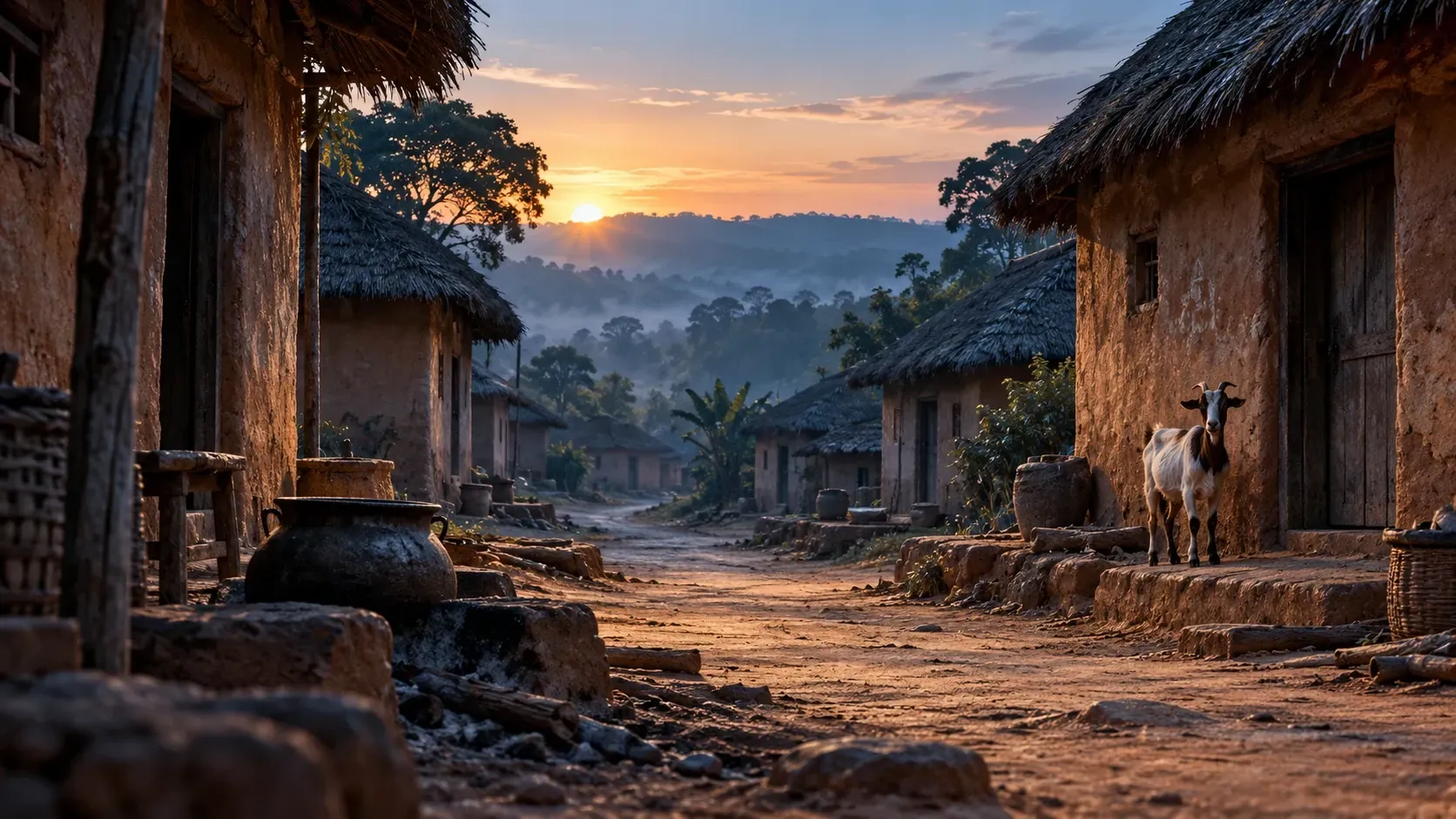
The Goat Is the First Problem
The goat is the first problem.
In one version of the story, an entire village vanished overnight in 1957. The houses were left standing. Food was still cooking. Fresh palm wine sat in calabashes. And somewhere in the deserted settlement, one goat remained, apparently spared by whatever had taken everybody else.
Nobody seems to have asked the goat for a statement. More importantly, the published accounts reviewed for this article do not identify a person who actually saw it there in 1957. There is no dated photograph, contemporary newspaper report or named witness for the scene. The animal arrives fully formed in modern retellings, a wonderfully specific detail with no independently traceable history.
The village has a name: Araromi-Oke. The alleged year is 1957. The setting is described as southwestern Nigeria, somewhere in the broad country of Yoruba-speaking communities. The event, supposedly, left no bodies and no signs of violence. It left an empty settlement where ordinary life had stopped in mid-sentence.
It is an excellent opening to a supernatural story. The historical difficulty is that nobody has established the opening actually happened.
Did Araromi-Oke really disappear in 1957? The reporting available so far offers no reliable evidence that a whole village vanished overnight. Local people interviewed about similar place names have rejected that account. But this does not make the story uninteresting. It changes the thing we should investigate. Instead of following footprints out of an empty village, we can follow a sentence from one website to another and watch a mystery acquire the appearance of history.
1. What the missing villagers supposedly left behind
The popular version makes an unusual choice. It does not begin with destruction. An earthquake, a fire or an attack would explain why a settlement might be empty, and would give a reader something to investigate. Araromi-Oke is left intact. The absence of damage is presented as evidence of something beyond ordinary explanation.
Then come the household objects.
A pot on a cooking fire is more effective than a hundred empty houses. It suggests that the people did not plan to leave. Fresh palm wine suggests that only a little time has passed. Clothes hanging to dry, in some versions, imply that tomorrow's chores were already under way. The goat supplies a final absurdly persuasive touch: the people have vanished, but everyday village life has not quite received the news.
These details are repeatedly reported as parts of a story. They are not evidence recovered from a documented site. No known investigation has established that those specific pots, calabashes, clothes or that goat existed. For a mystery writer, they are superb props. For a historian, each one raises the same awkward question: who saw it, and when?
The answer cannot be supplied by adding another vivid detail. A later retelling that includes an untouched meal does not independently corroborate an earlier retelling about an untouched meal. Ten copies of a sentence are still one claim unless we can follow them to separate witnesses or records.
That distinction becomes especially important when the story is published with a photograph. A picture of abandoned buildings may look like evidence. Unless the location, date and photographer can be established, it merely shows some abandoned buildings. An illustration commissioned for the story would be even further removed from the alleged event. The correct label for such an image is conceptual illustration, not the village in 1957.
The very things that make Araromi-Oke memorable are the things that need the closest scrutiny.
2. A remarkable trail through 2025
One advantage of investigating an internet mystery is that the internet sometimes leaves dates on its own footprints.
On 27 July 2025, a post appeared on the Nigerian forum Nairaland under a title asking whether readers knew of a town that had disappeared in a day. It named Araromi-Oke, supplied the year 1957, described intact houses and boiling pots, and included the solitary goat. The poster credited the text to OzoneTales on Facebook.
That credit is a clue, not a verified certificate of origin. The Facebook original has not been independently established in the sources reviewed here, and the Nairaland post cannot prove that nobody told a similar story earlier. It does, however, give us a dated, publicly visible version with a declared source.
Two days later, on 29 July 2025, a blog titled Araromi Oke: The Town that Disappeared Overnight reproduced substantially the same tale. It too credited OzoneTales. The phrasing, the household details and the goat travelled together. They look less like independent testimony than like the normal, visible process of copying and sharing online.
On 18 August 2025, Pulse Nigeria published a much fuller article. The headline announced a village that had disappeared without a trace; the first half read like a paranormal feature, complete with possible explanations involving a deity, forbidden land and migration. Farther down, under a fact-check heading, the article arrived at the opposite conclusion: the event had no credible historical documentation.
Both impressions came from the same page. A reader who stopped near the opening could come away with a vanished village. A reader who continued to the conclusion would find a caution against believing the tale.
On 20 August 2025, the Pulse piece circulated on Nairaland in another lively discussion. Some readers asked for an actual location. Others joked about migration. One commenter proposed a connection to another town, which is not the same as proving it. The thread itself showed how quickly a fixed narrative can produce an expanding menu of explanations, none of which supplies the missing historical record.
Later reporting by Leadership took a more useful route: instead of adding another explanation, journalists tried to locate a community whose people might know about the event. They spoke with residents of similarly named settlements and a traditional ruler. Their findings did not support the legend.
There is an important limit to this trail. We have found examples of the story circulating in July and August 2025, not a complete genealogy of every earlier version. It would be just as irresponsible to declare that the legend was invented on 27 July 2025 as it would be to insist that it began in 1957. The difference is that the 2025 posts can be inspected. The supposed mass disappearance has yet to produce comparable evidence.
3. Try putting the village on a map
A person can disappear from a familiar place. A whole village presents a different logistical problem. You first need to know where the village was.
Araromi-Oke is often described as lying somewhere between Oyo and Osun, sometimes in the vicinity of Ekiti as well. These descriptions give the impression of geographical precision without a road, a coordinate, an administrative record or a definite neighbouring settlement. The reader receives several place names but no address.
That matters because Araromi is not a unique label. The name, and related forms of it, appear in several existing communities. A search for Araromi-Oke may lead to a real, populated locality; a search for a similar name may lead somewhere else. Neither result proves that the place in the viral account was once an abandoned settlement.
Leadership reported examining three communities in Osun State with related names: Araromi Owu in Ayedire, Araromi Oke-Odo in Ife South and Araromi Itagunmodi in Atakumosa East. These are actual places with people and histories. Their names should not be treated as interchangeable parts of a supernatural puzzle.
A traditional ruler in Araromi Oke-Odo told the newspaper that he did not know of a settlement called Araromi-Oke that had suffered the alleged disappearance. Another resident interviewed about Araromi Owu similarly rejected any local history of people vanishing overnight.
This leaves a tempting possibility: perhaps the online story confused the name of a real village with an unrelated account. That is possible, but it remains a hypothesis. A similar name is not evidence of a particular chain of confusion, just as a similar photograph is not proof of a particular event.
If a village emptied in a single night, one might reasonably ask for its former location, the neighbouring people who first noticed the absence, and the settlement records that would help identify its inhabitants. The widely circulated versions provide none of these in a form that can be independently checked.
A mystery can survive not knowing where the people went. It becomes a different kind of mystery when we cannot establish where the people supposedly lived.
4. The man who questioned the roofs
Among the answers uncovered by Leadership, one detail is especially revealing because it concerns the ordinary physical world rather than the supernatural one.
Baale Wahab Anigilaje, the traditional ruler of Araromi Oke-Odo interviewed by the newspaper, spoke about the history of his own community. He said its ancestors had once occupied another site and moved to improve access to water. They were farmers, and water mattered to where they lived.
This was a migration account, but not the dramatic overnight disappearance of the viral legend. A community moving in response to practical needs is entirely different from a settlement instantly emptying while its food remains on the fire.
Anigilaje also questioned the photograph circulating with the Araromi-Oke story. He pointed to zinc roofs shown in the image and contrasted them with his recollection of the roofing materials associated with village houses in the period being claimed. The photograph, in his view, did not fit the story attached to it.
His observation does not establish the age or origin of every image that has circulated with the legend. It does show how easily a picture can import false confidence into an account. A photograph borrowed from one place may make another place seem more real, especially when the caption tells the viewer exactly what to believe.
The same investigation spoke with Kolawole Amuda of Araromi Owu. He said his community had no history of people disappearing as described, although movement between settlements was familiar in the wider history of Owu communities. Reporters also found no supporting local account in Araromi Itagunmodi.
These are not archaeological findings or a complete survey of every settlement in southwestern Nigeria. They are local interviews, reported by named journalists, that push against the claims of an unidentified vanished village. As evidence, they are more substantial than a paragraph repeatedly posted without an eyewitness, but they should still be described accurately as interviews rather than final proof of every possible historical circumstance.
For the reader looking for a supernatural solution, the roof is an inconvenient detail. For the investigator, it may be the most useful object in the entire story.
5. Did Ogun curse Araromi-Oke?
At some point in the circulating tale, the village is no longer merely empty. It has offended a power greater than itself.
Some versions claim that its inhabitants broke a covenant with Ogun, an important orisha associated in Yoruba religious and cultural traditions with iron, hunting and warfare. The Met Museum's account of iron in West Africa describes Ogun's long-standing connections with metalworkers, hunters and the opening of paths. That larger cultural background is well documented.
The supposed covenant at Araromi-Oke is not.
An established deity in a real religious tradition does not authenticate every internet story in which the deity appears. There is a difference between explaining who Ogun is and claiming to know that a particular community was punished by Ogun in 1957. The second claim would require evidence about that community, its traditions and the provenance of the story.
The same caution applies to another version in which the ground itself reclaims the settlement because its inhabitants built on forbidden land. Such an image can be part of folklore or fiction; it should not be confused with geological evidence or a documented disaster.
Writers describing a culture's religious imagery have a responsibility not to turn belief into a cheap substitute for missing facts. An extraordinary claim does not become more credible because it is attached to a name that carries genuine cultural significance.
There may be an older oral narrative behind some aspects of the viral story. There may not. The sources reviewed do not identify a verifiable chain of storytellers reaching back to 1957, let alone a living eyewitness who can describe what happened. Calling the narrative folklore is a useful way to describe its circulating form, but it is not a licence to invent a continuous ancient tradition for it.
The story's supernatural ending offers closure precisely where the evidence is weakest. That is why it deserves the greatest care.
6. Why 1957 sounds like evidence
A date is a small and powerful device. Tell someone a village vanished long ago and the story sounds like a legend. Tell them it vanished in 1957 and the mind immediately begins imagining newspaper files, official reports and elderly witnesses who might still have remembered the event when the story first circulated online.
The calendar invites verification. But it does not provide it.
Neither the July 2025 social posts nor the subsequent retellings identify a contemporary 1957 document establishing the event. The fact-check in Pulse concluded that it could find no credible archival or scholarly confirmation. Leadership approached people connected with several plausible locations and came back without a corroborating account.
There is an important distinction between saying we did not find a record and saying no record anywhere could possibly exist. A complete archival search is difficult, and the sources reviewed here do not amount to one. The responsible verdict is that the mass disappearance is unsubstantiated by the available evidence.
It is also worth considering what an inquiry would need to establish before debating supernatural causes. Was there a specific settlement? What were its boundaries? Who lived there? Did anyone report them missing? Which neighbouring community made the discovery, and who recorded that account? Where is the oldest attributable version of the story? Do the photographs match the date and location?
Only after those questions have usable answers can a serious investigator begin comparing explanations for what happened to the residents.
In the available Araromi-Oke material, the dramatic second half of the mystery has raced ahead of the first half. We have been offered theories of curses, migration and forbidden ground before anyone can identify a reliably documented disappearance for those theories to explain.
The year 1957 remains part of the legend's script. It is not, by itself, evidence that the script describes history.
7. The village that kept acquiring new witnesses
A peculiar transformation takes place when the same story passes through multiple websites. Each new headline looks like another source. Each new image makes the account easier to picture. Each repeated phrase becomes familiar enough to feel remembered.
An original post might be based on a family anecdote, a retelling, a creative invention or a misunderstanding. We do not know which of those possibilities best explains the earliest Araromi-Oke version. What we can see is the later circulation: a dated forum post that credits an earlier Facebook tale, an almost identical blog copy, a media feature that contains its own debunking section, and a discussion thread in which readers try to supply the missing geography themselves.
When several pages are all downstream of the same account, counting those pages does not reveal how many independent witnesses there were. It reveals how effectively a particular piece of writing travelled.
The cooking pot, the palm wine, the goat, the year. They are durable elements. A real historical account would gain strength from a new document, a location, a verifiable recollection or a record that can be examined independently. An internet legend can grow in the opposite direction, gaining increasingly elaborate details while remaining detached from any discoverable first-hand evidence.
The story also benefits from a ready-made comparison: Roanoke, the English settlement in North America whose disappearance has generated centuries of speculation. Some Araromi-Oke retellings invoke that famous mystery. But the comparison can mislead. Roanoke has a documented colonial history and a different body of evidence. Borrowing its atmosphere does not supply Araromi-Oke with missing records of its own.
Every culture has its own storytelling traditions and historical questions. The responsible thing is to investigate this claim on its own evidence, without assuming that an old American mystery provides either its explanation or its credibility.
What began as a report of missing residents has become a story about missing provenance. We can identify some of the people who repeated it. We have not identified the people who supposedly witnessed the event.
8. So what happened to Araromi-Oke in 1957?
The most reliable answer available is that there is no verified evidence of a village called Araromi-Oke disappearing overnight in 1957. The detailed scenes of abandoned food, silent houses and a surviving goat belong to circulating modern retellings. Journalistic attempts to identify the location and consult residents of similarly named communities did not corroborate the disappearance.
That does not prove no storyteller ever heard an earlier version. It does not reduce every local tradition to falsehood, or settle whether the viral narrative borrowed a small detail from some unrelated historical memory. Those are separate questions, and they remain open because the sources that could resolve them have not been established.
It does tell us where the most promising investigation now lies. We would need the original identifiable account, not another theory about how an entire population might have evaporated. We would need a place with a history, not an approximate location repeated beside an evocative picture.
The July 2025 forum post has an address, a date and an attribution to a Facebook source. The alleged village in 1957 has none of those things in the reviewed evidence. The documentary trail is clearer for the story than for the event it describes.
And the goat? It remains exactly where the retellings left it: in an imagined village square, patiently doing more to keep the mystery alive than any archive has yet managed.