Articles / LORQAI
The Dinosaur Was Never Found Standing Up
Why museum skeletons are assembled from fossils, casts and scientific decisions — and why a perfect replica may tell the truth better than a damaged original.
Some museum dinosaurs are original fossils. Others are casts, and some are both. Discover the surprising science behind assembling a prehistoric skeleton.
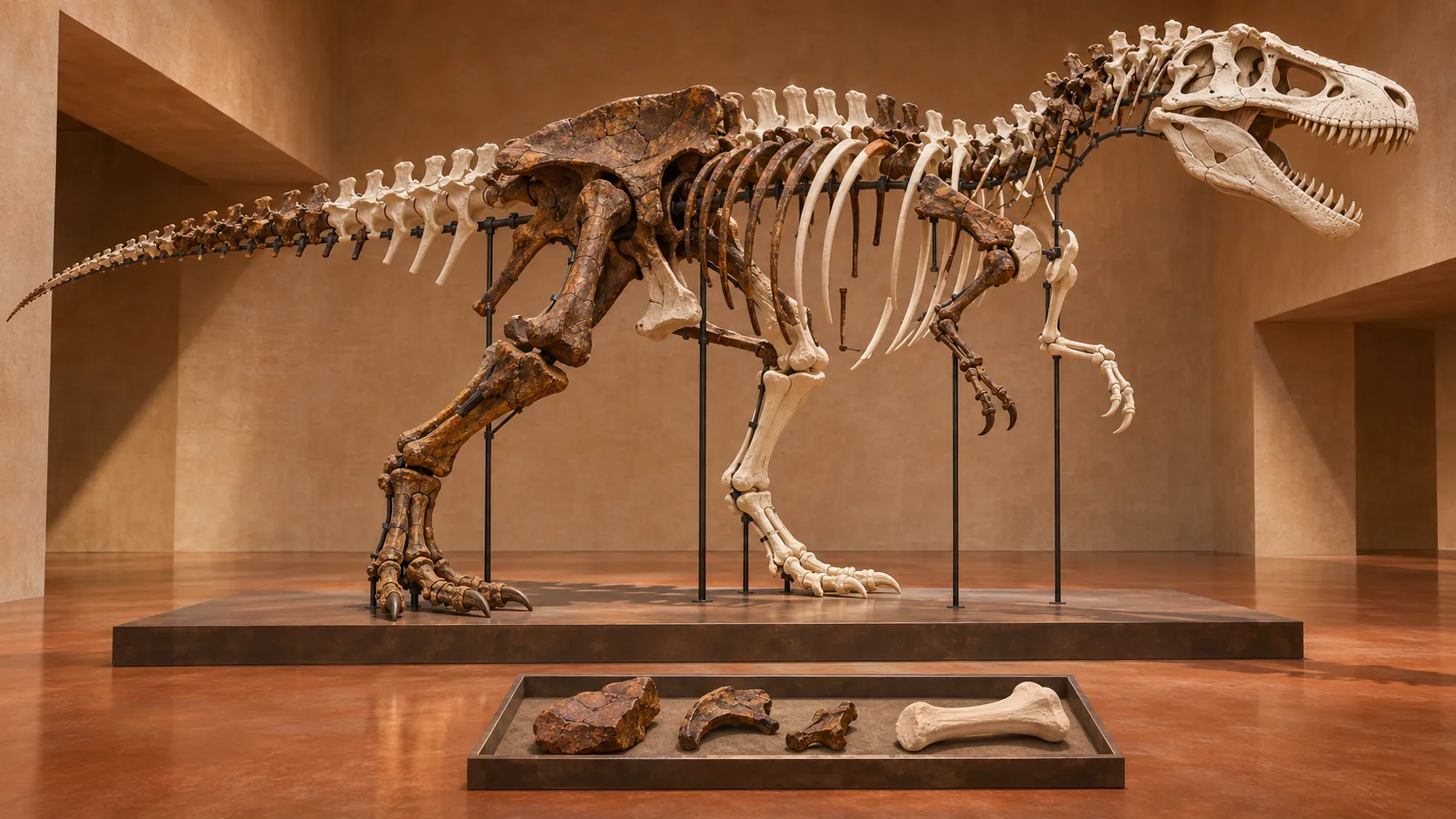
Two Skulls, One Dinosaur
The Tyrannosaurus rex at Chicago's Field Museum has two skulls.
This is not evidence of a previously unknown two-headed dinosaur. It is evidence that paleontologists have a rather practical attitude toward displaying irreplaceable objects.
One skull sits in its proper position on the enormous skeleton known as SUE.
The other is the original.
The mounted skull is a cast. The real fossil, weighing approximately 600 pounds, is displayed separately, where scientists can examine it without first dismantling a tyrannosaur.
This arrangement is entirely sensible.
It is also slightly alarming if you have spent your childhood assuming that every bone in every museum skeleton came out of the ground, was carefully dusted off and then put back exactly where it belonged.
Dinosaur exhibitions are considerably more complicated.
Some display original fossil skeletons. Others contain highly accurate replicas. Still others combine authentic fossils with casts, sculpted replacements and carefully designed support structures.
A dinosaur can therefore be scientifically valuable, physically impressive and only partly composed of the original material found during excavation.
A visitor encountering one of these reconstructed giants might reasonably ask a simple question.
Is it real?
The answer can require a surprisingly long explanation.
Not because museums are trying to conceal something, but because *real* is a rather inadequate word for an object assembled from millions of years of geological history and generations of scientific research.
To understand what is standing in the exhibition hall, we need to begin with what was actually discovered.
It was almost certainly not standing.
The Excavation Did Not Include Assembly Instructions
A museum dinosaur is often arranged in a recognizable pose.
Its legs support a powerful body. The spine follows a convincing curve. The skull faces the direction in which the animal might once have looked.
If it is a predator, the mouth may be open.
If it has a long neck, that neck may rise toward the ceiling.
And if the museum possesses an especially dramatic entrance hall, the dinosaur may be positioned to give arriving visitors an immediate understanding of how small they are.
Nature rarely leaves fossils in such convenient arrangements.
An animal dies. Its body begins to decompose. Scavengers may disturb the remains. Water or sediment can move the bones. Some disappear altogether.
Under suitable conditions, the surviving material becomes buried and may be preserved over geological time.
Much later, erosion or excavation can reveal part of the fossil.
The result is often fragmentary.
A researcher might discover several vertebrae, part of a limb, a collection of ribs or a skull missing important sections. Even a remarkably complete skeleton may contain absent or damaged elements.
The Field Museum explains that complete dinosaur skeletons are exceptionally uncommon. That is why SUE is so important.
The fossil preserves about 250 of the approximately 380 bones expected in a Tyrannosaurus rex skeleton. By volume, the museum describes it as roughly 90 percent complete.
That is extraordinary preservation.
It is also a reminder that a skeleton can be celebrated for its completeness while still missing more than a hundred individual bones.
Now imagine the problem facing an exhibition team.
The museum wants to show visitors an animal rather than a collection of mysterious geological objects.
A rib laid in a display case is interesting.
A complete rib cage tells a different kind of story.
The preparators, paleontologists and exhibition designers must decide how the surviving material fits together, what can safely be mounted and how missing parts should be represented.
They work from anatomical evidence, comparisons with other specimens and the current scientific understanding of the animal.
The objective is not to invent a more attractive dinosaur.
It is to create a defensible reconstruction from incomplete evidence.
The final skeleton may look effortless.
Its apparent simplicity conceals an enormous amount of decision-making.
Somebody had to decide where every surviving bone belonged.
Somebody had to determine what to do about the missing ones.
And somebody had to make certain that several tonnes of carefully arranged prehistoric evidence would not fall on the visitors.
What Was Actually Buried?
There is another complication, one that comes before questions of copies and reconstruction.
The real fossils displayed in museums are not necessarily ordinary bone anymore.
Fossilization can take several forms. In some cases, original biological material survives in altered condition. In others, mineral-rich groundwater fills pores or replaces portions of the original material, preserving the structure within rock.
An animal's bones may therefore become dense, mineralized objects whose appearance and composition differ greatly from those of a modern skeleton.
The American Museum of Natural History offers a memorable explanation of this transformation: the familiar dinosaur bones in its exhibits are, in an important sense, rocks preserving evidence of former bones.
This matters because an authentic fossil is not defined by how much it resembles the pale, clean skeleton illustrated in a children's encyclopedia.
Real fossil material may be dark, irregular, broken or still surrounded by rock.
There can be cracks, deformation and sections too delicate to expose completely.
Some fossils preserve extraordinary fine detail. Others retain only enough information to identify the kind of organism from which they came.
And not all fossils are bones.
Footprints, impressions and other traces can preserve evidence of animals without preserving their bodies.
The museum skeleton is only one possible way to organize the information found in the ground.
It is also a particularly complicated way.
Consider a fossil bone that has spent millions of years enclosed within sedimentary rock.
Removing that rock is not equivalent to washing mud off a shoe.
Specialists may work for long periods with fine tools, adhesives, support materials and microscopes, trying to expose the fossil while avoiding damage.
The Natural History Museum in London describes fossil preparation as a combination of technical skill, geological understanding and careful conservation.
A large specimen may arrive at a laboratory inside a protective plaster jacket, still embedded in the surrounding rock.
The preparator must decide which material can safely be removed and which must remain.
A small mistake could destroy information that cannot be recovered.
The work is not performed merely to produce something attractive for a glass case.
Preparation allows scientists to investigate anatomical details that would otherwise remain hidden.
It can reveal evidence of growth, injury, disease or relationships between species.
In other words, the original fossil is a scientific document.
The museum exhibit is one way of presenting some of what that document tells us.
Confusing the two is rather like assuming that a beautifully printed historical map must be the original handwritten field notes from which it was made.
Both can be accurate.
They serve different purposes.
The Tyrannosaur with the Substitute Head
Let us return to SUE.
A tyrannosaur's skull is one of the most recognizable objects in natural history.
It contains the enormous jaws, teeth and openings associated with an animal that has become famous far beyond scientific circles.
On a mounted skeleton, the head is also an awkward engineering problem.
SUE's original skull weighs approximately 600 pounds.
The Field Museum displays a cast on the skeleton while keeping the original in a separate case.
This makes the mounted animal visually coherent without requiring that massive, invaluable fossil to remain high above the ground.
It also makes the real skull available to researchers.
That second reason is easily overlooked.
A fossil is not finished contributing to science once a museum places it on display.
New technologies can reveal details that were difficult to investigate in the past. Researchers can revisit existing specimens with different questions. An unusual feature may acquire a new interpretation years after the fossil was first described.
If every important bone were permanently fixed into an elaborate exhibition, some kinds of research would become unnecessarily difficult.
For SUE, the difference between the mounted skull and the original is therefore more than a matter of weight.
One helps visitors see an enormous animal.
The other remains an accessible source of scientific evidence.
Neither makes the other less valuable.
And this is where the familiar museum question begins to produce a counterintuitive answer.
Suppose the museum replaced the cast with the real skull.
The mounted skeleton might become more authentic in a narrow material sense.
But the change could increase risk to the original fossil and make scientific access less convenient.
The exhibit would contain one more original object.
It would not necessarily become a better museum exhibit.
That is an unusual conclusion for anyone who has learned to associate the word *replica* with something inferior.
The best decision sometimes involves keeping the original safely where it can be studied and letting a copy perform the more public, theatrical duties.
SUE is hardly the only dinosaur with such an arrangement.
At London's Natural History Museum, the mounted Mantellisaurus displayed in Hintze Hall has been described as approximately 80 to 90 percent original fossil material.
Its skull, however, is a cast.
The original skull survives in pieces, and keeping those pieces separate has scientific advantages.
The head visible to visitors is therefore a reconstruction that provides the missing visual completeness without forcing the original material into a display arrangement that could compromise its value.
The visitor gets to meet the dinosaur.
The researchers get to keep the evidence.
It is a remarkably successful compromise.
The Dinosaur That Crossed the Atlantic Without Its Bones
Some replicas have lives almost as interesting as the fossils from which they were made.
Consider Dippy, the famous Diplodocus associated with London's Natural History Museum.
Dippy was unveiled to the public on May 12, 1905.
The skeleton became a major attraction, appearing in photographs, newspaper reports and the memories of generations of museum visitors.
It travelled within the museum, changed posture as scientific interpretations evolved and later toured venues across Britain.
For many people, Dippy was one of the most familiar dinosaurs in the world.
Dippy was also made of plaster.
The London skeleton was a cast of the Diplodocus carnegii specimen housed at the Carnegie Museum of Natural History in Pittsburgh.
The original fossil remained in the United States.
The replica travelled across the Atlantic.
The arrangement was made possible through the influence of Andrew Carnegie and interest in the newly discovered dinosaur from Britain's King Edward VII.
The result was a copy that became an international scientific and cultural ambassador.
And it was not the only one.
Other replicas of the Carnegie Diplodocus appeared in museums around the world.
Visitors in different countries could encounter the physical form of an animal whose original fossil material was held by one institution.
This was one of the great practical advantages of casting.
A museum could share a detailed representation without surrendering possession of an irreplaceable specimen.
The receiving institution could build an exhibition around an important dinosaur without requiring a new discovery of its own.
And audiences gained access to something they might otherwise never have seen.
That does not mean the cast was identical to a living animal in every detail.
The posture of mounted skeletons changes as scientific understanding develops.
Dippy's own display history illustrates this beautifully.
At one time, the tail was presented in a position that later research suggested was inaccurate.
The museum eventually raised it.
The physical replica remained a replica of the fossil material, but the overall reconstruction changed to reflect a revised understanding of how the animal carried itself.
This is an essential distinction.
A cast can accurately reproduce the shape of a fossil bone.
The position in which museums arrange those bones is an interpretation.
The material may be copied with great precision.
The pose is a scientific proposal, supported by evidence but open to revision.
An enormous skeleton suspended over visitors can give the impression that the ancient animal has returned exactly as it once stood.
What the museum has actually produced is a carefully reasoned representation.
And that representation can improve.
Dippy's bones were made of plaster, but the changing arrangement of those bones tells a real story about the progress of paleontology.
A Dinosaur Assembled from Evidence
So far, we have encountered original fossils, precise casts and complete replica skeletons.
There is another possibility.
A museum may exhibit an animal assembled from a mixture of original material and reconstructed parts.
This requires some care.
If a skeleton is incomplete, specialists may reproduce missing elements from the surviving specimen, use information from other specimens or create scientifically informed sculptural reconstructions.
Those methods do not all have the same evidential status.
A cast made directly from an original fossil can preserve its surface shape with considerable accuracy.
A 3D print derived from an appropriately detailed scan can reproduce similar information.
A sculpted missing bone, by contrast, involves more interpretation.
The sculptor may have excellent anatomical references, but if the original bone has never been discovered, there is no exact object to duplicate.
It is useful to distinguish *a copy of something known* from *a reconstruction of something missing*.
Both may belong in a museum.
They are not the same kind of evidence.
In the past, some institutions assembled mounted skeletons using bones from different individuals. This could make the animal appear more complete, but it could also introduce errors when the substituted bones differed in size or proportions.
The Smithsonian notes that accurate casts are preferable to poorly matched combinations of genuine fossils when the latter produce misleading anatomy.
This is a fascinating reversal of the ordinary hierarchy between original and copy.
A skeleton constructed entirely from authentic bones of several different animals might be materially genuine but anatomically inaccurate.
A skeleton constructed from carefully scaled replicas could communicate the anatomy more faithfully.
Which one is more real?
The answer depends on what you are asking.
If your question concerns the age and composition of the material, the authentic fossils have an importance the copies cannot reproduce.
If your question concerns the shape and proportions of the animal, the accurate reconstruction may give a clearer answer.
If your question concerns the history of scientific interpretation, even an older, imperfect mount can become an interesting object in its own right.
A museum is therefore doing several things simultaneously.
It preserves original evidence.
It makes that evidence available for research.
It creates understandable public displays.
And it attempts to distinguish what is directly known from what has been inferred.
No single choice can satisfy every purpose equally well.
A complete skeleton looks wonderful in a gallery.
A fragmented original may be more valuable to a scientist studying microscopic details.
A lightweight cast may be safer to suspend overhead.
And a carefully reconstructed missing element may help visitors understand the animal without pretending that every bone was recovered.
The difficulty is not that museums use copies.
The difficulty would be pretending that every kind of copy carries the same certainty as the original evidence.
The Authenticity Test
Museum visitors sometimes approach replicas with disappointment.
They came to see a dinosaur.
They discover that the enormous skeleton is a reproduction.
It can feel like learning that a famous painting has been replaced with a photographic print.
But there is an important difference between a museum presenting a cast honestly and an institution attempting to pass off an imitation as an original.
The label matters.
A proper description should help visitors understand what they are looking at.
Is this an original fossil?
A cast of an actual specimen?
A reconstruction incorporating missing bones?
An artistic model based on current scientific evidence?
These are useful distinctions, not reasons to dismiss the display.
In fact, major natural history museums are often remarkably explicit about the composition of their collections.
The American Museum of Natural History reports that approximately 85 percent of specimens in its fourth-floor fossil halls are actual fossils rather than reproductions.
That figure applies to the fossil-hall specimens described by the museum, not to every dinosaur skeleton or every natural history museum in the world.
The Carnegie Museum of Natural History provides a different example: it reports that approximately three-quarters of the more than 230 objects in its major dinosaur exhibition are original fossils.
The point is not that one museum has achieved a higher authenticity score than another.
Different institutions hold different collections and design exhibitions for different purposes.
The important point is that visitors should not assume all giant skeletons are copies, nor that every mounted bone must be original.
The answer is usually available, sometimes on a small label that competes rather unsuccessfully with an animal twenty metres long.
And once you begin paying attention to those labels, the exhibitions become more interesting.
A cast is evidence of another object located elsewhere.
A missing bone replaced by a sculpted element reveals a gap in the fossil record.
A reconstructed skull suggests an original too fragile, heavy or scientifically valuable to mount.
An old skeleton positioned differently from a newer reconstruction can reveal how scientific interpretation has changed.
The museum hall becomes a place where you can read both the ancient animal and the much more recent history of our attempts to understand it.
Even the metal framework has a story.
The support structure, called an armature, must hold the skeleton securely without introducing unnecessary risk to precious specimens.
It is engineering in the service of paleontology.
The result can appear invisible beneath the visual drama of the animal, but it is an essential part of the display.
The dinosaur does not stand up by itself.
A team of specialists has made it possible for us to see it that way.
The Small Label Under the Giant Animal
The next time you enter a dinosaur gallery, resist the temptation to look only at the skull.
It is a considerable temptation.
The skull has teeth.
The skull is usually enormous.
And the skull has the unmistakable advantage of being positioned at the end of a creature whose name may have occupied a large portion of your childhood imagination.
But somewhere nearby there may be a label describing the specimen.
Read it.
The label might identify the original fossil.
It might tell you that the animal is a cast of a specimen in another country.
It might explain that certain parts are reconstructed or that the mounted pose reflects current research.
The wording may vary, but the information changes the experience.
A dinosaur skeleton is not simply a prehistoric animal returned to its original condition.
It is the result of excavation, preservation, preparation, comparison, modelling, engineering and scientific judgment.
Sometimes almost all the visible material is original.
Sometimes hardly any of it is.
Sometimes the most famous part of the skeleton is deliberately kept nearby in a separate case.
None of those situations prevents the exhibit from teaching us something important about the animal.
What matters is knowing which parts of the display are direct physical evidence and which parts represent our best reconstruction of that evidence.
There is no need to feel cheated by a cast accurately identified as a cast.
Nor is there any need to pretend that a replica is the same thing as an original fossil.
The distinction is precisely what makes the exhibition worth understanding.
SUE's original skull remains available for examination.
Dippy's original fossil material remains in Pittsburgh, while the famous cast has travelled and acquired a remarkable history of its own.
Other museums preserve their irreplaceable specimens while using replicas to help visitors picture animals that have been extinct for millions of years.
And in countless laboratories, fossil preparators continue the slow work of separating real evidence from the rock that surrounds it.
The finished museum skeleton is the visible result of that work.
It looks like a dinosaur.
It is supposed to.
But the animal did not arrive in the museum on its own feet.
It arrived in pieces, as evidence, accompanied by a great many unanswered questions.
The standing-up part was ours.