Articles / LORQAI
The First Thing the Checkout Could Read
How a pack of chewing gum helped give supermarkets a new language — and why a barcode doesn't actually know the price.
A pack of chewing gum made history at an Ohio checkout in 1974. Behind that tiny barcode was a decades-long invention story — and a clever system that doesn't actually store prices in its stripes.
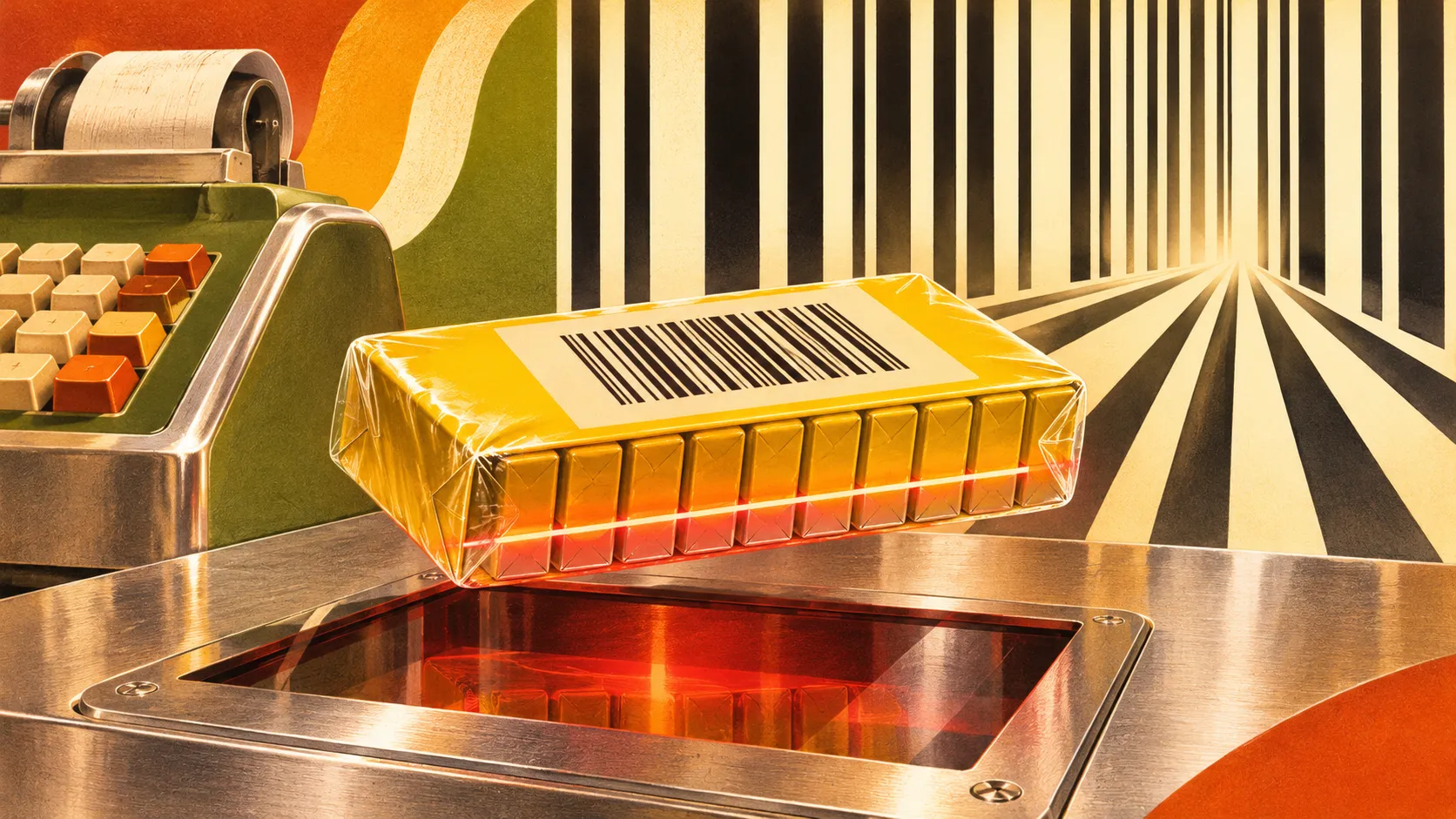
A Packet with an Assignment
On the morning of June 26, 1974, a supermarket in Troy, Ohio, had a special assignment for a packet of chewing gum.
It was not expected to taste better than its competitors. It was not launching a new flavour. Its packaging did not contain a secret ingredient.
It was supposed to be understood by a machine.
The product was a ten-pack of Wrigley's Juicy Fruit, placed at the checkout of a Marsh supermarket. An employee named Sharon Buchanan operated the register. The man presenting the gum was Clyde Dawson, who worked in research and development for the supermarket company.
At approximately 8:01 a.m., the package passed over a scanner.
For the first time, a product bearing the new Universal Product Code — UPC — was scanned at a retail checkout in a demonstration that would become part of commercial history.
The event was carefully prepared. It was not an ordinary customer accidentally participating in the birth of modern retail. There were people involved who had spent years trying to solve the problem, and the equipment had been installed specifically for the occasion.
The gum was a small object carrying a large experiment.
A machine had identified a product without somebody typing its price into the cash register.
That may seem modest now. We have taught ourselves to expect the little electronic acknowledgement of a successful scan. It comes from supermarket counters, self-checkout machines, warehouse terminals and other places where a physical object must become an entry in a computer system.
But the most surprising thing about the first checkout barcode is not that a machine could read it.
It is what the machine could not read.
The price.
The black lines did not contain that information. To find the cost, the register had to consult something elsewhere.
A packet of gum had introduced the supermarket to a new language. Most of the meaning lived outside the packet.
A Price Sticker on Everything
Before barcode checkout systems became common, the supermarket had a tedious communication problem.
A product arrived. Someone had to know what it was, how much it cost and how it should be recorded when sold.
There might be a manufacturer's description, a shelf label, a price sticker and an internal store code. But those details did not automatically form a shared language that a machine could recognize.
Cashiers entered prices manually. Staff changed stickers when prices changed. Stores maintained inventory records through methods that required considerable human effort.
Consider a row of ordinary canned goods.
Two cans may look nearly identical. One contains a different size, variety or recipe. The store must charge the correct price and maintain some idea of how many units have been sold.
Now multiply that problem by thousands of different products, then by hundreds of supermarkets.
The difficulty was not that cashiers were unable to recognize groceries. They were performing an enormous number of small identification and recording tasks under conditions where speed mattered.
A price could be entered incorrectly. A label could be overlooked. A product might be sold without the transaction contributing promptly or accurately to inventory records.
In the late 1960s, growing supermarket chains were looking for ways to reduce such friction.
It was tempting to imagine a mechanical solution: place an optical mark on a product, move it past a reader and let a computer handle the rest.
The idea sounded simple enough.
Actually building a system around it required solving several unrelated problems. The marks had to be cheap to print and reliable to read. The equipment had to function in a real checkout environment. Product identifiers had to be consistent across manufacturers and retailers.
And perhaps most importantly, everyone had to agree on what the marks meant.
A supermarket could invent its own code for a tin of soup. That would not automatically help a competing supermarket identify the same tin.
The ambition was larger than building a faster cash register.
The grocery industry needed a common way for a product to introduce itself.
Four Lines in the Sand
The barcode story begins well before that June morning.
In 1948, Bernard Silver, associated with the Drexel Institute of Technology in Philadelphia, learned of a request for a way to automate product identification at supermarket checkouts.
He discussed the problem with Norman Joseph Woodland, who became intrigued by the challenge.
Woodland had learned Morse code as a boy. He knew that information could be represented by patterns of short and long signals, provided the sender and receiver agreed on how to interpret them.
While staying in Miami Beach in the winter of 1948–49, he considered what a machine-readable version of that principle might look like.
According to Woodland's later recollection, the breakthrough came while drawing lines in the sand.
The idea was to replace dots and dashes with lines of differing widths.
The beach was an unlikely development laboratory. Sand is not famous for maintaining precise engineering tolerances. It has a tendency to rearrange itself when stepped on, rained upon or visited by an enthusiastic dog.
Nevertheless, the concept was sound.
Information could be represented through a pattern of contrasting marks. The marks might be printed on a label, and a suitable optical reader could distinguish the pattern.
Woodland and Silver developed and patented their approach. They filed in 1949 and received US Patent 2,612,994 in October 1952.
The patent included a design using concentric circles — a bull's-eye pattern that, in principle, offered flexibility over the direction from which a symbol could be read.
Their challenge was not merely to draw an intelligent picture.
It was to make a physical machine reliably recognize that picture.
Early experimental equipment was large and demanding. The reading system depended on optical technology that was not yet cheap or practical enough for thousands of busy grocery counters.
There were also difficulties in making printed marks sufficiently consistent.
Woodland and Silver had identified a powerful idea before the surrounding technology was ready to support it economically.
And the final familiar supermarket barcode would not simply be their circular design placed into production.
Other engineers still had considerable work ahead.
The Problem with a Perfect Circle
A bull's-eye barcode has an obvious attraction.
If its information is arranged in concentric rings, a scanner should not need the symbol presented at one particular angle.
For an object being moved quickly through a checkout, this appears useful. Nobody wants cashiers to conduct a small geometry lesson with every packet of breakfast cereal.
But a diagram can be ideal in ways that the physical world refuses to respect.
Ink spreads. Printing surfaces are imperfect. Packaging may be curved or flexible. Marks that look elegantly distinct on a drawing may become difficult to distinguish when manufactured at scale.
This was a significant challenge for circular barcode designs.
By the early 1970s, supermarket industry representatives had formed a committee to evaluate possible standardized product identification systems.
IBM's George Laurer led work on an alternative that used straight vertical bars and spaces.
The linear arrangement could be printed and read more reliably under the proposed conditions. The design was also compact enough for a wide range of packaged goods.
Laurer's work built on a longer history of optical coding, including Woodland and Silver's earlier invention. It was not a case of one engineer having a complete idea that everyone else merely copied.
There were competing proposals, technological constraints and decisions about printing, scanning and product identification.
In 1973, the grocery industry's selection of the linear Universal Product Code gave manufacturers and retailers a common standard.
That act of agreement is easy to miss when telling the story as a sequence of clever inventions.
A brilliant code that only one manufacturer used would be of limited value to the industry.
A scanner installed at a supermarket would be expensive equipment if hardly any products carried compatible symbols.
Manufacturers had to commit to printing the code. Retailers had to invest in equipment. The numbering system had to distinguish products consistently.
The barcode's success depended on a collection of organizations deciding to use the same small arrangement of lines.
The geometry mattered.
The agreement mattered just as much.
The Price Is Not in the Stripes
Look closely at a conventional UPC barcode.
There are vertical black bars and white spaces of different widths, accompanied by numbers printed beneath them.
The pattern is not an artistic rendering of the product's name. It does not contain a miniature photograph of the goods. It does not store a paragraph describing their ingredients.
Its main purpose is to represent a product identifier.
In a typical twelve-digit UPC-A code, the identifier includes numbering information assigned according to a shared standard, together with a final check digit.
The check digit is calculated from the preceding digits. It helps a system detect certain errors in reading or entering a code.
It does not prove that a product is genuine. It does not establish that the packaging contains what the label claims. And it is certainly not a password protecting the supermarket from fraud.
It is a modest mathematical safeguard against mistakes.
The identity encoded by the UPC ordinarily refers to a type of trade item: a particular product presentation, such as a certain size or variant.
Two identical packets of the same product may carry the same code.
The standard barcode is not automatically a serial number unique to each physical packet. A supermarket can identify what kind of item has been scanned without knowing which individual package was manufactured first.
This is where the question of price becomes interesting.
A regular retail barcode generally does not contain the selling price.
The store has that information in its own system.
The barcode provides an identifier. The computer uses the identifier to retrieve the corresponding product record, including the price currently associated with it.
Think of a library catalogue number.
The number does not contain the entire book. It helps you find a record that tells you what the book is and where it belongs.
Likewise, the barcode does not have to contain everything the supermarket knows about a product.
The identifier and the database work together.
There are specialized barcode systems for variable-weight goods and other retail purposes that can encode price or weight information. So saying that no barcode ever contains a price would be wrong.
But the ordinary fixed-product UPC used for packaged goods was built around a more useful principle: identify the product consistently, then consult the store's information about it.
That separation allows prices to change without manufacturers printing a new barcode for every supermarket.
It also makes the code capable of serving many organizations that may need to know different things about the same product.
The package carries a common identity.
The meaning of that identity depends on the system asking the question.
Under the Glass
The 1974 supermarket scanner looked considerably less discreet than many of its descendants.
The Spectra Physics Model A was a substantial piece of equipment incorporated into a checkout system developed with National Cash Register.
Inside the scanner, a helium-neon laser projected light toward a rotating mirror, which directed it through a glass plate.
When a package moved across the scanning area, the pattern of dark and light marks reflected different amounts of light.
A photodiode detected the returning light, allowing the equipment to turn those variations into a signal that could be interpreted as a product code.
The system then used the decoded information to identify the product in a stored database.
It is helpful to separate those events.
The laser did not recognize chewing gum in the way a person recognizes a familiar yellow packet.
It did not inspect the ingredients, read the advertising copy or decide whether the customer's choice was sensible.
The scanner measured a pattern of reflected light.
The electronics decoded the pattern.
The computer associated that code with a product record.
The register displayed the corresponding transaction information.
Four activities were made to feel like one.
When the system worked, the transaction acquired a tiny piece of punctuation: the familiar checkout beep.
It is a remarkable sound precisely because it tells the user so little.
It does not recite the code. It does not explain the light sensor or the database. It simply announces that a step has succeeded.
That small acknowledgement helps coordinate a complicated exchange between person, package and machine.
The cashier can move to the next item.
For the technology to become routine, the underlying machinery had to disappear from the user's attention.
In that sense, the barcode was not only an optical invention. It was part of a redesign of an ordinary human task.
The Most Carefully Prepared Purchase of Gum
By June 1974, the technology was ready for a public demonstration in a working supermarket.
The location was not entirely accidental.
Troy, Ohio, was close to companies involved in checkout and weighing technology, including NCR and Hobart. The Marsh supermarket provided a practical environment for demonstrating the new system.
Preparations were substantial.
Staff applied barcode labels to numerous products. Scanners and computers had to be installed and made to work with the checkout equipment.
The famous first transaction was organized around people involved in the project.
Clyde Dawson, a Marsh research-and-development employee, acted as the shopper. Sharon Buchanan operated the register.
The selected item was a ten-pack of Wrigley's Juicy Fruit gum.
According to the historical account, the gum was chosen deliberately rather than drawn randomly from a basket. A small chewing-gum package had presented a difficult printing challenge. The manufacturer had found a way to make the barcode practical on its packaging.
The first item therefore demonstrated more than the scanner.
It also demonstrated that an ordinary consumer product could carry a usable machine-readable symbol.
This distinction is worth keeping because histories of technology often improve themselves with accidental heroes.
A distracted customer buys an unremarkable object, an unknown cashier presses a button, and only later does the world discover that something historic has occurred.
The actual event was closer to a carefully arranged test.
That does not diminish it.
A demonstration in a functioning shop required the code, printing, scanner, electronics and database to cooperate.
If any one of those elements failed, the elegant concept would remain an elegant concept.
The test showed that a manufactured product could communicate its identity through a standard symbol to a machine designed to recognize it.
The 1974 transaction was the first retail scan using the newly standardized UPC, not the first occasion on which anyone had ever experimented with machine-readable marks. Optical identification systems had been investigated for other applications, including railway equipment, before the famous supermarket demonstration.
The word *first* needs a precise description of what came first.
The distinction is not pedantry. It explains the achievement.
The supermarket had not invented the act of reading patterns with light.
It had helped make one form of that technology commercially useful on a much larger scale.
The Invisible Work Behind the Beep
Once product identifiers could be read consistently, the implications extended beyond the checkout counter.
The sale of a product could update computerized records.
Stores could obtain more timely information about which products had moved. Managers could use sales records to support stock replenishment, ordering and decisions about what to offer.
Manufacturers and retailers gained a shared reference for products that passed between them.
None of that required the barcode itself to become more intelligent.
The intelligence, insofar as that word is appropriate, belonged to the wider information system.
It also required human labour.
Somebody had to assign product identifiers, maintain the catalogue, associate them with correct descriptions and prices, and manage exceptions when the printed code did not correspond to a useful record.
A scanner that correctly reads a product number cannot rescue a badly maintained database.
If the price stored in the system is wrong, optical accuracy merely allows the wrong price to appear more efficiently.
The barcode did not abolish mistakes. It changed where some mistakes were likely to occur and what procedures were needed to detect them.
Nor did automation eliminate every task at checkout. Cashiers still handled products, assisted customers, dealt with payment, resolved errors and performed other work. The distribution of tasks changed over time, and stores adopted the technology at different speeds.
It also created concerns. Some workers worried about automation and the future of their jobs. Customers had to trust a process in which the price was no longer necessarily being read from a sticker attached directly to the item.
For the system to earn that trust, the information behind the scan had to be maintained and made accountable.
There was another subtle change.
A single UPC typically identifies a product category or variant, not the individual physical item or the person buying it.
Additional retail systems may connect purchases to loyalty accounts, payment records or other information. Those are further data relationships, not a magical property hidden in the bars themselves.
Understanding what the barcode does and does not identify matters because the technology is frequently credited with powers belonging to the networks built around it.
The code can begin a chain of information.
It is not the whole chain.
When the Lines Refuse to Cooperate
Not every barcode scan works.
The label may be damaged. A printing defect can reduce contrast. A package can be bent, wrapped or moved across the reading area at an unhelpful angle.
A scanner may fail to decode the pattern. The product may have a valid code that is missing from the store's records.
In a well-designed retail system, such events require a practical alternative.
This is one reason the digits beneath conventional barcodes are useful. They provide a human-readable representation of the identifier that can be entered when optical scanning fails.
The machine-readable symbol did not entirely remove the human from the communication process.
It gave the human another way to supply the same information.
The existence of a check digit improves reliability, but it does not guarantee perfect identification in every circumstance. Some errors can be detected; others must be handled by system design, printing quality and operating procedures.
The design is full of such compromises.
Bars must be compact enough to fit on packaging, yet distinguishable by available readers. Printing must be economical enough to use on an enormous range of products. The code must remain usable when goods travel through warehouses, shops and checkout lanes.
It must also be boring.
Not artistically boring, necessarily. One can admire a good arrangement of lines.
Operationally boring.
The scanner should recognize the code, retrieve the record and let everyone continue with their day. A technology that requires a celebration at every successful scan is not yet a satisfactory supermarket system.
By this measure, the barcode became extraordinarily successful.
Its achievement was to make a complicated technical agreement feel like an uneventful part of buying groceries.
The Packet in the Museum
The original supermarket scanning equipment entered the collection of the Smithsonian's National Museum of American History. The institution preserves a Spectra Physics Model A scanner from the first group of machines installed for this new kind of checkout.
The famous Wrigley's gum package also became an object of historical interest.
It is an unusual fate for chewing gum.
The normal purpose of the product is to be opened, consumed and forgotten. Nothing about the contents suggested that the packaging should be preserved as evidence of a technological transition.
Yet the gum was present at the moment a new infrastructure became visible.
The barcode itself did not replace ordinary language. Products continued to have names, manufacturers and descriptions. A customer still knew what chewing gum was and why it might be worth purchasing.
What changed was that the supermarket's computer system acquired a standardized way to identify the item.
The significance lies less in the stripes than in the connection they made possible.
A printed package, an optical reader and a stored record could now participate in one transaction without requiring a cashier to translate every product manually into a price.
Later systems grew more capable. Product identifiers spread through retail, distribution and other industries. Different barcode formats evolved, including two-dimensional symbols capable of supporting additional kinds of encoded information.
The original UPC remains an example of a remarkably durable decision: keep the printed identifier simple and let larger information systems provide the details.
Which brings us back to the first packet of gum.
It had no useful opinion about its price.
It could not tell the scanner how much its contents should cost. It did not know whether the store was running a promotion, whether the shelf label was correct or whether a customer had enough money to complete the purchase.
All it could offer was a pattern.
The extraordinary part was that the machine, the supermarket and the people who built the system had finally agreed on what to do with it.
The first thing the checkout could read was not the price of chewing gum.
It was the address of an answer.