Articles / LORQAI
Forty-Six People, No Footprints
A science-fiction mystery
Forty-six residents disappear from an icy colony. Their boots remain inside, every airlock is sealed, and the only surviving clue is an old map nobody believed.
By LORQAI
A science-fiction mystery
The colony sent its final message at 03:17.
At 03:19, the orbital relay reported forty-six people alive.
At 03:21, the colony's doors locked themselves, and every voice on the surface went silent.
When the rescue crew reached the settlement eighteen hours later, there was nobody to rescue.
There were no bodies, no broken windows, no emergency vehicles missing from their bays. Forty-six sets of outdoor boots stood beneath a bench in the entrance hall. A tray of bread was still inside the communal oven. Somewhere behind a wall, a water pump was making a noise like an old man clearing his throat.
Mara Venn checked the count twice.
"Forty-six," she said.
"That's how many were supposed to be here," said the engineer behind her.
"I meant the boots."
Tavin looked at the bench. "Then I'd rather not count the coats."
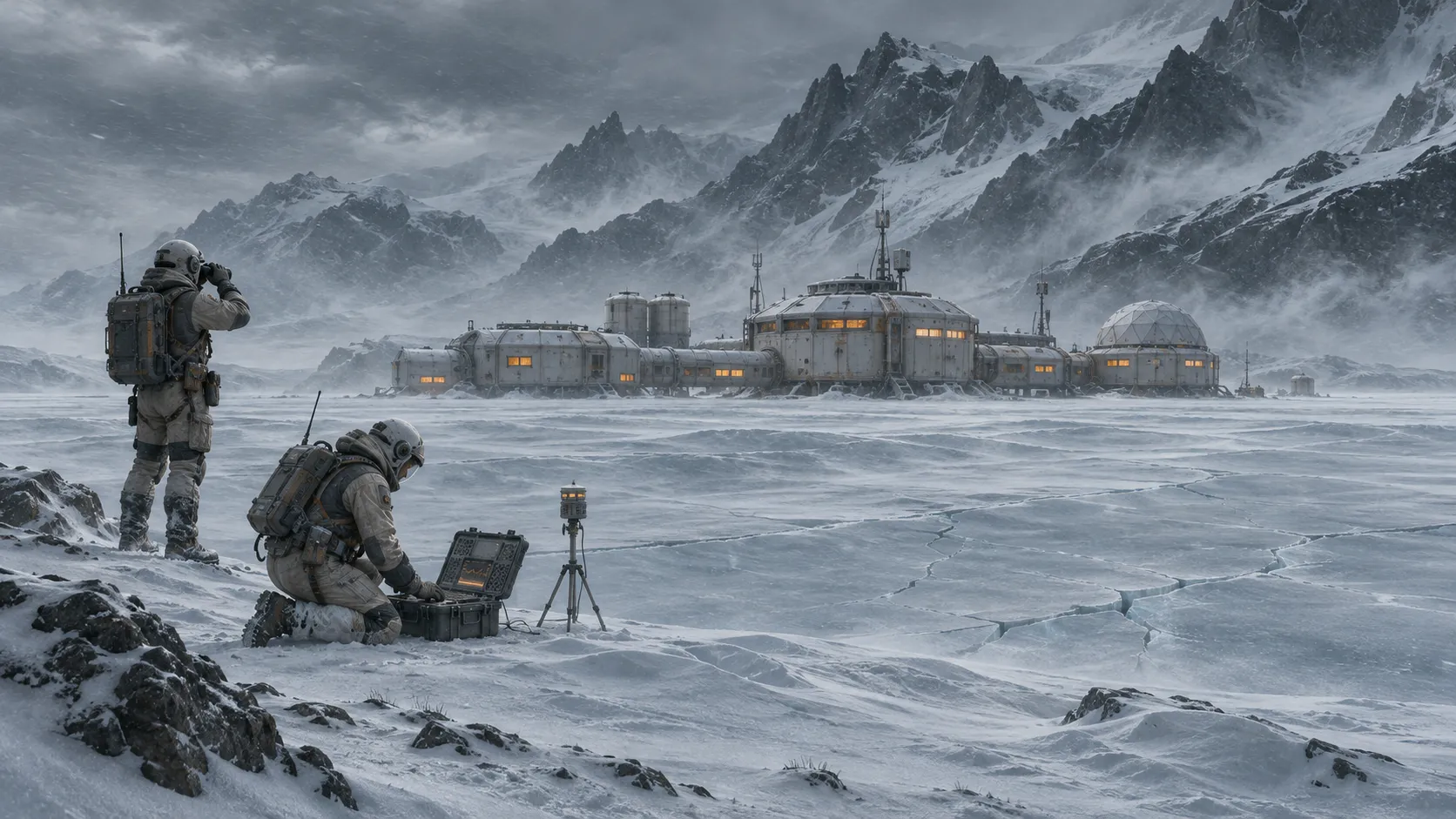
Outside, the ice plain extended to the black shoulders of a mountain range. The sky of Sere was the color of unpolished metal. A distant white sun hung behind a haze of blown crystals; it gave the landscape plenty of light and almost no warmth.
There was nowhere for forty-six people to hide.
At least, nowhere Mara could see.
—
The settlement was called Bellwether. It had been built by the descendants of a slow interstellar expedition, long before Mara was born. Its official purpose was to monitor a chain of subglacial reservoirs. Its unofficial purpose, judging from the painted flowers and mismatched furniture, was to give families something to look at besides ice.
Mara had investigated missing shipments, failing air systems, and a cargo vessel whose crew had spent nine months arguing about a thermometer. She was not a detective. In small settlements, a systems investigator often became one when there was nobody else available.
She connected her tablet to the medical terminal. Forty-six names appeared. Forty-six green circles.
"It says they're here," Tavin said.
Mara tapped the screen. Each green circle opened an employment record, a cabin assignment, a last completed health examination. No pulse measurements. No recent movement. The display had confused being registered with being alive.
"It's a census," she said. "Not a heartbeat monitor."
"Bad design."
"Good design if you only use it for counting meals."
The local communications archive contained one damaged transmission. Most of it was static. A woman's voice survived for five seconds.
*Get everyone down. The old—*
A sharp crack, then nothing.
The recording had been marked as a routine maintenance call, not an emergency. Mara played it again.
"The old what?" asked Tavin.
"That is what I intend to find out."
Their ship, *Lantern*, had landed on a ridge of exposed rock two kilometers away. Mara had refused to put its mass on the ice after seeing the colony's last geological survey: the ground beneath Bellwether was crossed by a web of faults, buried water channels, and heated service bores.
It had seemed like unnecessary caution when they arrived.
Now she was glad of it.
—
In the dining room, thirty-seven cups stood on tables. Nine were in the dishwasher. The number was so ordinary that Mara stopped to look.
"They didn't all leave at once," she said.
Tavin examined the oven. "Bread is charcoal. Power stayed on until the oven finished its cycle. Then the system went to standby."
"Doors?"
"All interior seals normal. Exterior locks untouched. Nothing has passed through an outside airlock since yesterday."
"Any gaps in the camera record?"
"All of it, after 03:21. Cameras lost their connection to the recording unit."
That gave them four minutes of evidence, followed by eighteen hours in which anything might have happened. Forty-six people, including seven children, were missing from a settlement designed to keep people indoors.
Mara looked under the tables. She did not expect to find anyone. She was checking for dragged objects, spilled liquid, the small physical mistakes people made when they hurried.
A dark wet line crossed the floor.
"Leak?"
Tavin knelt. The water had dried into a thin crust of salt.
"Could be condensation."
"From a pipe?"
"There isn't one above it."
The line continued through the dining room and vanished beneath a locked utility door. Mara asked for the key. Tavin's tablet identified it as a disused service corridor.
"No key," he said. "That corridor was removed from the modern plans sixty-two years ago."
"Removed physically?"
"Removed from the plans."
Mara stared at him.
"Yes," Tavin said. "I hear it too."
They opened the lock with a hand tool. Behind the door, a narrow staircase descended into darkness.
At the bottom lay forty-six pairs of indoor shoes.
Not neatly arranged. Kicked off in a hurry, one on a step, two lying beneath a handrail. A small knitted scarf had been caught under the heel of a rubber clog.
For the first time, Mara felt certain the people were alive when they left the dining room.
It did not tell her whether they were alive now.
—
The staircase ended at a metal hatch marked RETURN FLOW / NO PERSONNEL ENTRY.
Tavin pulled up the original engineering drawings from the settlement's oldest archive. Bellwether's first builders had drilled into a buried lake to exchange heat with warmer water far below the surface. The original return-flow system included a narrow maintenance passage, wide enough for a person in an emergency but never intended as a regular route.
"It's supposed to be dry," he said.
"Supposed to be?"
He touched a moisture sensor. "There's water on the other side. A lot of it."
The hatch was pressure-rated. A manual wheel could open it, but the warning light above it glowed red.
Mara put her palm against the metal. It vibrated very faintly.
"Pump?" she asked.
"Not at this level. The modern pumps are on the far side of the settlement."
The vibration stopped.
Then came three distinct impacts.
*Knock. Knock. Knock.*
They waited.
Three more.
Tavin stepped backward. "Tell me that was a machine."
Mara crouched beside the hatch and struck it four times with her glove.
There was no answer.
She tried again, slower.
Nothing.
"The water is hitting something," Tavin said. "A valve, perhaps."
"Perhaps."
On the tablet, the pressure beyond the hatch climbed. A line of text blinked into view:
**OUTFLOW PATH: UNVERIFIED**
"How long has the station been using a system it can't verify?" she asked.
Tavin called up the maintenance register. The most recent inspection showed all seals satisfactory, but the record referred to a digital model, not to an inspection of the physical structures.
"They trusted a drawing," he said.
Mara thought of the forty-six green circles in the medical terminal.
—
The first clue that changed the investigation was an ordinary bolt.
It lay on the floor beside a storage cabinet, half covered in frost. Mara picked it up and saw a stripe of yellow paint along its head. There were three others beneath the cabinet. All had broken free in the same direction.
"A shock?" Tavin asked.
"A sideways one."
A heavy shelf stood against the wall. The marks left by its feet were a few millimeters to the west of its present position. The shelf had shifted east. So had the bolt heads. So had a glass measuring cylinder, which had fallen from a laboratory bench and shattered against the eastern wall.
The settlement had moved.
"An icequake," Tavin said.
"Maybe. Bring up the ground-position record."
"I'm looking at it. Station center is exactly where it's always been."
"Whose coordinates?"
"Its own navigation beacon."
Mara had worked that particular class of accident before. If a navigation system used a local beacon as its fixed reference, everything around the beacon could move together. The map would still look perfect.
She asked *Lantern* for the settlement's absolute position as measured against orbital landmarks and the exposed mountain ridge.
The two positions disagreed by eleven meters and forty centimeters.
Tavin checked the numbers. Then he checked them again.
"Eleven meters? In one night?"
"Possibly over several days. The last external survey is three weeks old."
He pulled up the ice-motion measurements. They had been marked routine until the final twenty-four hours, when the gauges failed.
One surviving accelerometer had recorded a short, violent pulse just after 03:17.
Mara looked at the staircase.
"The colony didn't walk out," she said. "The ground under it walked away."
—
They found the oldest paper map in a cabinet under the greenhouse floor.
It was an absurd thing to preserve on an icy world: a folded sheet protected by two plastic covers, drawn by an engineer whose handwriting looked as if it had been done during an earthquake.
But the map showed something the digital model did not.
An emergency refuge had been cut into a tongue of bedrock beneath the mountain ridge. The old maintenance passage led there by a route partly independent of the moving ice above. The refuge had its own compressed-air reserve, water filters, and an exterior rescue lock at the mountain end.
"It's not on any current plan," Tavin said.
Mara read the notation beside the refuge entrance.
*Reserve chamber. Manual access only. Do not abandon unless structural survey confirms collapse.*
Beneath it, someone had written a second note in darker ink, decades later.
*If the lake drains, the upper settlement may shift. Exit through rock, not ice.*
They stared at the words.
"Who wrote that?" Tavin asked.
"Someone who knew this could happen."
"And nobody put it in the new plans?"
"The plans were made for the equipment people still used."
A low metallic clang came through the floor.
This time it was followed by a rapid series of faint strikes.
Mara placed a vibration sensor against the old return-flow pipe. The pattern was not random. It repeated, paused, and repeated again.
Three quick knocks. A long pause. Seven quick knocks. A pause. Three knocks.
Tavin frowned. "A code?"
"I don't know. But it's being made by something with a rhythm."
She compared the impacts with the archive's old emergency procedures. There was a page headed MECHANICAL SIGNALS, intended for workers who lost their radios underground.
Three-seven-three.
**SEAL LOCKED. OCCUPANTS INSIDE. AIR RESERVE CRITICAL.**
Mara ran.
—
The mountain refuge was less than a kilometer from the settlement on the old map. In the present landscape, the way was a maze of pressure ridges that had risen where the ice scraped against fixed rock.
Their rover made it halfway before a fracture opened across the route.
Tavin stopped the vehicle. Blue-black water pulsed below the crack, far beneath a crust that looked thick enough to stand on and was not.
"We walk from here," Mara said.
"I hate that plan."
"You can hate it on the way."
They roped together and followed the exposed rock, staying clear of the fractured ice. The wind pushed sharp particles against their helmets. Their suit heaters ran harder. Every few minutes, Mara saw the mountain emerge through the blowing crystals, closer and then apparently farther away as visibility changed.
She tried the colony frequency. Nothing.
She tried the old emergency frequency. Still nothing.
The magnetic compass in her suit drifted near the rock face. Tavin guided them by matching the old map to the shape of the cliff and the exposed mineral seams.
At the base of a narrow gully they found a circular metal door buried beneath ice. Someone had once painted an arrow beside it. Only the tail remained.
Mara scraped away frost until the handle emerged.
The outer pressure gauge registered nearly zero.
The inner gauge was not dead. It hovered above the pressure required to keep a chamber habitable, then dipped slightly, then rose.
"Life support," Tavin said.
"Or a leaking compressor."
"You really know how to spoil a good moment."
She pressed her helmet against the door.
Three knocks came through the metal, so close that she felt them in her teeth.
"We're here," she said into the external maintenance jack.
Static answered. Then a sound like someone moving a chair.
At last, a tired voice said, "If you brought a ship, tell me you didn't land on the ice."
Mara closed her eyes for one second.
"We didn't. Who am I speaking to?"
"Lio Sen. Shift supervisor. Forty-six inside. We have very little air."
Forty-six.
All of them.
"I'm opening the lock," Mara said.
"No," Sen snapped. "Not yet. The equalizer pipe broke when the ice moved. The outer chamber is still under vacuum. If you cycle the wrong valve, you'll empty our reserve into the mountain."
Tavin shone his lamp on the external control panel. The handles were labeled with old symbols, faded and partly concealed beneath repaired insulation.
"We need the sequence," he said.
Sen's breathing rasped over the jack.
"We need the old map. The paper one. There should be an emergency diagram."
Mara looked at the folded sheet in her glove.
"I have it."
There was silence on the line.
Then Sen laughed once, with no humor in it.
"Of course you do. We used to make jokes about that map."
—
The diagram showed two manually operated valves and a small buffer tank for bringing the outer lock up to pressure before opening the inner door. The buffer tank gauge was broken. The plumbing was not.
Tavin traced the pipes with a gloved finger, clearing snow from the panel as he went.
"Supply first," he said. "Close the exhaust. Fill the lock from their reserve."
"They can't spare much."
"They don't need to. It's a small chamber. We'll enter from outside, seal the door behind us, and equalize with their side. For the others, we'll need the second rover and its emergency pressure tunnel."
Mara told *Lantern* to send the second rover along the rock approach with its inflatable pressure tunnel. Then she explained the valve sequence to Sen. He confirmed the corresponding controls from inside. Mara and Tavin opened the outer door, stepped into the vacuum lock in their suits, sealed it behind them, and began to turn the first wheel.
It did not move.
Tavin braced both boots against the lock wall and tried again. The wheel shuddered, then stopped.
"Frozen shaft," he said. "Or bent."
"Can you cut it?"
"Then we lose the manual control."
"Can you free it?"
"Maybe."
He took a portable induction heater from his pack and clamped it around the valve housing. The device warmed the metal slowly. A bead of water appeared and immediately froze against the rim.
Inside the refuge, a child began coughing. Mara could hear it through Sen's open microphone. Someone spoke softly to the child, too far away for the words to be clear.
Mara checked the gas reserve indicator. It flickered at the bottom of its scale.
"Tavin."
"I know."
The heater chirped a warning. Its battery was nearly exhausted.
He struck the valve housing with his tool, once, then again. Mara saw him pull his shoulder back for a third blow.
"Wait," she said.
He stopped.
The tiny movement under his hands had exposed a second spindle behind the first. The old drawing showed it clearly: an emergency bypass, installed when the system was first built and never mentioned in the digital service manual.
Tavin gave a long, disbelieving whistle.
"They put the backup behind the broken part."
"They expected us to have the drawing."
He turned the bypass spindle with a square wrench. This time the metal moved.
The buffer tank began to hiss.
For six seconds they heard only the pressure entering the outer lock.
Then Sen said, "Equalizing. Keep it there."
The outer gauge climbed. The inner gauge steadied.
"You can open," Sen said.
Mara turned the inner wheel. The door swung inward.
—
The people of Bellwether were sitting on the floor of the refuge, shoulder to shoulder beneath emergency lights. Some wore work overalls. Others were wrapped in thermal blankets. A boy held a toy boat made from folded packaging, its corners softened by being held too tightly.
Nobody cheered when Mara entered. They were too exhausted for that.
The nearest woman touched Mara's arm as though checking that the suit was real.
"We heard the engines," she whispered. "Then the knocking stopped for a while. We thought you'd left."
"No," Mara said. "We were looking in the wrong place."
They transferred portable oxygen supplies from the rescue packs and checked the weak and unconscious first. When the second rover reached the rock gully, Tavin and its driver unfolded a rescue tunnel against the exterior hatch, clamped its flexible seal to the old metal frame, and supplied it with air from the rover. They checked the seals twice. Only then could the colonists move out in small groups, without suits, through the now-pressurized lock into the vehicle. The evacuation took several trips as the ice wind intensified.
Sen was the last to leave. He had a deep cut across one eyebrow and carried a dented metal bar.
"You made the knocks?" Mara asked.
"The line wasn't dead all the way to the surface. We could still reach the pipe."
"Why didn't you come out through the mountain door yourselves?"
"The outer lock was in vacuum, and the manual valve wouldn't turn. We didn't have suits down here for everyone. The chamber was built as somewhere to wait for help, not as a route you could just walk out of."
He looked back at the people already moving toward the rover.
"The old warning worked. We were all below before the main service tunnel flooded. The lock was meant to be our way out."
"Until it failed."
"Until it failed."
Mara showed him the paper map.
Sen put his hand over the dark-ink warning about the draining lake. His expression changed.
"We found that when we were children," he said. "We kept it because it looked ancient. We thought the warning was about a problem they'd fixed."
"Did anyone inspect the old refuge?"
"Every year. The air and filters. We never thought the surface would actually move."
The last of the evacuees passed through the outer door. Sen hesitated, staring at the little refuge that had kept them alive.
"You should take the map," he said.
"I intend to."
—
Back aboard *Lantern*, after the injured were stabilized and the youngest children had fallen asleep in the ship's crowded medical bay, Tavin ran a final comparison between the old survey and the new orbital measurements.
The ice had not moved eleven meters in one sudden slide. It had been creeping for years, with the motion accelerating as water accumulated beneath it. The final fracture and drainage had produced the sudden displacement, but the warning signs stretched back through several generations of maintenance records.
They had been recorded under different names: foundation adjustment, sensor offset, terrain recalibration, positional drift.
Every department had fixed its own problem. Nobody had put the measurements together.
"The founders knew," Tavin said.
Mara looked at the paper map spread across the table. Someone had drawn a little square beside the mountain refuge, and inside it a single word: *WAIT*.
"They knew the ice could move," she said. "They didn't know exactly when. The people who came later stopped knowing even that."
Tavin scrolled through the final incident report. Its first line read:
**CAUSE: UNEXPLAINED DISAPPEARANCE OF FORTY-SIX RESIDENTS.**
He highlighted it.
"What should it say?"
Mara thought of the shoes on the staircase, the bright green circles on the census screen, and the sound of a metal bar tapping through a pipe under forty-six frightened people.
"Write what happened," she said.
Tavin deleted the line and started again.
**CAUSE: SETTLEMENT DISPLACEMENT FOLLOWING SUBGLACIAL DRAINAGE. ALL FORTY-SIX RESIDENTS RECOVERED ALIVE.**
He stopped typing.
"And the disappearance?"
"That was ours," Mara said. "We lost where to look."