Articles / LORQAI
The Mountains That Became Rice Fields
How the Ifugao shaped and irrigated the Philippine Cordillera rice terraces, why their age is debated, and what keeps this living agricultural heritage alive.
Introduction
In the northern Philippines, generations of Ifugao farmers transformed steep mountain slopes into an extraordinary system of rice fields. The achievement is remarkable. But its history is more complicated—and more human—than the familiar story of a 2,000-year-old wonder.
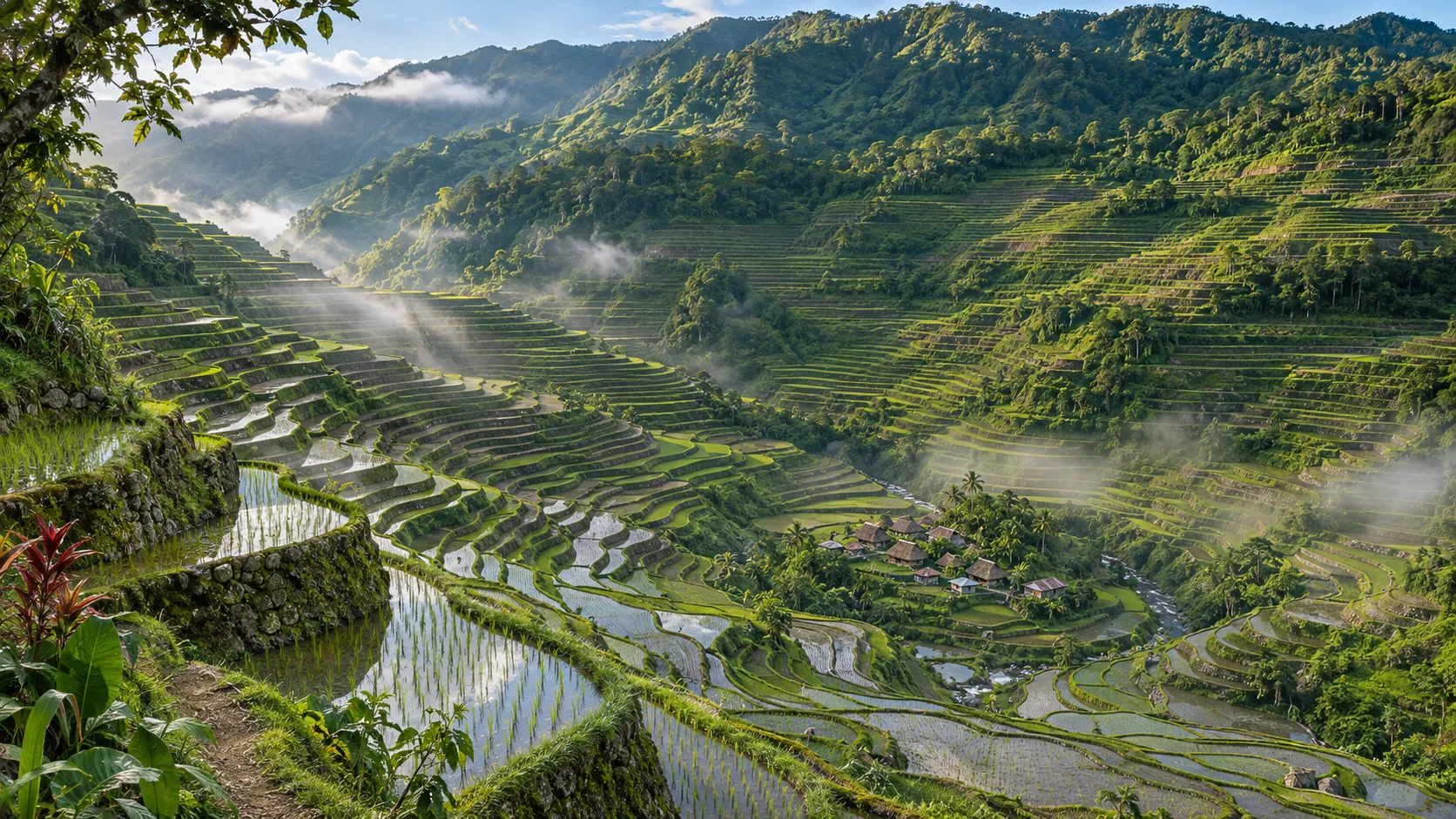
From a distance, the mountains seem to have been carved into an enormous staircase.
Hundreds of narrow green platforms curve around steep slopes, following the contours of the land. Some form long horizontal ribbons. Others create intricate patterns around entire valleys.
At Batad, the terraces rise in an immense amphitheater, with a small village nestled near the bottom.
There are no straight lines imposed across the mountains.
Instead, every field seems to respond to the shape of the slope beneath it.
It is difficult to imagine creating this landscape with heavy machinery.
Yet these fields were established and maintained through generations of human labor, engineering knowledge, and cooperation.
They are the rice terraces of Ifugao, in the Cordillera mountains of northern Luzon, Philippines.
Their story is often presented as a simple triumph of ancient ingenuity.
But the real achievement involves something more complicated than cutting steps into mountains.
It required turning steep slopes into productive farmland, moving water across an uneven landscape, maintaining an enormous network of walls and channels, and organizing communities around a system that could not survive without constant care.
And recent archaeological discoveries have added another unexpected dimension.
The terraces may tell us not only how people adapted to mountains, but also how they responded to a changing political world.
The Problem With Farming on a Mountain
Imagine being asked to grow rice on a steep hillside.
The first difficulty becomes obvious almost immediately.
Water runs downhill.
So does loose soil.
In a conventional mountain landscape, rainfall moves toward streams and valleys. The steeper the terrain, the more challenging it can be to maintain a level, water-retaining surface suitable for growing wet rice.
A flat agricultural field has advantages.
Water can be held at a controlled depth. Soil can remain in place. Farmers can manage planting, cultivation, and harvesting within a relatively stable environment.
A mountain offers very little naturally level land.
The Ifugao solution was to transform the slope itself.
Instead of treating an entire hillside as one inclined surface, farmers divided it into a sequence of smaller, flatter fields.
Each field became a separate step.
Together, those steps allowed cultivation to extend across terrain that would otherwise be difficult to use for irrigated rice.
But creating a platform is only the beginning.
A functioning rice terrace also needs a stable boundary, suitable soil, drainage, and reliable access to water.
Without those elements, the system would gradually fail.
How Do You Build a Rice Field on a Slope?
The underlying idea of terracing is straightforward.
Cut into the hillside, redistribute material, create a flatter surface, and hold that surface in place.
Executing that idea across a mountain is anything but straightforward.
In Ifugao, terrace construction varies according to local terrain and available materials.
Some fields are supported by stone retaining walls. Others use earthen structures.
Walls help stabilize the edges of the fields and retain the material behind them.
The field surfaces are shaped to hold water when required for cultivation.
A series of adjoining terraces distributes agriculture vertically across the hillside.
The shape of each field follows the contours of the mountain, which is why the finished landscape contains so many curves.
A straight rectangular grid might look orderly on paper.
On a steep, irregular mountain, it would often be impractical.
The terraces instead work with the landscape's natural geometry.
Where the slope changes, the fields change.
Where the valley curves, the terraces curve.
And where the terrain becomes particularly steep, the arrangement must account for that difficulty.
This is not a single standardized engineering design repeated thousands of times.
It is a collection of local solutions built around the same general principle: making mountain land suitable for cultivation.
But building the terraces does not solve the most important problem.
The fields still need water.
The Invisible Engineering Above the Fields
The most impressive part of the Ifugao agricultural system may be the part visitors rarely notice.
Above the rice terraces are forested mountain areas that help supply and regulate water.
Traditional Ifugao land management includes privately or communally managed woodlots, often known as *muyong*.
These managed forest areas are connected to the broader agricultural landscape.
The trees and vegetation help protect soil and support watershed functions, while the surrounding land provides water for irrigation.
From these higher areas, water can be directed through channels toward the terraces below.
Gravity does much of the work.
The challenge is controlling where the water travels.
An irrigation system must accommodate changing terrain, distribute available water, and avoid damaging fields through uncontrolled flow.
The terraces are therefore not simply an arrangement of independent paddies.
They belong to a connected water-management network.
The Food and Agriculture Organization of the United Nations describes the Ifugao agricultural landscape as a system of five interconnected components: forests, shifting-cultivation areas, rice terraces, settlements, and water bodies with irrigation infrastructure.
This is a crucial distinction.
The rice fields visible in photographs are only one part of the system.
The surrounding forests and the communities managing them help make those fields possible.
If the water supply is disrupted, terrace farming becomes more difficult.
If channels are neglected, fields may receive too little water or suffer damage.
If retaining walls collapse, a terrace can lose its ability to function as a stable agricultural surface.
The system requires continuous attention.
It is engineering that never reaches a final, maintenance-free state.
Five Landscapes, Five Different Patterns
The UNESCO World Heritage property known as the Rice Terraces of the Philippine Cordilleras consists of five inscribed clusters, all within Ifugao Province.
They are not five identical versions of the same place.
Each has its own relationship between land, water, fields, and settlement.
The Batad terraces, in Banaue municipality, are perhaps the most visually recognizable.
Their curved fields form an enormous amphitheater around a village.
Nearby, the Bangaan cluster combines terraced slopes with a traditional Ifugao settlement.
In Mayoyao, terraces are interspersed with traditional houses and granaries.
The Nagacadan cluster in Kiangan features two ascending sequences of terraces divided by a river.
And Hungduan is known for a distinctive arrangement resembling a spider's web.
Together, these landscapes demonstrate how a shared agricultural tradition can produce dramatically different physical forms.
The mountains determined much of the challenge.
The Ifugao developed the responses.
UNESCO inscribed these five clusters on the World Heritage List in 1995.
The recognition was not based solely on the terraces' appearance.
It acknowledged a living cultural landscape in which agricultural practices, traditional knowledge, community organization, and environmental management remain closely connected.
Are the Rice Terraces Really 2,000 Years Old?
This is where the history becomes especially interesting.
For decades, the Ifugao rice terraces have commonly been described as approximately 2,000 years old.
That age appears in traditional accounts, tourism descriptions, and UNESCO's historical presentation of the property.
But archaeological dating has complicated the story.
One of the most influential researchers in this field is archaeologist Stephen B. Acabado.
His research challenged the assumption that the monumental wet-rice terrace systems necessarily originated two millennia ago.
A 2009 study used radiocarbon evidence and Bayesian chronological modeling to investigate the age of agricultural terraces in Ifugao.
Its findings suggested a substantially more recent development of the terraces studied, associated with the period of Spanish arrival and expansion in the Philippines.
Subsequent research drew on additional evidence, including plant remains, archaeological deposits, and historical records.
A broader interpretation emerged.
Rather than beginning as a fully developed system thousands of years ago, intensive wet-rice terracing in parts of Ifugao may have expanded significantly during the sixteenth and seventeenth centuries.
That does not mean the Ifugao people themselves arrived only a few centuries ago.
Nor does it mean there was no earlier agriculture or landscape modification in the region.
Communities occupied the mountains long before the period suggested for the expansion of extensive wet-rice cultivation.
Earlier agricultural systems, including cultivation of taro and other crops, form part of that longer history.
It is also difficult to assign a single construction date to a landscape that has been extended, rebuilt, repaired, and cultivated over generations.
Different terraces may have different histories.
The distinction matters because the age of a community, the age of its farming traditions, and the age of a particular rice terrace are not automatically the same.
The familiar 2,000-year narrative remains culturally influential.
But the archaeological evidence requires a more careful explanation.
A Landscape Shaped by Resistance?
The revised chronology raises a fascinating historical possibility.
During the sixteenth century, Spanish colonial influence expanded across parts of the Philippine archipelago.
For communities living in northern Luzon, colonial expansion created new political and economic pressures.
Researchers have proposed that migration, resistance, and social reorganization during this period contributed to the expansion of intensive agriculture in the Cordillera highlands.
Wet-rice terracing could support larger and more concentrated populations by increasing food production on mountainous land.
But building the terraces also required considerable labor and coordination.
The development of extensive agricultural infrastructure may therefore reflect not only farming knowledge, but also community organization during a period of external pressure.
This interpretation changes the way we think about the landscape.
Instead of seeing the terraces exclusively as an ancient monument whose origins are lost in the distant past, we can also understand them as evidence of people responding creatively to historical challenges.
The mountains could provide a difficult environment for outsiders.
But surviving there required food, water, labor, and social cooperation.
Terraced agriculture helped make that possible.
The relationship between colonial expansion and terrace development remains an area of archaeological and historical investigation, rather than a single proven explanation for every field.
Still, it offers a powerful reminder.
Engineering is not always driven by a desire to build something extraordinary.
Sometimes it develops because communities need a way to continue living on their own terms.
Why the Terraces Are More Than Agriculture
To understand the Ifugao terraces, we also have to look beyond stone walls and irrigation channels.
Rice cultivation has traditionally been connected to cultural knowledge, rituals, social relationships, and agricultural calendars.
The management of fields depends on knowledge passed between generations.
Farmers must understand the behavior of water, the condition of walls, planting cycles, and the demands of local varieties.
They must also coordinate activities that can affect neighboring fields.
Water flowing through one part of a terrace system may be relevant to another farmer farther downhill.
That means individual decisions can have consequences beyond a single household.
Agriculture is connected to cooperation.
The cultural dimension is equally important.
The *Hudhud* chants of the Ifugao, recognized by UNESCO as intangible cultural heritage, form part of a broader oral tradition associated with agricultural activities and community life.
Such traditions preserve knowledge, memory, and cultural identity in ways that cannot be reduced to the physical appearance of a landscape.
The terraces are therefore not simply archaeological objects.
They remain connected to the people who work, maintain, and understand them.
A stone wall may survive for generations.
But the knowledge needed to repair that wall must also survive.
What Happens When Farmers Leave?
There is a paradox at the heart of this beautiful landscape.
The terraces have become internationally famous because of their appearance.
Yet their continued existence depends on agricultural work that is demanding and often economically difficult.
Maintaining a terraced field involves repairing walls, managing water, clearing channels, preparing soil, and carrying out agricultural activities across steep terrain.
These tasks require labor.
And labor has a cost.
As younger people seek opportunities elsewhere, some communities face difficulties maintaining the agricultural workforce needed to care for the terraces.
Economic pressures can make rice cultivation less attractive than other forms of employment.
Environmental changes create additional problems.
Heavy rainfall can damage walls and channels.
Erosion and landslides can destroy sections of the agricultural landscape.
Periods of insufficient water can complicate cultivation.
Tourism brings attention and potential income, but it does not automatically solve the problem of sustaining farming.
In 2001, UNESCO placed the Rice Terraces of the Philippine Cordilleras on the List of World Heritage in Danger, reflecting concerns about their conservation and management.
The property was removed from that list in 2012 after conservation improvements.
But removal from the danger list did not mean the underlying challenges had permanently disappeared.
In November 2025, Typhoon Uwan damaged part of the Batad terraces, with landslides and erosion affecting more than 80 paddies, according to a June 2026 report from the Philippine Information Agency.
The damage demonstrated how vulnerable even a long-established agricultural landscape can be to extreme weather.
By mid-2026, restoration efforts involving residents, volunteers, civic groups, and government agencies were being pursued.
This is not simply the story of an ancient structure threatened by time.
It is a working agricultural system exposed to present-day economic and environmental pressures.
Can a Living Monument Be Preserved Without Its Farmers?
Traditional monuments are often preserved by protecting their physical structures.
A historic building may need restoration.
A stone sculpture may require careful conservation.
But what does preservation mean for a landscape that must be farmed?
The Ifugao terraces are different from a monument whose original function has ended.
Their agricultural purpose is central to their cultural significance.
If the fields stop being cultivated and maintained, the landscape itself can change.
Walls deteriorate.
Channels become blocked.
Vegetation reclaims abandoned areas.
Water follows different paths.
The appearance that attracts visitors depends, in part, on work that visitors may never witness.
That creates a difficult challenge for heritage conservation.
Preserving the terraces cannot mean treating the people who live and farm there as secondary to the scenery.
It requires attention to livelihoods, agricultural knowledge, access to resources, and the choices of local communities.
The Food and Agriculture Organization recognized the Ifugao Rice Terraces as a Globally Important Agricultural Heritage System in 2011.
This designation highlights the importance of traditional agriculture, biodiversity, landscape management, and community knowledge.
It recognizes that the value of the terraces lies in a functioning relationship between people and their environment.
The goal is not to freeze an entire mountain landscape at an imaginary moment in history.
It is to support the conditions that allow its agricultural and cultural systems to continue.
The Engineering That Must Be Rebuilt Every Generation
Perhaps the most impressive part of the Ifugao terraces is not the number of steps carved into the mountains.
It is the fact that the system continues to require human participation.
A photograph can make the terraces seem permanent.
Their stone walls appear to belong naturally to the mountains.
Their shapes are so closely fitted to the landscape that the boundary between nature and human construction becomes difficult to distinguish.
But the terraces did not simply emerge from the mountains.
They were created, extended, and maintained by people.
Their existence depends on the interaction of engineering, water, forests, agriculture, and social organization.
Every repaired wall is part of that history.
Every maintained irrigation channel helps keep the system functioning.
Every generation that learns how to cultivate and care for the terraces participates in their continuation.
We often celebrate great engineering achievements by asking how long they have survived.
The Ifugao terraces invite a different question.
How many generations have worked to keep them alive?
The answer cannot be measured simply by dating the oldest stone or the earliest soil deposit.
It is written into the ongoing relationship between the fields and the people who care for them.
The mountains became rice fields because the Ifugao learned how to work with their contours, manage water, and organize cultivation across challenging terrain.
And the terraces remain rice fields only because that knowledge continues to be practiced.
The greatest achievement may not be that people once transformed a mountain.
It is that generations have continued the work.
Listen & explore
- UNESCO World Heritage Centre — Rice Terraces of the Philippine Cordilleras (external platform)
- FAO — Ifugao Rice Terraces Agricultural Heritage System (external platform)
- Stephen Acabado — A Bayesian Approach to Dating Agricultural Terraces (2009) (external platform)
- Acabado & Martin — Older Is Not Necessarily Better (2024) (external platform)
- Philippine Information Agency — Batad Rice Terraces Restoration (2026) (external platform)