Articles / LORQAI
The Lake That Fell From the Sky
How a meteorite created India’s Lonar crater in ancient basalt, why its age remains debated, and how a saline lake turned pink in 2020.
Introduction
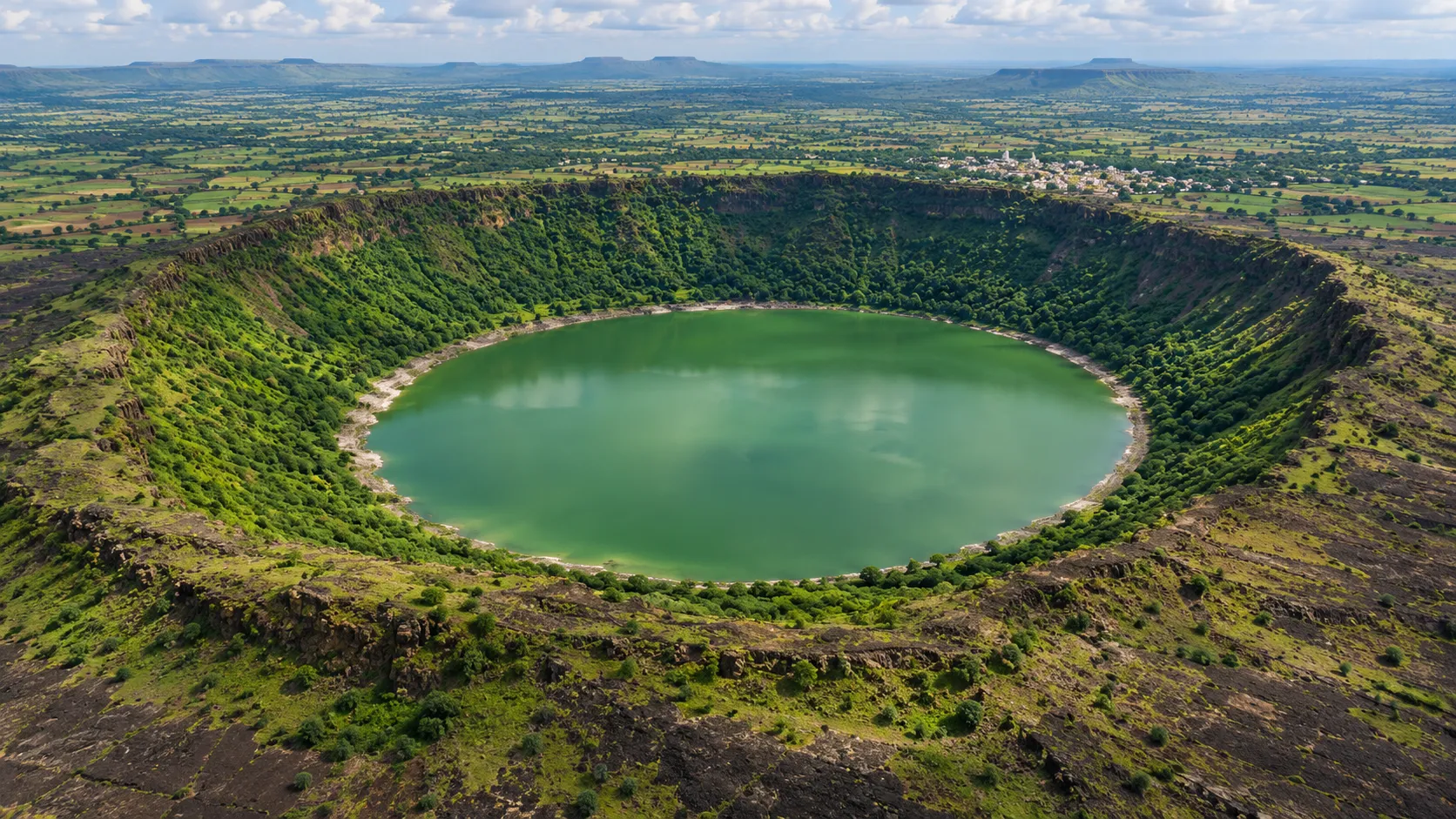
In the heart of India's volcanic plateau lies an almost perfectly circular lake. It was created by a visitor from space, filled with unusually alkaline water, and one day turned an astonishing shade of pink. Its story is stranger than its appearance suggests.
Imagine walking across a vast landscape of dark volcanic rock.
The ground stretches toward the horizon, broken by villages, fields, and occasional hills. Nothing seems particularly unusual about the terrain.
Then the land suddenly falls away.
Ahead is an immense circular depression, its steep slopes covered with vegetation. At the bottom sits a quiet lake, surrounded by an almost continuous ring of rock.
From above, the shape is unmistakable.
It resembles a giant bowl pressed into the Earth.
You might assume that a volcano once erupted here.
After all, this is the Deccan Plateau, one of the world's great volcanic regions.
But the explanation is very different.
The depression was created when an object from space struck the ground at tremendous speed.
This is Lonar Lake, in the Buldhana district of Maharashtra, India.
Its existence connects an ancient volcanic landscape with a much later cosmic collision.
And what happened after the impact may be almost as fascinating as the impact itself.
The Crater in the Wrong Kind of Landscape
Lonar presents a geographical puzzle.
Its surrounding terrain consists largely of basalt, a dark volcanic rock formed when lava cools and solidifies.
Approximately 65 million years ago, enormous volcanic eruptions spread lava across what is now western and central India.
Repeated flows accumulated into the immense rock formations known as the Deccan Traps.
These events occurred long before the Lonar crater existed.
The result was a thick sequence of basalt layers extending across a vast region.
When early observers encountered Lonar's circular depression, its location within volcanic terrain made a volcanic explanation seem reasonable.
A crater surrounded by basalt sounds exactly like something a volcano might leave behind.
But geology does not identify a volcanic crater simply by looking at its shape.
Different processes can create depressions that appear similar from a distance.
And at Lonar, the rocks contained evidence of a much more violent event.
How Scientists Discovered the Truth
The decisive clue was not the lake itself.
It was what had happened to the minerals inside the surrounding rock.
During a meteorite impact, enormous amounts of energy are released over an exceptionally short period.
The resulting shock waves pass through the target rocks at pressures far beyond those produced by ordinary surface weathering.
These pressures can deform minerals, fracture rock, and even transform some crystalline materials into glass-like substances.
In a landmark study published in *Science* in 1973, researchers K. Fredriksson, A. Dube, D. J. Milton, and M. S. Balasundaram described shock-metamorphosed material found at Lonar.
Their evidence included fractured rock, impact melt, and the mineral transformation known as maskelynite.
Maskelynite is a glass-like material that can form when plagioclase feldspar experiences intense shock.
Its presence, together with other impact-related features, provided compelling evidence that Lonar was formed by a high-speed collision.
The geological evidence pointed away from a volcanic explosion.
The crater had been excavated by an impact.
This transformed Lonar from an unusual feature of India's volcanic landscape into an important site for planetary science.
The surrounding basalt was volcanic.
The crater itself was not.
What Happens When a Meteorite Hits the Ground?
Imagine a rocky object approaching Earth from space.
As it enters the atmosphere, frictional heating and compression of the air around it produce intense temperatures.
Smaller objects may break apart or burn up before reaching the ground.
But sufficiently large and fast objects can survive atmospheric passage and strike the surface.
The energy released depends on the object's mass and velocity.
At the speeds involved in cosmic impacts, kinetic energy becomes extraordinarily important.
The event is not equivalent to a large boulder simply dropping into a field.
A hypervelocity impact produces shock waves, intense compression, fractured rock, and the rapid excavation of material.
Some rock is thrown outward.
Some is broken into fragments.
Some may melt.
As the crater forms, the surrounding material is displaced, and a raised rim may develop around the newly excavated depression.
The exact sequence occurs very rapidly compared with ordinary geological processes.
At Lonar, the result was a bowl-shaped crater approximately 1.88 kilometers wide.
Its depth and internal structure have since been modified by erosion, sediment accumulation, and the formation of the lake.
What visitors see today is not an untouched snapshot of the moment of impact.
It is the surviving landscape after a long period of geological and ecological change.
The original collision created the basic shape.
Time altered everything around it.
How Old Is Lonar Crater?
This sounds like a question that should have a straightforward answer.
Scientists can date rocks and sediments.
Surely they can establish when a meteorite struck the ground?
In practice, impact dating can be surprisingly difficult.
Different methods measure different materials and processes.
One technique may estimate when a rock was last exposed to cosmic radiation.
Another may date minerals or glass altered during an impact.
Sediments may provide information about events before or after the crater formed.
Each method has assumptions and possible sources of error.
Lonar has produced an especially striking disagreement.
For many years, the crater was commonly described as approximately 50,000 years old.
A study using argon isotope dating of impact-related material reported an age of about 570,000 years, with an uncertainty of roughly 47,000 years.
That was dramatically older than many previous estimates.
But another investigation, published in 2014 in *Geochemistry, Geophysics, Geosystems*, used cosmogenic isotopes and additional chronological evidence to derive an age of approximately 37,500 years, with an uncertainty of 5,000 years.
The researchers suggested that the much older argon-based result might have been influenced by inherited radiogenic argon in the impact glass.
More recent scientific literature has continued to acknowledge uncertainty in the crater's precise age.
This is not a dispute about whether a meteorite created Lonar.
The impact origin is well established.
The disagreement concerns when it happened.
And that difference is important.
A scientific explanation can be strong even when one part of its chronology remains unresolved.
Sometimes the most accurate answer to a simple question is that researchers are still working toward a reliable date.
Why Did a Lake Form Inside the Crater?
The impact created the depression.
But it did not instantly create the lake as it exists today.
After the collision, the crater became part of the surrounding drainage environment.
Rainfall entered the basin.
Water moved down the slopes.
Natural springs contributed additional water.
Sediment accumulated over time.
Eventually, water collected within the lowest part of the depression.
One of Lonar's most important characteristics is that it is an endorheic basin.
That means it has no natural surface outlet carrying lake water into a larger river or the sea.
Water can enter through rainfall and local drainage.
But it does not simply flow away through an ordinary outlet.
Instead, much of the water is lost through evaporation.
And evaporation has a chemical consequence.
When water evaporates, dissolved salts and minerals do not necessarily leave with it.
They can become increasingly concentrated in the remaining water.
Over time, this helps explain why Lonar developed unusually saline and alkaline conditions.
The impact created the bowl.
Hydrology and climate helped create the lake's distinctive chemistry.
The Lake With Unusual Chemistry
Lonar is not an ordinary freshwater lake.
It is often described as a saline, alkaline soda lake.
Its water contains dissolved salts, including sodium compounds, and can reach a pH of approximately 10, although measured conditions vary with location, season, and environmental changes.
To understand why this is unusual, consider the pH scale.
A pH of 7 is neutral.
Lower values indicate more acidic conditions.
Higher values indicate more alkaline conditions.
A lake with a pH near 10 is therefore substantially more alkaline than ordinary neutral water.
These conditions can create challenges for many organisms.
They influence how nutrients behave, which chemical compounds remain dissolved, and which microorganisms are capable of surviving.
But Lonar is not lifeless.
Its chemistry supports specialized biological communities adapted to conditions that would be difficult for many familiar freshwater organisms.
Some microorganisms tolerate high salt concentrations.
Others are adapted to alkaline environments.
Some can survive both.
Scientists study these communities because they reveal how life can operate under environmental conditions very different from those found in an ordinary lake or river.
And in 2020, the microorganisms of Lonar became part of a remarkable natural spectacle.
The Day the Lake Turned Pink
In early June 2020, satellite images captured an extraordinary change.
Lonar Lake, normally greenish in appearance, had turned pink.
The transformation happened over a short period.
Images from NASA's Landsat 8 satellite showed a striking contrast between late May and early June.
The lake appeared to have changed its identity almost overnight.
At first, the precise cause was uncertain.
Scientists considered the effects of salinity, environmental conditions, and organisms capable of producing colored pigments.
Subsequent research focused attention on microbial responses to the lake's chemistry.
One study, using Sentinel-2 satellite observations, associated the color change with salt-loving archaea known as haloarchaea.
These microorganisms can contain reddish carotenoid pigments.
Another investigation emphasized the role of *Dunaliella*, a salt-tolerant alga whose pigment production can change under environmental stress.
Such pigments can make water appear pinkish or red when the organisms become abundant or their coloration becomes especially pronounced.
The research does not require imagining an entirely new organism suddenly arriving at the lake.
Changes in salinity, temperature, rainfall, and the biological community can alter the visible appearance of the water.
The precise contribution of different organisms and environmental factors has been examined through different methods, and studies have not assigned exactly the same role to every possible cause.
The important conclusion is that the color change was connected to the lake's unusual biological and chemical environment.
The crater was formed by a cosmic collision.
Its temporary pink coloration came from life responding to conditions inside it.
A World of Microorganisms
Lonar provides scientists with a natural laboratory for studying life in high-salt, high-pH environments.
Microbial research has identified diverse groups involved in different ecological processes.
Some microorganisms use sunlight to obtain energy.
Others participate in the cycling of carbon, nitrogen, and sulfur.
Some produce methane.
Others consume it.
Together, these organisms form interacting communities whose activity influences the chemistry of the lake.
This matters because a lake is not merely a container of water.
It is an ecosystem.
Its chemistry influences the organisms that can live there.
Those organisms, in turn, can change the chemical conditions through their metabolism.
The relationship works in both directions.
Researchers have also been interested in enzymes and other biological products from organisms that tolerate extreme conditions.
Microorganisms adapted to high salinity or alkalinity may possess biochemical mechanisms useful for scientific and industrial research.
But Lonar's importance is not limited to possible future applications.
It demonstrates that ecosystems can develop in places formed by extraordinarily violent events.
A meteorite impact created the depression.
A specialized biological community eventually occupied the environment.
What began with destruction became a habitat.
Why Scientists Compare Lonar With Mars
One of the most surprising reasons scientists study Lonar has little to do with India itself.
It involves other planets.
Many impact craters on the Moon and Mars formed in basaltic terrain.
Basalt is widespread on Earth, but well-preserved terrestrial impact structures excavated directly into basalt are relatively uncommon.
Lonar provides an unusual opportunity to examine how high-speed impacts affect this particular rock.
Researchers can study fractured basalt, impact breccias, altered minerals, crater structure, and the effects of later erosion.
These observations help scientists interpret features observed remotely on other planetary surfaces.
A 2003 study investigated hydrothermal alteration at Lonar and its implications for understanding impact craters on Mars.
More recently, a 2024 geophysical investigation used ambient seismic noise recorded by instruments around the crater to reconstruct subsurface damage.
The study identified a complex pattern of disrupted rock beneath the visible crater.
This matters because an impact affects more than the surface.
Shock waves can fracture and alter rock beneath the excavation.
Some of that damage remains hidden until geophysical observations reveal it.
The crater's present surface is only part of the evidence.
But there is an important distinction.
Lonar is an analogue for studying geological processes.
It is not a perfect miniature version of a crater on Mars.
Earth has liquid water, extensive biological activity, atmospheric weathering, and climatic conditions that differ greatly from those of present-day Mars.
Scientists use Lonar to investigate particular physical processes, not to assume that the two environments are identical.
An impact crater in India can help researchers ask better questions about another planet.
It cannot provide every answer.
The Heritage Around the Crater
Lonar's importance extends beyond planetary science.
The crater is also part of a cultural landscape.
Temples and historical structures stand near and within the crater area.
Local traditions have long associated the landscape with religious and cultural significance.
This means Lonar cannot be understood only as a geological specimen.
For scientists, its rocks preserve evidence of an impact.
For ecologists, the lake and surrounding forests support an unusual ecosystem.
For local communities, the area includes historical places, cultural traditions, and everyday relationships with the landscape.
These forms of significance can coexist.
In July 2020, Lonar Lake was designated a Wetland of International Importance under the Ramsar Convention.
The designation recognizes the site's ecological significance, including its distinctive saline and alkaline environment and surrounding habitats.
The protected area includes more than the water surface.
It also encompasses parts of the crater walls and adjoining forested zones.
This broader boundary matters because the ecosystem does not stop at the waterline.
Natural springs, vegetation, wildlife, soils, and surrounding land all influence the lake.
The crater is a connected landscape.
What Threatens a Lake Made by a Meteorite?
It may seem that a place created by an enormous cosmic impact should be practically indestructible.
But the geological origin of Lonar does not protect it from ordinary environmental damage.
The Ramsar Convention has identified household sewage, urban wastewater, and unsustainable tourism among the threats affecting the site.
Pollution can change water chemistry.
Wastewater can introduce nutrients and contaminants.
Human disturbance can damage habitats around the crater.
Changes in the surrounding catchment can also affect runoff, sediment movement, and the quality of water entering the lake.
These pressures are very different from the event that originally formed the crater.
They operate through gradual environmental change rather than a single violent collision.
Yet they can alter the ecosystem that developed inside it.
Conservation therefore requires attention to both geological heritage and living systems.
Protecting Lonar is not simply about keeping the crater's shape recognizable.
It also means maintaining the conditions that make its biodiversity and scientific value possible.
A crater can survive for tens of thousands of years while its ecosystem changes substantially over a much shorter period.
The Space Rock That Left More Than a Hole
Lonar is extraordinary because its history unfolded in several very different chapters.
The first chapter began with volcanism.
Ancient lava flows spread across India and solidified into thick layers of basalt.
Much later, an object from space struck that rock, releasing enough energy to excavate a huge circular depression.
Rainfall and springs gradually supplied water to the basin.
Evaporation and local geology helped establish an alkaline, saline lake.
Microorganisms adapted to its unusual chemistry.
And one June, biological activity helped turn the water pink.
Today, scientists investigate Lonar to understand impacts, geological dating, microbial ecosystems, and even planetary surfaces beyond Earth.
Each field of research reveals a different aspect of the same place.
The crater is not simply the scar of a meteorite strike.
It is a landscape that continued developing after the collision.
Perhaps that is the most remarkable thing about it.
An object from space struck the Earth and created a hole.
But what happened afterward was not written by the meteorite.
It was written by rain, rock, chemistry, life, and time.
The lake did not fall from the sky.
Only the event that made room for it did.