Articles / LORQAI
The Bridges That Are Still Growing
Discover how communities in Meghalaya guide the aerial roots of living Ficus elastica trees into bridges that can support generations of travelers.
Introduction
Imagine standing beside a river in the middle of a dense tropical forest.
The water is moving quickly over rocks. The opposite bank is close enough to see, but the current makes crossing difficult.
There is a bridge ahead.
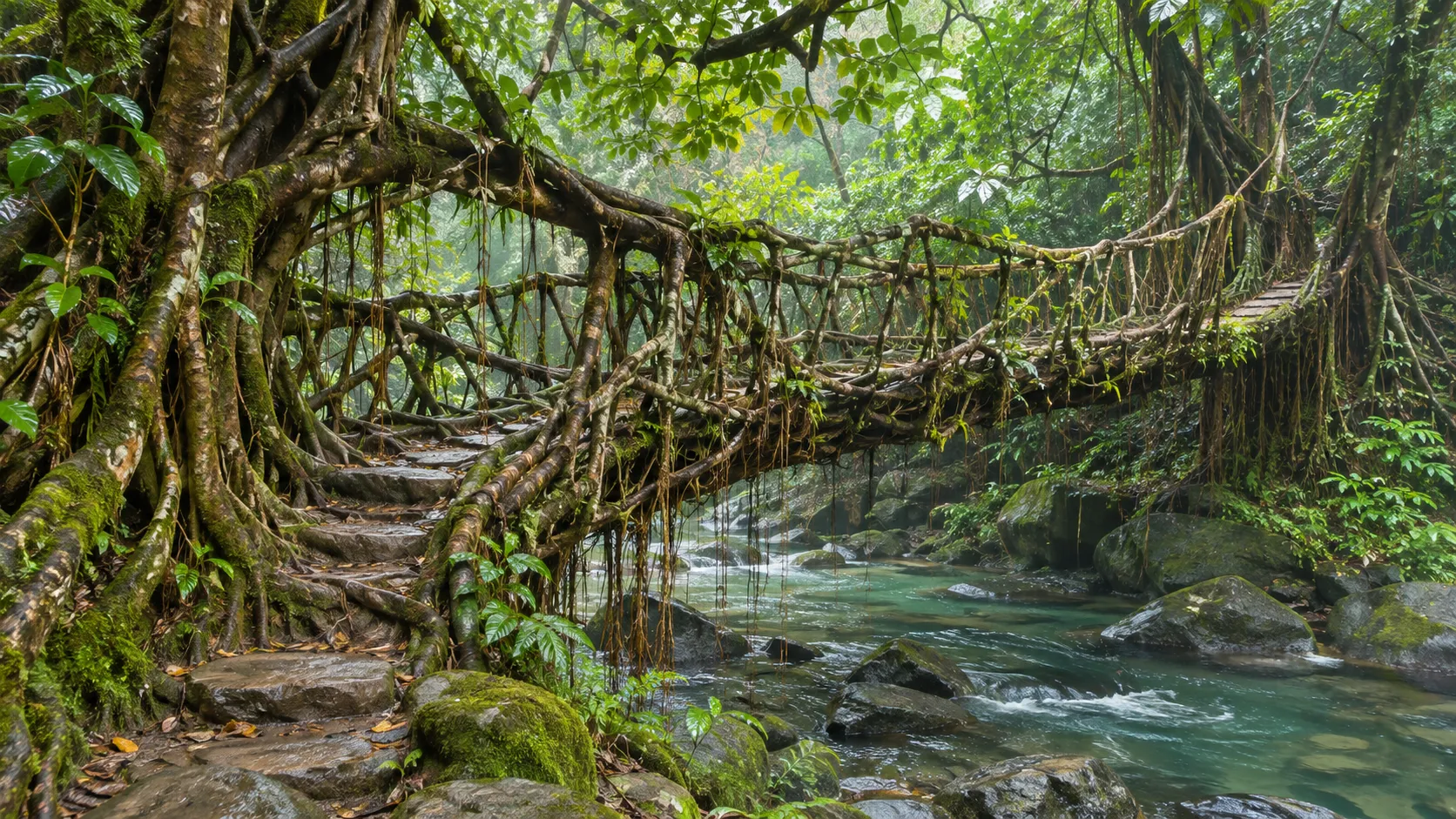
At first, it appears to be made from twisted branches, thick vines, and an irregular collection of wooden supports.
But as you approach, something becomes clear.
The bridge is alive.
Its railings are formed from intertwined roots. Its walkway is supported by a complicated network of living plant material. At either end, enormous trees connect the structure to the forest.
The roots have not simply fallen into place.
People have guided them, trained them, intertwined them, and cared for them over many years.
This is a living root bridge, known locally as Jingkieng Jri.
These extraordinary structures are found in the Khasi and Jaintia Hills of Meghalaya, in northeastern India.
They are remarkable because they challenge one of our most familiar ideas about construction.
Normally, a bridge is finished before people begin using it.
Here, construction and growth can continue long after the first person crosses.
And the original builders may never see the bridge reach its mature form.
Why Would Anyone Grow a Bridge?
Meghalaya is a landscape shaped by extraordinary rainfall.
In parts of the state, heavy monsoon rains feed streams that descend through steep valleys and forested hillsides.
A small watercourse can become difficult or dangerous to cross during periods of intense rain.
For communities connected by footpaths, that creates a serious problem.
A river can separate a village from agricultural land, markets, neighboring settlements, and other essential destinations.
A bridge is not necessarily a luxury.
It may be the difference between reliable access and a journey interrupted by dangerous water.
But conventional bridge construction can be difficult in this environment.
Timber deteriorates in constantly wet conditions.
Bamboo structures may require frequent replacement.
Flooding can damage temporary crossings.
And building large concrete or steel structures in remote valleys can require materials, equipment, and financial resources that are difficult to obtain.
Generations of Khasi communities developed another approach.
They used a tree that was already suited to the surrounding forest.
Instead of removing the tree and cutting it into construction materials, they worked with its living roots.
This was not an accidental discovery that trees sometimes grow across streams.
It became a deliberate tradition of botanical engineering.
The communities learned how to influence the direction of root growth, support young structures, and maintain bridges as their components became thicker and more interconnected.
The result was a crossing that remained biologically active.
The Tree That Makes the Bridge Possible
The main species used in Meghalaya's living root bridges is Ficus elastica.
It is sometimes called the Indian rubber tree or rubber fig.
Unlike the commercially dominant rubber-producing tree, Hevea brasiliensis, Ficus elastica belongs to the fig family.
One of its most useful characteristics is its ability to produce aerial roots.
These roots develop above ground rather than beginning entirely within the soil.
In suitable conditions, they grow downward or outward from the tree and may eventually reach the ground.
Once established, they can become thicker and contribute structural support to the plant.
For someone trying to create a bridge, this offers an unusual opportunity.
The roots are flexible enough during early growth to be directed along a chosen route.
Over time, they can develop into substantial woody structures.
They are not naturally programmed to become bridges.
The tree simply grows according to its biology.
Human intervention gives some of those growing roots a new purpose.
This distinction is essential.
The bridge is neither purely natural nor manufactured in the conventional sense.
It is a living structure produced through a continuing relationship between people and a tree.
How Do You Train a Tree to Cross a River?
The process begins long before there is anything resembling a finished bridge.
First, a suitable location must be selected.
The crossing needs appropriate trees, stable banks, and an understanding of the surrounding terrain.
The tree may already be established, or the community may plant one in a position where its growth can eventually support the desired route.
Young aerial roots are then directed toward the opposite side.
Traditional methods include guiding them through hollowed areca palm trunks or along bamboo frameworks.
These temporary supports help hold the roots in the desired direction while they continue growing.
As the roots extend, people adjust their position and guide them across the gap.
Some roots are trained horizontally to form parts of the future walkway.
Others contribute supports, connections, and railings.
When suitable roots reach the opposite bank or connect with established structures, they may be encouraged to become anchored and integrated into the growing network.
Additional roots are introduced as needed.
The process is not completed in a single construction season.
New growth must be monitored.
Weak connections may need reinforcement.
Temporary materials may need replacement.
And the bridge gradually becomes more substantial as its living components increase in size.
Stones can be placed within gaps to improve the walking surface, although methods vary between bridges.
The result is not a wooden bridge with a few decorative roots growing across it.
The roots themselves become essential structural components.
Why Do the Roots Join Together?
One of the most fascinating features of living root bridges is a biological process known as inosculation.
Inosculation occurs when two growing plant parts come into contact and develop a joined connection.
Under suitable conditions, the tissues can grow together, forming a structural union.
This is sometimes described as natural grafting.
At Meghalaya's bridges, roots are repeatedly trained to cross, touch, and intertwine.
As they grow, some of these contact points become integrated.
The network can develop connections that help distribute mechanical forces through different parts of the structure.
A mature bridge therefore contains more than a collection of separate root strands.
It can contain a complex network in which many elements support or reinforce one another.
The scientific significance of this system was examined in a 2019 study published in Scientific Reports.
Researchers led by Ferdinand Ludwig investigated the morphology and structural characteristics of living root bridges made from Ficus elastica.
Their work found that root shape and cross-sectional characteristics varied according to root orientation.
They also examined how secondary growth and joined root networks contribute to mechanical stability.
The important principle is that a plant's growth can be incorporated into the development of a load-bearing structure.
That does not mean every contact between two roots becomes a perfect biological joint.
Nor does it mean the bridge grows stronger under every possible condition.
The health of the tree, the condition of the roots, the quality of connections, and continued maintenance all matter.
But the underlying mechanism is extraordinary.
Some of the materials supporting the bridge are still growing into their structural roles.
The Bridge That Takes Decades to Build
Most construction projects are organized around a completion date.
A bridge might take several months or years to design and construct.
Once the main structure is finished and approved for use, it enters its operational life.
A living root bridge follows a different timeline.
The Meghalaya Biodiversity Board describes a typical period of approximately 15 to 25 years for roots to develop into a firm bridge.
Some community and conservation descriptions give a similar range extending to about 30 years.
These are useful estimates, not universal deadlines.
The time required depends on the tree, the length of the crossing, environmental conditions, maintenance, and the desired structure.
A short crossing may develop differently from a much longer one.
And a bridge does not necessarily move from completely unusable to fully finished on one particular day.
Different sections can mature at different rates.
Additional roots may be trained even while the bridge is already being used.
The process therefore creates an unusual relationship between construction and time.
Someone may begin guiding the roots of a tree knowing that the finished crossing will benefit people many years later.
Children may grow up watching it become stronger.
And future generations may continue improving a structure whose original builders are no longer alive.
The bridge is an investment in a future community.
Not just an answer to an immediate problem.
Can a Living Bridge Really Last for Centuries?
One of the most repeated claims about Meghalaya's living root bridges is that they can last for 500 years.
The Meghalaya Biodiversity Board uses that figure as an estimated potential lifespan.
But it should not be interpreted as a guaranteed service life for every bridge.
Living structures do not arrive with a fixed expiration date.
Their durability depends on tree health, environmental conditions, structural development, land stability, and maintenance.
Some documented bridges are believed to be several centuries old.
A scientific survey published in 2019 recorded bridges ranging from approximately two meters to more than 52 meters in length.
The researchers also documented differences in form, location, and maintenance.
These variations matter because each bridge is a unique living structure.
A young bridge and a mature bridge do not have identical capabilities.
Nor should the number of people that one well-developed crossing can support be applied automatically to every bridge in Meghalaya.
The impressive durability associated with the tradition is real.
But safe use still depends on the condition of each individual structure.
What makes the bridges especially interesting is not a precise promised lifespan.
It is the possibility that the structural network can continue developing instead of simply deteriorating after construction.
Conventional materials frequently require repair or replacement as they age.
Living roots can add new material through biological growth.
Yet this advantage exists only as long as the living system is properly supported.
The Double-Decker Bridge of Nongriat
Perhaps the most famous example of this tradition is the double-decker living root bridge near Nongriat.
It is situated in a steep, forested valley in the East Khasi Hills.
Unlike the more familiar single-level structures, the Nongriat bridge consists of two crossings arranged at different heights.
The result seems almost impossible.
Two levels of living roots span the same watercourse, supported by an intricate network connected to surrounding trees.
The structure demonstrates how adaptable root-based construction can be.
The basic technique is not restricted to one straight walkway.
Roots can be guided into different arrangements according to the terrain and the needs of the community.
The Nongriat crossing has become widely known among visitors to Meghalaya.
But reaching it involves descending a long series of steps from the area around Tyrna, followed by the corresponding climb on the return journey.
The surrounding landscape is as much a part of the experience as the bridge itself.
Steep hillsides, streams, forest paths, and heavy seasonal rainfall reveal why a reliable crossing mattered in the first place.
Without that context, the bridge can look like a remarkable curiosity.
Within its landscape, its practical purpose becomes obvious.
More Than Bridges: An Entire Living Architecture
The tradition does not end with bridges.
Research and community documentation describe other structures formed from trained Ficus roots.
These include ladders, pathways, platforms, steps, and structures that help stabilize slopes.
Some are designed for crossing water.
Others assist movement through steep terrain.
Root networks may also help hold soil or support areas vulnerable to erosion.
The wider system shows that local communities developed more than a single clever technique.
They built an adaptable form of living architecture.
The exact structure depends on what the site requires.
A steep slope presents a different problem from a wide stream.
A narrow forest path requires a different arrangement from a bridge carrying regular foot traffic.
The roots provide a flexible biological material.
Local knowledge determines how that material can be guided.
This is an important reason to understand living root bridges as a cultural tradition rather than an isolated natural wonder.
The bridge does not simply appear because a certain species of tree is present.
People must know what they are trying to create.
They must understand how to influence growth.
And they must continue caring for the result.
The Science of Building With Living Materials
For architects and engineers, living root bridges challenge a fundamental assumption.
Buildings are usually designed around materials whose properties are treated as relatively stable at the moment of construction.
Concrete hardens.
Steel is fabricated into structural elements.
Wood is cut, shaped, and assembled.
These materials may change over time, but the finished structure is not expected to grow new beams.
A living root bridge is different.
Its geometry can change as the plant grows.
Roots may become thicker.
New connections can develop.
Existing elements can be supplemented with additional growth.
This creates intriguing possibilities for architecture that incorporates living plants as structural components.
Researchers working in the field sometimes called Baubotanik have investigated how botanical growth can become part of architectural design.
Scientific studies published in 2019 and 2022 examined the morphology and geometry of Meghalaya's living bridges, including methods of documenting their complicated three-dimensional networks.
Photogrammetry and digital reconstruction allow researchers to study structures whose irregular shapes are difficult to represent using conventional drawings.
These investigations do not suggest that living roots can simply replace steel and concrete in every modern building.
Different materials have different strengths, limitations, and safety requirements.
Living structures also introduce challenges involving growth, maintenance, biological uncertainty, and long-term monitoring.
But the bridges offer a different design principle.
Instead of making a structure and then attempting to prevent all change, some forms of architecture might be developed with change as part of the design.
The building becomes a process.
The People Behind the Living Bridges
It would be easy to describe the bridges as though the forest had made them on its own.
That would overlook the people responsible for them.
The tradition is closely associated with Indigenous Khasi communities, as well as wider regional knowledge and practices in the Khasi and Jaintia Hills.
Their expertise includes knowing where suitable trees can grow, how roots behave, which routes need crossings, and how to maintain the structures.
Much of this knowledge has been transmitted through practical experience rather than formal architectural drawings.
The work also depends on cooperation.
A bridge used by an entire community cannot always be understood as the project of one individual.
Different people may contribute to its development, repair, and daily care.
Those responsibilities can continue over generations.
The living roots therefore carry a history that is not visible simply by counting their thickness or estimating their age.
They represent decisions made by earlier community members.
They also reflect the continuing choices of people who keep the structures useful.
In 2024, the United Nations Development Programme documented community-led conservation efforts and the importance of local participation in maintaining Meghalaya's living root bridges.
The report highlighted that these bridges remain part of daily life, not merely attractions created for visitors.
This is what makes them especially significant.
Their value belongs to both the physical structure and the knowledge needed to sustain it.
Are the Living Root Bridges a UNESCO World Heritage Site?
The living root bridge cultural landscapes of Meghalaya were added to India's UNESCO World Heritage Tentative List in February 2022.
The proposed property is titled Jingkieng jri: Living Root Bridge Cultural Landscapes.
The nomination material describes a continuing cultural landscape associated with Indigenous knowledge, community cooperation, and the growing of living structures from Ficus roots.
It identifies dozens of villages and groups of villages connected with the tradition.
However, inclusion on the Tentative List is not equivalent to inscription on the World Heritage List.
It indicates that India has identified the property as a potential candidate for future nomination.
The distinction matters because the bridges are frequently described in travel writing using language that can make preliminary recognition sound like full World Heritage status.
Their importance does not depend on that exaggeration.
The scientific evidence, living tradition, and community knowledge already make them remarkable.
The UNESCO proposal adds another dimension by recognizing the relationship between cultural practices and the landscape in which they developed.
The bridges cannot be separated entirely from the forests, rivers, villages, and people that sustain them.
What Happens When Tourism Changes the Forest?
International attention has brought new opportunities for some communities around the living root bridges.
Visitors can support local guides, accommodation, food services, and other livelihoods.
The bridges have also become symbols of Meghalaya's cultural and ecological heritage.
But growing attention creates challenges.
A bridge that once served mainly local movement may begin receiving much larger numbers of visitors.
Trails may experience pressure.
Surrounding vegetation can be disturbed.
Waste management becomes more important.
And local communities may find themselves balancing their everyday needs with the expectations of tourism.
A research project undertaken by National Law University Meghalaya during 2023–2024 identified unsustainable tourism, deforestation, and urban encroachment among the pressures affecting the cultural and ecological heritage of the bridges.
The problem is not that visitors are inherently harmful.
It is that living structures require sensitive management.
Their roots are not simply inert pieces of timber.
The trees and surrounding environment must remain healthy.
The interests of residents also matter.
A bridge that has helped connect a community for generations should not become valuable only as a photograph for outsiders.
Conservation must account for the people who live with and maintain it.
The most sustainable future for the bridges is therefore not necessarily one in which every crossing becomes a major tourist attraction.
It is one in which communities have the resources and authority to decide how their living heritage is protected and used.
Can We Build Cities That Grow?
Living root bridges inspire an appealing vision.
What if urban infrastructure could become stronger through biological growth?
What if structures could provide shade, support biodiversity, and remain integrated with surrounding ecosystems?
The bridges demonstrate that people can deliberately shape living plants into useful architectural forms.
But translating that knowledge into modern urban environments requires care.
A bridge grown in a humid subtropical forest depends on conditions that may not exist in a dry, cold, or highly urbanized setting.
The tree species matters.
Water availability matters.
Soil conditions matter.
And the structure's intended use determines the level of safety and reliability required.
Researchers can learn from the bridges without pretending that the original system is a universal solution.
Its broader lessons are more valuable than a simple promise of buildings made entirely from trees.
Design can respond to local ecology.
Useful structures can coexist with living ecosystems.
Long-term maintenance can be part of construction planning.
And infrastructure can be understood as something communities care for across generations.
Perhaps the most important lesson is that technology does not always mean replacing nature with manufactured materials.
Sometimes technology means learning how to cooperate with biological processes.
The Bridge That Belongs to the Future
There is something quietly extraordinary about planting a tree for a bridge that may not be ready for decades.
The person who begins the work may not be the person who benefits most from it.
A young root may be guided across a stream by someone who knows that others will continue the task.
Years later, the root becomes thicker.
Another grows beside it.
Two roots join.
A walkway gradually takes shape.
Eventually, people cross a river where no durable passage existed before.
The structure does not owe its existence entirely to the tree.
And it does not owe its existence entirely to human hands.
It exists because both have contributed over time.
That relationship makes Meghalaya's living root bridges different from almost every ordinary construction project.
They are not simply built.
They are grown, guided, repaired, and inherited.
Their history is written in living wood.
And their future depends on people who may never have met those who began the work.
A concrete bridge is generally completed before its useful life begins.
A living root bridge can continue changing throughout that life.
Perhaps that is the most remarkable part of the story.
The bridge was started by people from the past.
It is maintained by people in the present.
And some of the roots that will support it in the future are still growing today.
Listen & explore
- Scientific Reports (2019) — Living Bridges Using Aerial Roots of Ficus elastica (external platform)
- Meghalaya Biodiversity Board — Living Root Bridges (external platform)
- UNESCO — Jingkieng jri: Living Root Bridge Cultural Landscapes (external platform)
- Scientific Reports (2022) — Representing Living Architecture Through Skeleton Reconstruction (external platform)
- UNDP India — Conserving the Living Root Bridges of Meghalaya (external platform)
- National Law University Meghalaya — Living Root Bridges Conservation Research (external platform)