Articles / LORQAI
Purple Was Not the Assignment
How a failed attempt to make a malaria treatment produced a fashionable colour — and helped launch the synthetic dye industry.
An eighteen-year-old chemist failed to make a malaria treatment and discovered a remarkable purple dye. The harder part was turning that laboratory accident into a product the world wanted to wear.
The Silk Sample
The piece of silk has outlived the fashion that made it important.
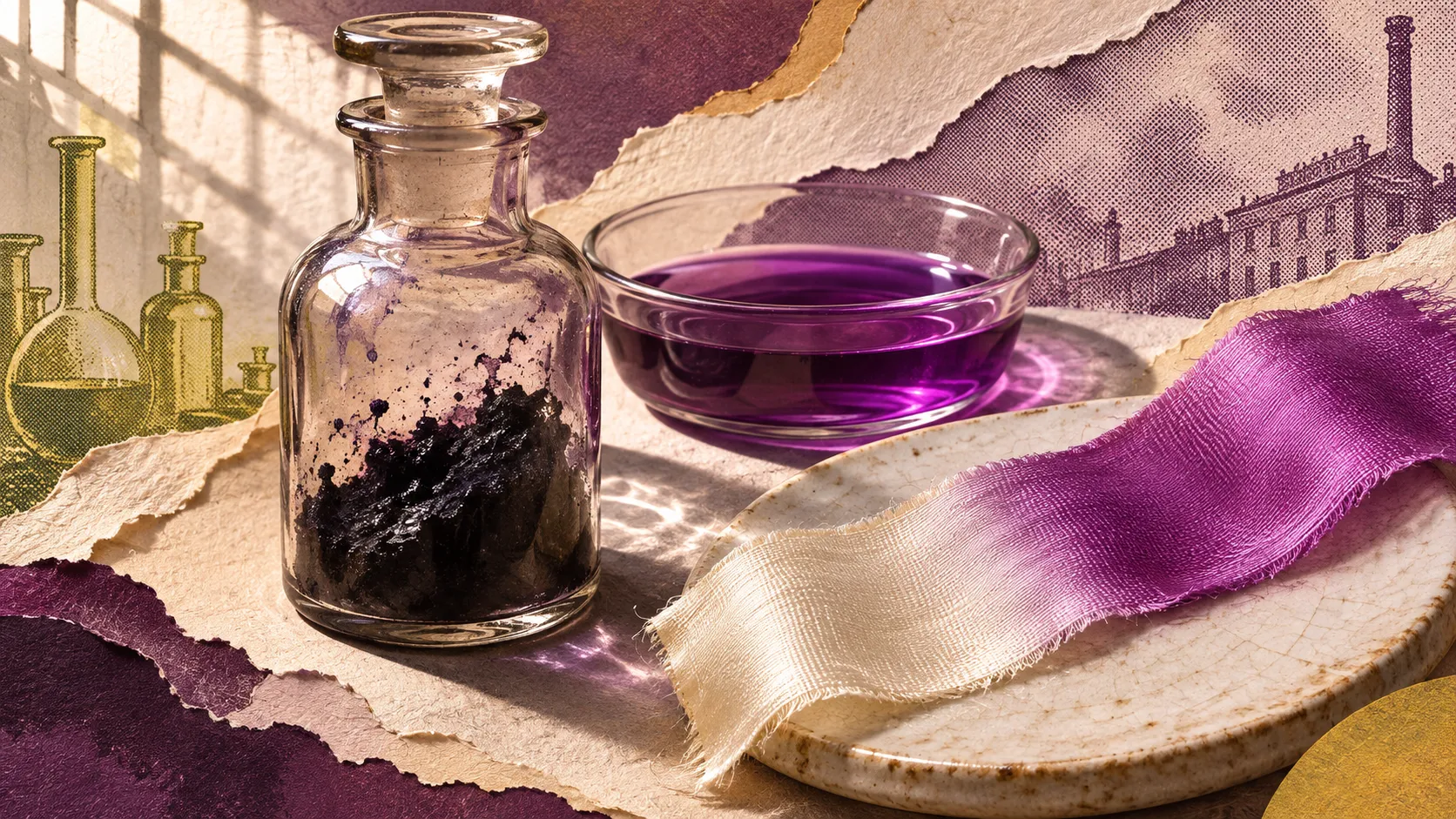
It is a small rectangle of purple fabric, preserved as a historical specimen rather than part of a garment. The Smithsonian's National Museum of American History holds a sample associated with William Henry Perkin, the English chemist whose unexpected discovery helped transform textile manufacturing in the nineteenth century.
There is nothing particularly dramatic about the object.
No elaborate embroidery. No spectacular dress. Just a piece of silk whose colour has lasted long enough to become evidence.
Yet it represents an unusual answer to a scientific question.
In 1856, Perkin was trying to manufacture quinine, a substance used to treat malaria. His experiments did not produce the medicine. What emerged instead was a dye that could make silk a striking purple.
The discovery would become known as *mauveine*, or Perkin's mauve. It helped establish the commercial manufacture of synthetic organic dyes and contributed to the growth of a new chemical industry.
The standard version of the story is charming: an eighteen-year-old made a mistake, found a beautiful colour and became successful.
That version leaves out most of the work.
A coloured substance is not necessarily a useful dye. A useful dye is not necessarily something a factory can manufacture. A factory can produce an excellent dye that nobody wants to buy.
Perkin had to get past all three problems.
And there was a fourth complication, discovered much later: chemists would spend more than a century trying to establish exactly what his famous purple substance contained.
The Medicine That Wouldn't Appear
In the middle of the nineteenth century, quinine was a valuable medicine.
Obtained from cinchona bark, it had an important role in treating malaria. Supply could be expensive and uncertain, particularly as demand grew in regions where the disease posed a serious threat.
The possibility of making quinine artificially was therefore an attractive challenge.
William Henry Perkin was studying at London's Royal College of Chemistry, where he worked under the German chemist August Wilhelm von Hofmann.
Perkin was young, but not a beginner. He had entered the college at fifteen and was already engaged in research. At seventeen he became Hofmann's assistant. He had also established a modest laboratory at home, where he could continue experimenting outside his formal duties.
The work was taking place at a period when organic chemistry was developing rapidly but lacked much of the structural knowledge that later chemists would take for granted.
Researchers could identify elements and determine something about the composition of substances. Understanding the precise arrangement of atoms within complicated organic molecules was a different matter.
Today, quinine's intricate molecular structure helps explain why the youthful plan to manufacture it through relatively simple reactions was unlikely to succeed.
Perkin did not have that hindsight.
During the Easter vacation of 1856, he continued investigating possible reactions. One unsuccessful attempt involved an organic compound known as allyltoluidine.
He then tried a related approach using aniline, a chemical associated with coal-tar processing.
The reaction produced an unpromising dark material.
There are many reasons a chemist might be disappointed by such a result. A black residue is not an encouraging answer when the intended product is a valuable pharmaceutical substance.
But a failed synthesis is not necessarily an empty experiment.
The material may contain products that were never expected. It may reveal a property of the reaction, suggest another process or create a new question.
Perkin examined the dark product further.
When treated with alcohol, it yielded a purple solution.
The colour was interesting. The next observation was much more important.
It coloured silk.
A Stain Is Not Yet an Industry
Anybody who has spilled something on a favourite shirt knows that producing a coloured mark on fabric is not particularly difficult.
Making a commercially useful dye is another matter.
The colour must attach to the textile in a way that survives ordinary handling. It should remain reasonably stable when the fabric is washed or exposed to light. It must be possible to repeat the process without producing wildly different results every time.
A substance that creates a beautiful stain but disappears in the first wash is an interesting inconvenience, not necessarily a product.
Perkin's purple behaved promisingly on silk.
The material took up the colour, and early tests indicated useful resistance to washing and light compared with many existing alternatives.
He did not immediately know the detailed molecular structures responsible for the effect. Indeed, nineteenth-century organic chemistry did not yet possess all the concepts needed to describe them fully.
But the behaviour of the dyed fabric could be observed.
That was enough to establish a practical problem worth solving.
Could the purple be produced reliably?
Could other textile workers apply it?
Could a quantity suitable for manufacturing be made without depending on a single fortunate laboratory accident?
These questions turned the discovery into a project.
Perkin's younger age is often emphasized because the result was so unusual. But the story becomes more impressive when one remembers that he did not merely find the colour.
He recognized that the colour might have a use, then pursued the means of making it useful.
There is also a historical qualification worth making.
Perkin did not create the first coloured substance ever obtained through chemical synthesis. Chemists had produced other artificial colorants before 1856, although those earlier discoveries had not established a comparable commercial synthetic-dye industry.
Mauveine is more precisely celebrated as the first commercially successful synthetic organic dye.
That narrower description is not a reduction of its importance.
It identifies the achievement.
A laboratory substance crossed the difficult boundary into manufacture, distribution and repeated everyday use.
The breakthrough was not simply that purple appeared.
It was that purple could be ordered.
A Colour With Expensive Ancestors
Purple already had a long history before Perkin was born.
In the ancient Mediterranean world, certain purple dyes obtained from marine molluscs were famously laborious to produce. The resulting colour became associated with prestige and political authority.
Other societies obtained purple shades through different sources and methods, including combinations of plant-based dyes.
It would be misleading to suggest that nobody could wear purple before 1856, or that all purple garments required exceptionally expensive marine dye.
The history of colour is much more varied.
But the textile industry still faced practical limits.
Natural dyestuffs depended on agricultural products, insects, minerals and other materials whose availability, processing and results could vary. Some colours demanded complicated procedures or large quantities of raw materials. Different fibres required different treatments.
A reliable manufactured dye offered an appealing alternative.
The manufacturing context mattered just as much as the fashionable result.
Perkin's work took place in a country with a large textile industry, established commercial networks and growing industrial chemical production.
There was a market for new colours, provided textile firms could use them economically and confidently.
The material from which the new dye was made carried its own industrial history.
Coal gas was widely used for lighting. Its production generated coal tar, a dark, complicated by-product that presented manufacturers with problems of disposal and processing.
Chemists were learning to isolate valuable organic compounds from coal-tar-derived materials.
Aniline was one of the substances involved in this developing chemistry.
It was not necessary to imagine that a jar of raw coal tar could simply be poured over a silk dress and produce a fashionable shade. Chemical processing, purification and controlled reactions separated the industrial residue from the finished dye.
The transformation was far more demanding.
Yet the connection was remarkable.
A material associated with the unpleasant side of gas production had become part of the route to a colour that people might pay to wear.
That inversion gave the new dye an economic advantage that stretched beyond its appearance.
Perkin was exploring chemistry capable of converting industrial feedstocks into desirable manufactured goods.
For a chemist accustomed to thinking in terms of substances and reactions, the next challenge was to learn what a textile manufacturer actually needed.
The Factory Is a Different Laboratory
On 26 August 1856, Perkin obtained a British patent for his colouring process.
He was eighteen.
The patent was a beginning, not a guarantee that customers would appear.
Large-scale chemical manufacturing involved equipment, premises, raw materials and processes that were substantially different from those of a home laboratory.
The reactions had to be carried out in larger quantities. Ingredients had to be obtained consistently. Products needed to reach textile businesses in a usable form.
Perkin had little experience of industrial manufacture.
He also had to persuade people already familiar with natural dyes that his new material was worth trying.
He received practical encouragement from textile specialists, including members of the Pullar family involved in Scottish dyeing businesses.
His family supported the commercial venture as well.
Perkin's father invested in the construction of a factory at Greenford Green, west of London, close to the Grand Junction Canal, now part of the Grand Union Canal system.
The location was connected to the practical movement of materials, not simply to the romance of placing an inventor beside a waterway.
Construction began in 1857. By the end of that year, Perkin and Sons was supplying mauve dye to silk dyers.
The new enterprise had made it from the experimental bench to commercial manufacture in a remarkably short period.
Yet another difficulty remained.
The purple dye worked well with silk, but cotton was less cooperative.
This mattered because the textile market was not composed entirely of silk garments purchased by fashionable customers.
Cotton was a major industrial fibre. A colour that worked on silk but failed to attach adequately to cotton had a substantial limitation.
Perkin developed a method using tannic acid to help fix the dye to cotton.
This was not the glamorous part of the invention. Nobody was likely to celebrate a tannic-acid treatment in a fashionable drawing room.
But without practical dyeing methods, a new colour could remain a chemical curiosity.
A textile manufacturer needed instructions that could be followed, results that could be repeated and fabric that customers would accept.
The product had to work on the material people wanted to colour.
The factory had to produce it.
The dye houses had to apply it.
Only then could the fashion business do its part.
The Fashion Business Notices
Fashion is an unreliable partner for an industrial chemist.
It can create tremendous demand for a colour and then abruptly decide that something else looks better.
Perkin's new dye benefited from the first part of that arrangement.
By the late 1850s, mauve became fashionable in France and Britain. The colour was promoted through the appearance and preferences of influential figures, including Empress Eugénie of France and Queen Victoria.
The Science Museum's account records Victoria wearing mauve to her eldest daughter's wedding in January 1858.
Royal endorsement could make a colour highly desirable.
That did not mean the royal wardrobe alone created the market. Textile workers, commercial distributors, dressmakers and manufacturers all helped turn the pigment into fabric and garments that people could buy.
The fashion was also capable of encouraging demand well beyond the immediate circle of royalty.
For clothing manufacturers and consumers, the key attraction was not an interesting chemical reaction.
It was the result.
A vivid new shade, available through a manufacturing process that could be repeated and expanded.
Perkin originally marketed the colour under names including *aniline purple* and *Tyrian purple*. The association with ancient prestige was commercially useful, but the eventual name *mauve* came from the French word for the mallow flower.
The dye became known as mauveine.
There is a satisfying absurdity in this progression.
A teenager fails to produce a malaria treatment. A dark residue yields a bright colour. The colour finds its way into silk. The silk becomes fashionable. A laboratory mistake acquires a name suitable for polite conversation in Paris and London.
The whole sequence seems improbable only when told backward.
At each stage, somebody recognized a practical opportunity.
Perkin noticed an unusual property. Textile specialists tested whether it could be used. His family helped finance manufacturing. Dye houses applied it. Consumers decided they liked the shade.
The chemistry did not dictate the fashion.
It created the possibility of an industrial supply, and the fashion made that supply commercially valuable.
There is also a limit to the familiar story of a sudden purple takeover.
Mauveine's peak popularity did not last forever. Other synthetic dyes emerged, and fashions changed.
By the later 1860s, the initial excitement surrounding the original mauve had diminished.
A short-lived colour craze, however, could leave a much longer-lived industrial consequence.
The manufacturers had learned that synthetic organic dyes could be profitable.
They were not obliged to keep producing only purple.
The Business That Outgrew Its Colour
Perkin's success attracted attention from other chemists and manufacturers.
The wider field of synthetic colour chemistry developed rapidly. New compounds offered different shades and properties, and chemical firms competed to produce them.
The industry was not the achievement of one chemist working alone.
It drew on scientific education, laboratory research, industrial engineering, textile expertise and investment. Competition encouraged new methods and new products.
Perkin himself continued researching colour chemistry.
His later work included the manufacture of other synthetic dyes and important investigations related to alizarin, the red colouring substance traditionally associated with madder.
Synthetic alizarin became another significant example of how organic chemistry could change the textile industry's dependence on natural sources.
By 1874, Perkin had sold his dye works and retired from industrial manufacturing, although he continued chemical research.
He was only thirty-six.
The business he helped establish belonged to a rapidly changing field. Other manufacturers were developing new processes and colours, and leadership in the synthetic-dye industry would increasingly involve major continental European chemical firms.
The larger story extended beyond clothing.
The expertise, feedstocks, industrial equipment and research practices developed for synthetic dyes contributed to the growth of organic chemical manufacturing more generally.
Related industrial chemistry later became important in pharmaceuticals and many other fields.
That relationship should not be exaggerated into a claim that mauveine directly invented modern medicines.
Perkin's original attempt to synthesize quinine failed.
The discovery of a commercial dye did not magically solve the medical problem he had been investigating.
Its broader significance was that the synthetic manufacture of complex organic products became a business worth investing in.
Companies could employ chemists to discover and improve substances, engineers to manufacture them and commercial specialists to find useful applications.
The idea that systematic chemical research could support large-scale industry became increasingly powerful.
Perkin's purple helped demonstrate that model.
The colour itself gradually ceased to be the most important part of the business story.
A Mystery Still Inside the Dye
There is a final complication to the invention, and it is perhaps the most scientifically interesting.
What exactly was mauveine?
A modern reader may imagine a single molecular compound with one definitive structure, neatly identified and reproduced in every batch.
The original chemistry was less tidy.
Perkin's starting materials came from industrial chemical processing at a time when purity and detailed molecular analysis were very different from modern standards.
The coloured material produced by his reactions was complex.
The precise chemical composition remained a subject of investigation long after the first mauve-dyed garments were fashionable.
In 1994, researchers Otto Meth-Cohn and Mandy Smith examined historical samples and showed that an established account of mauveine's molecular structure was incorrect.
Their analysis identified a mixture dominated by related colouring compounds.
Later studies investigated more surviving specimens.
A 2008 study of fourteen historical samples found a considerably more complicated chemical mixture, including at least thirteen closely related molecular variants.
The familiar name *mauveine* therefore describes a historical dye material whose composition is more complex than the simple picture of one perfectly isolated molecule.
This is an unusual afterlife for a fashion trend.
The garments have become historical objects. The factory has long since ceased its original operations. The young chemist became a figure in the history of science.
Yet the substance still offers questions for modern researchers.
Museum samples allow chemists to investigate the materials used in nineteenth-century manufacturing. Their analyses can distinguish recipes, identify components and help establish the history of objects whose labels alone cannot tell the entire story.
A piece of old purple fabric is therefore capable of holding more than visual evidence.
Its fibres may contain traces of the chemistry that produced its colour.
The fabric is a historical document written in molecules.
It can tell us something about what manufacturers actually made, rather than merely what they believed they had made.
And those two things are not always identical.
For Perkin, the inability to explain every component did not prevent the dye from functioning.
He could establish that the coloured material was useful, improve its production and market it successfully long before later generations could fully characterize its composition.
Modern scientific analysis gives that achievement a second dimension.
The teenage chemist was working at the boundary of what his century knew.
The surviving samples still help reveal how much lay beyond it.
The Colour That Stayed Behind
Return to the purple silk in the museum.
Its survival is striking, but it should not be mistaken for proof that every early synthetic colour remained bright indefinitely. Textile dyes vary in their resistance to light, washing and age. Surviving garments may have been protected by storage conditions, while others faded or disappeared altogether.
The sample is valuable partly because so much ordinary fabric was never intended to survive.
A dress might be altered, worn out, passed on or discarded. Manufacturers could change their products, and fashionable colours could become unfashionable almost overnight.
The industrial changes triggered by successful synthetic dyes were more durable.
Mauveine's commercial rise helped establish an expanding field of chemical manufacture. Its early popularity demonstrated the market for laboratory-produced colours. Its complicated composition later gave scientists an opportunity to reconstruct historical chemistry using surviving objects.
The failed quinine experiment remains part of the story, but it no longer seems like an adequate summary.
The original medical objective failed. The purple substance appeared unexpectedly. Recognizing its potential required attention. Manufacturing it required investment and technical skill. Selling it required cooperation with an industry whose customers were interested in clothes, not experimental chemistry.
Even the chemical identity of the material proved less straightforward than its popular name suggested.
In a museum case, all that history can fit inside a rectangle of silk.
It is still purple.
The medicine never appeared.