Articles / LORQAI
How to Write a Personalized Birthday Song
Learn how to write a heartfelt birthday song in seven simple steps, with a fill-in worksheet, an original example verse and chorus, and practical ways to record it.
Introduction
A birthday message can be lovely and still sound like something you could send to almost anyone. A personalized birthday song does something different: it remembers one particular person. It can mention the joke only they would recognize, the ordinary morning you still think about, or the habit that makes everyone in the room smile.
You do not need to read music, own a microphone, or sound like a professional singer to begin. You need a real memory, a message worth saying, and a few lines that are comfortable to sing. This guide takes you from a blank page to a short, personal song you can record or share as a gift.
The quick version: make a birthday song in seven steps
- Choose one person and one feeling you want to leave them with.
- Write down three specific memories or things you admire about them.
- Turn the strongest idea into a short, repeatable chorus.
- Build one verse around a real moment, not a list of compliments.
- Pick a simple musical mood and speak the words to find their rhythm.
- Record a rough version, with your own voice or an appropriately licensed tool.
- Listen back, check the personal details, and deliver it in a way that feels thoughtful.
The quick version: make a birthday song in seven steps
The most useful shortcut is to write the chorus before the entire song. Once you know what you are trying to say, the verses have a clear job: lead the listener toward that message.
Step 1. Decide what the song should make them feel
Start with one sentence: "When they hear this, I hope they feel ________."
Maybe the answer is appreciated, understood, hopeful, celebrated, or simply amused. A song for a close friend who loves silly jokes should not sound identical to a quiet tribute to a parent. Neither approach is more sincere. What matters is whether it fits the recipient.
Ask yourself three questions: What is our relationship? What kind of birthday would they enjoy? Would they prefer a big singalong or a private voice note?
If you are writing for a child, simple images, playful repetition, and a chorus they can join in may work well. For an adult, one vivid memory often says more than a series of grand declarations. Be careful with private stories: a joke that is funny between two people may be uncomfortable when played at a public party.
Step 2. Collect details that belong to that person
Open a note and write three categories: a moment, a habit, and a wish.
A moment might be "the rainy road trip when we took the wrong exit." A habit might be "you always bring an extra chair for someone who arrives late." A wish might be "more unplanned mornings and places you have never seen."
Notice how those details reveal a person. "You are kind and amazing" is pleasant but generic. "You remember how everyone takes their coffee" lets a listener discover kindness for themselves.
Try a two-minute memory exercise: write five objects, places, or sounds you associate with the person. Then circle one that carries a genuine feeling. A steaming kitchen, the squeak of a bicycle, and a familiar phrase can be more useful than a complicated rhyme.
Do not force all the memories into a single song. One strong detail is enough to make a short lyric feel unmistakably personal.
Step 3. Write the chorus first
A chorus is the part a listener can recognize when it returns. For a birthday song, it should contain the central message in plain language. Think of it as a sentence the person would be happy to hear twice.
Here is a practical formula: Who this is for + what makes them special + what you wish for them now.
For example, a personalized idea could be: "For [Name], who makes ordinary days feel like adventures, here is to another year of unexpected turns."
That is a message, not yet a lyric. Shorten it, say it aloud, and remove anything that feels awkward to sing. A name can appear in the first or final line, but do not squeeze a long name into a melody that cannot accommodate it. A nickname may work better if the recipient likes it.
A helpful chorus test: can you say the main idea in one breath? Can someone repeat at least one line after hearing it once? Does the chorus actually sound like this person's birthday, rather than a generic greeting?
Step 4. Write one verse like a tiny story
Your first verse should show something. It does not need to describe the person's entire life.
Consider a simple scene: You were late to a train, you both laughed, and the evening became one of your favorite memories. The verse can paint that scene; the chorus then explains what it means to you.
A beginner-friendly structure is Verse 1 → Chorus → Verse 2 → Chorus → Closing line. For a short birthday gift, one verse, two choruses, and a personal ending can be plenty.
Try four short lines in the first verse. Use everyday language. Avoid cramming a full paragraph into a single line simply to make the rhyme work. Read the words aloud and listen for where you naturally pause.
Rhyme is optional. An honest sentence with a natural rhythm can be stronger than a perfect rhyme that sounds unlike anything you would ever say.
A complete mini-example you can personalize
Below is a newly written illustrative lyric, not the words or melody of an existing birthday song. Replace the details with something true about your recipient. The example uses a friend who makes the best of unexpected plans.
Verse
We missed the last train out of town,
Found a little café and watched the rain come down.
You turned a wrong turn into somewhere new,
And I still love that about you.
Chorus
[Name], here's to the roads we've yet to find,
To open doors and a little peace of mind.
May this next year feel bright and true,
And bring some good surprises home to you.
Closing line
Happy birthday, [Name]. I'm glad we met.
This example is a starting point. It will become more personal if you replace the missed train with your own memory and revise every line until it sounds like something you would genuinely want to say.
Step 5. Choose a musical mood without overcomplicating it
Ask what should happen when the chorus arrives. Should it feel like a room full of people singing together, a quiet acoustic message, a bright pop celebration, or a gentle piano letter?
If you play an instrument, start with a comfortable pattern you already know. If you do not, clap a steady pulse and speak your lyrics over it. A simple repeating melody is easier to remember than a melody that changes direction every few words.
Do not insist on a complicated key or tempo. Sing the chorus at a comfortable pitch. If you cannot get through a line without running out of breath, shorten the line or adjust the phrasing. Make a quick voice memo and listen with fresh ears.
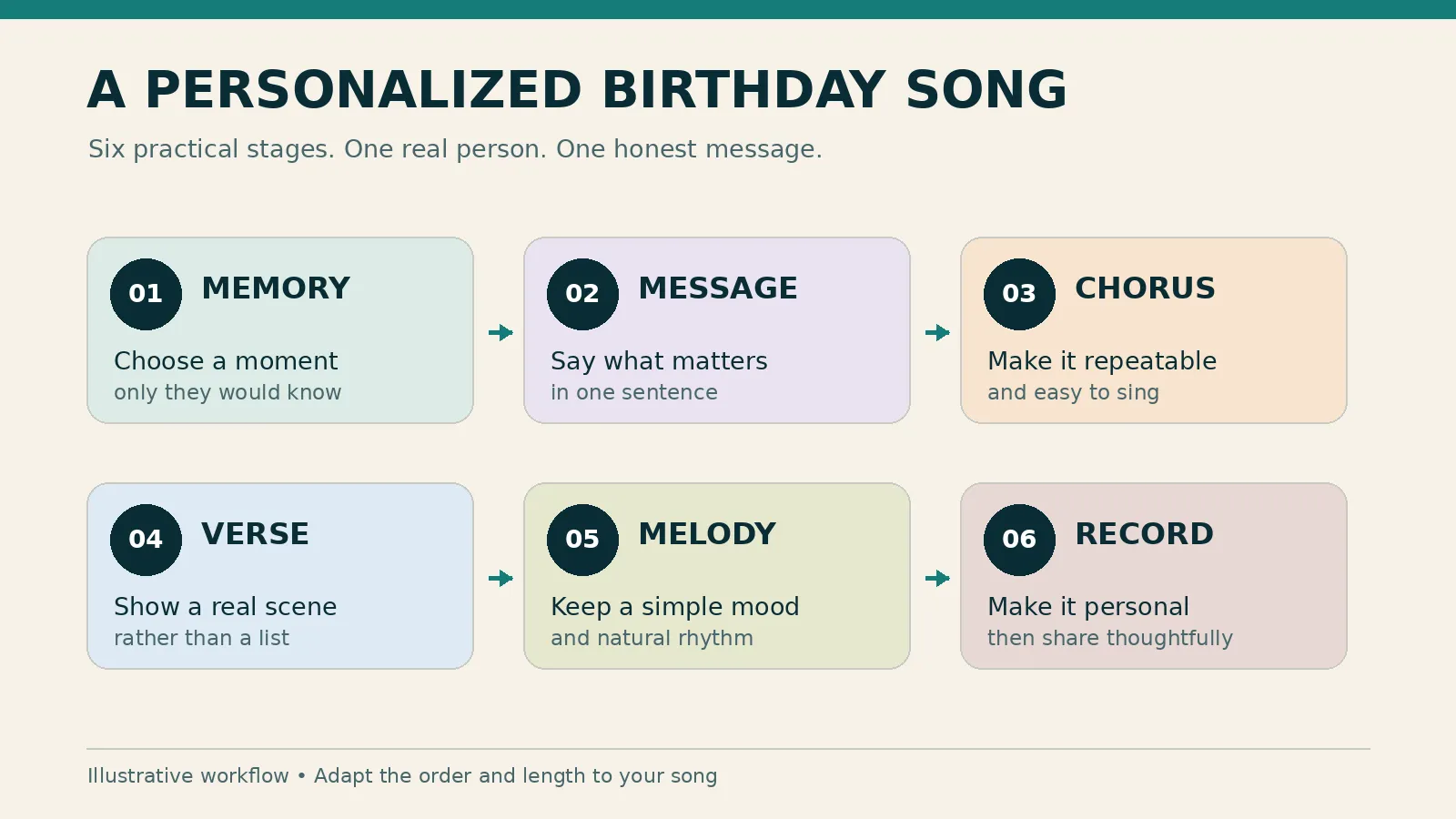
Step 5. Choose a musical mood without overcomplicating it
A useful test is to remove the backing music and speak the lyrics. If the words still communicate the birthday wish, your core message is doing its job.
Step 6. Make a recording you can actually share
You have several routes, and a polished studio track is not required.
Option A: Your own voice
Record yourself singing or speaking the lyric over a simple instrumental part you are allowed to use. Find a quiet room, move away from humming appliances, place the phone at a steady distance, and record two or three takes. A warm performance with a small imperfection can feel more intimate than an overly edited one.
On iPhone, Voice Memos can capture an idea and let you trim a recording. GarageBand offers more tools when you want to combine voice and instruments, then export a song file. You can choose a comparable recorder or music editor on another device.
Option B: Ask a musical friend
Give them the lyrics, the mood, an approximate length, and one example of how the chorus should feel. Explain which words matter most and invite them to suggest a melody. Agree in advance on how the recording may be shared, especially if you plan to upload it publicly.
Option C: Use an AI-assisted music tool
Some music-creation services let you supply your own lyrics and describe a musical style. This can be useful for trying an arrangement without playing an instrument. Keep the lyrics, the recipient's name, and private details under your control. Listen carefully: generated vocals can mispronounce names or change a phrase in ways you did not intend.
For example, a neutral style brief could read: "Warm mid-tempo acoustic-pop birthday song, intimate and sincere, light piano, gentle drums, clear lead vocal, memorable singable chorus, no crowd chant. Use the supplied original lyrics without adding names or new personal facts."
Check the service's current terms for downloads, sharing, and commercial uses before you distribute the result. Permission to use an audio output is not automatically the same thing as a copyright guarantee, and rules vary by tool, plan, and location.
Step 7. Edit for the person, not for perfection
Listen once without reading your draft. Does the message come through? Then make a final pass:
Step 7. Edit for the person, not for perfection
- Say the recipient's name out loud. Is the pronunciation correct?
- Remove details that are inaccurate, exaggerated, or too private for the intended audience.
- Shorten any line you stumble over when singing.
- Check that the chorus contains the birthday wish, not just descriptions of the person.
- Listen on a phone speaker, because that may be how the gift is first heard.
- Keep a clean copy of the lyrics and the recording.
Step 7. Edit for the person, not for perfection
Finally, deliver the song in a way that matches the recipient. A private audio note with a short personal message may be more meaningful than a public post. If you pair it with a photo slideshow, ask before sharing private pictures or intimate moments beyond the intended audience.
A fill-in-the-blanks birthday song worksheet
Use this quick worksheet before writing any lines:
A fill-in-the-blanks birthday song worksheet
- Recipient: [Name or preferred nickname]
- Relationship: [Friend, partner, parent, child, colleague]
- Main feeling: [Gratitude, joy, encouragement, affection, gentle humor]
- One shared moment: [A specific scene you both remember]
- One recognizable habit: [A small, true detail]
- One wish for the coming year: [Something kind and realistic]
- Mood: [Warm, playful, cinematic, acoustic, upbeat]
- Delivery: [Private recording, live performance, birthday video]
A fill-in-the-blanks birthday song worksheet
Then write four short lines for the scene, four for the central birthday message, and one closing line. If you get stuck, write a letter first and underline the sentence that matters most. That sentence can become your chorus.
1. Using every compliment at once
A long list of "amazing," "wonderful," and "perfect" tells us less about a person than a single true observation. Choose one memorable detail.
2. Forcing rhymes
A rhyme should support the thought, not decide it. If the lyric sounds unnatural when spoken, rewrite it before searching for another rhyme.
3. Making it too long
A birthday gift does not need three verses, a bridge, and a four-minute arrangement. Make the version that suits the occasion, even if it lasts only a minute.
4. Writing for the platform instead of the recipient
A catchy public singalong can be lovely, but not everyone wants their private memories posted online. Decide who is meant to hear the song before choosing what to include.
5. Forgetting the practical rights and privacy checks
A melody or backing track from another song may require permission. Buying a song or crediting its creator does not, by itself, grant the rights to publish a new recording that uses it. This is particularly important if you upload the finished gift to a social platform. Use original material or appropriately licensed music, and check the rules for any AI-generated audio as well.
Do I need to know music theory to write a birthday song?
No. You can write meaningful lyrics first, speak them aloud, and hum a simple melody. Music theory can help, but it is not a prerequisite for giving someone a personal song.
How long should a personalized birthday song be?
There is no required duration. A short verse, repeating chorus, and final personal line may be enough. Choose the length based on the listener and how the song will be delivered.
Can I write a birthday song without singing?
Yes. You can collaborate with a musician, read the lyrics as a spoken message, or try an appropriately licensed music-generation tool. The emotional specificity of the message matters more than whether the creator sings.
Can I use someone else's famous birthday song melody?
Do not assume that changing the lyrics makes a familiar copyrighted melody free to use. Some works may be in the public domain, and some uses may be licensed, but you need to check the actual work and intended use. An original melody avoids many complications.
Will an AI music tool give me the exact song I imagined?
Not necessarily. Generated arrangements, pronunciation, vocal tone, and melody can vary. Treat drafts as experiments and review the output carefully before sharing.
Should I include the person's age and full name?
Only if they would enjoy that. Names can be difficult to sing, ages can make a song feel dated, and private details may not be suitable for public sharing. A preferred nickname or a meaningful scene can feel more personal.
One last thing: the best birthday song sounds like you
You do not have to compose a masterpiece. The person listening is unlikely to judge your chord changes or recording equipment. They are more likely to notice that you remembered the way they laugh, the morning you got lost together, or the small thing they do when everyone else is tired.
Begin with one true detail, put it into a simple lyric, and build a chorus that says what you hope this year brings them. The song becomes special because it could only have been written for that person.
Listen & explore
- Berklee Online — How to Write Song Lyrics (external platform)
- Berklee Online — How to Write Songs With Killer Hooks (external platform)
- Apple Support — Make a recording in Voice Memos on iPhone (external platform)
- Apple Support — Share songs with GarageBand for iPhone (external platform)
- Suno Help — Can I use my own lyrics? (external platform)
- Suno Help — What rights do I have with a paid subscription? (external platform)
- YouTube Help — Common copyright myths (external platform)