Articles / LORQAI
Nobody Has Heard the Whole Piece
A concert that began in 2001, a note added in 2026, and the extraordinary task of keeping one piece of music alive until 2640.
An organ concert began in Germany in 2001 and is scheduled to end in 2640. Its extraordinary duration has turned a musical performance into a responsibility shared across generations.
One Note Was Added
On August 5, 2026, a church in Germany hosted a musical event that would ordinarily have escaped notice.
One note was added.
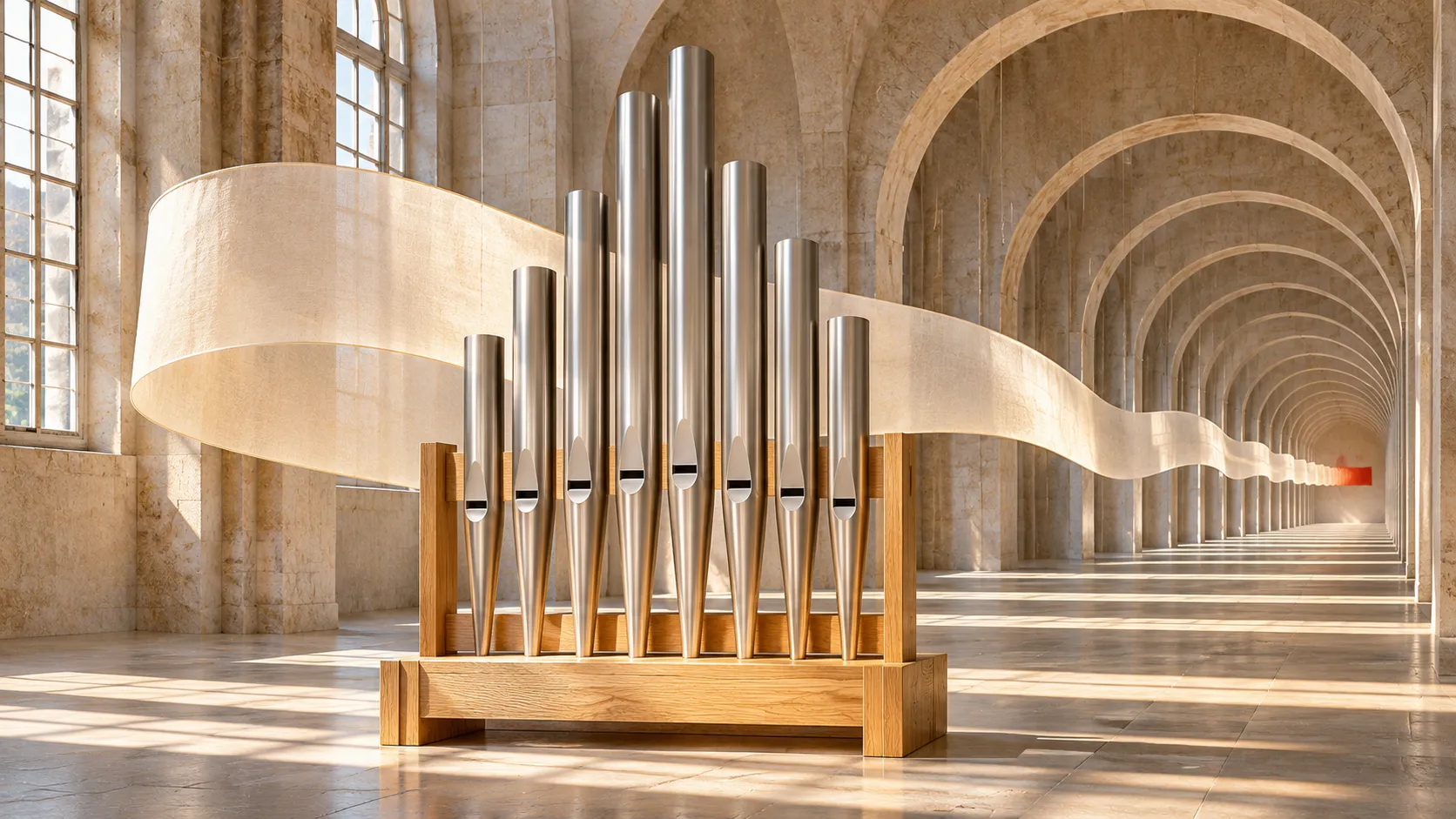
There was no new movement, no dramatic finale, no orchestra suddenly entering at full volume. An organ that had been sustaining seven pitches began sustaining eight.
People travelled to Halberstadt to witness the change. For the musicians and volunteers responsible for the performance, it was the seventeenth such occasion since the project began twenty-five years earlier.
The previous change had occurred in February 2024. The next is scheduled for October 2027.
This is not an unusually slow rehearsal. Nobody has forgotten to turn the page.
The organ is performing John Cage's *ORGAN²/ASLSP*, in an interpretation scheduled to last 639 years. It began on September 5, 2001. If the plan succeeds, the final day will be September 4, 2640.
The audience attending in 2026 will not be there for the ending. Neither will the people maintaining the instrument, the volunteers raising funds, or anyone currently deciding how the performance should continue.
The concert has already outlived its composer. It is expected to outlive countless generations of its performers.
And the most extraordinary thing is that John Cage never instructed anybody to play it for 639 years.
That decision came later.
How Slow Is Possible?
John Cage was not especially interested in making music behave the way an audience expected.
The American experimental composer worked with silence, chance, unconventional sounds and unusual methods of deciding what a performance should contain. His compositions often challenged the assumption that music existed primarily to deliver the composer's intended emotional message.
In 1985, Cage wrote a piano work called *ASLSP*, an abbreviation usually explained as *As SLow aS Possible*. Two years later, he adapted the work for organ at the request of organist Gerd Zacher.
The title contains an apparently simple instruction.
Play as slowly as possible.
But musicians are accustomed to instructions with useful limits. A score may specify a tempo, a duration, a relationship between beats or a particular character of movement.
*As slowly as possible* provides no number.
For a pianist, there is a practical problem with stretching a note indefinitely. The hammer strikes a string, the string vibrates and the sound gradually decays. Pressing the key for an hour does not keep the initial sound alive for an hour.
An organ behaves differently.
A pipe can continue sounding while air is supplied and the relevant key or mechanism remains engaged. Sustain does not depend on a vibrating string slowly losing energy after a single strike.
Under suitable conditions, a note can last much longer.
This raises a problem that is more philosophical than technical. An organ can continue producing sound for a substantial period, but what duration would make the performance *as slow as possible*?
An hour? A day? The working life of an organist?
Why stop there?
A musical instruction that seems clear when printed on a page becomes less definite when someone decides to follow it without the ordinary limits of a concert.
In 1987, Zacher performed the organ adaptation in a conventional concert-length interpretation.
The work did not inherently require centuries.
Cage died in 1992. It was after his death that others pursued an interpretation on a very different timescale.
They were not carrying out a hidden 639-year plan left in his instructions.
They were choosing one possible answer to the question his music had created.
The Arithmetic of a Very Long Concert
The answer emerged in a German city with a significant place in organ history.
Halberstadt has a connection to an organ installed in its cathedral in 1361, historically notable for its keyboard design. The project organizers looked back to this event while considering what an extraordinarily slow performance might mean.
At the turn of the millennium, the interval between 1361 and the year 2000 was 639 years.
The organizers chose to project that length of time into the future.
Starting in 2001, a performance lasting 639 years would end in 2640.
The calculation linked a historic instrument to an experiment in contemporary music. It was not derived from a universal mathematical rule about how long an organ note can last.
Nor is 639 a sacred number hidden inside Cage's composition.
It is a choice made by the people creating this particular interpretation.
That distinction matters because the project is often described as if Cage composed a work lasting 639 years. He wrote the music; the Halberstadt organizers established the extraordinary performance duration.
The difference is more than a footnote.
It raises questions about what performers are allowed to do with a score, how much freedom an instruction permits and whether a composition changes when its timescale changes so radically that ordinary listening becomes impossible.
A performance lasting half an hour can be heard as a continuous experience. A listener can remember its opening, follow its development and relate the ending to what came before.
A 639-year performance removes that possibility.
A visitor can hear a portion. A recording can preserve another portion. A schedule can describe the relationship between them.
But a single human listener cannot experience the entire sequence as one continuous event.
To understand the whole, people must trust records of what happened before they arrived and plans for what will happen after they are gone.
In that respect, the duration does not merely make the piece longer.
It changes what it means to attend.
The Concert Began Without a Note
The opening of the Halberstadt performance took place on September 5, 2001, which would have been Cage's eighty-ninth birthday.
It began with a rest.
No pitched organ note was initially sounded.
For almost seventeen months, the performance continued in this opening state. The equipment was operating, but the musical score required silence before the first pitches.
The first audible chord arrived on February 5, 2003.
Imagine explaining this to someone accustomed to a concert beginning late.
The performance has started, you tell them.
Has the musician arrived?
Yes.
Has the music started?
Yes.
Then why can't I hear it?
Because the opening passage is a rest.
The absurdity is not an accident. Silence has a long and complicated place in Cage's work. He questioned the idea that music consists solely of deliberate sounds produced by instruments, leaving everything else outside the composition.
In Halberstadt, the opening rest became something a visitor could encounter as an event lasting longer than many concert seasons.
The church was not literally free of all sound during that period. A blower, footsteps, voices, weather and the surrounding world did not cease to exist.
Rather, the performance contained no pitched organ tones at that stage.
This difference between musical silence and absolute physical silence is essential.
An audience can sit through thirty seconds of silence and remember how the pause felt. It can compare that moment with the sound that follows.
But seventeen months?
The people present at the first audible chord in 2003 were not necessarily the same people who had marked the beginning in 2001. Their experiences could only be connected through the shared knowledge that these were different moments in the same scheduled work.
The music was already asking its audience to rely on something beyond memory.
By the time a single note was heard, the concert had been taking place for nearly a year and a half.
An Instrument That Has to Be Looked After
The venue is St. Burchardi, a former church in Halberstadt.
It is not the setting one would naturally choose for a conventional organ recital lasting centuries. The instrument used for the project is comparatively small, and its sound is sustained by an electrically powered air supply.
Individual pipes are added or removed at scheduled changes.
There is no organist required to hold down eight keys continuously for the next year. That would be an unreasonable employment contract, even by the standards of experimental music.
Instead, the system maintains the required sound until a scheduled intervention changes it.
The mechanism makes long durations physically possible. But it does not make the entire enterprise self-sustaining.
Air must keep flowing. Equipment needs maintenance. Pipes must be built, installed, checked and cared for. The building itself requires attention.
The organ is not independent of its surroundings.
As the sound fills the church, the architecture shapes how visitors hear it. Reflections from walls, the distance between the listener and the pipes, and the position of a person within the room affect the experience.
Two visitors may stand in different places and perceive different balances between sustained pitches.
The sound may appear almost motionless, yet the experience of hearing it is not necessarily static.
Move across the room and the acoustic relationships change.
A listener arriving at midday encounters a different physical situation from someone who enters when the church is empty and quiet. Even if the organ's pitches have remained unchanged for months, the rest of the audible environment has not.
This is an important part of the performance's identity.
It is tempting to imagine the music as an enormous recording left playing very slowly. But a recording can be copied, paused, restarted and replayed under controlled conditions.
The Halberstadt project is tied to a particular instrument, a particular building and a particular history of decisions.
The physical performance continues whether visitors are present or not.
When the church closes for the evening, the concert does not necessarily stop.
The audience goes home.
The organ stays.
The Most Recent Change
On August 5, 2026, the project reached its seventeenth scheduled sound change.
The existing seven-note chord gained another pitch, played by an additional organ pipe.
Eight notes now sounded together.
A change of this kind would be difficult to distinguish from ordinary orchestral activity if it occurred during a busy passage of a symphony. A new instrument enters, the harmony thickens and the piece continues.
In Halberstadt, it became an event worthy of international reporting.
The difference was not the size of the musical gesture.
It was the amount of time surrounding it.
The previous change had taken place on February 5, 2024. The listeners in 2026 had waited two and a half years for a single additional pitch.
The next alteration is scheduled for October 5, 2027, when one of the currently sounding pipes is due to be removed.
There is a curious tension in this arrangement.
The change is both extremely small and unusually significant. The addition of a pipe may alter the harmony only slightly, yet it marks another completed portion of a process that nobody alive is likely to witness in full.
These events also demonstrate that the work is not a 639-year single note.
It includes different pitches, combinations of notes and rests. The composition unfolds, but at a speed that prevents an ordinary human audience from following the entire development through personal recollection.
The sound before a change belongs to one period of the performance. The sound after it belongs to another.
For the audience, the date becomes almost as important as the sound.
A listener can say they attended the 2026 change, but not that they heard the performance in its entirety.
That may be the only sensible form of concert attendance available here.
People attend moments.
The piece continues between them.
Who Is Actually Performing?
The ordinary answer to the question *Who is performing?* would involve naming a musician.
In Halberstadt, the answer requires a rather longer explanation.
The organ supplies the sound. A blower provides the air. Builders and technicians maintain the instrument. Musicians and project organizers determine and enact changes. Volunteers welcome visitors, arrange events and help keep the institution functioning.
Donors contribute money.
None of these roles can be treated as incidental if the performance is to continue for centuries.
The project's official organization describes how its first twenty-five years have depended on private support, sponsorship and volunteer work. The church contains plaques commemorating sponsorships connected to the long performance.
There is even a scheme offering tickets associated with the final event in 2640.
One can admire the audacity of selling a ticket for a concert ending more than six centuries after it began.
The practical difficulty is obvious. The person purchasing such a ticket now will not use it personally in the year 2640. Its value depends on the ticket, the institution and the planned event surviving through future generations.
The ticket is partly a way of supporting the project and partly a symbolic claim on an extraordinarily distant future.
This is a strange arrangement for a concert, but not for a cathedral, a library or an institution whose work is designed to outlast any one employee.
Human beings have long constructed things that take longer than one lifetime to complete.
Large buildings can be started by one generation and finished by another. Scientific observations may be maintained across decades. Archives preserve material for readers who have not yet been born.
The difference here is that the unfinished thing is a musical performance.
It is not simply an object to be preserved after completion.
It must keep happening.
A future caretaker will inherit the consequences of decisions made in 2001 and 2026, even if those decisions have become remote historical facts.
To continue the work, the caretaker will need more than enthusiasm for John Cage.
They will need a functioning institution, records of the schedule, a maintained instrument and people willing to undertake the task.
At some point, every part of the project that currently seems familiar will require replacement, renewal or reinterpretation.
This does not automatically invalidate the performance.
It reveals what the experiment demands.
A score can survive in a library without anyone playing it. The Halberstadt interpretation asks that the music survive as an ongoing activity.
That is much harder.
What Happens After the People Who Made the Plan Are Gone?
The first large section of the Halberstadt performance is currently scheduled to conclude in 2072.
That is a relatively near date compared with 2640, although it is already far enough away that the people making decisions then will have lived much of their lives in a different musical and technological world.
The project's own documentation acknowledges that questions about future interpretation remain open.
How should the remaining parts of the score be arranged? What happens if an interruption occurs? Who decides whether a change was made at precisely the right time? Can an unexpected pause be accommodated without destroying the continuity of the performance?
Such questions are not signs that the project has been carelessly planned.
They arise because an artistic instruction has been extended beyond the ordinary conditions under which artists and musicians make decisions.
A performance that lasts centuries cannot be entirely administered by the people who started it.
Future participants will encounter circumstances that the original organizers could not reasonably have anticipated.
The building might need major repairs. The equipment may be replaced or redesigned. The city around the church will continue changing. Musical customs, funding arrangements and ideas about cultural preservation may alter beyond recognition.
Even the means by which listeners discover the project will evolve.
In 2001, smartphones were not the ordinary devices they became later. By 2640, today's most advanced technologies may seem as remote as medieval instruments do now.
The score will remain a document. Its interpretation will remain a responsibility.
That makes the project unusually vulnerable to human choices.
A concert that ends after an hour has little need to worry about whether someone will be available to perform the final passage six hundred years later.
This one does.
There is no guarantee that the Halberstadt performance will reach its scheduled conclusion. Wars, economic problems, physical deterioration or a simple loss of public interest could interrupt it.
The organizers know this.
A centuries-long concert is therefore also a wager that people who have not been born will decide that the work is worth continuing.
The Part of the Music You Can Never Hear
There are recordings of earlier stages of the performance. The project's website documents previous sound changes and supplies information about the scheduled sequence.
A future researcher could, in principle, compare surviving recordings from different centuries.
But that would not be the same experience as hearing the entire performance unfold.
A recording compresses the practical problem into an accessible archive. A listener can jump between periods and compare them without waiting years.
The actual Halberstadt performance refuses that convenience.
It unfolds in real time, on its own schedule.
There is a reason an ordinary concert takes place within a span the audience can inhabit. Music creates relationships between events. We hear one phrase in the context of another, recognize returning patterns and notice changes against what we remember.
When a composition is stretched across centuries, the listener cannot retain the whole structure as a continuous lived experience.
The relationships still exist in the score and in the records of the performance.
They simply become too large for one person's memory.
What does it mean to listen to something you cannot finish?
One answer is that the visitor hears a fragment, and the fragment is enough to constitute a genuine encounter with the work.
Another is that the total performance belongs to an institution rather than to a single listener.
These interpretations are not mutually exclusive.
Music has never belonged only to people who hear every note. Listeners arrive late, leave early, attend one movement or encounter recordings of works they will never hear performed live.
Halberstadt takes that familiar incompleteness to an extreme.
Here, incompleteness is unavoidable.
The audience knows from the beginning that the conclusion lies beyond any reasonable personal horizon.
Cage's score did not demand that interpretation. But it provided the unusual freedom from which the project emerged.
The result is a performance in which the question of duration has become inseparable from the question of listening.
September 4, 2640
The official plan gives the performance an ending.
September 4, 2640.
It is a wonderfully precise date for something whose future cannot possibly be guaranteed.
By then, the physical world surrounding St. Burchardi will have changed. The people who heard the first chord in 2003 will belong to a distant past. So will those who gathered in 2026 to hear one additional note.
If the project survives, the people present in 2640 may know its early history through recordings, written records and whatever forms of preservation exist by then.
They will not remember the beginning.
Yet they may be able to participate in the ending of the same artistic undertaking that began in 2001.
No one currently alive can know what that experience will be like.
The project requires people to act anyway.
For now, the organ continues sounding in Halberstadt. Its eight pitches are scheduled to remain until the next change in October 2027.
Visitors can come for a few minutes. They can listen, walk through the church and leave. The music will be almost exactly where they found it.
Their visit will be shorter than a note.
The concert will go on without them.