Articles / LORQAI
OUT OF ORDER, IN TUNE: When Life Doesn't Follow the Plan
An album story by LORQAI
A missed turn, a last peach, a late-night crossing, a train left behind. Nine different lives discover what happens when the plan changes.

Nine moments, one album
There are things nobody thinks to photograph while they are happening: the wet corner of a cardboard sign, a cup of coffee going cold, a single piece of fruit left in an almost empty house. Years later, those might be the details that survive. Not the speeches. Not the schedule. The details that happened while everybody was looking somewhere else.
We plan because we have to. Trains leave at certain hours. People need to be picked up. Work begins in the morning; celebrations end when the hall has to be locked. A plan is one of the ways we care for other people and for ourselves. It says: I will be there. I will remember. I will make enough time.
But a plan cannot tell us what a moment will ask of us when it finally arrives.
OUT OF ORDER, IN TUNE is built around nine such moments. The stories belong to different people, in different places, with no secret meeting that brings them all together. What connects them is smaller, and perhaps more familiar: something goes off schedule, and someone has to decide whether to put it back or listen to what is happening instead.
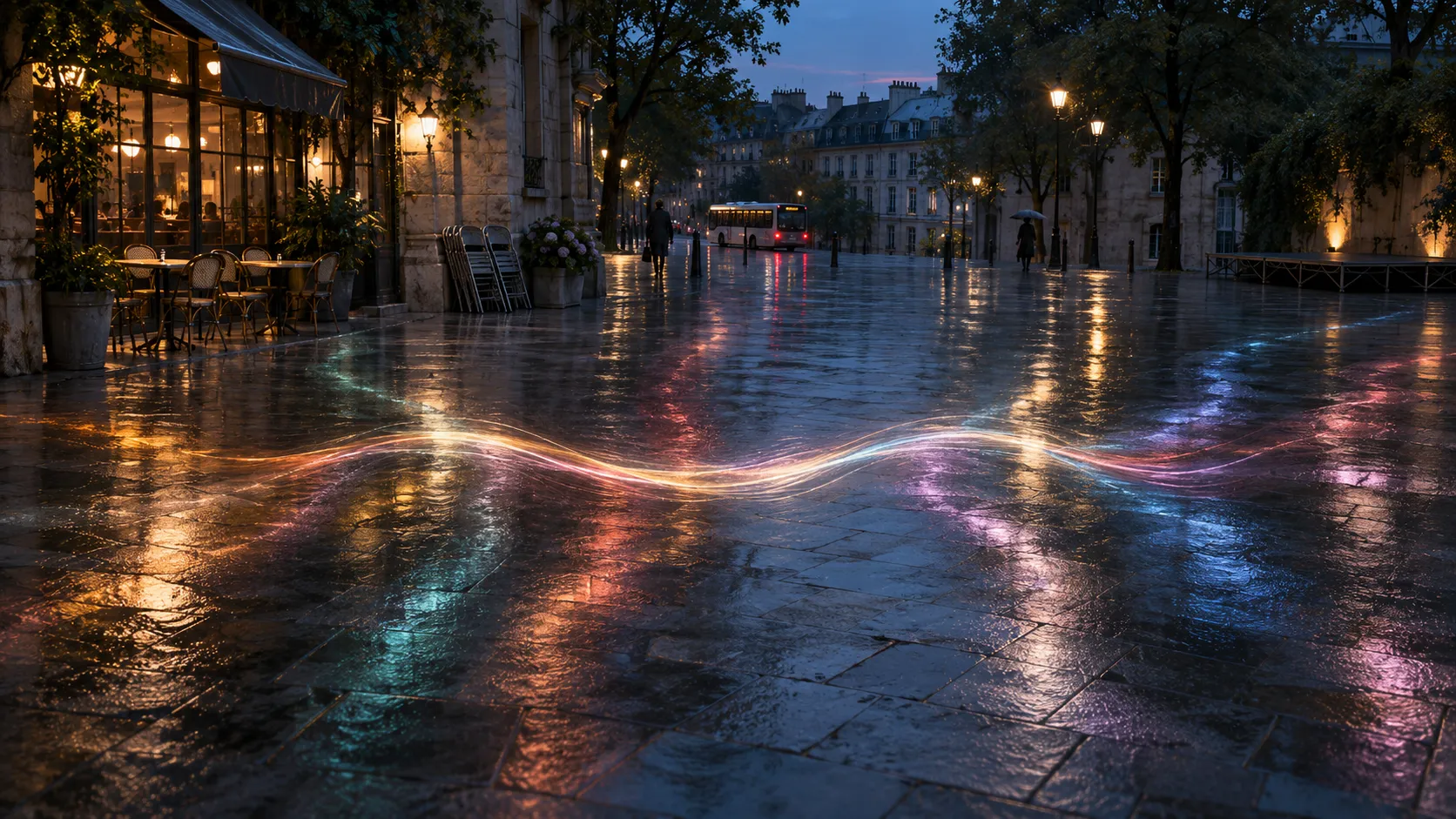
The road that was supposed to lead home
After a wedding, two people drive through the dark with confetti still caught in their shoes. Everyone at the celebration has had a question for them about the future, and none of the questions has been easy to answer. The road home is clear. They know exactly which exit to take.
Then they let it pass.
The map across their knees is upside down, but this is not a story about getting lost. It is about how difficult it can be to speak when everybody expects certainty. They stop at a gas station, buy an orange and a postcard of a lake they have never visited, and ignore another shortcut. By the water, a conversation finally begins. Nothing has been solved by the time dawn arrives. Still, something has changed: for once, neither person needs to pretend to be unafraid.
In another house, the journey is ending rather than beginning. Moving boxes stand against the walls, and two siblings are clearing the rooms they once shared. There is one peach left from the tree of their childhood. It would be easy to make the fruit mean forgiveness, but that would be too convenient. One of them remembers the visits, the practical work, the long hours of caring for someone. The other remembers the money sent, the calls made, the ways of helping that were never quite enough. They have different accounts of the same years, and both accounts contain things the other has failed to see.
They share the peach. The argument does not disappear. The room does not become a better room because of one beautiful gesture. But for a few minutes they stop trying to win the past, and manage to sit at the same table.
Sometimes that is as far as a real beginning can go.
The day with nothing written in it
On a Monday morning, a woman reaches for the blue shirt she used to wear to work. Her badge is still lying beside the keys. Her calendar has an empty square where a whole life of obligations used to be.
She takes the familiar route anyway, then watches the bus pull away without boarding it. At the café, someone asks if she is late. “Not anymore,” she says. The answer is true, but it doesn't tell her what to do with the rest of the day.
She thought she would miss the urgency: the ringing phone, the lists, the feeling of being needed. What she misses instead is a colleague laughing when the printer jams. An ordinary sound that never appeared in a job description. She sends a message asking about lunch. A reply comes back: there is room at the table.
No reinvention. No speech about finding herself. Just a small proof that a person can leave a role without losing every connection that grew around it.
Not every interruption is melancholy, of course. In a kitchen after a party, two exhausted hosts face an unreasonable number of dishes. The dishwasher, standing a little crooked, begins to knock out a rhythm. A tea towel becomes a flag; someone slides across the floor; someone else misses a beat on purpose. The machine finishes its cycle and falls quiet. They keep dancing anyway, using their own hands and heels to carry the rhythm forward.
There will still be plates in the morning. They know that. For these few minutes, however, doing the sensible thing can wait.
The people who don't make the photograph
Near the end of a charity race, the volunteers are dismantling the barriers. The crowd has gone, the rain has come in, and a friend waits beside the finish with a handmade sign. He has brought oranges and a prepared speech, certain that encouragement ought to sound impressive.
The runner arrives long after the cheering has stopped. What matters is not the speech, or the photograph, or where the runner placed. There are days when simply leaving the house is a considerable journey. On those days, another person standing at the end of the road can mean more than all the excellent advice in the world.
The sign is wet. The name on it has been spelled wrong. That, at least, is something a friend can fix.
Elsewhere, rain sends a traveler into a harbour café. A stranger moves an empty chair closer to the window. There are two cups, a broken umbrella, and no demand for an explanation. They talk about an unreliable bus and a dog that refuses a puddle. They never exchange names. When another soaked stranger appears at the door, the traveler passes the chair on.
These moments share no grand solution. The friend cannot run the race for anyone. The woman in the café cannot repair the weather. Their help has a limit, and that is precisely why it feels believable. They offer something within their reach.
A place to stand. A place to sit. A little more time.
Listening when the city turns itself down
At 3:17 in the morning, a worker finishes a shift among parcels and loading gates. Her playlist stops at a pedestrian crossing. She could begin another song, but leaves the headphones quiet.
A florist raises a shutter. A broom brushes the pavement. A taxi indicator ticks beside the curb. The crossing signal contributes three small notes. The city has not suddenly become a different place; it has simply become audible. When the person sweeping the bus stop answers the crossing's rhythm with his broom, she taps along with her shoes. For a moment, two strangers are part of the same tune without ever needing to introduce themselves.
We often imagine that a meaningful change must come with a dramatic announcement. Yet sometimes it is nothing more than lowering the volume of what we brought with us and noticing what has been there all along.
There is another kind of quiet after a family birthday celebration. The laughter has gone down the stairs, the microphone is switched off, and paper stars still hang above the chairs. A son checks the time for his train while his mother starts tidying the hall. She doesn't ask him to stay. She has probably spent years making sure other people could leave on time.
He puts his coat beside the leftover cake and carries chairs instead.
The train goes without him. Another will run tomorrow. Tonight there is a hall to clear, and someone he wants to be beside while they do it. Nothing in this decision demands applause; it happens precisely after the applause is over.
The last song comes first
And then there is a stage in a public square, a set list with nine songs written in blue marker, and two musicians who have agreed on the order of everything. Before they can begin, the speakers stop working.
They could wait for the sound to return. They could abandon the performance. Instead, someone opens an old guitar case, and they begin with the song that was supposed to come last. A girl by the fountain finds a beat against the stone. The crowd comes closer. One musician loses a line and the other picks it up. The mistake becomes part of the performance, not its ending.
When the sound finally comes back, the person at the desk offers to restart the show properly. But properly is no longer the interesting part. The musicians keep the speakers low. They finish the evening in the order it has found for itself.
Later, the stage is empty. The cables are wound away. A listener walks out through the gate, quietly whistling something she heard there. The music has left the schedule behind and gone home with somebody else.
That is where the nine stories meet—not in a single room, and not because everyone reaches the same conclusion. One person needs to speak. Another needs to stop speaking. Someone stays; someone leaves an expected route; someone simply makes space for a stranger. What is right in one story would not necessarily be right in another.
OUT OF ORDER, IN TUNE is not an argument against making plans. It is a reminder that the people inside them are more important than the order of events. A missed train is sometimes a problem. A missed train is sometimes an evening worth remembering. The difference cannot always be known in advance.
We make our lists. We mark the exits. We count in the first song.
Then life answers in a rhythm of its own—and, if we are paying attention, we might find a way to play along.