Articles / LORQAI
Soli Well: The Well That Set a Table Every Friday
In an old neighbourhood of Kano, a water source was said to display silver plates that nobody could reach. The stranger story is what happened when the well began to change.
A Friday display of silver plates, a strict rule about buckets, a rain-calling frog and a passage to River Wudil: the stories surrounding Soli Well are unusual. Its local history is just as compelling.
The Well That Set a Table Every Friday
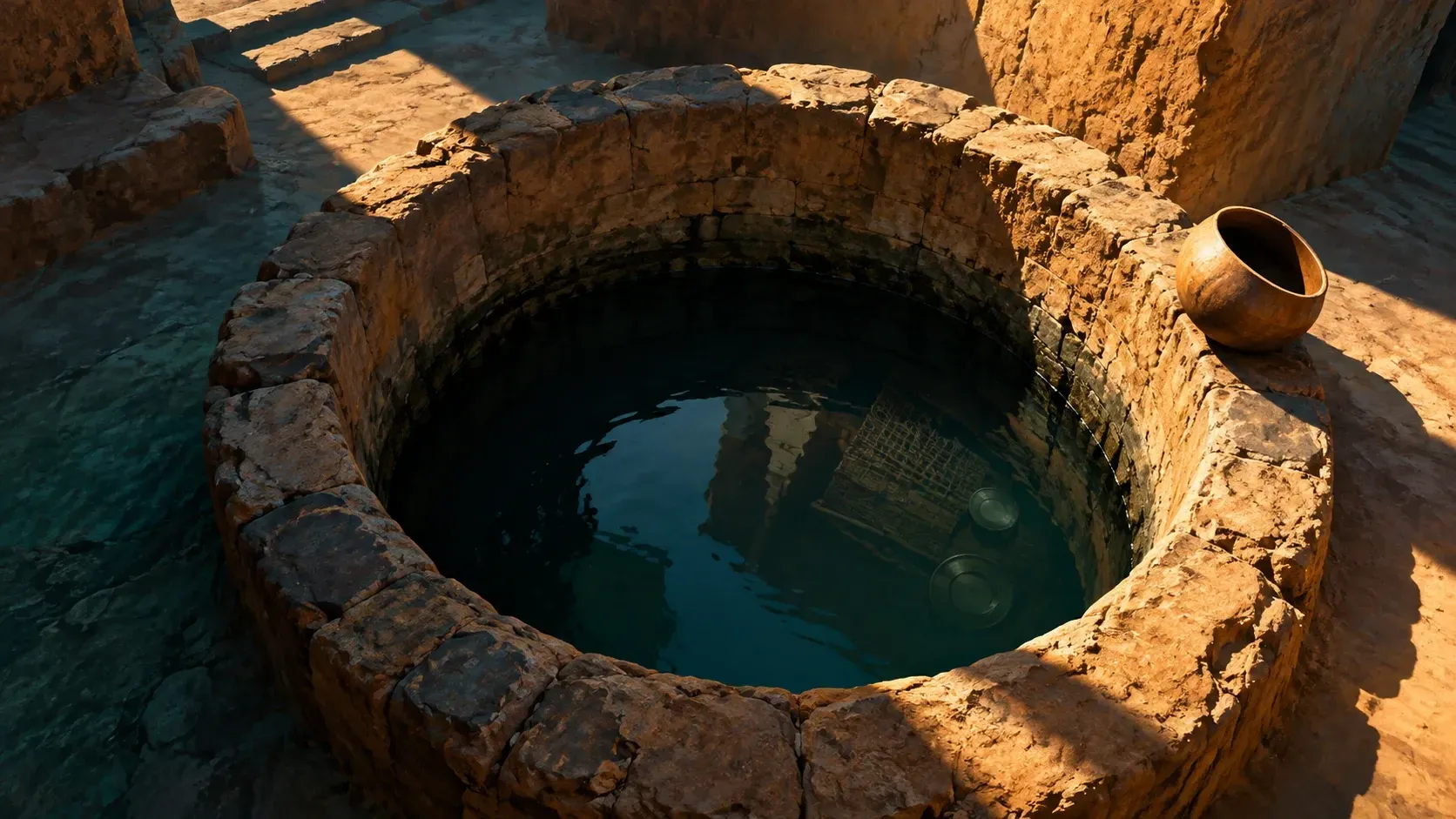
At noon on Fridays, according to an account preserved in a Nigerian newspaper, the well displayed a table setting.
Not a table, exactly. A mat appeared to rest on the water. Silver plates lay across it, arranged as though somebody had finished washing them and set them out to dry. People could look down and see the objects. They could lower things into the well. They could not reach the mat. By another day of the week, the display was gone.
The place was called Soli Well, in the Naibawa area of Kano State. And by the time a journalist recorded the story in March 2021, its most remarkable attraction had reportedly been absent for more than forty years.
That last point is important. Nobody was inviting the reporter to return the following Friday with a camera. The description came from local memory, including the testimony of a man who had grown up near the well. The published account offered no photograph of the silver plates, no recovered object and no independent observation that could establish what had been seen.
Yet the report did include something more concrete than a supernatural claim: a location, a named resident, descriptions of how people used the well and a request that authorities make its surroundings safer. It also contained a series of extraordinary details that did not fit neatly into a single explanation. There was a frog that supposedly announced rain. There was a paper bearing Ajami writing. There was a strict rule about the container people were allowed to use. And somewhere beneath the ground, residents spoke of a passage to a river many kilometres away.
What is the mystery of Soli Well in Kano? The only responsible starting point is that the well was a documented local landmark, while the silver plates and other marvels survive in a published account of what residents said had happened. The real question is how so many different stories came to belong to the same hole in the ground.
1. A water source with no construction date
The March 2021 feature by Daily Trust, now available through Trust Radio, places Soli in Naibawa, in the Kumbotso Local Government Area of Kano State. It describes the well as more than two hundred years old. But the article does not present a construction record, an archaeological report or an independently established date. Its age comes from the community's recollections, passed down through parents and grandparents.
According to the account told by Malam Abdulmuminu Kassim, a Fulani man travelling with cattle noticed water at the site. People then surrounded the water source so it could be used as a well. This is a tradition about its origin, not an eyewitness report of an event from two centuries ago.
The practical value is easier to understand. Residents remembered the well providing water when others nearby had failed. The report gives its local nickname as Soli Hamada Uwar Ruwa, interpreted there as a reference to a well that never dried up. In a place where the dry season matters, a reliable water source does not need a supernatural explanation to become famous.
The word never, however, is doing difficult work. No continuous record of its water level appears in the 2021 feature. The same account later describes the water falling low enough to require dredging. The well's reputation for reliability was real as a reported local belief; the claim of absolute, uninterrupted abundance was not established by measurements.
The report also mentions a dyeing pit close to Soli, where the well's water had reportedly been used for textile work. Kano has a deep history of dyeing cloth. The much better-known Kofar Mata dye pits belong to that wider history, although they should not be confused with the particular pit beside Soli. Water, then, was useful for more than drinking or washing. It could support work, trade and the rhythms of a neighbourhood.
Long before anyone began telling outsiders about silver plates, people had reasons to know exactly where Soli was.
2. The Friday objects nobody could collect
Abdulmuminu Kassim was sixty-five when Daily Trust interviewed him in 2021. He described a phenomenon that, in his telling, had once occurred at about midday on Fridays: a mat bearing silver plates visible at the water's surface. Attempts to reach it failed. The display did not stay, and the story said it would appear again the next Friday.
The precision is the intriguing part. The objects were not vaguely described lights. They were ordinary domestic items, presented as if somebody had been doing an ordinary chore in a place where no ordinary household could possibly be working. Silver suggested value, but the image was closer to washing up than to a treasure chest.
A story can be vivid without its central event being documented. We do not know the number of plates, whether anyone wrote down the claim during the years when it supposedly occurred, who first described it or whether different residents remembered exactly the same scene. The 2021 publication gives us a named narrator and a reported tradition. It does not allow us to examine the original event independently.
A reflection on moving water is one possible category of natural explanation. A floating object is another. But choosing one would require observations that the article does not contain: photographs, the shape and depth of the well, lighting conditions, dates and the testimony of identified people present at the same time. Calling it an optical illusion without those details would be guesswork dressed up as science.
The same is true of more exotic explanations. There is no documented collection of silver plates recovered from Soli, no verified hidden room beneath it and no reliable basis for claiming that unseen occupants regularly arranged household objects on the water.
Kassim said the display had stopped appearing more than forty years earlier. On the evidence available, did silver plates really appear at Soli Well every Friday? remains unanswered. What can be established is that a resident publicly recalled the tradition and that a journalist recorded it in 2021.
3. The bucket that was not welcome
One of the most revealing details in the same interview concerns a rule that sounds less theatrical than silver plates.
Residents, Kassim said, did not permit people to fetch water using an ordinary rubber or tube-made bucket, known in the report as Gugan Danko. A calabash, described as Koko, was required instead. He said people would object if somebody tried to use the wrong container, though the reason for the rule was not explained to him.
Here is the part of the story we should resist simplifying. A rule about a bucket does not prove that a well has supernatural properties. Equally, not knowing why a rule began does not prove it was invented randomly. Communities develop practices around shared resources for reasons that may be practical, ceremonial, social or some mixture of these. The 2021 report does not establish which explanation applies at Soli.
It does tell us that the well was regulated through everyday behaviour. A visitor did not simply arrive with any vessel and help themselves. There were expectations about how water should be taken and, apparently, neighbours prepared to enforce them.
The interview adds another prohibition: Kassim recalled that people were not supposed to pass close to the well carrying anything black. He wondered whether the breaking of such practices had something to do with the disappearance of the reported mysteries. That is his interpretation, not evidence that an object of a particular colour caused the silver plates or the frog to vanish.
These are the details that separate Soli from a generic haunted-well story. The place had a code of use. Even if nobody can now explain the code's origins with certainty, the rules themselves belonged to how residents talked about the well.
4. A passage to the River Wudil
Then the story goes underground.
On the eastern side of the well, the reporter described an opening or cave that local people associated with the River Wudil. Kassim said older generations told of a passage connecting the two. One version involved a canoe belonging to a Sarkin Ruwa of Wudil, an official associated in the account with the water. The canoe was said to have gone missing and to have reached the well by means that residents understood as extraordinary.
According to the same tradition, the Sarkin Ruwa could enter Soli and return to Wudil by the underground route. The storyteller admitted that the canoe itself had not been seen there by the people repeating the account.
The article's headline describes a well that connects to River Wudil. But a headline is not a geological survey. The account identifies a local belief about a connection; it does not show a mapped, navigable tunnel or scientific proof that the water in the well came from that river.
Groundwater is not as simple as an underground river in a storybook. Water moves through pores, fractures and permeable layers. Its level and movement depend on geology, rainfall, pumping and recharge. The United States Geological Survey explains that neighbouring wells can respond differently according to their depth and the aquifers they tap. An apparently reliable well does not, by itself, reveal the direction from which water is arriving.
If a hydrologist wanted to test a connection between Soli and the River Wudil, an investigation would need a reliable map of the local geology and water levels, measurements at different times and possibly water-chemistry or tracing studies. The sources reviewed for this article provide none of those results for Soli.
The distance in the story makes the route tempting to imagine: a vessel entering darkness and emerging far away. But for now the alleged Soli Well–Wudil River passage is a reported local tradition, not a demonstrated underground waterway.
The well was mysterious enough when viewed from above. Its reputation became considerably more ambitious when people began describing what might lie beneath it.
5. The frog that could tell farmers when to prepare
Silver plates are memorable. A frog is more useful.
Kassim told Daily Trust of a frog that used to call for three days before the rainy season. According to his recollection, rain would follow soon afterwards. People from neighbouring communities supposedly came to ask whether the frog had sounded, because the signal helped them decide when to prepare their farms.
By 2021, he said, that behaviour too had ceased more than forty years earlier.
This part of the account sits on an interesting boundary. Scientists have observed relationships between amphibian calling, humidity, breeding and seasonal rain. Research on indigenous weather knowledge in parts of Africa also documents people interpreting frog calls as signs of approaching rainfall. Those findings make the broad connection understandable; they do not verify the existence of one particular forecasting frog at Soli, nor do they establish a reliable three-day or one-week timetable for its calls.
The geographical context matters. Northern Nigeria has a pronounced dry season and a shorter rainy season. The timing of rain affects farming decisions and water availability. Nigerian Meteorological Agency forecasts today rely on extensive scientific observation, and the local knowledge of farmers addresses some of the same urgent questions from another direction: when should we begin, and how much time do we have?
A frog calling from a familiar water source could become a useful landmark in memory, particularly if its appearances seemed to coincide with a change in weather. But memory does not automatically preserve the misses as clearly as it preserves the successes. Without a dated series of observations, we cannot calculate how often the animal's call really preceded rain.
The story is nevertheless revealing. The well's alleged wonders were not all about things that nobody could touch. One of them concerned a familiar animal and the practical problem of deciding when to work the land.
6. A note written where nobody could read it
The most peculiar object in Kassim's account may be neither the mat nor the plates.
He said a paper bearing Ajami writing had appeared on the southern inner wall of the well. People could see it, he recalled, but could not read the message. After some days it disappeared. He told the reporter that he had witnessed this himself.
The paper is a detail easily distorted in retelling. It was not reported as a carved inscription in the stone, an ancient manuscript excavated by historians or a message decoded by scholars. It was described as a piece of writing pasted inside the well. No photograph, transcription or preserved original was provided in the newspaper account.
Ajami itself is not mysterious writing. It is a real, long-established way of using adapted Arabic script to write African languages, including Hausa. Boston University's African Studies Center has documented and digitised Ajami texts, preserving a rich literary and intellectual tradition often overlooked outside the communities that used it.
What makes the Soli paper unusual is the setting in which it was allegedly seen and the absence of the document now. Without knowing its language, handwriting, content or date, nobody can responsibly announce what it said. If the account is accurate, it could have been an ordinary written communication placed in a highly unusual location. Or the recollection may have changed over time. The available source does not let us choose.
The temptation to invent a translation is obvious: warnings about forbidden water, instructions for a hidden entrance, the name of an unseen guardian. None of those words has been documented on the alleged paper.
A real writing tradition deserves better than being converted into an imaginary spell. The mystery at Soli concerns a missing physical object and a remembered event, not a secret alphabet waiting to be cracked.
7. When the water level fell
For all its legends, the well eventually presented residents with a problem that no silver plate could solve.
The water dropped.
Kassim reported that the well's level had fallen in a way people found unusual. It needed dredging. According to his account, the community summoned a Sarkin Ruwa from Wudil to assist. Workers entered the well; water returned during the work, and they hurried out. He recalled several dredging operations, after which the water continued to be available.
These are specific statements from a named local source. They are not independent measurements of how fast the water rose, what sediments were removed or why the level changed. Nor is a sudden rise of water evidence that an underground passage large enough for a boat must exist.
There are ordinary reasons why well levels can fall. The USGS lists factors including rainfall recharge, pumping, well depth and the properties of surrounding rocks and sediments. Sediment can also affect how a well functions. Those principles explain why field observations would matter, but they cannot be used to diagnose Soli from thousands of kilometres away.
The important correction is to the phrase the well that never dried up. In the report, that is a reputation, not a record of unbroken abundance. The same narrator who praised its reliability recalled a period of low water and the need for intervention. Both parts belong to the story.
And beneath the tale of dredging lies another awkward fact: wells can be dangerous. The Daily Trust feature records residents' recollections of a fatal fall long before the 2021 interview and another incident in which a man reportedly survived by sheltering near the opening. Those claims have not been independently documented in the sources reviewed, but the physical risk of an open well needs no supernatural explanation.
The safest part of this mystery may be the thing residents asked for at the end of the interview.
8. The request nobody should overlook
In the 2021 feature, a shopkeeper near Soli, Sani Muhammad, told the reporter that people sometimes warned him about remaining so close to a supposedly dangerous place. He said he had not experienced anything unusual there. Children played nearby. Neighbours sat around the well and talked. Local residents used the place for gatherings, including prayers for the community.
This is a less dramatic picture than the one suggested by Friday silverware. A place people regarded as mysterious could also be somewhere they met their friends, bought provisions and spent time with their children.
Residents told the newspaper that the area needed fencing and protection. The report mentioned community-financed work on the surroundings in 1973, followed by what interviewees regarded as inadequate further attention. They wanted the well recognised for its historical importance and made safer.
That request is the strongest unfinished business in the published account. It is concrete and could, in principle, be checked on the ground. Did the site later receive a protective barrier? Was it documented or conserved? Has the community's request been acted on? The sources reviewed for this article do not establish the well's present condition in October 2026. A responsible publication should not describe the place today as newly restored, abandoned or open to visitors without a fresh local source.
The Friday plates, the forbidden bucket, the frog and the underground passage are all part of what made Soli notable in memory. But an ordinary hole in the ground, still part of a neighbourhood, creates responsibilities that do not depend on whether any of those things happened as described.
At the end of the Daily Trust report, the well had not produced a silver plate for anyone to photograph. It had produced a request for a fence.
That is the part of the story whose outcome is still worth finding out.
Sources and further reading
- Daily Trust / Trust Radio — Kano's Mysterious 200-Year Well That Connects River Wudil From City (27 March 2021) (external platform)
- U.S. Geological Survey — What Makes a Groundwater Well Go Dry? (external platform)
- Boston University African Studies Center — African Ajami (external platform)
- NOAA — Inter-Tropical Convergence Zone and Nigeria's Rainfall Seasons (external platform)
- Weather, Climate, and Society — Indigenous Knowledge Systems and Indicators of Rain in Western Uganda (external platform)
- Google Arts & Culture / The Centenary Project — 500 Years of Tie and Dye Production (external platform)