Articles / LORQAI
Left Was Right Until Five
The extraordinary morning Sweden changed which side of the road everyone drove on — and the much harder task of changing people's habits.
At five o'clock on a September morning in 1967, Sweden changed sides. Behind the famous photographs was a remarkable effort to rebuild roads, retrain instincts and prevent an entire country from making the wrong turn.
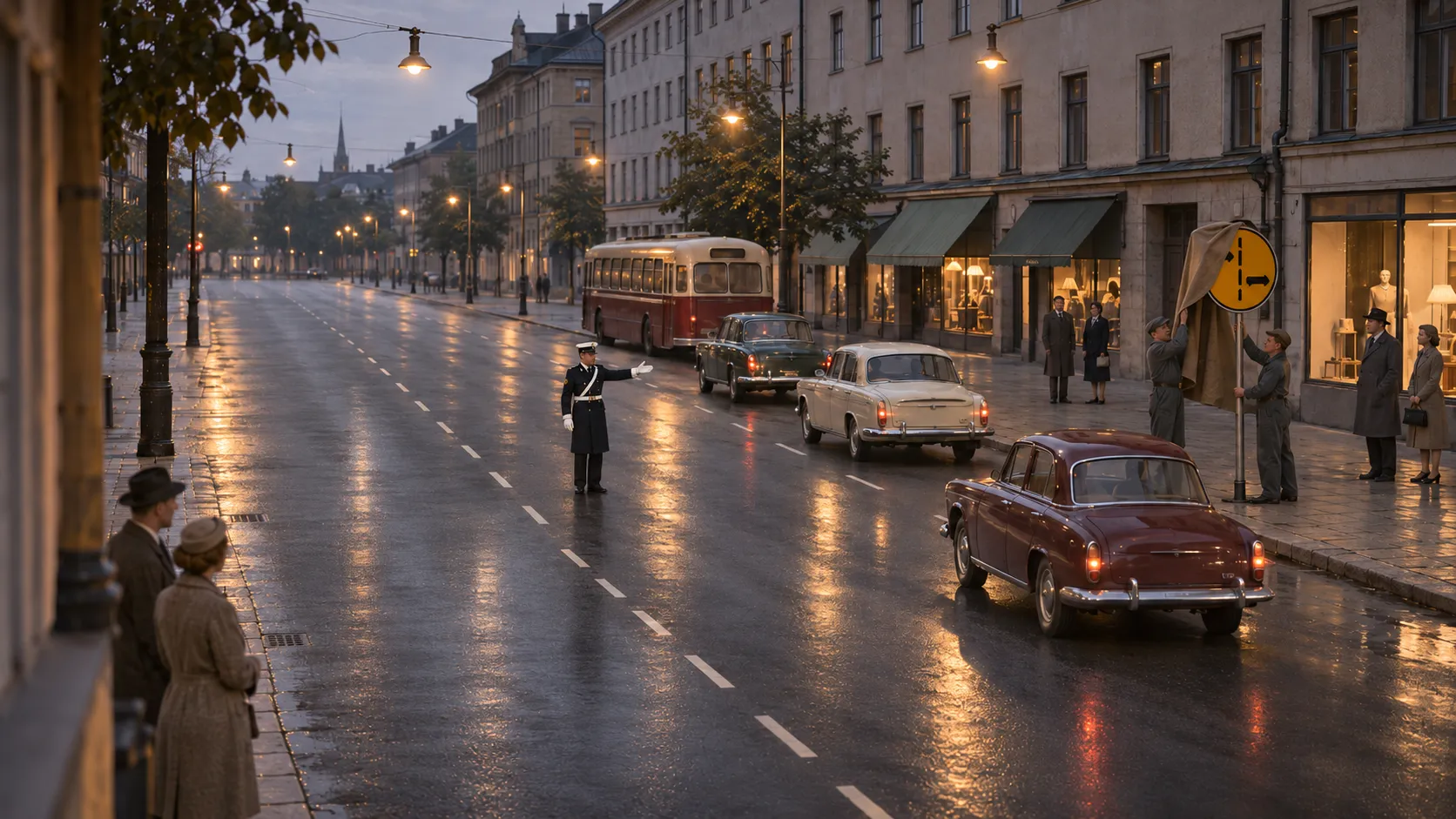
At 4:50 A.M.
At 4:50 on the morning of Sunday, September 3, 1967, the drivers still permitted on Sweden's roads were required to stop.
They had ten minutes to prepare for a peculiar manoeuvre.
The vehicles stood on the left, where Swedish traffic had belonged for generations. The drivers were to move carefully across the roadway, position themselves on the right and wait for the appointed hour.
At five o'clock, the new rule would take effect.
Most ordinary motorists were not there to participate. A nationwide traffic restriction had begun at one in the morning, and general traffic was not allowed to resume until six. Buses, taxis, emergency vehicles and other authorized traffic followed special arrangements.
The country was changing sides under supervision.
From the perspective of a road sign, the operation was uncomplicated. Yesterday, this arrow pointed drivers toward the correct side. Today, the correct side would be the other one.
For human beings, it was less straightforward.
A driver could understand the new rule perfectly and still turn into an empty road on the wrong side. A pedestrian could know which way traffic was supposed to arrive and still glance in the direction that had been safe for a lifetime.
The difference between knowing and doing was the central difficulty.
Sweden called the occasion *Dagen H*, from *högertrafik*, meaning right-hand traffic. The preparations involved years of planning, extensive road reconstruction, changes to public transport and one of the country's most ambitious information campaigns.
But the transformation had to become real in a particular moment.
On Saturday, people drove on the left.
On Sunday, they drove on the right.
The roads could be redesigned in advance. The habits could not be switched with a screwdriver.
The Steering Wheel Was Already on the Other Side
The Swedish arrangement before 1967 contained an awkward contradiction.
Traffic kept to the left, but most passenger cars had their steering wheels on the left too.
This was not a requirement of left-hand traffic. In countries where vehicles drive on the left, a right-hand steering position usually places the driver closer to the centre of the road.
That position helps when judging oncoming vehicles, particularly during overtaking.
Many Swedish cars had the opposite arrangement.
The driver sat nearer the outside edge of the road, while oncoming traffic approached from the other side of the vehicle.
Imagine following a large truck on a narrow two-way road.
To see whether the opposite lane is clear, the driver may need to move outward from behind the truck. When the steering wheel is on the side away from the centre line, the view can be more restricted.
The problem is not solved by simply being a cautious driver. The driver's position affects what can be seen.
Swedish manufacturers produced vehicles for domestic and international markets, and left-hand steering became common even while Sweden continued using the left side of the road.
Another difficulty waited at the borders.
Norway and Finland drove on the right. Crossing from either country into Sweden meant changing the side on which traffic moved. The vehicle itself did not change, and the driver might have to adjust familiar expectations immediately after crossing.
As motoring expanded in the 1950s and 1960s, international travel and commercial traffic increased.
This made an old national convention progressively less convenient.
For decades, the question had appeared in reports, proposals and parliamentary debates. By the early 1960s, advocates argued that aligning Sweden with most of continental Europe would improve consistency and address safety problems associated with its steering-wheel arrangements.
That did not mean everyone agreed.
The population had already been asked.
And it had given a remarkably clear answer.
An Unpopular Idea That Refused to Disappear
On October 16, 1955, Sweden held an advisory referendum on changing to right-hand traffic.
Of the votes cast, **82.9 percent opposed the change**.
Only 15.5 percent supported it, with the remainder blank. Turnout was approximately 53 percent.
The result was hardly ambiguous. For many people, changing sides seemed expensive, inconvenient and potentially dangerous.
Their concerns were understandable.
A country cannot simply notify drivers that their existing instincts are now wrong and expect everyone to perform safely the following morning.
Roads would need alterations. Signs would have to move. Buses might require different doors. Intersections designed for one direction of traffic could present problems when used in the opposite direction.
The prospective expense was substantial.
The possibility of confusion was genuine.
Following the referendum, Sweden retained left-hand traffic.
But discussion continued as the number of vehicles and international journeys grew. Officials reviewed the likely costs and safety consequences, while Nordic and European organizations encouraged greater consistency in road rules.
The referendum had been advisory rather than legally binding.
On May 10, 1963, the Swedish parliament voted to implement right-hand traffic in 1967.
The decision was made by a large majority, despite the earlier public opposition.
This is sometimes told as a story of a government ignoring what everyone wanted. The disagreement was real, but the chronology matters: eight years separated the referendum from the parliamentary decision, and the debate concerned changing transport conditions as well as public preferences.
It would be misleading to claim that the referendum result somehow vanished or that everyone had suddenly become enthusiastic.
A decision had been made.
The next problem was engineering.
The Swedish authorities now had approximately four years to prepare an enormous physical and behavioural change.
They needed to rebuild parts of the transport system while keeping the existing system operating until the appointed night.
That is a difficult way to renovate anything.
It is particularly awkward when the thing being renovated is the set of instructions followed by every person using the road.
Build the New Road, but Keep It Hidden
A large road sign is a simple object until the moment it gives incorrect instructions.
Then it becomes dangerous.
Before Dagen H, workers had to install or reposition signs that would become correct after the change. They could not simply expose all of them as soon as they were ready, because the country was still driving on the left.
The solution involved installing parts of the future road system while concealing them from present-day traffic.
New signs were covered. Older signs remained in service. Traffic signals, intersections, lane markings and one-way arrangements were prepared for the coming reversal.
The Swedish transport-museum account describes hundreds of thousands of road signs requiring replacement or modification, together with a vast network of reminder signs.
The work was much more complicated than exchanging arrows.
A roundabout could need a revised arrangement of entry and exit movements. A bus stop on the wrong side of a street was not useful merely because a new sign identified it. A redesigned intersection had to function with vehicles approaching from different directions.
Some projects could be completed in advance. Others had to wait until the last hours, when the existing traffic arrangements could finally be taken out of service.
The buses presented a problem that passenger cars largely escaped.
A private car could often continue being driven without relocating its steering wheel. Its driver simply had to follow the new traffic rule, although certain equipment, such as asymmetrical headlamps, might need adjustment.
A bus had doors.
Before the switch, many Swedish buses were designed for passengers to board and leave on the left-hand side, facing the pavement.
After the switch, that arrangement could put the doors toward the middle of the road.
Passengers generally prefer not to step directly into moving traffic. Bus operators were required to address the problem.
Vehicles were rebuilt, replaced or temporarily fitted with arrangements allowing doors on both sides. Some tram services were changed or discontinued, increasing the demand for buses.
A contemporary technical account published in 1968 described a national fleet comprising newly built buses, rebuilt vehicles and transitional designs.
These choices had to be made years before the final morning.
A transport operator could not wait until five o'clock and then discover that the passengers were expected to leave through the traffic.
The work extended into schools, police operations, public communications and traffic safety research.
The changeover commission divided its work between roads, vehicles, safety, legal arrangements, administration and public information.
There was even a science to deciding *when* to tell people what to do.
That turned out to be unexpectedly complicated.
The Danger of Practising Too Soon
Most safety campaigns encourage people to practise the correct behaviour before it becomes necessary.
Sweden's traffic planners faced a paradox.
The future correct behaviour was still the present incorrect behaviour.
A person trained too thoroughly to drive on the right in July might return to ordinary Swedish roads and use that new habit at exactly the wrong time.
The authorities were not merely teaching something unfamiliar. They were replacing an established response while the old response still had to remain active.
Research considered by the changeover planners suggested that alternating between left-hand and right-hand driving could lead to errors when drivers returned to the original arrangement.
That finding influenced the timing of the campaign.
Public information about the change began well in advance. The population needed to know the date, understand the importance of the reform and prepare for temporary restrictions.
But detailed instructions about how to behave in right-hand traffic were concentrated close to the transition.
The plan distinguished between understanding that a change was coming and rehearsing the new behaviour before it was safe to use.
This was an unusual educational problem.
Imagine teaching everyone in a city to climb stairs using the opposite leg first, while warning them that the new instruction does not apply until Sunday morning.
The analogy is imperfect. Road behaviour is more complex than a staircase.
But it captures the central difficulty: people do not operate entirely through conscious decisions. Repetition creates expectations, and expectations influence movement before deliberate thought has finished.
The commission therefore worked on the physical environment and the road users at the same time.
Signs would change. Speeds would be restricted. Police and other personnel would supervise the transition. Drivers, cyclists and pedestrians would receive specific guidance.
Public information appeared in newspapers, on television and radio, in leaflets and on everyday objects.
The campaign even produced a popular song from the Swedish group The Telstars, reminding listeners to keep right.
For a road-safety operation, this was a surprisingly musical approach.
The message also appeared on stickers, souvenirs and items of clothing. A person could encounter the traffic reform at the breakfast table, at work or while listening to the radio.
Yet reaching most people through mass media was not enough.
The official historical account describes efforts to reach isolated residents, people with disabilities and those who did not speak Swedish. Information had to be adapted to different needs and languages.
A traffic rule is only useful if the people affected by it know how to respond.
There is little benefit in successfully informing every car owner while forgetting the person who will walk across the street.
And the pedestrian presented one of the most stubborn difficulties of all.
The Sidewalk Has a Memory
Before Dagen H, Swedish pedestrians were accustomed to traffic approaching according to the left-hand system.
When stepping from a pavement, many would instinctively look toward the direction from which nearby traffic was expected.
After the change, that instinct could become dangerous.
A driver has a steering wheel, a windshield and the immediate visual reminder of which lane the vehicle occupies.
A pedestrian may have no such physical cue.
The road can look almost unchanged.
The kerb is still in the same place. The shop opposite has not moved. The distance to the other pavement has not increased.
Only the direction of approaching vehicles has changed.
Researchers investigated this problem before the reform.
A contemporary American transportation report described a Swedish observational study in which roughly seven in ten pedestrians looked to the right before leaving the pavement, while comparatively few initially looked left.
The findings reflected behaviour under the old traffic system.
The changeover would reverse which direction demanded the earliest attention.
This posed a different training problem from teaching drivers to occupy a new lane.
For pedestrians, there was no vehicle to reposition. The adjustment involved attention, expectation and the order in which they examined their surroundings.
The safe habit was to look carefully in both directions, but the first glance still mattered.
Traffic arriving from the newly expected direction could be missed by a person whose attention had been conditioned by years of experience.
The danger did not end when the new rule became familiar as a sentence.
Some people would need longer to adjust their automatic responses.
The planners recognized this and incorporated pedestrian education into the campaign.
In the final days, the message became more specific.
Everyone needed to remember that the next morning's traffic would arrive from the other side.
The new rule applied to cars.
The new habit was required of everybody.
Sunday, 4:50 A.M.
The changeover took place during the night leading into Sunday, September 3.
A broad traffic restriction began at one o'clock in the morning. Most private traffic was prohibited, while certain essential and authorized vehicles could continue operating.
Road workers completed the last alterations. Signs for the new system were uncovered, while instructions belonging to the old system were removed or concealed.
Traffic personnel took up their positions.
Radio coverage accompanied the transition.
At 4:50 a.m., the vehicles authorized to remain on the roads had to stop.
They were instructed to move carefully from the left side to the right, ready to continue under the new rule at five.
There is a photograph of central Stockholm that has become one of the enduring images of Dagen H: cars clustered on a city street, traffic directed across the centre, pedestrians looking on.
The image captures an extraordinary moment, but it can also give the impression of a spontaneous nationwide shuffle involving every Swedish motorist.
The reality was more tightly controlled.
Most drivers had been ordered to stay off the roads.
The famous movement belonged to a limited, supervised portion of traffic during the changeover period. General driving was allowed again at six, subject to local restrictions.
The ten minutes between 4:50 and five were therefore not a public invitation to demonstrate a spectacular U-turn.
They were part of a carefully arranged procedure intended to reduce the number of simultaneous decisions people had to make.
The preparations also had spectators.
The National Library of Sweden preserves a photographic account by Bo Wingård, who was seventeen in 1967 and went into central Stockholm to document the event.
His photographs offer an eyewitness record of a city changing its traffic pattern in the early hours.
The occasion had the atmosphere of something simultaneously mundane and historic.
A country was not changing its government, currency or language.
It was changing where vehicles travelled within the width of a road.
Yet this required police, engineers, transport operators, broadcasters, educators and thousands of workers to coordinate around one clock.
At five o'clock, Sweden's right-hand traffic era began.
The new signs could finally be obeyed.
The First Morning Was Not the Final Test
The feared catastrophe did not occur.
Swedish road-transport history records the transition as broadly orderly, with widespread compliance and without the mass confusion that some opponents had expected.
That was a substantial achievement.
But it would be too convenient to declare the operation a complete safety triumph on the evidence of one Sunday morning.
Traffic had been deliberately restricted. Speeds were reduced. Police and other personnel were highly visible. Drivers knew that ordinary habits might lead them into danger.
These were not normal road conditions.
The test extended into the days and months that followed, when more people returned to regular journeys and the novelty of the change gradually faded.
Swedish museum and municipal sources describe lower traffic casualties around the transition. The transport-museum account reports 236 fewer road deaths in 1967 than in the preceding year.
This figure is significant, but it does not establish how much of the reduction was caused by the change of driving side alone.
Other measures accompanied the reform, including speed restrictions, altered road arrangements and an enormous safety campaign. Road users may also have behaved more cautiously because they knew they were operating under unfamiliar rules.
Later research has tried to isolate longer-term effects.
A 2017 economic study used statistical comparisons to estimate the road-safety impact of Sweden's earlier mismatch between steering-wheel position and traffic side. It found substantial potential benefits from matching left-hand steering with right-hand traffic.
That is a model-based estimate, not a direct observation of a parallel Sweden that continued driving on the left.
Such research helps investigate causation, but it depends on assumptions about how comparable the alternatives are.
The simple conclusion is also the strongest one: the feared immediate disaster did not happen, and the reform was accompanied by important safety improvements.
Exactly how much credit belongs to the traffic-side change itself remains a more technical question.
There is a temptation to judge infrastructure changes solely by the first dramatic photographs.
If the cars are moving, the job is done.
But a successful transition must survive the moment when the police supervision becomes less intense, the reminders grow familiar and people stop consciously thinking about every movement.
That is when a rule has to become a habit.
The New Meaning of an Ordinary Street
By the time later generations learned to drive in Sweden, right-hand traffic was no longer an experiment.
It was simply traffic.
A driver approaching an intersection no longer needed to remember the 1955 referendum, the four years of preparation or the early-morning traffic ban.
The necessary behaviour had become ordinary.
That is an unusual fate for such an enormous project.
Much of the work was designed to make the change disappear from everyday attention.
The new signs had to become unremarkable. The altered bus doors had to feel natural. Drivers needed to turn onto the correct side of a road without rehearsing a historical argument about the decision.
The authorities had been able to replace, move or uncover road signs according to a schedule.
Human habits were less punctual.
A person who had spent decades looking right before stepping from a pavement did not acquire a new instinct simply because a radio announcer confirmed that the law had changed.
That instinct had to be corrected through attention, repetition and experience.
Today, the images of Dagen H are memorable because they show the brief period in which the old and new rules occupied the same street.
A queue of cars stood where they had always belonged.
A few minutes later, the correct place was across the road.
The physical distance was small.
The change took years to prepare, and longer than an hour to absorb.
At five o'clock, the rule changed.
The habit had to follow.