Articles / LORQAI
The World That Asked for Darkness
An original first-contact science-fiction story
A photographer sees what looks like a city in an empty alien valley. With a landing capsule descending, the expedition must decide whether a shifting field of glass is merely alive—or answering.
By LORQAI
A first-contact story
The first photograph showed an empty valley.
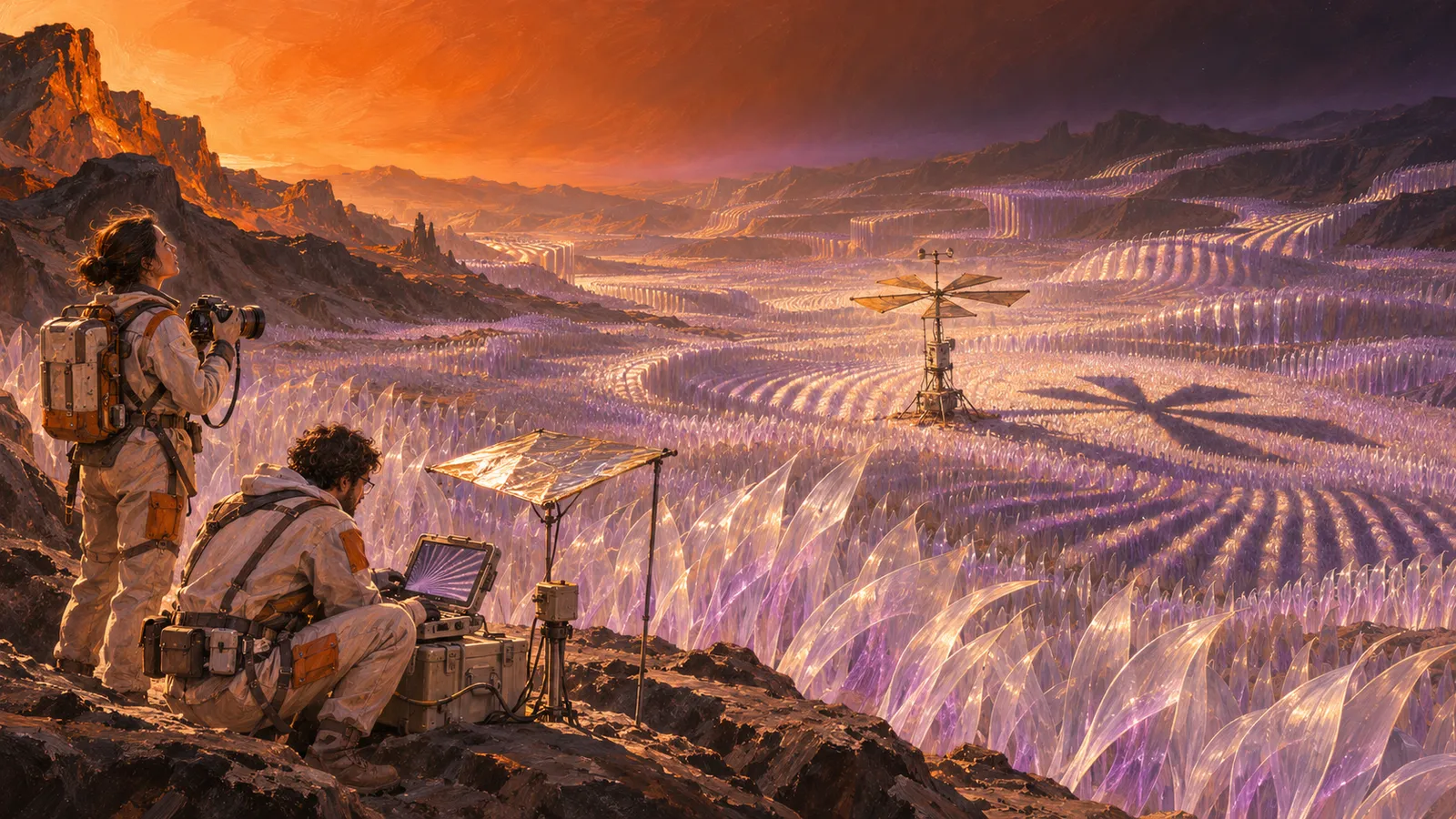
The second showed what looked like the ruins of a city: thousands of narrow, upright shapes arranged in orderly terraces beneath a copper-colored sky.
Eli turned the ring on his camera lens a few degrees. The city disappeared.
He turned it back. There it was again.
"I've got a problem," he told the others.
"Can it wait?" Sal asked. "We're landing an expensive machine in twelve minutes."
"I think the problem is looking at us."
Sal made the sound she reserved for instrument technicians, a short exhalation that meant I'm not encouraging this. She was on the other side of the rover, anchoring the optical landing beacon to a shelf of black rock. Above them the sky was dull orange, bright at the eastern horizon and darkening westward into a belt of permanent night.
The star never rose or set on this world. The planet kept one face toward it, and the valley lay near the boundary of light and dark. The expedition had chosen the site because temperatures here were survivable and, according to the surveys, very little happened.
In front of Eli, something happened again.
A tall shape bent sideways. Another leaned toward it. A third seemed to fold flat against the ground.
He called the biologist.
Oren came up the slope carrying a sampling case and a bag of markers. His suit was stained reddish brown from the dust. He watched Eli rotate the polarizing filter.
"Reflection," he said.
"Obviously."
"You made it sound like architecture."
"It looks like architecture."
"So does a honeycomb. That doesn't mean the bees are architects."
"I believe the bees would dispute that."
Oren took the camera. Under the filter, the valley returned: columns, rings, long narrow corridors. He held it very still.
One of the columns changed shape while they watched.
Oren lowered the camera.
"All right," he said. "Don't move anything."
That instruction arrived three minutes too late.
—
Their expedition had not come looking for minds. It had come to retrieve a dead weather probe.
Eighteen years earlier, an unmanned surveyor had landed in the valley and survived for sixteen months. It measured wind, radiation, temperature and airborne dust before its transmitter failed. The last pictures showed a featureless plain of pale mineral plates. A later orbital survey found the probe still standing, its instrument mast intact and its sunshade casting a neat six-pointed shadow.
Nothing in the archive suggested a reason not to recover it. The returning capsule would land near the probe, drive a short anchor into the ground, fold it into a storage cradle and carry it back to the ascent vehicle. There were old data buffers worth salvaging, if the electronics had survived.
Sal was responsible for the capsule. Oren was responsible for not bringing home a harmful organism. Eli was responsible for photographs convincing enough that the people who funded their trips would fund another one.
He was, he sometimes thought, in the business of making small places look important.
The valley did not need his help.
Their rover was parked above a field of translucent blades no taller than Eli's knee. In ordinary light they looked like stiff weeds made of cloudy glass. They grew in crowded patches separated by strips of dark grit. There were no flowers, branches or leaves in the familiar sense. Each blade was ridged and laminated, with a thin inner layer that shone violet when viewed at the correct angle.
Eli's camera had a polarimetric mode for cutting glare from mineral surfaces. Now, as he turned its filter, the blades emerged from the background in a dense arrangement of bright and dark strokes.
"The satellite didn't see this," he said.
"Its images weren't taken through a polarization analyzer," Oren answered. "Most of what we're looking at could have vanished into the glare."
"You said it was rock."
"I said it might be rock."
Sal joined them, checking the landing timer on her wrist. "Can it be rock until our capsule arrives?"
Oren touched one blade with a probe. It bent away, not from the probe itself but from the shadow his arm had made. A few neighboring blades turned as well.
"Maybe not," he said.
He uncovered his portable lamp. The blades nearest it flattened. Their violet reflections vanished.
He switched it off. Over the next half-minute the blades rose again.
"Phototropism," Sal said. "Plants turning toward the light. Congratulations."
"They turned away from it," Eli said.
"Fine. Plants with opinions."
Oren began setting out sensors. "We need controls. Heat, light intensity, angle. It could be a protective reflex."
Eli aimed his camera at a cluster near the edge of their shadow. A band of dark reflections passed over it, then stopped. He checked his own position. He hadn't moved.
It happened again, in a different direction.
The blades were not turning toward the lamp or away from it. They were turning in sequence, one patch after another, like spectators standing at the wrong moment during a concert.
Sal's wrist chimed.
"Capsule in nine minutes. Move your experiments back behind the beacon."
Eli looked across the bright plain. Beyond the cluster he had been watching, a broad, pale patch of glass surrounded the old probe. Its six-armed sunshade was visible through the haze.
Along the shade’s long, slanting shadow there was something dark.
A small patch, no more than a few meters across, that never brightened when he turned the filter.
"We need to go down there," he said.
"We need to leave the landing corridor clear," Sal replied.
Then, all at once, every blade between the rover and the old probe tilted in the same direction.
The bright lines in Eli's camera went black.
They were pointing at the landing beacon.
—
Oren ran the test Eli suggested, though he complained through most of it.
They used two identical shades cut from foil. Both blocked the same amount of light. Under one shade Oren hid a small heater; the other remained at ambient temperature. Eli put them on opposite sides of a cluster and moved them at random intervals while the camera recorded the blades' orientations.
The response followed the shape and position of the shade, not the heater. When Eli reversed the sequence, the cluster reversed its movements. When he held one shade still and moved the other, only the nearby blades tracked the moving one.
"That's a local response," Oren said. "Not a language."
"I didn't call it a language."
"You called me because it was looking at you."
"It was a useful description."
They repeated the test with the foil stationary and a narrow strip of darkness moving across it, like the hand of a clock. The blades followed, then continued rotating for a few seconds after the strip stopped.
Eli frowned.
"They're anticipating us?" Sal asked over the channel.
"Or the tissue has a delayed response," Oren said. "One test doesn't tell us which."
Eli rewound the recording and watched a patch they hadn't illuminated. Its blades were moving too, but out of step with the nearer cluster. Not copying. Something more like opposition.
He stepped sideways and changed the polarization angle. The second patch became a clear shape in the image, separate from the first. A dark line appeared between them, then filled with flecks of violet.
"Look at the boundary," he said.
Oren leaned close to his screen. "There might be conductive tissue underground."
"Across the whole valley?"
"We haven't earned the whole valley yet. Perhaps across five meters."
Sal interrupted. "Seven minutes. And the descent vehicle has gone behind the planet. We are now the landing site. Whatever you want to do, do it from the ridge."
The capsule had been released from orbit before their landing. Its course was already set. Radio commands from the mother ship were temporarily blocked by the planet; the local optical beacon would provide the final landing correction. The capsule could divert within a limited range, but its automated system was committed to putting hardware on the ground.
Eli checked the projected footprint. The capsule was aimed between the old probe and the ridge, exactly where the largest bright cluster stood.
"How deep are the anchor spikes?" he asked.
"Half a meter. It won't fall over," Sal said.
"How wide is the exhaust plume?"
"Why?"
"Because I think we're about to land on something alive."
There was a pause.
Sal walked back to the camera, studied the patterns and looked up toward the flat plain. She had spent two years calculating a recovery route for the dead probe, then another six weeks getting a capsule built for it. Eli could almost hear her comparing those numbers with the movement of the glass blades.
"If we move the beacon," she said, "the capsule will follow it as long as we stay inside the divert envelope."
"Where can we put it?" Oren asked.
Sal pointed west, toward a bare tongue of black basalt rising from the valley wall. "There's rock over there. Twelve hundred meters. Rough, but the lander has legs."
"And if we don't reach it?"
"The capsule follows the beacon here."
For the first time since landing, Sal sounded frightened.
"Six minutes," she said. "Help me lift the mast."
—
The mast was designed to remain where it had been installed. Its ground screws were deep, its optical head heavy and its battery pack bolted inside the base.
Sal pulled the screws with a powered wrench. Oren helped her heave the lower frame onto the rover's cargo rack. Eli went ahead on foot to find a route across the broken rock, carrying a hand beacon in case the main one failed.
Below the ridge the glass blades kept turning. The movement traveled in bands from the cluster around the old probe, through narrow bridges of darker material and into the broader valley.
It was beautiful, which made the situation worse.
"Four minutes," Sal said.
Eli climbed a ledge and found himself above a shallow hollow. A rim of black stone enclosed a patch of glass that was almost entirely transparent. It barely registered in his visor.
He stepped toward it.
The patch darkened.
Not because of his shadow. His shadow was falling behind him. The blades nearest his boot had rotated to face him, their invisible reflective layers suddenly aligned with the polarizing film in his visor.
They made a narrow stripe across the rock.
He moved left. The stripe moved left. He moved right. It moved right.
Then the stripe stopped him.
It widened across the hollow in a dark, glossy band. A sudden gust swept dust through the opening, revealing a drop he hadn't noticed. He had been about to step onto a crust above a steep cleft.
"Stop," he told the others. "There's a hole. I'm coming around."
Oren answered at once. "Did the plants warn you?"
"I don't know. They might simply be responding to my movement."
"That's a terrible answer."
"It's the one I have."
Sal brought the rover around the upper side of the hollow, grinding its wheels over uneven basalt. They reached the outcrop just as the timer passed three minutes.
The ground was solid. The position was at the edge of the allowed divert region. The approach angle, Sal said, was unpleasant but survivable.
She attached the mast to a drilled rock socket and brought up its light source.
Nothing happened.
"Why isn't it transmitting?" Oren asked.
Sal opened the panel. A cable had torn from its contact when they hauled it onto the rover.
"Don't talk," she said.
She bent into the housing, stripped the insulation with the biting jaw of her multitool and pushed the wire into a spare clamp. The optical head flashed amber.
A green confirmation appeared on her wrist.
"Beacon acquired," she said.
Far overhead a white speck appeared in the copper sky.
The capsule was falling faster than it looked. Its engine fired twice, making two brief white circles in the haze. Eli watched it shift sideways toward the basalt tongue.
For a few seconds it seemed the correction would not be enough.
Then its landing legs opened. It struck the rock in a spray of black dust, bounced once and came to rest at an angle with one leg hanging over the edge.
Sal sat down in the grit.
"I hate this planet," she said.
Eli looked back at the glass valley. Under his polarizing visor, a wave of alternating dark and light moved across the closest patches.
They had spared the bright cluster.
The valley was doing something new.
—
They had just under an hour before the wind forecast forced them to return to the ascent vehicle. The capsule was safe enough to leave where it stood; retrieval could wait. The old probe would remain where it had stood for eighteen years.
Oren wanted to take a piece of the glass.
"Not a core," he said quickly. "A detached fragment. Something we can test without harming the colony."
"You just called it a colony," Eli said.
"I know."
Sal, who had not moved from her rock, raised a hand. "Before anyone acquires a new species, can we confirm that we haven't mistaken a few synchronized plants for an extraterrestrial parliament?"
Oren looked down into the valley. "We can demonstrate environmental response. Possibly coordination. We can't demonstrate a mind from a pattern alone."
"That's the trouble with first contact," Sal said. "Someone needs to know if they're saying hello."
"Maybe hello isn't a useful concept here," Eli said.
He photographed the old probe through the longest lens he had. It sat in the center of a precise shadow, six thin arms cast across the glass. The automated instrument had been designed to make measurements under its own sunshade. For sixteen months, a shutter in the housing had opened at regular intervals to expose a detector to the star.
Eli found the original maintenance sequence in the archive: open for three seconds, close for nine, repeat four times, then remain closed until the next cycle. There had been thousands of cycles before the transmitter failed.
He replayed the orbital photographs in date order.
At first, the field around the probe had been nearly bare. Several years later there were faint lines. Then growing clusters. Then a darker ring just outside the sunshade's permanent shadow.
"It grew around our instrument," he said.
"Likely for warmth or shelter," Oren said.
"Or because it changes the light."
Eli put the archive sequence beside the live camera feed. The nearest blades were moving through a short, repeated pattern: a brief turn, a longer pause, then a series of four turns.
It wasn't an exact match. Some pauses were longer, some shorter. But the family resemblance was strong enough that Eli stopped speaking.
"What?" Sal asked.
He showed her the sequence.
"The old shutter?" she said.
"Perhaps."
"You're saying it learned our machine?"
"I'm saying the machine changed the light there for sixteen months, and the growth around it is responding to light patterns now. What that means is another question."
Oren enlarged the photographs. "The growth begins along the shadow, where the light is lower. We haven't proved imitation."
"No," Eli said. "But the first thing we sent here wasn't a message. It was a routine."
He looked again at the old probe. For eighteen years it had occupied a few square meters of foreign ground. Its designers had wanted an instrument that could survive a harsh sky. Nobody had asked what those few square meters might become.
"We need a new experiment," he said.
—
They returned to the edge of the valley with the portable polarimeter and two flat pieces of foil.
The glass blades reacted when Eli passed his arm above them. He set one foil square on a low support, casting a sharp rectangle of shadow. He waited until the nearest cluster settled into a stable orientation, then removed the square.
The cluster held its position for several seconds. Then half of it turned, revealing a dark rectangular patch where the shadow had been.
Sal watched on the screen. "Delayed afterimage."
"Could be," Oren said.
Eli held the foil in a different place. This time the blades reacted differently. He repeated the test until he had a baseline for simple tracking, then made two shadows at once and removed only one.
The nearest cluster reproduced one rectangle. The other remained bright.
A second cluster, farther away, produced the opposite arrangement.
"You see that?" Eli said.
Oren nodded. "They're not following the same local conditions."
He checked the sensors. Temperature and illumination were nearly identical at both patches. The two clusters had been given the same recent sequence. Yet they had settled into different configurations.
"They're behaving differently," Oren said. "We don't know why."
"Could they be responding to each other?"
"Possibly. But we'd need to trace the connection, if there is one."
Sal crouched beside them and turned the polarimeter toward the broad valley. Through it, the apparently uniform field separated into hundreds of little patches, each moving on a different schedule.
"We kept saying 'the valley'," she said.
"Yes," Oren answered.
"Maybe that's like looking at a crowd and calling it 'the person'."
Eli had been thinking almost the same thing. He had imagined one gigantic intelligence stretched through the terrain, receiving their every gesture. It was an attractive thought, and the evidence refused to make it easy.
One cluster turned away from their shadows. Another approached. A third seemed wholly indifferent.
The difference was more arresting than unanimity would have been.
Then something extraordinary happened near the old probe.
Its surrounding growth had stood nearly still during the experiment. Now it began to move in successive rings, from the shadow of the six-armed canopy outward. The rings traveled slowly enough that Eli could follow them with his eyes. Each ring showed an alternating polarization pattern: bright, dark, bright, dark.
The nearest clusters answered with their own patterns. Not copies. Different sequences. Some turned inward, others outward, and a broad patch near the base of the ridge flattened completely.
Oren whispered, "We need to record every second of this."
Sal checked the wind forecast. "We have eleven minutes before we need to leave."
Eli looked down at his foil squares. Perhaps their arbitrary shapes had meant nothing. Perhaps the motion was a defensive cascade. Perhaps it was ordinary biology more complex than anything in their textbooks.
He had never been less certain of what he was seeing.
He had also never wanted more badly to stay.
The broad patch at the ridge rose again. Its blades aligned to form a stripe pointing away from the valley, toward the route back to the ascent vehicle.
Sal followed it with her eyes. "That's our path."
"Or a coincidence," Oren said.
"I have a healthy respect for coincidences that point toward my ship."
They gathered the equipment and climbed.
At the top of the ridge, Eli turned around once more. His visor showed the valley full of shifting bands, as though a crowd had begun a conversation after the visitors left the room.
He took one final photograph.
The ordinary image was almost empty.
—
At the ascent vehicle, Sal checked the capsule's telemetry while Oren sterilized the exterior of the sampling cases. Nobody had brought back an alien specimen. They had brought recordings, time series, controls, and an embarrassing number of unanswered questions.
Eli transferred the photographs to the ship's archive. The first file opened in ordinary color: brown light, pale ground, a small black probe in a huge landscape.
The next showed the valley through a polarization analyzer, alive with hundreds of separate patterns.
He placed them side by side.
"What will you call it?" Sal asked.
"I don't know."
"The life? The place? The experiment?"
"The photograph."
She considered the screen. "Could call it first contact."
"I don't think we've made contact yet. We've found something that responds. That's different."
Sal pointed at the striped patch beside their route, which had risen as they passed and turned toward the ridge.
"It responded to us leaving."
"Yes."
"Well, whatever it was, it got its wish."
Eli zoomed in on the last image. Beside the long shadow of the old surveyor, a narrow band of glass had formed the outline of the square shadow he'd made with his foil.
The band was visible only with the analyzer rotated a few degrees to the left.
He changed the angle. It vanished.
Changed it back. The square returned.
He saved both versions, including the camera settings, and wrote the only caption he trusted:
The pattern changed after we left.
Then he looked at the next photograph.
The square had moved.
There had been nobody there to cast it.