Articles / LORQAI
The Treasure Found Beneath a Family Home
In 1938, an ordinary attempt to store water uncovered some of West Africa's most extraordinary metalwork. The objects became famous. Their hometown, however, was left with a peculiar problem: the originals were somewhere else.
A water cistern uncovered extraordinary ancient metalwork in 1938. Follow the Igbo-Ukwu bronzes from their discovery to museum collections and a new effort to reconnect their hometown with its heritage.
The Face That Weighs 102 Grams
The British Museum has a face that weighs 102 grams.
It is a bronze pendant, just 7.6 centimetres high, with a carefully arranged hairstyle, patterned cheeks and tiny loops worked into the metal. The museum's catalogue places it in Room 25, in a display case devoted to Africa. Anyone looking for it can begin with an accession number: Af1956,15.1.
The number is precise. The story behind it is less obliging.
The little face was found near Igbo-Ukwu, in southeastern Nigeria, as part of a discovery that began when a man tried to build something useful at home. What emerged from the soil would change the history of African art. Later, the objects were dispersed into collections, studied under microscopes and reproduced in books. Some ended up in London. Many others remained in Nigeria, principally in institutions far from the town whose name they carry.
Today, the original Igbo-Ukwu bronzes are associated with collections including the National Museum in Lagos, the University of Ibadan and the British Museum. Researchers working with the community reported that none of the originals remained in Igbo-Ukwu itself. That is the short answer to a deceptively simple question: Where are the original Igbo-Ukwu bronzes?
The longer answer begins with a hole in the ground.
The discovery Isaiah Anozie wasn't looking for
In 1938, Isaiah Anozie was digging a cistern at his family compound. A cistern is a practical response to a practical problem: when water is difficult to obtain in the dry season, you make a place to keep it. Nothing in the task required an interest in archaeology.
Then the metalwork appeared.
Some accounts describe vessels and ornaments decorated with extraordinary intricacy, pieces quite unlike the ordinary household things one would expect to find beneath a working compound. They had been underground for centuries. Their original owners had left no convenient inventory explaining why they were there or how they were meant to be used.
There was no orderly archaeological excavation that first day. Objects were lifted out, handled and passed around before anyone understood the importance of the find. Some were acquired by neighbours. A district officer, J. O. Field, learned of the discovery and obtained pieces from Anozie. Other officials collected material in later years.
That initial disorder matters. Archaeologists do not only want to know what an object looks like. They need to know its precise position and what lay beside it: ash, beads, bones, fragments of cloth, the edge of a pit. Such details can be as informative as a magnificent bronze vessel. Once an object has been moved, the clues around it may be gone for good.
A later study of the early discoveries records local recollections of objects being used as household containers before their importance was widely recognised. It is a startling detail, but not an invitation to laugh at the people who found them. A vessel is still a vessel when nobody has yet attached an antiquities label to it. Museums and households have different ways of deciding what an object is for.
The first finds entered an expanding chain of attention. Collectors became interested. Scholars began comparing the metalwork with known traditions. Eventually archaeologists were invited to investigate the site properly.
The discovery had already spent two decades travelling beyond its original setting before the most systematic excavation began.
Three names on a map, and a far bigger story beneath them
Thurstan Shaw began excavating at Igbo-Ukwu in 1959. Further work followed in 1960 and 1964. What looked at first like the story of a single extraordinary find became an investigation into three archaeological sites: Igbo Isaiah, Igbo Richard and Igbo Jonah.
These were not invented names for lost kingdoms. They referred to the family compounds associated with the discoveries.
Igbo Isaiah contained a remarkable concentration of metalwork and other materials, often interpreted as objects connected with ceremonial activity. Igbo Richard revealed a richly furnished burial, with ornaments and an astonishing number of beads. Igbo Jonah contained pottery, metal objects and deposits with a different character again.
The distinctions are important. A burial is not the same thing as a storeroom. An accumulation of broken objects is not automatically a second burial. Archaeologists can compare them, but they cannot responsibly compress all three places into a single dramatic moment when someone supposedly hid a fortune and fled.
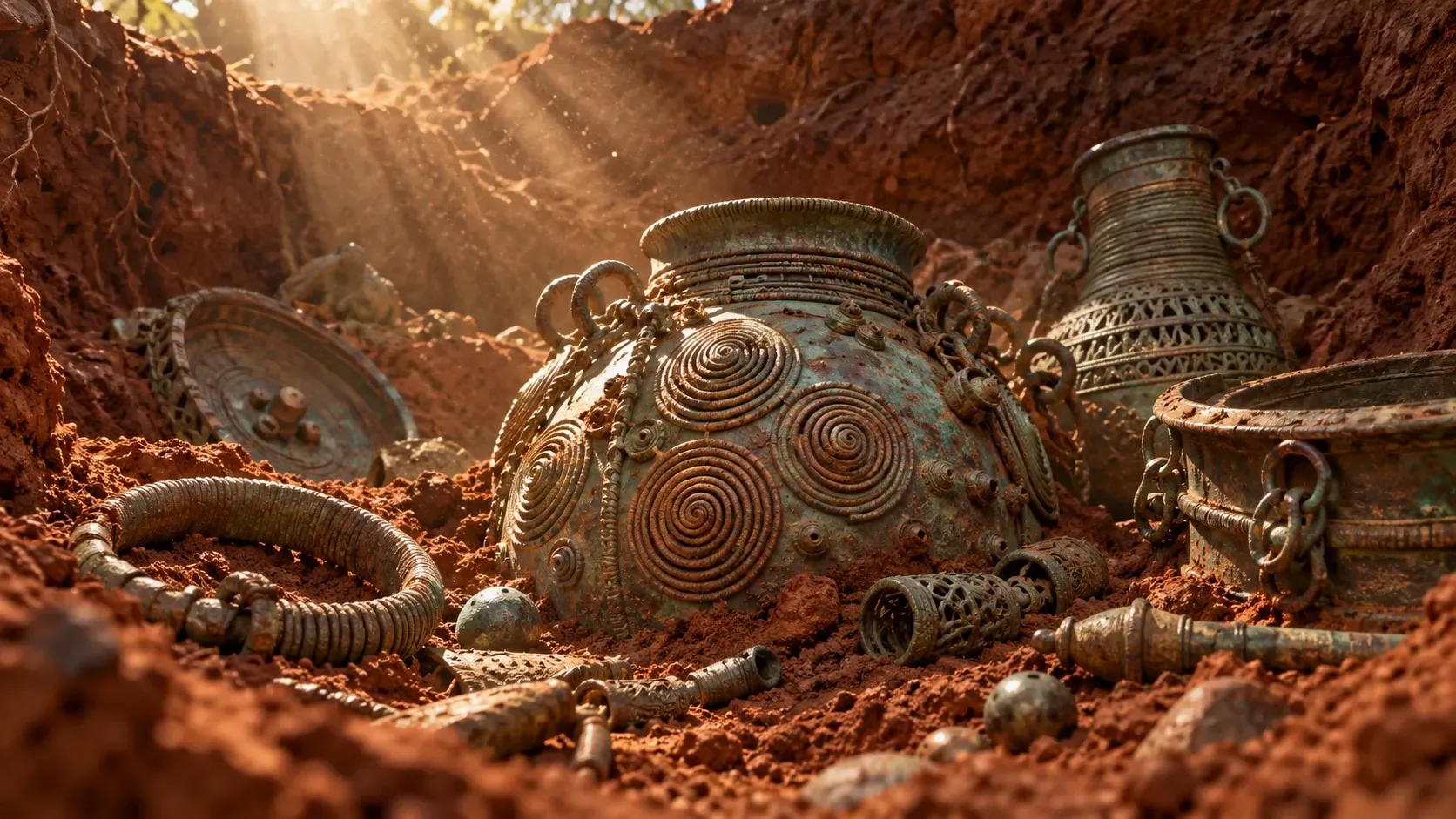
The finds included elaborate copper-alloy vessels, personal ornaments, pottery, textiles and glass beads. Some pieces were so finely worked that the decorative elements seemed almost too delicate for metal. Their makers produced tiny coils and patterns, raised details and shapes that appear to imitate objects made from rope, wood or other materials.
The famous Roped Pot is a particularly good example. Its surface suggests a container bound in intricate cords, yet the elaborate form is preserved in metal. Imagine the difficulty of preserving such a design through a casting process: every line must be planned before the molten metal is poured. The finished object does not offer a second chance to correct an awkward curve.
And the beads posed another problem for anyone hoping for a simple explanation. They pointed to relationships and exchanges beyond one compound. Materials and objects had travelled. The buried metalwork belonged to a society connected to a wider world, even if the precise routes and relationships are still debated.
The treasure had become evidence. It was no longer just a collection of beautiful things.
The missing workshop
One of the strangest parts of Igbo-Ukwu is what archaeologists have not found.
The bronze objects show extraordinary casting skill, much of it associated with the lost-wax method. In simplified terms, a maker models the desired shape in wax-like material, builds a mould around it, removes the model by heating and pours molten metal into the space it leaves. When the mould is opened, its design has become metal.
The precision of the Igbo-Ukwu objects is difficult to overstate. Some pieces contain decorations on a miniature scale, and technical analysis has shown that their makers also understood when to hammer and anneal components rather than cast them. The choice depended on the metal and the job it needed to do.
Yet a major archaeological reassessment published in 2022 noted that no crucibles or casting moulds had been recovered from Igbo-Ukwu itself. That absence does not mean the objects arrived from another continent or that their makers possessed some impossible technology. It means the evidence for precisely where the objects were manufactured remains incomplete.
Perhaps production took place elsewhere. Perhaps the relevant workshop has not been found. Perhaps traces of it did not survive. The available research does not settle the matter.
Metal analysis points toward regional sources for much of the material. An elaborate object could have been made by skilled local craftspeople using knowledge developed over generations, then carried to the place where it was eventually deposited. The precise story is still being investigated.
This is a better mystery than a fabricated curse or a secret map. Researchers have the finished masterpieces. They can examine the metal, measure components and reconstruct possible techniques. What they do not have is the workshop floor where the makers stood.
The evidence seems to begin at the point where a long tradition of skill had already reached an extraordinary level.
How old are the Igbo-Ukwu bronzes, really?
The date most often attached to the Igbo-Ukwu bronzes is the ninth century. It appears in museum essays and countless summaries. Readers can easily come away thinking that every object in the collection has been assigned the same year of manufacture.
Archaeological dates are rarely so cooperative.
The original excavations placed the material broadly in the early medieval period, and discussions of ninth- to eleventh-century production remain common. But a 2022 study of textiles associated with Igbo Isaiah produced a calibrated eleventh- or twelfth-century date for the cloth. The researchers were explicit about what their result meant: dating the textile does not necessarily date the bronze underneath it. An object may have been used for years before someone covered or deposited it.
Other dating work and competing interpretations have further complicated the chronology of the sites. The chronology is a research question, not a tidy label that can be printed once and forgotten.
There is an appealing trap in the treasure-hunting version of history. If the objects are old, make them older. If a chamber is mysterious, call it forbidden. If a workshop is missing, invent a vanished civilization.
None of those additions explains the real objects.
Their age is impressive without exaggeration. Their technical sophistication is documented. The unresolved questions concern how different sites were used, how long the objects remained in circulation and how their makers developed such elaborate methods. An uncertain date is not a failure of archaeology. It is the record of researchers refusing to claim more precision than their evidence allows.
How did a small bronze face reach London?
Return to the pendant in the British Museum.
The catalogue gives more than its size and weight. It describes the object as a lost-wax casting, records its presumed findspot in Isaiah Anozie's compound and identifies Frank W. Carpenter as the donor. The British Museum acquired the pendant in 1956, alongside other objects from the early Igbo-Ukwu finds.
That record gives the little face a traceable twentieth-century journey. The museum notes that Carpenter visited the site in 1939 and obtained objects that had already been distributed locally. Some were later presented to the museum; other related objects entered different collections through further transactions. Not every item followed the same route, and not all pieces now in museums abroad came from Shaw's later archaeological excavations.
The pendant has a remarkably ordinary bureaucratic identity for something so old: a registration number, dimensions, acquisition notes, a recorded condition and a display location. Those details are useful because they let readers inspect an actual object rather than rely on an unsourced claim about a mysterious cache of gold.
The British Museum's public collection record has listed the pendant as on display in Room 25, although museum displays can change and visitors should check before travelling.
Most of the excavated material, however, did not end up in London. Research drawing on excavation records and community oral histories explains that the great majority remained in Nigerian museums and university collections. This distinction matters because Igbo-Ukwu objects are sometimes swept into conversations about the Benin Bronzes, a different body of material with a different history of removal and restitution.
The histories deserve to be kept separate.
The correct answer to where did the Igbo-Ukwu bronzes go? is not a single dramatic shipment to Europe. It is a much less cinematic network of individual objects, early acquisitions, archaeological collections and institutional decisions made over decades.
That network is precisely why their present whereabouts require more than a one-line answer.
The Roped Pot and the problem with being famous elsewhere
Another object provides a different kind of clue. The Roped Pot, one of Igbo-Ukwu's best-known creations, is held in the National Museum in Lagos. The point is worth emphasising: the original is in Nigeria, but it is not in Igbo-Ukwu.
In research involving local oral histories, residents described knowing about the celebrated bronzes without having seen them in person. Some regarded the Roped Pot as a particularly important expression of local identity. Its meaning had not vanished simply because the object was physically elsewhere.
This is a practical problem as well as a cultural one. A photograph tells you what an object looks like from the angle the photographer selected. It is less helpful with scale, depth, the unevenness of a cast surface or the surprises hidden around the back. A glass case in a distant city can preserve an artefact exceptionally well while leaving people in its place of origin with limited access to it.
An archaeological object's location is not proof that its entire story is understood, either. Some bronzes have become familiar through reproductions while questions about their original purpose remain unresolved. Museum labels can be revised. Dating can be reassessed. Communities can contribute knowledge and questions absent from older scholarship.
The recent collaboration with Igbo-Ukwu residents has made that last point impossible to ignore. The participants are not characters waiting for the authorities to return a mysterious gift. They have been involved in recording local memories, preserving knowledge and shaping a project about access to the collection.
That project took a distinctly twenty-first-century turn.
The copies that followed the originals
In May 2024, representatives of the Igbo-Ukwu community joined a digitisation workshop at the National Museum in Lagos. The collaboration involved researchers and organisations including the University of Cambridge, the University of Nigeria, the National Commission for Museums and Monuments and Factum Foundation.
Using photogrammetry, participants helped capture the surfaces of selected bronzes from many photographic angles. The resulting digital models could be used to create facsimiles: physical reproductions designed to convey the shape and intricacy of the originals.
Six iconic objects were recorded in high resolution during the project. Some reproductions were created through detailed 3D printing in steel, then finished to approximate the visual appearance of bronze. They were exhibited at Cambridge in March 2025 and at Oxford soon afterwards.
At first glance, creating copies while the originals remain in museums might seem an odd way to bring treasure home. A replica is not a recovered artefact. It carries no centuries-old manufacturing history, and it cannot settle debates over the custody of the originals. The people who built the ancient objects never touched these new versions.
But a replica can be handled, studied and seen at close range. It can provide a local museum or educational programme with material that is not confined to a photograph or a distant display case. And because community representatives participated in the digital recording, the project was more than an exercise in sending electronic files from one institution to another.
Cambridge reported in June 2026 that further facsimiles had been made available in connection with the programme and that a formal return of high-quality reproductions to the community was planned for August during the New Yam Festival. I found no later independent confirmation of that particular handover in the sources checked for this article, so it should not be described as a completed event.
For a treasure story, this is an unusual modern chapter. Centuries-old craftsmanship is being studied with cameras, computers and metal printers. The originals still have individual histories. The copies have their own, and the possibility of local access is changing because of them.
No one needs to invent a hidden royal fortune to make the sequence strange enough.
A treasure with several addresses
The bronze pendant in London has an accession number. The Roped Pot in Lagos has a place in an institutional collection and a place in the stories people tell about Igbo-Ukwu. The archaeological sites in Anambra State still have names taken from family compounds, not from imaginary kings.
Together, they explain why the first answer to where are the original Igbo-Ukwu bronzes today? is straightforward and incomplete at the same time. The objects are dispersed among recognised collections, particularly in Nigeria and the United Kingdom. The originals are not currently documented as residing in Igbo-Ukwu. Their journeys began at different moments, and the question of community access remains alive.
The man digging a cistern in 1938 needed somewhere to keep water. He uncovered work made by people whose names we cannot recover, using techniques that researchers continue to investigate. Almost ninety years later, their objects are still travelling, sometimes physically, sometimes through the painstaking manufacture of copies.
For now, the final address in this treasure story is not another buried chamber. It is the next place where someone can finally stand close enough to see how those tiny spirals were made.
Sources and further reading
- British Museum — Igbo-Ukwu pendant-mask, Af1956,15.1 (external platform)
- Smarthistory — Igbo-Ukwu (external platform)
- African Archaeological Review — Igbo-Ukwu at 50 (external platform)
- African Archaeological Review — Igbo-Ukwu Textiles: AMS Dating and Fiber Analysis (external platform)
- African Archaeological Review — Metallographic study of Igbo Isaiah objects (external platform)
- Factum Foundation — The Igbo-Ukwu Bronzes (external platform)
- University of Cambridge — Digitisation Project Reconnects Igbo-Ukwu with Historic Artefacts (external platform)
- Azania — A Multivocal Case Study of Archaeological Exploration in Igbo-Ukwu (external platform)