Articles / LORQAI
The Last Person Still Clapping
A mildly embarrassing guide to how applause begins, becomes contagious, finds a rhythm and finally persuades everyone to stop.
The performance is over. Everyone stops applauding. Except you. A witty exploration of the surprising science behind how crowds begin, synchronize and finally end their applause.
By LORQAI
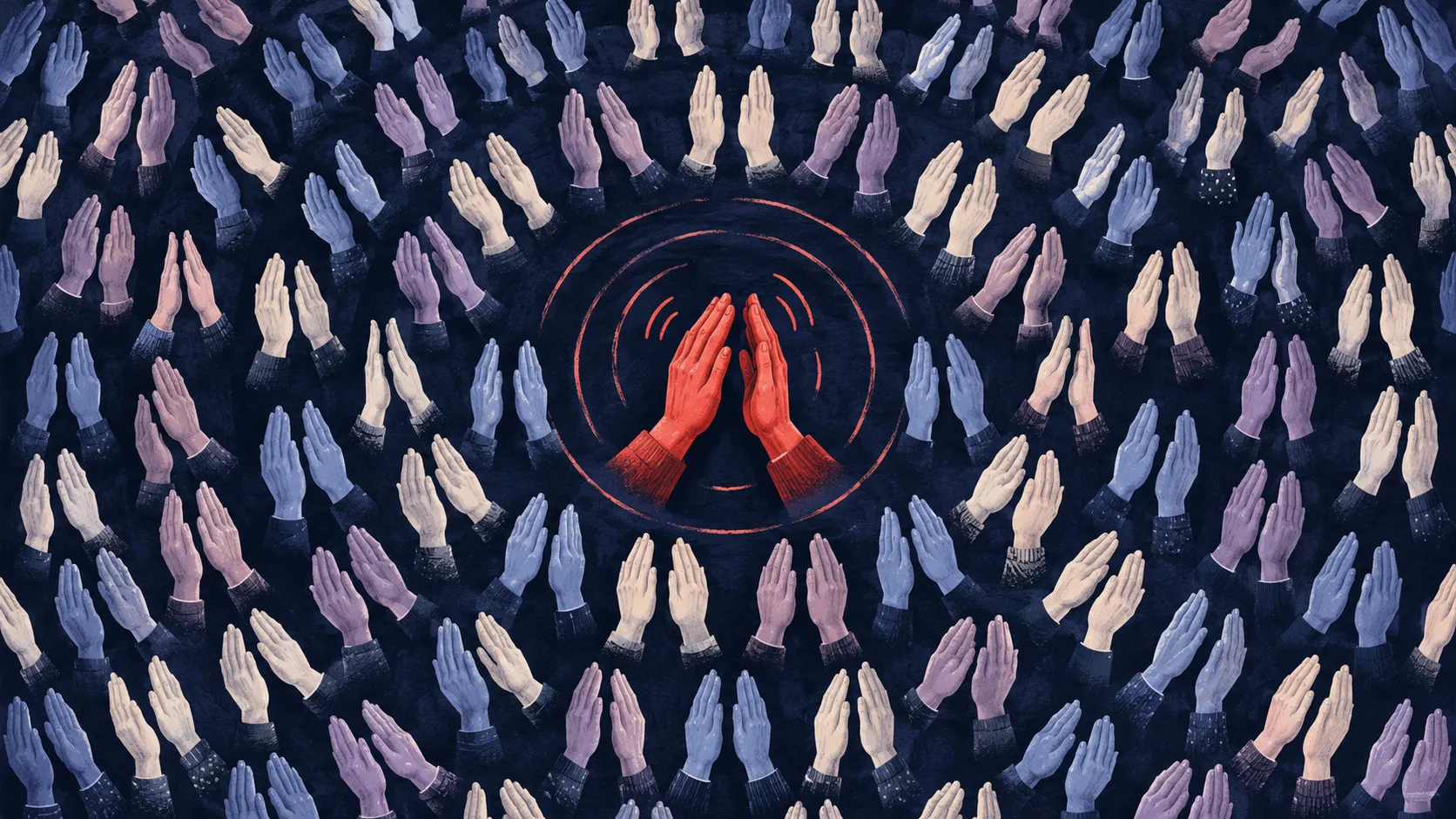
The Last Clap
The performance has ended.
People are applauding enthusiastically. You are among them, expressing your appreciation with the standard equipment provided at birth.
Two hands. A repeated collision. No special training required.
Everything is going well.
Then the noise begins to fade.
A few people stop. Others follow. The room becomes quieter. You notice the change, but your hands are already committed to another clap.
And another.
Suddenly, the entire audience is silent.
Except you.
Clap.
It is an exceptionally clear sound.
Clap.
The second one is worse because it confirms the first was not an accident.
You stop. A person three rows ahead turns slightly. Somewhere in the room, someone coughs with the unmistakable confidence of a person who has not just made a public fool of themselves.
Congratulations. You have become the last person still clapping.
This is a hypothetical incident, although a perfectly plausible one. No real individual needs to be identified or embarrassed for the purposes of our investigation.
The problem is surprisingly interesting.
An audience contains dozens, hundreds or sometimes thousands of people. Most have not met. They have no shared timetable for applause, no appointed conductor and no reliable method of communicating when their appreciation has reached the appropriate quantity.
Yet the applause normally begins, grows and finishes without anybody holding an administrative meeting.
Occasionally it develops a rhythm.
Sometimes it stops abruptly.
And sometimes one unfortunate individual finds that their hands have missed a decision taken by everyone else.
Scientists have studied this behavior.
Their findings are not especially reassuring for anyone hoping that applause operates according to clear, objective rules.
1. Wait Until Someone Else Starts
Suppose you are attending a presentation.
The speaker finishes. There is a short silence.
You think the presentation was good, but you are not certain whether it has officially ended. Perhaps there is another slide. Perhaps the speaker is preparing to make one final observation. Perhaps the concluding sentence was simply delivered with an unusual amount of confidence.
You consider clapping.
The difficulty is that beginning applause alone is socially expensive.
If you are right, you may appear enthusiastic and decisive. If you are wrong, you have interrupted the presentation by making a noise that is difficult to disguise as anything else.
A single clap cannot easily be mistaken for adjusting a jacket.
You could pretend to be swatting a mosquito, but this explanation becomes less convincing after the third repetition.
So you wait.
Then someone near the back starts applauding.
Wonderful.
You join in.
Within moments, the audience is producing a respectable amount of noise.
What happened?
In a 2013 study published in the Journal of the Royal Society Interface, researchers Richard Mann, Jolyon Faria, David Sumpter and Jens Krause investigated the way applause spreads through groups.
They filmed six groups of university students, comprising 107 people in total, as the students responded to oral presentations.
The researchers were interested in social contagion: situations in which one person's behavior increases the likelihood that somebody else will do the same.
Applause offers a particularly convenient example.
Unlike a complicated personal opinion, clapping can be observed directly. A participant either starts clapping or has not yet started. Later, that participant either continues or stops.
The researchers compared different models of what might influence those decisions.
Their analysis found that a person's likelihood of beginning to clap increased with the number of other people already applauding. Physical proximity was not the decisive factor in their model.
You did not necessarily need the person beside you to begin.
The collective signal was enough.
This does not prove that every audience everywhere behaves in precisely the same way. The experiment involved relatively small student groups, and the researchers acknowledged the limits of what their observations could establish.
But it identifies an important mechanism.
Applause can spread because people respond to the applause itself.
The first person starts with an individual decision.
Everyone else receives increasingly persuasive evidence that clapping has become the accepted activity.
And before anyone has formally agreed on anything, the room is applauding.
2. Nobody Has Been Appointed Director of Clapping
The next question is whether the growing applause actually measures appreciation.
Surely an excellent performance deserves longer applause than a mediocre one.
That seems reasonable.
But the findings from the 2013 study complicate the assumption.
The researchers' model suggested that applause duration could vary considerably even without corresponding differences in the quality of the presentations.
The reason was not that the audience had stopped caring about what it had heard.
It was that the duration of applause also depended on how individuals responded to one another.
One person continued because others continued.
Another stopped because enough people had stopped.
The collective result emerged from all those decisions, none of which required a complete understanding of the group's intentions.
This raises an awkward possibility for anyone who has ever estimated the success of a speech by the length of the applause.
Perhaps the applause lasted longer because the audience was more impressed.
Or perhaps one group contained people who were particularly reluctant to stop, and their neighbors were similarly reluctant to become the first people to put their hands down.
Both situations can produce extended applause.
The original study does not imply that performance quality never matters. It investigated a particular mechanism in a particular setting and found that group dynamics could influence the outcome.
The practical lesson is narrower than a grand theory of human behavior.
You cannot reliably read an audience's entire emotional response from the duration of its clapping alone.
An applause meter would be convenient, of course.
The performer could look up at a screen and receive a numerical assessment of artistic success based on the number of hand collisions per second.
Unfortunately, the machine would also have to account for audience size, local customs, the kind of event, enthusiasm, individual behavior and the possibility that somebody is clapping primarily because they would feel awkward stopping.
The proposed device begins to sound rather expensive.
It might be easier to ask people what they thought.
Although that introduces an entirely different set of problems.
3. The Room Discovers a Beat
Sometimes applause undergoes a remarkable transformation.
At first, people clap independently.
Each person has a preferred rhythm. Some are fast. Others are slow. Hands strike at different times, producing a continuous wash of sound.
Then something changes.
A pattern emerges.
Instead of a chaotic collection of individual claps, the audience begins clapping together.
The separate sounds form a recognizable beat.
For a moment, an audience that cannot agree where to place its coats has become a reasonably effective percussion ensemble.
Nobody rehearsed.
There was no conductor.
The rhythm simply appeared.
In 2000, researchers studying audience behavior published an investigation in Nature and a more detailed paper in Physical Review E examining this phenomenon.
Their work explored spontaneous synchronization: the ability of separate rhythmic activities to become coordinated through their interactions.
The phenomenon has parallels in other physical and biological systems, although those comparisons do not mean people are behaving identically to pendulums or insects.
In an applauding audience, people can hear the surrounding rhythm and adjust their timing.
The fascinating part is how synchronization becomes possible.
The researchers found that individual clapping could shift between a relatively fast, noisy mode and a slower mode with more consistent timing.
By slowing their clapping, audience members made it easier for their rhythms to align.
The crowd developed a beat.
But the result involved a trade-off.
Synchronized applause could be less noisy than the initial chaotic applause.
That is strange because an audience trying to express strong enthusiasm may want to produce a great deal of noise.
Clapping more slowly helps people keep time together.
Clapping more rapidly can produce a louder, more continuous sound, but makes coordination harder.
The researchers described this tension as a form of frustration within the system.
It was a technical term, not evidence that everyone had become personally annoyed.
The audience was effectively trying to achieve two objectives that did not always cooperate.
A strong collective rhythm.
And a satisfying amount of noise.
When the rhythm became too slow or insufficiently loud for some participants, faster clapping could disrupt the synchronization.
The room returned to irregular applause.
Then, under suitable conditions, synchronization might emerge again.
It is an impressive amount of physics to discover inside an activity usually performed without conscious calculation.
The next time a crowd begins clapping in unison, remember that an elaborate coordination problem is being solved by people who may simultaneously be wondering where they left their car keys.
4. Please Stop Before It Becomes Personal
Starting applause is one problem.
Ending it is more delicate.
At least the beginning has an obvious external event. The performance finishes. The speaker steps away. A curtain falls. The audience receives some indication that it may now begin making noise.
The end of applause has no equally reliable signal.
Someone must decide that enough has been said.
Except nothing is being said.
Everyone is hitting their hands together.
The 2013 research found that stopping, like starting, was socially influenced. People reacted to others who had ceased clapping, although individual tendencies also mattered.
Some participants were more inclined to continue than others.
The researchers' model included both social influence and personal reluctance to clap indefinitely.
That makes sense from the perspective of a person in an audience.
At first, you clap because you wish to show appreciation.
After a while, you notice that other people are still clapping.
You continue.
Then a few stop.
The noise becomes thinner.
You begin considering whether to join them.
At some point, your desire to express appreciation must compete with the possibility that you are now merely producing unnecessary sound.
There is no precise number of claps at which the situation changes.
A person who stops early may feel conspicuously unenthusiastic.
A person who stops late may feel conspicuously enthusiastic.
Between those two risks lies a narrow region of social comfort in which most people hope to place themselves.
You can attempt to monitor your surroundings.
Listen for the applause fading.
Watch the hands of the people nearby.
Try to estimate whether the audience has entered its final moments.
But this creates a new difficulty: while you are analyzing the crowd, you are still required to operate your own hands.
The task involves both observation and participation.
If you think about it too hard, you may lose the rhythm entirely.
One could propose a technical solution.
Install a traffic-light system above every stage.
Green: applause permitted.
Yellow: begin reducing hand activity.
Red: please stop immediately.
It would be effective, but perhaps a little severe.
And somebody would have to decide when to change the light.
The original question would remain.
5. What If the Entire Audience Is Waiting for You?
Imagine that you are attending a small public lecture.
The speaker concludes. There is applause.
You begin clapping because you enjoyed the talk. The person beside you continues, so you continue too.
They are watching you.
You are watching them.
Neither wants to be the first to stop.
The applause becomes a polite disagreement conducted entirely with palms.
Now imagine several people doing the same thing.
No participant needs to consciously decide that applause should last unusually long. The collective behavior can continue because each person receives signals from other people who are themselves responding to the group.
This is the amusing practical consequence of social contagion.
The audience can collectively generate an outcome that nobody individually planned.
It does not mean every prolonged ovation is an accident. In many settings, the audience deliberately wants to express sustained enthusiasm, and cultural expectations shape how that expression works.
But the mechanism investigated by researchers helps explain why the duration can sometimes have a life of its own.
There is also a difference between clapping in a small lecture room and applauding in a large concert hall.
In a lecture room, individual claps may be easy to distinguish. You might notice precisely who stops or starts.
In a large hall, the sound becomes a collective environment. You hear the applause around you, but determining the actions of particular people may be difficult.
The social cues are different.
So are the expectations.
At a formal concert, audiences may follow conventions about when applause is appropriate. During a comedy performance, laughter can interrupt the action and applause may follow particular moments. At a sporting event, appreciation may erupt without waiting for any official ending.
Some audiences clap rhythmically.
Others don't.
Some stand.
Others remain seated.
There is no universal law specifying the correct number of claps for a particular experience.
That is fortunate, because enforcing one would require an international committee.
It would eventually publish a document containing recommendations about applause intervals, acceptable enthusiasm and procedures for exceptional performances.
The document would be very long.
The audience would be expected to applaud its publication.
And nobody would know when to stop.
6. Your Hands Are Not a Scientific Instrument
The difficulty with interpreting applause is that a single observable action can express several things.
Clapping may show approval.
It may also acknowledge effort, signal encouragement, celebrate an outcome or participate in a social convention.
Sometimes the act is expected regardless of whether everyone was equally impressed.
At the end of a school performance, for example, applause may serve a supportive purpose that is not comparable to evaluating a professional concert.
A person can clap for someone they care about, even if the performance involved a few technical difficulties and an instrument making a noise its manufacturer never intended.
The action looks the same.
The meaning differs.
The Max Planck Institute for Empirical Aesthetics has examined applause as a social and cultural phenomenon, asking how individuals relate to the group and why collective appreciation begins and ends.
Such research recognizes that applause is simultaneously a personal action and a public one.
One person's private response becomes part of a sound everyone can hear.
That creates an unusual form of communication.
A written review can describe exactly what somebody liked or disliked.
Applause is less specific.
It provides intensity, duration, perhaps rhythm, and whatever additional signals accompany the behavior.
It cannot explain which scene was especially successful or which argument changed someone's mind.
Nor can it reliably identify how much of the response came from personal enthusiasm rather than convention.
In a large group, individual differences are mixed together.
Someone may be delighted.
Someone else may be politely appreciative.
A third person may be trying to finish clapping while holding a program, a coat and a bag.
All three contribute to the same sound.
This does not make applause meaningless.
It makes applause a wonderfully imprecise instrument.
It is good at creating a collective event.
It is less suited to producing a detailed report on the quality of what just happened.
A performer listening to an audience may receive valuable encouragement, but the applause alone cannot explain every individual response.
For that, the performer would need to ask people.
Preferably after they have stopped clapping.
7. The Official Emergency Procedure
We can now return to the unfortunate person from the beginning.
The hypothetical audience has become quiet.
You are still clapping.
Your last two claps echo through the room with a clarity that would make a professional sound engineer proud.
What should you do?
First, stop.
This is the most effective available intervention.
Do not attempt to explain yourself with additional clapping.
Do not look indignantly at the audience, as though everyone else has abandoned a collective commitment.
And do not try to transform the situation into a standing ovation. That would introduce a second problem requiring an entirely new article.
If you are extremely lucky, another person may produce an accidental final clap at the same time.
You can then share responsibility for the ending.
If nobody does, accept that you have briefly supplied the room with one extra piece of percussion.
The consequences are likely to be modest.
Most people will return to whatever they were doing. They may gather their belongings, look toward the stage or begin leaving. The performance will remain the main event.
You are unlikely to become a permanent figure in the history of applause.
The scientific research does not provide a method for identifying the socially perfect moment to stop.
It explains why the moment is difficult to determine.
People observe the group.
The group changes as people act.
Each participant is both responding to the collective sound and helping produce it.
The ending therefore emerges through many small decisions, rather than from an official signal that everybody receives at exactly the same time.
And if you happen to be the person whose decision comes last, there is no need to panic.
After all, somebody has to be last.
It could be the person in the front row.
It could be the person who was particularly impressed by the performance.
It could be the person who lost track of the surrounding noise.
Or it could be you, discovering a surprisingly public way to find out that everyone else has gone quiet.
There is only one situation that requires immediate attention.
Suppose you finish your final clap.
The room is silent.
Then, from somewhere behind you, another person begins applauding again.
You turn around.
They are looking at you.
You are looking at them.
Neither knows whether to continue.
And suddenly the entire experiment starts over.