Articles / LORQAI
The Forest That Buries Its Monkeys
Why Boabeng-Fiema has a monkey cemetery, what a funeral can mean for the living, and how two Ghanaian villages made an old obligation part of wildlife conservation.
In two Ghanaian villages, sacred monkeys receive funerals and graves. Behind the unusual cemetery lies a system of religious obligation, community rules and wildlife protection.
The Forest That Buries Its Monkeys
The most surprising thing about the monkey cemetery in Boabeng-Fiema is not that the animals have graves. It is that the graves are only one part of a much larger set of rules governing how people live.
In a study of wildlife protection in central Ghana, published in 2019, a traditional priest described what could be required of someone who killed a monkey, even accidentally. The person might have to provide a coffin and take part in a funeral. The point was not merely to dispose of the body. A death had consequences for the community, and the community expected the person responsible to acknowledge them.
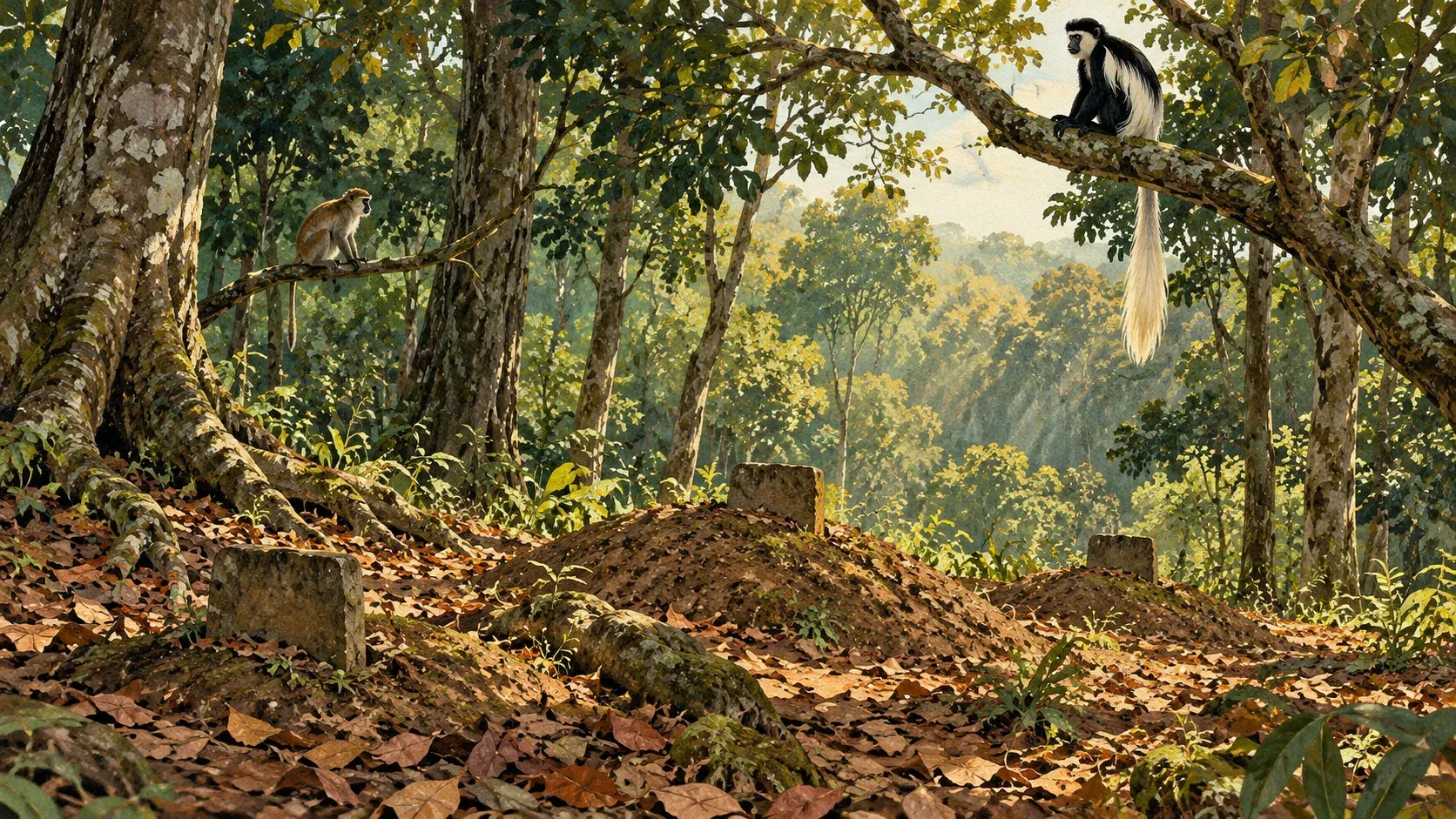
That is an unusual detail to encounter in a scientific paper. It sounds like the beginning of an absurd story about a village that has confused animals with people. But there is a real cemetery in the forest near Boabeng and Fiema, neighbouring communities in Ghana's Bono East Region. Researchers, reporters and local heritage organisations have described marked graves for monkeys. A journalist who visited in 2023 recorded a guide's account of bodies wrapped in cloth, placed in coffins and given special rites.
Why are monkeys buried in Boabeng-Fiema? Because, in local religious tradition, these animals are regarded as closely connected to the communities' deities and therefore entitled to protection and respect in death as well as in life. Their burials make that relationship visible. They also belong to a system of rules that has helped keep primates alive in a landscape where the survival of wildlife cannot be taken for granted.
The cemetery is the detail visitors remember. To understand it, we need to meet the residents who are still alive.
Two villages, two very different kinds of monkey
Boabeng and Fiema lie near Nkoranza in central Ghana. The name of the sanctuary joins them with a hyphen, but the two communities have histories and traditions of their own. Between and around them stands a patch of forest whose inhabitants are unusually free to cross a boundary that normally divides people from wild animals.
Mona monkeys are the conspicuous ones. Accounts from visitors and local heritage organisations describe them climbing onto roofs and moving through village spaces, sometimes approaching people who offer food. They are quick, curious and comfortable enough around humans to make an encounter feel almost domestic. That familiarity can be misleading: they remain wild animals, and an animal accepting a banana is not an invitation to treat it as a pet.
The black-and-white colobus monkeys tend to stay higher among the trees. Their pale tails and contrasting coats make them visible through the foliage, but they are less inclined to investigate a visitor's possessions. The two types of primate occupy the same protected landscape without behaving as though they have read the same guidebook.
Ghana's Forestry Commission describes the sanctuary as a community-based protected area. It credits generations of local prohibitions against hunting and killing monkeys and notes that the forest also protects the headwaters of streams used by nearby residents. Conservation here is not solely a story about charismatic animals. The water and trees matter to the people too.
Descriptions of the sanctuary's monkey population vary substantially from one publication to another. Some count several hundred; a 2023 report cites a larger figure. The sources do not always specify the date, method or species breakdown behind each number. We cannot responsibly turn one of those estimates into a precise current census for October 2026.
What can be said with much greater confidence is that monkeys still form part of everyday village life, and that their protected status is not a recent invention designed to entertain tourists. The protection grew from a relationship whose origins are told as a story.
The story of a hunter who did not shoot
Versions of Boabeng-Fiema's foundation tradition do not agree on every object or every person. In one account, a hunter encountered monkeys gathered around a calabash or vessel in the forest. In another, the vessel was covered with cloth. The encounter became associated with instructions from a local deity: the animals were to be treated with special care rather than hunted.
The name Daworo appears in accounts of Boabeng's religious tradition. Fiema is also associated in local narratives with a deity whose name is rendered in different spellings, including Abodwo. A Nkwantananso cultural heritage project hosted by the University of Michigan describes the first monkeys as children of the deity, and later generations as descendants entitled to protection.
These are traditions about the origins of the communities' obligations. They should not be read as verified transcripts of a hunter's conversation or as records from a particular morning in the nineteenth century. A 2006 scholarly study notes that the taboo is thought to go back to the 1830s, while also recording an alternative view that earlier inhabitants may have established the practice before the present villages took shape.
That uncertainty is not a defect that needs to be repaired with a better date. Oral traditions may preserve relationships and obligations while telling their beginnings in different ways. The important fact for this investigation is not whether someone can prove the number of monkeys standing beside a calabash. It is that the rule they represent has persisted long enough to shape how later generations treat living animals.
A photograph of a monkey beside a house can show a moment of coexistence. It cannot show the unwritten rule that makes the moment possible. The story of the hunter does that work: it places a prohibition inside the history of the community.
One modern misunderstanding deserves to be separated from the tradition. Calling monkeys the 'children of the gods' is an expression of sacred kinship within the belief system described by local and scholarly sources. It is not evidence that the animals were literally human beings transformed into monkeys. A sensational retelling may prefer that version. The sources on which this article relies do not establish it.
A village can recognise an animal as sacred without making claims about its biological origin. Scientists still study the monkeys as primates. Residents and priests may understand their relationship to them through religious duty. Those two descriptions address different questions.
What happens when a monkey dies?
The sanctuary has a burial ground. That fact is independently reported in accounts from the Nkwantananso cultural project, the Ghanaian newspaper Graphic Online, and Cultural Survival, whose 2021 article describes records of the dead on cemetery markers.
A journalist for The Mirror, published through Graphic Online in November 2023, spoke with a sanctuary guide, Sophia Dansoaa Opoku. She described wrapping a dead monkey in calico, placing it in a coffin and carrying out funeral rites. The guide also told the reporter that two former traditional attendants had been buried in the monkey cemetery. Those are attributed statements about local practice, not scenes we can claim to have witnessed.
There are small but significant limits to what the reporting establishes. It does not provide a contemporary photograph of every burial, a complete list of who is entitled to a marked grave or a rule proving that every dead monkey is treated identically. The Michigan-linked cultural project refers specifically to graves for special monkeys. Practices may vary with the animal, the circumstances of death and the decisions of those responsible for the rites.
Still, the existence of a cemetery changes what a death means. For most wildlife stories, an animal disappears from the count and enters the language of population trends. In Boabeng-Fiema, at least some dead monkeys enter the community's memory through a grave and a name or identifying record. The animal had been a familiar presence. Its absence can be acknowledged in a public place.
Human burial rituals are complicated even within a single town. They can combine belief, family duty, public recognition and the practical need to care for the dead. The monkey funerals should not be flattened into a claim that humans and monkeys have exactly the same status. What the sources describe is a distinctive ritual respect expressed through some comparable forms: wrapping, coffin, burial and ceremony.
The cemetery also has an unusual place in the story of responsibility. According to the 2019 research, a traditional priest explained that someone who killed a monkey could be required to purchase a coffin and take part in the funeral. This is a reported example of community enforcement, not a statement that every accident today receives an identical penalty. But it makes the logic plain. A person who destroys something protected cannot simply treat the animal as rubbish and leave.
The grave is where the rule becomes impossible to overlook.
An old prohibition acquires a modern uniform
A surprising fact about this sanctuary is that the traditional rules did not remain untouched by modern government. They acquired legal support.
The Forestry Commission explains that local taboos originally protected the animals, but changes in behaviour and weaker enforcement threatened their survival. The communities were helped to establish district assembly bylaws, with the Wildlife Department assisting enforcement. Academic studies document arrangements that include traditional authorities, local government and wildlife officers.
During the 1970s, according to researchers, hunting pressures and disputes over the older prohibitions created serious concern. The sanctuary's establishment is dated to 1974 in some public accounts and to 1975 in others; those dates may refer to different stages of recognition, but the reviewed sources do not give enough detail to reconcile every usage confidently. What is clear is that community protection became linked to formal wildlife management during that period.
The arrangement is not as tidy as two separate boxes labelled 'tradition' and 'law'. In a 2019 study by Emmanuel Yeboah-Assiamah and colleagues, researchers interviewed thirty-three people involved in the sanctuary's governance, including chiefs, priests, officers, farmers and community members. Their picture was of overlapping authority. Traditional leaders could interpret prohibitions and impose community consequences; wildlife officers and public institutions provided legal powers and formal oversight.
A chief might see an offence through the lens of local obligation. An officer might see a violation of wildlife protection rules. The same act could matter in both systems. The researchers found that cooperation between them strengthened protection, while also warning that arrangements need to adapt and include the people affected by them.
This matters more than the convenient claim that the monkeys are safe because everyone happens to love monkeys. Love is difficult to legislate. Expectations, reporting, sanctions and institutions are things people can organise. Boabeng-Fiema has spent generations doing some version of that work.
The result is distinctive, but it is not magical. Laws can be ignored. Customs can weaken. Visitors can behave badly. Communities can disagree over who has authority. A sanctuary survives through repeated decisions, not through the existence of a charming story on a signboard.
The forest is harder to protect than the monkeys
There is a complication in the success story that any serious account must include.
In 2006, researchers Tania Saj, Charles Mather and Pascale Sicotte examined the sanctuary's traditional taboos. They acknowledged the notable protection given to the colobus and mona monkeys but identified a limit: the surrounding forest and other animals did not always receive the same level of religious protection. The animal at the centre of the taboo could be spared while the habitat around it remained vulnerable.
That distinction is easy to miss when the forest looks green in a photograph. Trees may stand and still have fewer places for wildlife to find food or shelter. Land can be gradually cleared around the edges, firewood collected, farms expanded or pathways altered. The question for conservation is not only whether a person will shoot a monkey; it is also whether the monkey will have somewhere to live.
A much earlier assessment by Patrick Fargey, later published in Oryx, likewise described degradation or loss of parts of the forest on which the animals depended. Research that followed has explored how local agreements and government regulations might work together to protect more than the most visible species.
The point is not to dismiss the burial tradition as ineffective. It is to understand exactly what it does well. A prohibition against killing a sacred animal is highly specific. Managing a changing ecosystem requires decisions about vegetation, water, farming, access and development. The first rule can support the second set of decisions, but it cannot replace them.
In a 2021 essay for Cultural Survival, Samuel Afutor described community efforts including tree planting and a fire belt around the sanctuary. He also noted the importance of ecotourism income for local projects. Those details bring the story down from symbolism to ordinary maintenance. A tree planted to reduce fire risk may do more for an animal's future than a story repeated a hundred times, even though the story might be what persuades people to plant the tree in the first place.
The cemetery and the living forest are connected. There is little reason to celebrate the first if the second cannot support the animals whose lives the community honours.
What visitors see, and what they don't
If the phrase 'monkey cemetery' catches a person's attention online, they may expect the entire sanctuary to be a collection of unusual graves. That is only a small part of the place.
Visitors come to see monkeys moving through forest and village. Mona monkeys may approach settled areas; colobus monkeys tend to keep to the trees. A local guide can explain the traditions and help visitors understand why certain behaviours matter. The historical and cultural interpretations belong to the people whose community made the sanctuary possible, not simply to outside photographers collecting exotic images.
Tourism has practical costs. Graphic Online's 2023 feature recorded complaints about poor road conditions, particularly in wet weather, and difficulties reaching the site. It also discussed the challenge of maintaining older ceremonial roles as social expectations changed. Those observations came from people interviewed at that time; they cannot be taken as a definitive report on conditions today.
And tourism has possible benefits. Local guides, rest houses and community projects give residents reasons to keep the sanctuary functioning. Cultural Survival describes community work and the use of visitor revenue for local improvements. The value of those benefits needs to be assessed locally, not assumed merely because a project calls itself ecotourism.
The distinction between a protected animal and a tame animal remains essential. A monkey taking food from a visitor may be accustomed to people but is still a wild primate, with its own needs and risks. Any contemporary visit should follow the sanctuary's current rules and qualified local guidance rather than imitate behaviour seen in a travel video.
The funeral custom, in particular, deserves care in how it is presented. It is part of living religious and cultural practice. It is not a performance that exists so a visitor can collect an amusing photograph. Nor should the story be exaggerated into the claim that every monkey has a personal grave or that everyone in the communities interprets the rituals in exactly the same way.
A respectful account leaves room for variation and for the people who are actually responsible for the place to speak for themselves.
The rule that outlives an animal
There is a practical reason to ask why monkeys are buried in Boabeng-Fiema, and a historical reason to keep asking after the first answer.
The practical answer is that some monkeys receive graves and funeral rites because the animals hold sacred status in local tradition. This is documented by cultural organisations, reporters and researchers. The custom recognises a relationship that is meant to continue beyond any one animal's life.
The historical answer is larger. The prohibitions surrounding those animals have been maintained, challenged, adapted and reinforced by community authority and public wildlife law. They helped make the sanctuary possible. Research has also shown why their success does not eliminate pressure on the forest.
The most revealing detail remains the coffin. It turns an offence against a protected animal into a responsibility that others can see. The person who caused the death may have to face the community and the ritual consequences. The dead animal is treated with care, and the living are reminded that protection is an obligation rather than a slogan.
A cemetery normally looks backward. It records lives that have ended. In Boabeng-Fiema, the monkey graves also point forward, toward the next animals moving through the trees and the next generation deciding what kind of neighbours they intend to be.
That decision is what keeps a forest inhabited.
---
Sources and further reading
- Ghana Forestry Commission — Boaben-Fiema Monkey Sanctuary (external platform)
- Nkwantananso Cultural Center / University of Michigan — Boabeng Fiema Monkey Sanctuary (external platform)
- Graphic Online / The Mirror — Living with Monkeys at Boabeng-Fiema (6 November 2023) (external platform)
- Cultural Survival — Part of Nature, Co-existing and Sharing: Insights from Boabeng Fiema (20 April 2021) (external platform)
- Yeboah-Assiamah et al. — Two Sides of the Same Coin: Formal and Informal Institutional Synergy in a Case Study of Wildlife Governance in Ghana (2019) (external platform)
- Saj, Mather & Sicotte — Traditional Taboos in Biological Conservation: Boabeng-Fiema (2006) (external platform)
- Attuquayefio & Gyampoh — The Boabeng-Fiema Monkey Sanctuary, Ghana: Blending Traditional and Introduced Wildlife Conservation Systems (2010) (external platform)