Articles / LORQAI
The Door That Never Quite Opens
Why buildings have revolving doors, how a nineteenth-century invention learned to control the weather, and why the simplest way inside is sometimes the door next to it.
A building wants visitors, but not the weather they bring. The surprisingly ingenious history of revolving doors, from nineteenth-century patents to modern architectural design.
By LORQAI
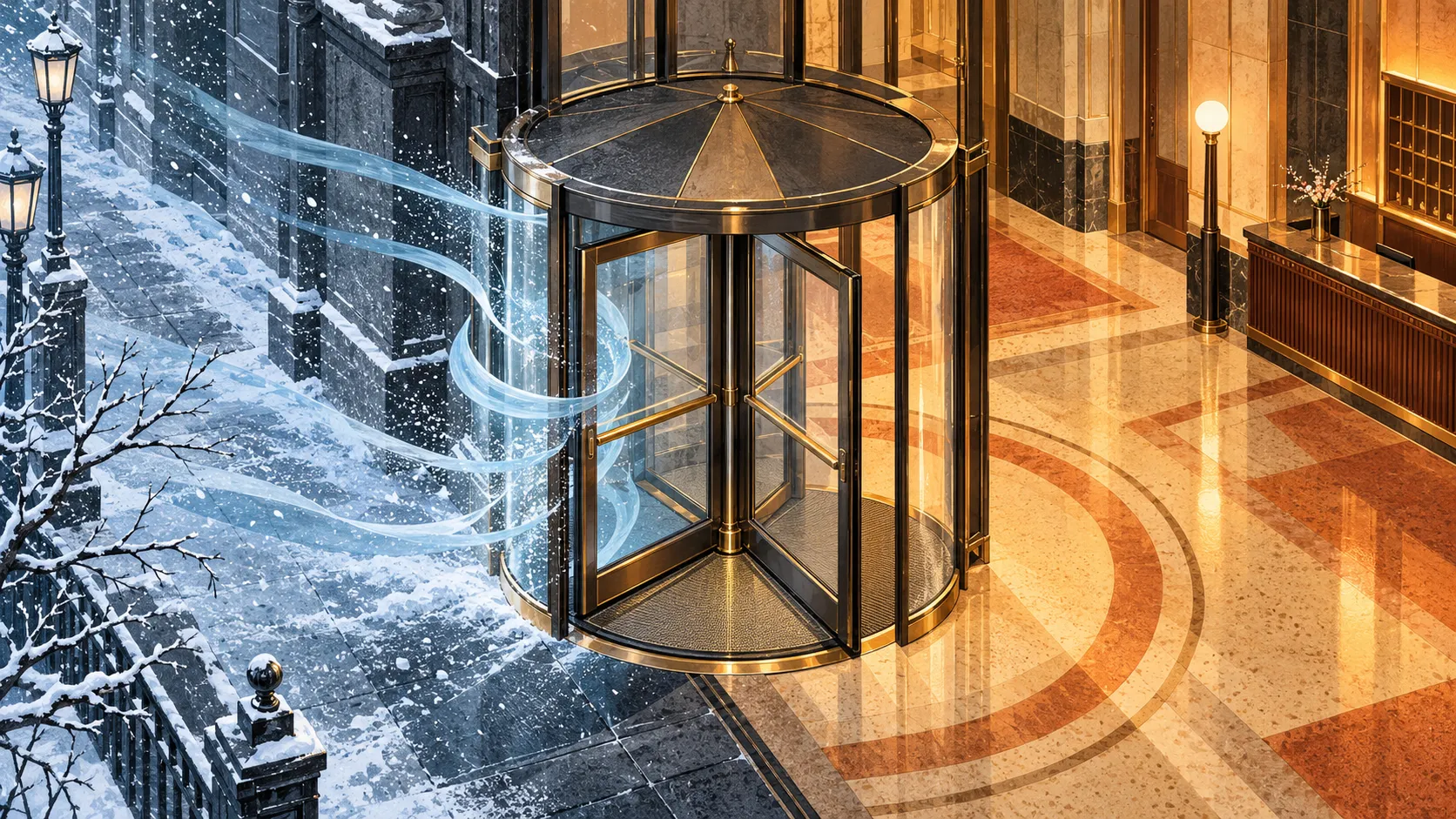
The Building and the Door
The building would prefer that you did not open the door.
This is an awkward position for a building to take, particularly one containing a hotel, a restaurant or several hundred offices. Its owners have spent a considerable amount of money attracting people inside. There may be an impressive lobby, a reception desk, carefully arranged furniture and somebody employed to make visitors feel welcome.
Nevertheless, the building would rather you kept the outside outside.
On a cold morning, the street contains air that the heating system has not paid to warm. On a hot afternoon, it contains air that the cooling system would prefer not to acquire. There may also be dust, traffic noise, rain and a strong wind apparently determined to inspect the reception area.
An ordinary door presents a simple choice.
Open or closed.
When it is closed, the building is reasonably content. When it is open, the two environments are invited to exchange air.
This arrangement becomes increasingly inconvenient as people arrive and leave throughout the day. The door opens. Someone enters. It closes. Someone else appears. It opens again.
The building cannot reasonably ask everyone to come back at a more convenient time.
So architects found another solution.
A door that moves people between inside and outside without creating the same uninterrupted opening between them.
It looks like a cylindrical glass cabinet divided into compartments. You enter one section, walk around a central axis and emerge on the other side.
If you are fortunate, nobody approaches at a dramatically different speed.
The revolving door is one of the few architectural devices that turns entering a building into a brief exercise in coordination. It is also a remarkably clever piece of environmental engineering.
And it was developed to address a problem that ordinary doors had been admitting for centuries.
The wind.
The Smallest Room You Will Never Rent
A typical revolving door has several leaves radiating from a central shaft, enclosed by a curved outer wall.
The leaves divide the circular space into compartments. As the assembly turns, each compartment moves between the street and the lobby.
A person steps in, advances with the rotating structure and steps out.
The essential feature is not that the door moves in a circle. It is that the moving partitions keep the outside and inside from being directly connected by a large, continuously open passage.
At least, that is the objective of a properly operating design.
The compartments are not perfectly airtight. Air can leak through gaps, and some is carried along as the door rotates. A revolving door does not maintain a laboratory-grade separation between environments.
But it can greatly reduce the uncontrolled air exchange associated with repeatedly opening an ordinary hinged door.
Consider what happens with a conventional entrance on a windy day.
Someone pushes the door outward. A large opening appears. Pressure differences encourage air to move through it. The visitor enters, perhaps holding the door for another person. More air crosses the threshold.
The entrance is serving its human purpose extremely well.
Its thermal performance is less impressive.
Now consider a revolving door.
As one compartment opens to the street, other leaves continue separating the lobby from the exterior. The passage is divided into smaller moving spaces rather than becoming one continuous opening.
People can pass through while much of the separation remains in place.
The design is sometimes described as functioning like an airlock. The comparison is useful, provided nobody imagines that a hotel entrance maintains the pressure conditions of a spacecraft.
A revolving door is not a sealed airlock with a controlled sequence of independent gates.
It is a rotating arrangement that restricts the direct passage of air.
That distinction also explains the door's peculiar appearance.
An ordinary entrance needs a clear opening and a moving panel.
A revolving entrance needs curved walls, several panels, a central pivot and enough space for people to walk through its compartments.
All that construction serves one deceptively modest purpose.
To admit the person without admitting quite so much of everything surrounding the person.
The visitor may believe they have entered a building.
From the building's perspective, it has successfully admitted a visitor while declining most of the visitor's atmosphere.
The Building Is an Enormous Chimney
Wind is only part of the problem.
Tall buildings introduce another complication, one that is difficult to appreciate from the pavement.
Air moves in response to pressure differences. These differences can be created by wind, mechanical ventilation and variations in temperature.
Warm air is less dense than cold air. In a tall building during cold weather, warm indoor air tends to rise, creating a pressure pattern that can draw outside air into lower levels and push air outward higher up.
Engineers call this the stack effect.
The name is appropriate. A tall building can behave, in certain respects, like an enormous chimney.
Unfortunately, its occupants may have rather different ideas about what a lobby should feel like.
Imagine the main entrance of a tall office tower on a freezing morning.
Outside, the air is cold. Inside, the heating system is trying to maintain a comfortable temperature. The building's height and internal temperature differences contribute to pressure conditions that can make an entrance surprisingly difficult to manage.
An ordinary door may feel unusually heavy. Once opened, it can admit a noticeable rush of cold air. Nearby staff may experience drafts each time another group of people arrives.
The problem is not that the architect has accidentally left a window open.
It is that the entrance connects two environments under different conditions.
The taller the building, the more important these pressure effects can become, although the actual result depends on its design, temperature difference, air leakage and mechanical systems.
A revolving door helps manage that connection.
Because it limits the large, direct opening between interior and exterior, it can reduce drafts and uncontrolled air movement through the entrance.
The American Society of Heating, Refrigerating and Air-Conditioning Engineers, known as ASHRAE, includes revolving doors and double-door airlocks among design approaches for managing airflow between building zones.
This is important because a revolving door is not a replacement for ventilation.
Buildings still need appropriate fresh air, temperature control and pressure management. An entrance that restricts uncontrolled drafts does not eliminate the need for a properly designed mechanical system.
The objective is to exchange air deliberately rather than allowing every visitor to make an independent decision about the building's heating bill.
A comfortable lobby depends on much more than the entrance.
But the entrance is an unusually busy hole in the building's protective envelope.
And someone eventually had the idea of putting that hole on a turntable.
The Invention That Declared War on Drafts
In December 1881, a German inventor named H. Bockhacker obtained a patent for an early form of draft-reducing revolving entrance.
The basic ambition was already recognizable: allow passage without creating the uncomfortable airflow of an ordinary open doorway.
Several years later, an American inventor developed the design that would become particularly influential.
Theophilus Van Kannel, working in Philadelphia, received United States Patent No. 387,571 on August 7, 1888.
Its title was Storm-Door Structure.
Not A Magnificent Circular Entrance for Important Hotels.
Not The Modern Door of Tomorrow.
A storm-door structure.
The name states the problem without ceremony.
Van Kannel's design featured a rotating central assembly with three radiating wings inside a fixed enclosure. Its construction was intended to reduce the entry of wind, rain, snow and dust while allowing people to pass.
The original patent describes the mechanical arrangement in considerable detail. The wings were fitted within the curved structure, with provisions to help them form a close fit.
The essential principle remains familiar to anyone who has used a modern revolving door.
The person advances.
The enclosure rotates.
The entrance remains divided.
Van Kannel continued developing variations on the idea and established a business producing revolving doors. He was awarded Philadelphia's John Scott Medal in 1889 in recognition of the invention's usefulness.
By the early twentieth century, revolving doors had become associated with the entrances of larger commercial buildings, hotels and offices.
They belonged naturally to an era in which architecture was learning to accommodate increasingly busy, increasingly tall buildings.
It is easy to admire the invention as a piece of mechanical ingenuity.
But its commercial appeal was not limited to its workings.
A polished revolving door could make an entrance look impressive. Glass, metalwork and careful proportions turned a practical draft-reducing device into a feature of architectural presentation.
For a hotel, that combination was particularly attractive.
The door could help protect the lobby's atmosphere while also announcing that the building was a serious establishment with a carefully designed entrance.
Guests might not have understood the pressure differences.
They understood the polished brass.
An object created partly to keep unpleasant weather outside became one of the familiar visual signals of an elegant interior.
There is a certain architectural cleverness in that transformation.
The machine was performing a practical task.
The building allowed it to look ceremonial.
The Students Who Preferred the Wrong Door
More than a century after Van Kannel's patent, a group of students at the Massachusetts Institute of Technology noticed something inconvenient.
Buildings had revolving doors.
People did not always use them.
At MIT's Building E25, students and staff frequently chose the adjacent swinging entrance instead.
This was entirely understandable from a human perspective.
A conventional door offers a simple, familiar interaction. You approach it, open it and walk through. If somebody is holding a large bag or walking with a friend, the process may feel more convenient than entering a compartment that is already rotating.
But the choice created an energy problem.
In 2007, MIT's Energy Initiative described a student campaign encouraging the use of revolving doors. The project grew from an examination of the energy associated with air leaking through entrances.
The students calculated that increasing revolving-door use at Building E25 could reduce energy consumption associated with heating and cooling that exchanged air.
One project participant offered a vivid comparison: a person using the revolving door in February could save enough energy, under the study's assumptions, to power a 60-watt light bulb for 23 minutes.
This is not a universal measurement.
It does not mean that every revolving-door passage, in every climate and building, delivers precisely that saving. The estimate depended on a particular building, weather conditions and the project's engineering assumptions.
But it illustrates the scale of a problem that is otherwise easy to ignore.
An ordinary door may remain open for only a few seconds.
A busy building can repeat those few seconds thousands of times.
Each event is small. The cumulative effect can be substantial.
The students encountered a difficulty familiar to anyone who has designed something efficient and then watched people interact with it.
The efficient option is not always the option people instinctively choose.
A person entering a building does not normally calculate the volume of conditioned air that may be exchanged during their passage.
They are thinking about a meeting, a coffee, a train, an appointment or the fact that their umbrella has just turned inside out.
The building is concerned with energy.
The visitor is concerned with getting inside.
Both have reasonable priorities.
The challenge for an entrance designer is to make those priorities cooperate.
Sometimes that requires more than installing a good revolving door.
It may require making the door easy to notice, understandable to approach and comfortable to use.
And it certainly requires recognizing that the people using an entrance are not standardized components in a mechanical system.
The Human Problem Inside the Machine
The revolving door is wonderfully simple when viewed from above.
A circle.
Several radial lines.
A predictable direction of movement.
Each person enters one compartment, progresses around the axis and exits.
If every visitor moved at the same speed, carried nothing and understood the mechanism perfectly, the door would be a remarkably orderly system.
Real people introduce variation.
One person walks briskly.
Another slows down to check a phone.
Someone arrives with a suitcase. A parent approaches with a child. Two colleagues continue a conversation while trying to determine whether they can occupy the same compartment.
A visitor pauses just outside the opening, attempting to establish whether the door expects to be pushed or will move automatically.
The person behind them has already decided.
This is not necessarily the door's fault.
Nor is it evidence that people are uniquely incapable of navigating circles.
It is a consequence of introducing movement into a space that people normally expect to remain still.
An automatic sliding door makes the opening for you.
A hinged door waits until somebody moves it.
A revolving door asks you to become part of its operating sequence.
There is a small element of timing involved.
Enter too close behind another person, and the available space may feel cramped. Hesitate at the threshold, and the compartment continues to change position. Push too energetically on a manual door, and somebody on the other side may suddenly find the pace considerably faster than expected.
Modern designs can include sensors, controlled drive systems, speed adjustments and safety features intended to reduce these risks.
But a fundamental difficulty remains.
A revolving door has a particular geometry.
The usable compartment must accommodate the person passing through it, along with whatever they are carrying or using for mobility.
A person pushing a stroller, using a wheelchair or moving with a large piece of luggage may need a different kind of entrance.
And this is where an elegant architectural solution encounters a requirement more important than conserving energy.
People must be able to enter the building safely and independently.
Under United States accessibility standards, revolving doors — including automatic models — cannot form part of the required accessible route.
Where a revolving door is installed at an accessible entrance, a compliant alternative door is needed.
That is not an incidental inconvenience. It is a recognition that a doorway cannot be evaluated solely by how effectively it manages the atmosphere.
An entrance must work for the people who need it.
The best solution may therefore be a combination: a revolving door for appropriate everyday traffic, with a properly accessible swinging or sliding door nearby.
Different parts of the arrangement perform different jobs.
One helps control air exchange.
The other ensures that access does not depend on a visitor being able or willing to navigate a rotating compartment.
The most sophisticated entrance is not necessarily the one that makes everyone use the same mechanism.
Sometimes sophistication means knowing when not to insist.
When the Circle Has to Stop
A revolving door is designed for controlled movement.
An emergency is rarely controlled.
That creates another question for architects and engineers.
What happens when a large number of people need to leave quickly?
A normal revolving door divides the entrance into compartments. During ordinary movement, this division is useful because it restricts airflow.
During an emergency, the same arrangement can limit how people pass through unless the installation has appropriate safety provisions.
Modern revolving-door systems may incorporate mechanisms that allow panels to fold or break away, creating a larger opening under specified conditions.
The details depend on the design and applicable building and fire-safety requirements.
Van Kannel himself was developing related ideas long before electronic sensors became part of entrance design.
In a United States patent granted in 1900, he described a configuration intended to allow the revolving structure's wings and enclosure to yield under the pressure of a crowd, opening a broader passage.
The patent explicitly addressed the problem of people needing to move through the entrance during an emergency.
That is a revealing development.
The original challenge was to prevent excessive movement of air while allowing normal movement of people.
A later challenge was to ensure that the same mechanism would not obstruct people when circumstances became abnormal.
An invention can succeed at its primary task and still require substantial improvement around situations it handles less well.
A revolving entrance must be judged as part of an entire building design, not as an isolated clever object.
Its suitability depends on the people using it, the quantity of traffic, available alternative routes, safety arrangements and the climate the building needs to manage.
The perfect mechanical solution to one problem can be the wrong solution to another.
That is not a contradiction.
It is what happens when an elegant invention meets a world containing more than one requirement.
The Door Next Door
There is one final detail worth noticing about revolving doors.
They have changed surprisingly little in their essential idea.
Materials have evolved. Many installations use automatic drives, sensors and more elaborate controls. Glass, metalwork and architectural finishes differ greatly between buildings.
But the recognizable arrangement remains.
A rotating assembly.
A curved enclosure.
People passing through in moving compartments.
And the separation of two environments that would otherwise meet through an open doorway.
It is an old solution to a problem that modern buildings still encounter.
A door must admit people.
A building must maintain comfortable internal conditions.
Doing both at once requires more thought than the word door suggests.
Next time you approach a revolving entrance, you can watch it as a small piece of engineering rather than an architectural eccentricity.
Notice that the street and lobby are not directly exposed to each other in the same way as when a wide swinging door is held open.
Notice how little machinery is required to accomplish that effect.
A central shaft and a few panels are enough to create a moving barrier.
Then notice the adjacent door.
It may be less impressive.
It may be an automatic sliding entrance with no polished brass and no particularly interesting history.
It may also be the entrance that better accommodates somebody arriving with a wheelchair, a stroller or an awkward piece of luggage.
Both doors belong to the same building.
One is particularly good at managing the weather.
The other may be better suited to a different human need.
There is no prize for insisting on the more elaborate route when the simpler one is appropriate.
You can enter through whichever accessible entrance suits you.
The building will continue managing its atmosphere.
The revolving door will continue turning.
And somewhere in the lobby, the heating system will be quietly grateful that the entire street was not invited inside.
The revolving door, having completed another revolution, is ready for the next visitor.
It has not opened in the ordinary sense.
It has simply allowed someone through.