Articles / LORQAI
The Staircase That Descends Into the Earth
Why India’s Chand Baori has thousands of steps, how its design gave access to changing water levels, and what its architecture reveals about Rajasthan’s past.
Introduction
In a village in Rajasthan, thousands of stone steps descend toward a pool of water. What looks like an impossible geometric sculpture was built to solve a very practical problem: how to reach water when the level keeps changing.
Imagine standing at the edge of a square courtyard.
At first, the structure below you seems impossible to understand.
There are staircases everywhere.
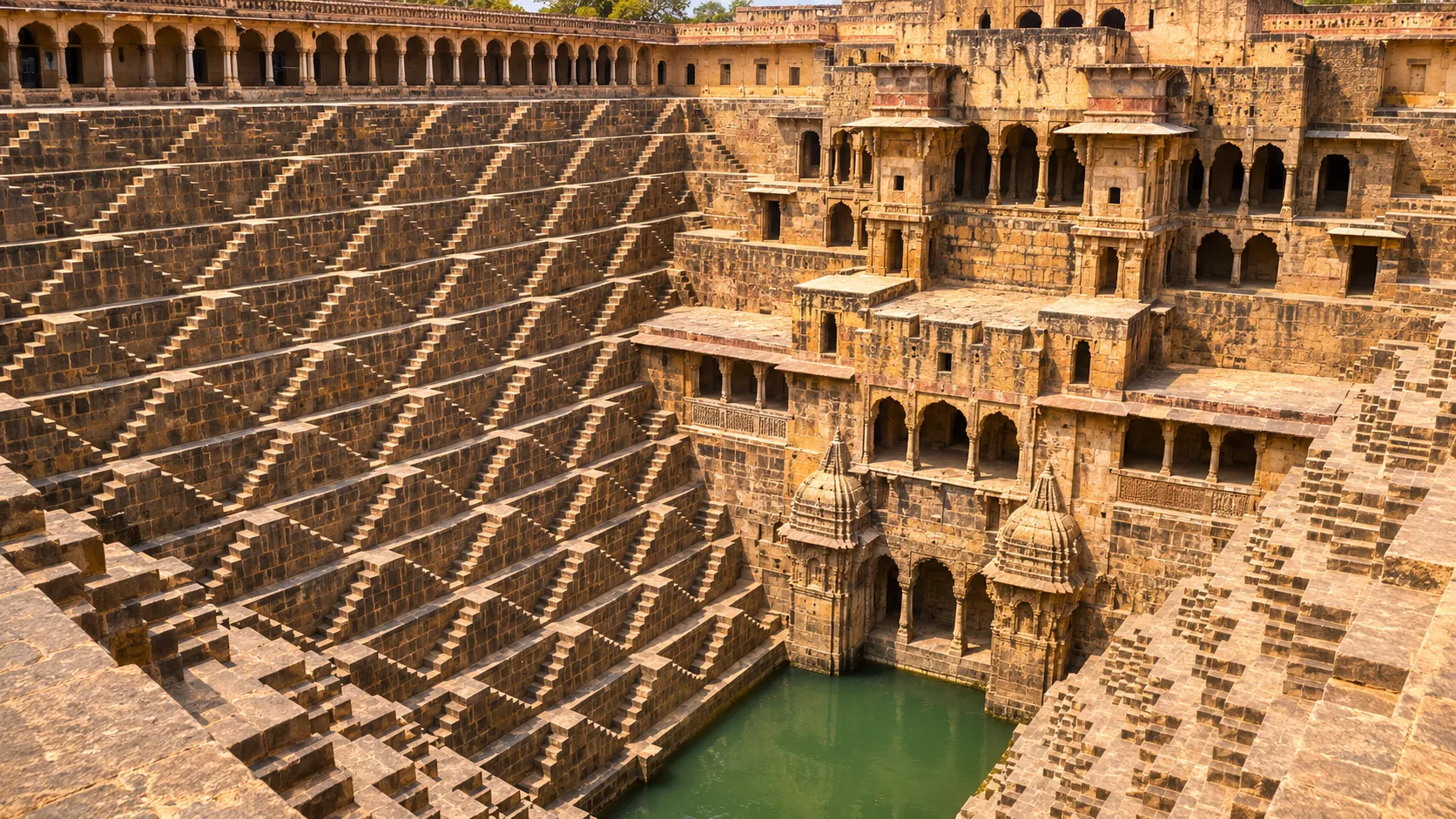
Thousands of narrow stone steps descend in repeating diagonal patterns. Their lines intersect, reverse direction, and form an enormous geometric design that narrows toward a pool far below.
From above, it resembles an inverted pyramid.
Or perhaps an architectural drawing that someone somehow carved into the ground.
But this is not an optical illusion.
It is not an unfinished palace.
And the steps were not built simply to impress visitors.
They belong to Chand Baori, an extraordinary stepwell in the village of Abhaneri, in the Indian state of Rajasthan.
Its most famous feature is the roughly 3,500 steps that descend into the earth.
Yet the real wonder is not how many steps were built.
It is why anyone needed so many in the first place.
The Problem With Water That Disappears
To understand Chand Baori, imagine living in a region where water does not arrive evenly throughout the year.
For part of the year, seasonal rainfall replenishes rivers, reservoirs, soils, and underground water supplies.
During drier periods, available surface water becomes less reliable.
A community may have water beneath the ground but still face a difficult question.
How do you reach it?
A conventional well can provide access to groundwater, but drawing water from a deep shaft requires lifting it upward.
A reservoir can store water, but its water level changes as supplies increase or decrease.
If the water surface falls far below the surrounding ground, access becomes more difficult.
The builders of India's stepwells developed another solution.
Instead of placing a narrow opening above a deep water source, they created structures that allowed people to descend toward the water itself.
These structures are called stepwells.
Depending on the region and language, they are known by names including *baori*, *baoli*, *bawdi*, and *vav*.
They were particularly important in parts of western and northern India, where water management had to account for strongly seasonal conditions.
Their designs varied enormously.
Some looked like elongated underground corridors.
Others contained richly decorated pavilions.
Some were relatively simple, while others became monumental works of architecture.
But many shared the same essential idea.
When the water level changes, the route to the water must still work.
Why Build 3,500 Steps?
The famous number can sound absurd.
Why would anyone create approximately 3,500 steps when a single staircase might lead to the bottom?
The answer is partly about access and partly about the structure's unusual geometry.
Chand Baori has three sides covered by closely spaced, descending flights of steps.
The steps form a repeated pattern across multiple levels, narrowing toward the lower part of the well.
The fourth side is different.
Instead of the same repeating stair geometry, it contains a multi-storeyed architectural arrangement with galleries, pillars, niches, and balconies.
According to Rajasthan Tourism, the stepwell has approximately 3,500 narrow steps.
They are arranged in double flights that create the distinctive intersecting patterns visible from above.
This does not mean a visitor must walk down 3,500 individual steps to reach the water.
The number describes the steps distributed across the structure.
Their arrangement creates multiple descending routes rather than one enormously long staircase.
As water levels changed, lower or higher steps could serve as access points.
The geometry made the structure both functional and visually extraordinary.
There is something almost mathematical about the repetition.
Each small group of steps is relatively ordinary.
Placed alongside hundreds of others, it becomes one of the most recognizable architectural patterns in India.
The beauty emerged from the organization of a practical system.
A Building That Goes Down Instead of Up
Most monumental architecture is designed to rise above the ground.
Towers reach toward the sky.
Temples and palaces create impressive silhouettes.
Fortifications occupy high positions.
Chand Baori reverses that familiar arrangement.
Its defining space is below the surrounding land.
The Archaeological Survey of India's documentation describes the stepwell as approximately 19.5 meters deep.
Other modern descriptions sometimes give greater figures, including around 30 meters.
These differences should not be treated as interchangeable measurements. Sources may describe different vertical extents or repeat estimates without specifying their measurement points.
For a careful account of the monument, the documented archaeological figure provides a useful reference.
The essential architectural principle remains the same.
As someone descends into the well, the surrounding walls rise higher.
The open sky appears smaller.
The structure becomes more enclosed.
And the descending stair patterns create an increasingly concentrated space around the water.
This experience is almost the reverse of climbing a monument.
On a tower, the surrounding landscape gradually opens beneath you.
Inside a deep stepwell, the surrounding world gradually disappears above you.
The architecture makes depth visible.
How Did a Stepwell Store Water?
A stepwell does not create water from nothing.
It must remain connected to a functioning water source.
Depending on its location and design, that source may involve groundwater, rainfall, runoff, or a combination of supplies.
In a monsoon-influenced region, water entering the local environment can replenish underground reserves and storage structures.
As conditions become drier, the water level may fall.
The stepped architecture allows people to reach progressively lower levels instead of relying solely on access from the surface.
This distinction is important.
A stepwell is not necessarily a modern rainwater-harvesting tank.
Nor is every stepwell connected to exactly the same type of aquifer or drainage system.
Indian stepwells developed in different geological and climatic settings, and their hydrological characteristics varied.
The main purpose was dependable access to water.
Water management did not stop at construction.
A functioning well required attention to sediment, structural condition, water quality, and the surrounding drainage environment.
If the steps became unsafe, access could be restricted.
If water supplies were contaminated or depleted, the monument's architectural beauty could not solve the problem.
Chand Baori is therefore best understood as infrastructure shaped by a particular relationship between settlement, climate, and water.
Its geometry tells us how people approached the water.
Its original usefulness depended on the availability of that water.
Why Was It Cooler Below Ground?
Water was the primary attraction, but stepwells also created distinctive environments.
Anyone who has stepped into a shaded stone building on a hot day understands that architecture can change how heat is experienced.
Deep stepwells offered extensive shade.
Their lower areas received less direct sunlight than the exposed ground above.
Stone surfaces, enclosed spaces, and the presence of water could contribute to a different thermal environment.
The exact cooling effect depends on factors such as solar exposure, air circulation, evaporation, masonry properties, and the dimensions of the structure.
A 2024 scientific review of passive cooling in medieval Indian stepwells examined how traditional design principles supported thermal comfort.
It highlighted the value of subterranean spaces and climate-responsive architectural features.
But there is an important distinction between recognizing that stepwells offered cooler retreats and claiming a precise temperature difference for Chand Baori itself.
Without a documented measurement under specified conditions, it would be misleading to assert that the bottom is always a fixed number of degrees cooler than the surface.
The broader idea is nevertheless fascinating.
A water structure could provide shade and shelter as well as access to a vital resource.
The space used to collect water became part of everyday social life.
The Social Life of an Underground Monument
Chand Baori was not simply a piece of equipment.
Rajasthan Tourism describes it as a community gathering place associated with both local residents and royalty.
That reflects an important feature of many historical Indian water structures.
Water access was connected to social interaction.
People visited wells as part of their daily routines.
Water-related spaces could become places where neighbors met, information was exchanged, and community life unfolded.
In some locations, stepwells also acquired religious and ceremonial importance.
Their architectural forms often expressed the significance of water within local culture.
At Chand Baori, the monumental stairways are accompanied by a fourth side that looks very different from the others.
The northern side contains a multi-level structure with pillared corridors and elaborately decorated architectural elements.
The Archaeological Survey of India describes two projecting niche-shrines containing images of Mahishamardini and Ganesha.
This side gives the well the character of a formal architectural complex rather than a purely utilitarian shaft.
It also shows how the functions of a monument can overlap.
Infrastructure, public space, architectural prestige, and religious imagery can exist together.
The purpose of obtaining water did not prevent the builders from creating a visually ambitious place.
Who Built Chand Baori?
The monument is commonly dated to the eighth or ninth century CE.
Rajasthan Tourism attributes its construction to King Chanda of the Nikumbha dynasty, placing the work in the ninth century.
The Archaeological Survey of India's heritage documentation similarly associates its name with Raja Chanda, described there as an eighth-century ruler.
These sources support an early medieval context, but they do not offer perfectly identical dates.
Nor should the traditional royal attribution be confused with a complete surviving construction record.
For a monument this old, the precise original building sequence, later modifications, and the historical identities associated with patronage may require more caution than popular descriptions suggest.
The safest conclusion is that Chand Baori is an early medieval stepwell, traditionally associated with a ruler named Chanda.
Its construction represented a major investment of labor and materials.
Stone had to be prepared and fitted.
The stair geometry required careful organization.
The retaining structures had to remain stable.
And the well had to serve its intended relationship with water.
The builders were not simply repeating a decorative motif.
They were creating a substantial piece of hydraulic and architectural infrastructure.
An Extraordinary Exercise in Geometry
One of the most remarkable features of Chand Baori is how easily its complex appearance can be reduced to a simple principle.
Repeat a short staircase.
Reverse its direction.
Arrange it beside another.
Continue the pattern across multiple levels.
From the courtyard, the result becomes a dense network of diagonal lines.
The walls appear almost to vibrate with repeating triangles.
As sunlight moves across the structure, some steps are brightly illuminated while others fall into shadow.
The patterns change depending on the time of day and the observer's position.
Yet this visual complexity rests on a practical system of circulation.
The paths permit descent through a large vertical distance while distributing access across the structure.
The repeated flights also create a compact arrangement around the central water area.
Instead of treating functionality and beauty as competing goals, Chand Baori demonstrates how functional repetition can create visual power.
This is why photographs of the well can look almost computer-generated.
Its pattern seems too regular to belong to a structure built so long ago.
But geometry is not a modern invention.
And the ability to organize space with great precision did not begin with digital tools.
The builders had something more fundamental.
An understanding of materials, measurement, repetition, and the demands of the site.
The Temple Beside the Well
Close to Chand Baori stands the Harshat Mata Temple.
Rajasthan Tourism dates the temple to the ninth or tenth century and identifies it as dedicated to Harshat Mata, a goddess associated with joy and happiness.
The Archaeological Survey of India notes a further historical distinction: although the temple is now worshipped as Harshat Mata Temple, its surviving iconography indicates that it was originally dedicated to Vishnu.
Its presence adds another layer to the story of Abhaneri.
The stepwell and temple belong to a historic cultural landscape in which water, architecture, and religious life existed close together.
Water has long held practical and symbolic importance in Indian traditions.
It sustains agriculture and daily life, but it also appears in rituals, sacred places, and ideas of purification.
The proximity of a monumental water structure and a temple reflects this broader cultural environment.
However, proximity alone should not be used to invent a detailed ritual history for every part of the well.
The surviving monuments demonstrate a relationship between water architecture and religious architecture.
They do not document every activity carried out there over the centuries.
That distinction matters.
An archaeological site can be rich in meaning without every popular story about it being historically verified.
Why Did India Build So Many Stepwells?
Chand Baori is remarkable, but it was not an isolated invention.
Stepwells appeared in several regions of India and evolved into different architectural traditions.
They are especially associated with Rajasthan and Gujarat, where seasonal water availability created strong incentives to develop durable storage and access systems.
Some stepwells emphasized straightforward utility.
Others featured elaborate corridors, pavilions, sculptures, and ceremonial spaces.
A 2022 review published in the journal *Water* examined the potential of Indian stepwells as sustainable water-management structures.
It described their historical role in groundwater access, seasonal storage, and community life.
The review also explored their possible relevance to contemporary approaches to water management.
But it would be a mistake to assume every historical stepwell can simply be reopened and used as a modern drinking-water source.
Present-day water quality, structural safety, groundwater conditions, and conservation restrictions can be very different from those of the past.
A centuries-old engineering solution offers valuable principles.
It does not remove the need for modern assessment.
The important lesson is that water infrastructure has always been shaped by local environmental conditions.
Where water is difficult to reach, architecture may have to change dramatically to reach it.
Chand Baori is one especially memorable expression of that idea.
What Happens When the Original Purpose Changes?
Many historical water structures eventually lose some or all of their original everyday function.
Water supplies change.
Communities develop new infrastructure.
Pumps and piped networks can replace older systems of collection and access.
A monumental stepwell may survive physically even when people no longer depend on it for their daily water.
At that point, the question of preservation becomes more complicated.
The building is no longer maintained simply because it is essential infrastructure.
It must also be recognized as part of a historical and cultural inheritance.
Chand Baori is now visited primarily as a heritage monument.
Its extraordinary geometry attracts people who may know little about traditional water management before arriving.
Visitors encounter the well as architecture.
But its design becomes much more meaningful once its original practical purpose is understood.
The thousands of steps are not a riddle without an answer.
They were connected to the movement of people toward water.
The shaded lower spaces were not just atmospheric.
They belonged to an environment designed around real climatic conditions.
And the monument's unusual shape is not an arbitrary artistic decision.
It reflects the organization of a large water-access structure.
Preserving Chand Baori therefore means preserving more than a photogenic pattern.
It means preserving evidence of how earlier communities responded to environmental challenges.
Could Ancient Stepwells Teach Us Anything Today?
Water scarcity remains an important challenge in many parts of the world.
Modern societies rely on technologies that were unavailable to the builders of Chand Baori: pumps, large reservoirs, filtration systems, monitoring networks, and complex distribution infrastructure.
These tools make it possible to manage water on scales that earlier communities could scarcely imagine.
Yet modern systems still face familiar problems.
Water supply is uneven.
Seasonal rainfall varies.
Groundwater can be depleted.
Infrastructure must be maintained.
And access to reliable water remains closely connected to public health and economic life.
Stepwells remind us that successful infrastructure begins with understanding local conditions.
Their builders did not attempt to make the climate behave differently.
They developed structures that responded to how water was available.
The stairways are one result of that approach.
Their geometry does not offer a universal solution for contemporary water shortages.
But their underlying principles remain worth studying: adaptation to the site, durable construction, passive environmental design, and the recognition of water as a shared resource.
The challenge today is not to reproduce an ancient monument everywhere.
It is to understand the reasoning that made such monuments useful.
The Staircase That Was Never About the Stairs
From above, Chand Baori appears almost impossibly elaborate.
Thousands of stone steps form a precise pattern.
They descend toward a small pool, surrounded by high masonry walls and the remnants of an architectural world that has changed enormously over the centuries.
A visitor may spend several minutes simply trying to understand the arrangement.
And then comes the realization.
The stairs were never the destination.
The water was.
The extraordinary geometry existed because the builders needed to solve an ordinary but essential human problem.
How do people reach water when it lies deep beneath the ground?
How do they continue reaching it when its level changes?
How can a structure serve the needs of a community across generations?
The answer became one of the most visually remarkable monuments in India.
Chand Baori seems to descend into the Earth for the sake of beauty.
But its original ambition was much more practical.
It was built to make a difficult resource accessible.
And that may be why it remains so impressive.
Listen & explore
- Archaeological Survey of India — Inventory of Monuments, Baori (Abaneri) (external platform)
- Rajasthan Tourism — Chand Baori (external platform)
- Frontiers of Architectural Research (2024) — Passive Cooling Techniques in Medieval Indian Stepwells (external platform)
- Water (2022) — Stepwells as Sustainable Water Management Structures (external platform)
- Incredible India — Chand Baori (external platform)