Articles / LORQAI
The Owl Has Been Asked to Leave
A fictional neighborhood hearing inspired by the very real reason crows attack owls in daylight.
An owl tries to sleep in a tree. Twelve crows object and call an emergency neighborhood hearing. A funny fictional story inspired by a very real bird behavior.
By LORQAI
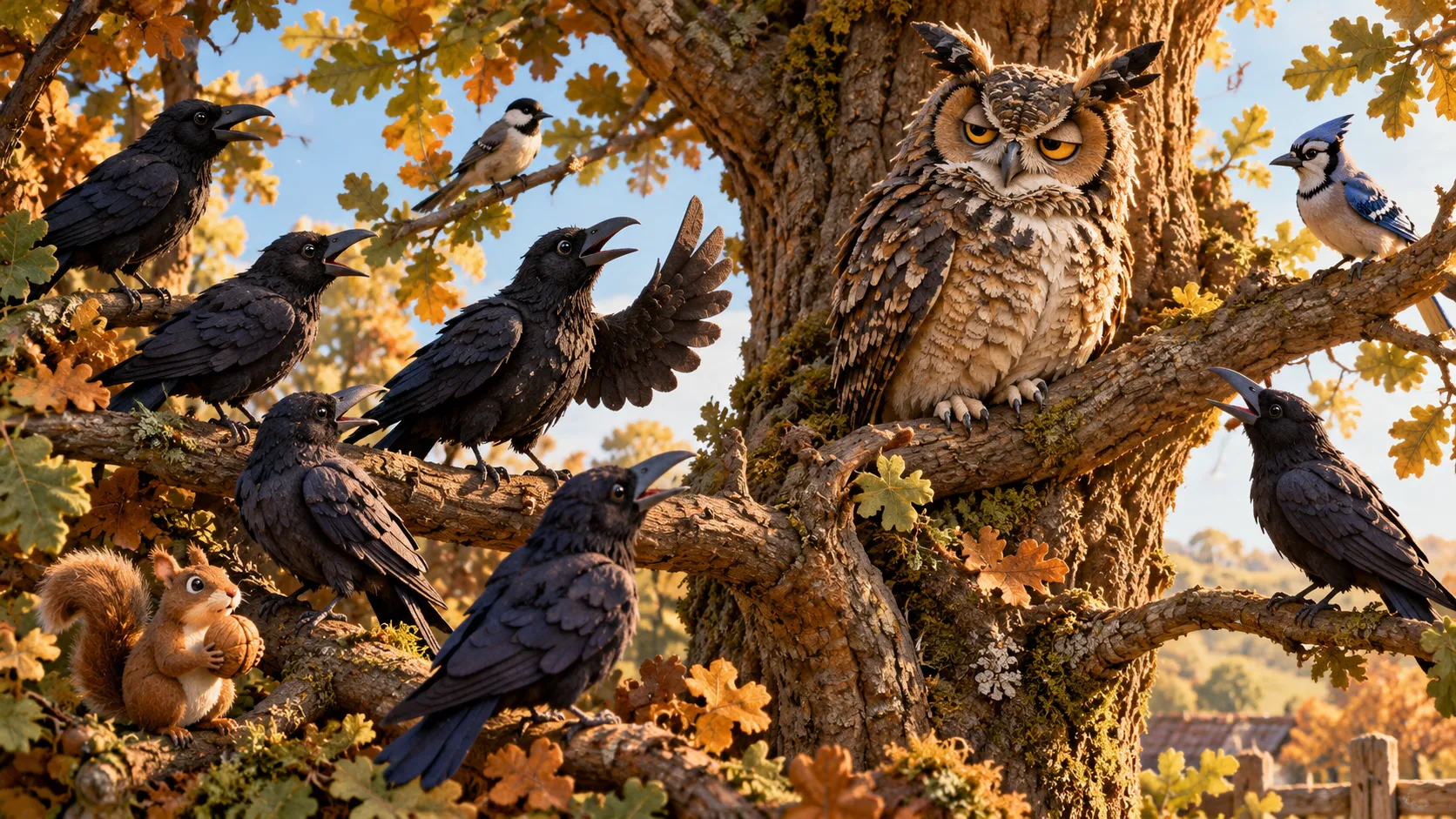
The Eviction Notice
The eviction notice was delivered at 10:17 in the morning by twelve crows and a noise of such extraordinary unpleasantness that a squirrel dropped a walnut it had spent twenty minutes stealing.
The owl did not open its eyes.
“Occupant of the upper fork,” called Mica, who had appointed herself chair of the Neighborhood Safety Committee, “you are required to attend a hearing regarding your continued presence in this tree.”
Nothing.
“Failure to attend will be considered an admission.”
One enormous yellow eye opened.
“An admission of what?” asked the owl.
Mica glanced at the younger crow beside her. He was arranging three small twigs on a branch to represent the minutes. The third twig rolled off and disappeared into the grass.
“We haven't established that yet,” she said. “That's why we're having a hearing.”
The owl closed its eye again. This struck the committee as deliberately provocative.
The Complaint
The tree stood beside an untidy patch of woodland where the gardens of several houses gradually lost the argument with the wild. There was a ditch full of rushes, a neglected shed, a fence that no longer kept anything in or out, and a reliable supply of interesting scraps near the houses.
For the crows, it was a satisfactory neighborhood. There were high branches for watching, rooftops for announcing opinions, and enough other birds to provide news. The arrival of a great horned owl in the daylight had altered the mood considerably.
Nobody could agree when the owl had appeared. Alder claimed it had been there since breakfast. Pip said it had arrived before breakfast, when the sky was still pink. Another crow insisted that it had been there the previous afternoon, but his testimony was rejected because he had been attending to a sandwich wrapper several streets away.
What mattered was that the owl was here now, perched against the trunk in a camouflage of mottled feathers, looking like a piece of bark that had acquired an alarming beak.
“You're occupying a residential tree,” Mica told it.
“I am occupying a branch.”
“There are families nearby.”
“Most trees have families nearby.”
“You know what we mean.”
“I expect I do.”
Mica disliked the calmness. It had the flavor of someone who knew exactly how much trouble he was causing and considered it insufficient.
“Can you state your business?” she asked.
“Rest.”
“For how long?”
“Until I am finished.”
This was entered into the record as refuses to supply departure time. Pip represented it with a bent twig, which he thought looked uncooperative.
The owl shifted one foot. The crows flinched as a group, an effect that would have been more impressive if they had not immediately begun arguing over which of them had flinched first.
Witnesses for the Neighborhood
The committee had invited other birds to speak. It had done so by making enough noise to prevent them from doing anything else.
A chickadee arrived from a hedge and landed on the smallest available branch.
“I was told there was an emergency,” she said.
“There is,” Mica replied. “A predator has established himself above the east path.”
The chickadee looked at the owl. The owl looked back with an expression that might, in another species, have suggested boredom.
“Has he done anything?”
“He is capable of doing things.”
“So am I.”
“Not the same things.”
The chickadee considered this. “Fair.”
A blue jay entered next, announcing that he had flown over from the oak and was therefore entitled to speak early. He also wanted to know whether the hearing had a refreshments committee.
“There are no refreshments,” Mica said.
“Then why did you invite me?”
“We didn't invite you. You followed the shouting.”
“Exactly. An organizational problem.”
The jay pointed one wing toward the owl. “I support a firm position. Perhaps a strongly worded call. Perhaps several.”
“We have been calling for twenty minutes,” said Alder.
“Good. I support the ongoing policy.”
Alder, an older crow with a ragged feather above one shoulder, took the branch reserved for testimony. He was not an especially dramatic bird, except in matters involving garbage collection schedules, but the sight of the owl had made him grim.
“Some of us roost in trees at night,” he said. “Some of us have young. That creature hunts birds. At night, when the rest of us would prefer not to be hunted.”
For once the committee did not interrupt.
The owl opened both eyes.
“That is an objection to my diet,” it said, “not my address.”
Alder stepped forward. “It's an objection to you being near the people on your diet.”
Several crows called at once. The noise ricocheted between the trees and over the garden fence. The squirrel, having recovered its walnut, decided to relocate its lunch.
Mica raised a wing for silence. Nobody obeyed until she threatened to move the hearing to a lower branch, where the view of the owl would be worse.
The Defense
The owl requested permission to speak. This was granted after a lengthy discussion about whether giving a suspected predator the floor constituted a security breach.
“I arrived because this is a shaded tree,” said the owl. “It offers cover. I was asleep until your committee began conducting what I can only describe as an outdoor equipment test.”
“Your presence creates risk,” said Mica.
“Your noise creates headaches.”
“Headaches are not the issue.”
“They are currently my issue.”
The owl had a voice like a drawer being closed in an old wooden cabinet. It was difficult to tell whether he was annoyed or merely awake. The distinction seemed important to the committee, which regarded sleep as evidence of suspicious confidence.
“Do you deny that owls eat birds?” asked Mica.
“No.”
There was an excited chorus of caws.
“Do you deny that some owls take crows?”
“No.”
“Are you asking us to trust you?”
“Certainly not. I would prefer you to leave.”
Pip's twig system was now entirely inadequate. A breeze had scattered the testimony into the ditch, and he was trying to reconstruct the sequence with a feather, two needles from a pine tree, and something that might have been a beetle. The beetle objected to serving as an exhibit and walked away.
The owl spoke again.
“Consider a simple question. Suppose I fly to another tree. What exactly happens next?”
“We make this tree safe,” Mica replied.
“Then I find another tree.”
“That is outside our jurisdiction.”
“And if those birds object?”
“They can form their own committee.”
The blue jay nodded enthusiastically. “An excellent opportunity for regional coordination.”
The owl stared at him long enough for the jay to discover an urgent appointment elsewhere.
The Cost of Making a Scene
By midday the hearing had become an event. Birds came to see what the shouting was about, then shouted because everyone else was shouting. A blackbird contributed three minutes of indignation without learning whom it concerned. A pair of sparrows arrived, decided the branches were overcrowded, and left to investigate the shed.
The original crows had been calling, swooping and changing perches for so long that even Mica could no longer pretend the operation required no effort.
“I have missed two feeding opportunities,” complained Pip.
“You were assigned to take minutes.”
“I have also missed most of the minutes.”
Alder had not eaten either. He kept looking toward a nest farther along the trees, where the youngest birds were still developing their judgment and had a dangerous interest in everything that moved. The owl was not merely an unwelcome symbol. It was a large predator sitting close enough to be watched, and being watched was better than leaving it free to disappear unnoticed.
Mica understood this. She also understood that if everyone flew away to eat, the owl might still be there when they returned.
The owl turned its head slowly and examined the gathering. Crows on one branch. A crow on the fence. Two more circling above. The creature it might have approached quietly under different circumstances had become the focus of an entire noisy neighborhood.
“You've made me rather conspicuous,” it observed.
“That,” said Alder, “is the idea.”
For a moment the hearing ceased to resemble a hearing. The crows did not need speeches, records or a vote. The alarm itself had an effect. Every bird nearby could hear where the danger was. Every abrupt movement by the owl was answered by wings and noise. Surprise was becoming difficult for everyone involved.
But being conspicuous did not make the owl harmless. It remained larger, equipped with powerful talons, and perfectly capable of a response that a careless crow would regret. Mica had no desire to turn the committee into a casualty report.
“Maintain distance,” she ordered.
“We are already maintaining several different distances,” Pip said.
“Choose the safer ones.”
He wrote that down using a new twig. At this point the minutes resembled a very small and badly planned nest.
The Proposal
It was the owl, rather than the committee, who finally suggested a compromise.
“I shall leave this branch,” he announced, “if you stop calling long enough for me to fly away.”
The committee erupted.
“He's trying to negotiate!” cried the jay, who had returned without refreshments.
“He's trying to escape!” cried a crow from the fence.
“He is trying to leave,” said the chickadee, who had been regretting her involvement for some time.
Mica raised her wing and waited. She had discovered that patience, used with sufficient severity, could make an impressive substitute for authority.
“What guarantee do we have,” she asked, “that you won't return?”
“None.”
“Will you agree to avoid this neighborhood?”
“I will agree that I am currently in it.”
“That is not helpful.”
“It is the most accurate statement I can offer.”
Alder leaned toward Mica. “Let him go. We can follow until he's beyond the next line of trees.”
“You've suggested further harassment,” said the owl.
“Yes,” said Alder.
“Why do you insist on describing it so politely?”
Mica did not smile. Crows do not hold committee elections on the basis of charm, and even in this entirely invented administration there were standards to maintain.
She proposed a motion: the owl would be permitted to depart without physical contact, while the crows reserved the right to maintain what the committee called an audible security corridor. This was a grand term for following someone and making their journey as disagreeable as possible.
There was a vote. Pip counted seven in favor, four opposed, and one crow who said he had been asking where everyone was going. The total did not match the number of birds present. Mica declared it unanimous enough.
The owl unfolded its wings.
Every branch went quiet.
For a bird that had looked like a lump of tree for most of the morning, it occupied a surprising amount of sky. The crows drew back. The owl launched into the open space, passed the garden fence and flew toward the darker trees beyond the ditch.
The committee went after it, calling in furious bursts. Nobody got close enough to test the wisdom of that decision. After a while the owl passed out of sight.
Alder returned first. Then Pip. Finally Mica came back and landed on the branch the owl had occupied.
The tree was quiet. The light had shifted. Somewhere below, the squirrel retrieved its walnut for the third time and looked as though it had lost confidence in the entire morning.
“Successful hearing,” Mica announced.
Pip looked at the scattered twigs. “Do we have to file anything?”
“No. The respondent has left the premises.”
The chickadee, departing at last, said, “You could have done that without the hearing.”
Mica chose not to enter the remark into the record.
An Unexpected New Resident
For several minutes, the neighborhood returned to normal. Birds searched for food. Leaves shifted in the ditch. Mica settled into the pleasant business of examining something shiny beside the fence.
Then Pip flew in from the houses.
“Chair!” he shouted.
“We've adjourned.”
“There's another owl.”
Mica stopped examining the shiny thing.
“Where?”
“In the garden. On a post. Facing the vegetable beds.”
They went together. The new owl stood at the edge of a lawn, with round eyes, a painted beak and wings that never moved. It was a molded plastic garden ornament, newly positioned by a person hoping to discourage unwelcome visitors.
Mica approached from a cautious angle. The thing did not blink. She called once. Nothing. She called again. Still nothing.
Pip leaned forward. “It might be a very disciplined owl.”
Mica tapped the post. The owl rocked slightly, then returned to exactly the same position.
There were two possibilities. One was that the newcomer had no life in it at all. The other was that it had achieved a level of composure beyond the experience of every bird in the neighborhood.
Mica considered the matter.
“Call the committee,” she said.
Pip stared at her. “Again?”
“We have a new problem.”
“What sort?”
She regarded the plastic eyes, the immovable wings, the smile that had been painted where no sensible owl would have put one.
“I suspect,” she said, “that this one will be considerably harder to evict.”
A Note from the Real World
The hearing, dialogue and named birds in this story are fictional. The behavior behind them is real. When crows discover an owl during daylight, they may give loud alarm calls, attract other birds and swoop at the predator, a defensive response known as mobbing. Some owls, including great horned owls, prey on crows. Harassing a discovered owl can help drive it away and make an ambush harder. Such encounters do not always end the same way, and getting close to a predator involves risk. The birds are defending themselves, not conducting a vote.