Articles / LORQAI
The Iron Pillar That Refused to Rust
Discover why Delhi's 1,600-year-old iron pillar resists corrosion, how ancient Indian metalworkers forged it, and what science reveals about its protective rust.
Introduction
Imagine placing a large piece of ordinary iron outdoors.
Rain falls on it.
Humidity changes throughout the year.
The surface becomes wet, dries, and becomes wet again.
Over time, reddish-brown corrosion usually begins to appear.
Leave the metal exposed long enough, and the damage can become serious.
Now imagine an iron structure that has endured outdoor exposure for approximately 1,600 years.
It is more than seven meters long, weighs over six tonnes, and was produced centuries before modern industrial steelmaking.
Its surface is dark and weathered, yet much of the exposed metal has resisted the kind of destructive corrosion that we might expect.
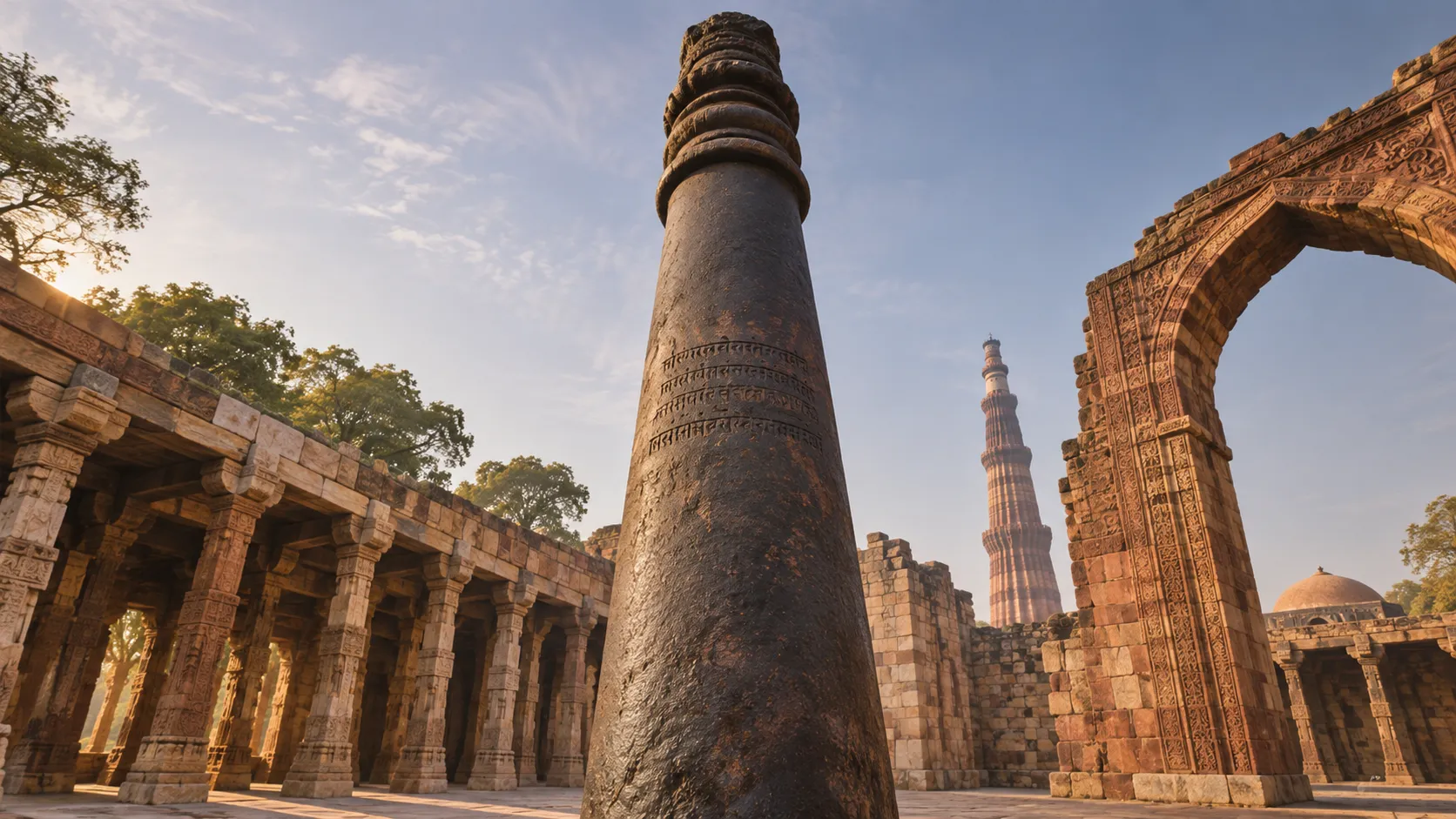
This is the Iron Pillar of Delhi.
It stands within the Qutb archaeological complex at Mehrauli, surrounded by monuments from different periods of Indian history.
Visitors often encounter it while exploring the much taller Qutb Minar and the surrounding ruins.
At first, the pillar may appear almost ordinary.
It is a tall iron column with a decorative capital and an ancient inscription.
But its apparent simplicity conceals an extraordinary achievement.
Somehow, metalworkers living more than fifteen centuries ago produced a massive iron structure whose material properties have fascinated modern scientists.
And the most surprising part of the explanation is that the pillar did not escape corrosion entirely.
The small amount of corrosion it developed became part of its protection.
An Ancient Monument in a Much Younger Complex
The Iron Pillar stands in a courtyard associated with the Quwwat-ul-Islam Mosque, within Delhi's Qutb complex.
Its surroundings belong largely to a different historical period from the pillar itself.
The Qutb Minar and associated Indo-Islamic monuments were developed beginning in the late twelfth century.
The iron column, however, is considerably older.
It bears a Sanskrit inscription written in Gupta-period script, generally assigned to the fourth or early fifth century CE.
The inscription celebrates a ruler named Chandra.
Most historians identify this ruler with Chandragupta II, an emperor of the Gupta dynasty who ruled in the late fourth and early fifth centuries.
The text also connects the pillar with Vishnu, one of the principal deities of Hindu tradition.
This gives the monument a religious and commemorative context beyond its technological significance.
The pillar was not originally created as a scientific demonstration.
It appears to have been erected as a monumental standard associated with royal achievement and religious dedication.
Its current location is almost certainly not its original one.
The Archaeological Survey of India describes the pillar as having been brought to Mehrauli from another location.
Its precise original setting remains a subject of historical research.
One influential interpretation connects it with Udayagiri in central India, although the complete history of its relocation is not established beyond dispute.
Whatever its exact route to Delhi, the pillar eventually became part of an architectural complex constructed centuries after it was first made.
That unusual history explains why a Gupta-period object now stands among much later monuments.
The inscription tells one story.
The metal tells another.
A Six-Tonne Problem for Ancient Metalworkers
Before asking why the pillar resists rust, consider how difficult it must have been to manufacture.
The monument measures approximately 7.2 meters in total length, including a portion buried beneath the ground.
Its mass exceeds six tonnes.
This is not a small decorative object forged by a single worker at an ordinary village hearth.
Producing it required substantial quantities of iron and a sophisticated understanding of hot-metal working.
Ancient Indian metalworkers did not have modern blast furnaces, industrial hydraulic presses, or automated steel mills.
Their methods depended on furnaces, fuel, carefully managed temperatures, tools, and coordinated labor.
In traditional bloomery ironmaking, iron ore is heated with a carbon-rich fuel such as charcoal.
Under suitable conditions, chemical reactions reduce the iron oxides in the ore, producing metallic iron.
The product does not normally emerge as a convenient stream of liquid iron ready to pour into a giant mold.
Instead, bloomery processes produce a solid or semi-solid mass containing iron and nonmetallic material.
This mass is often called a bloom.
The iron must then be worked to consolidate it and remove part of the unwanted material.
For a structure as large as the Delhi pillar, numerous pieces of wrought iron could be joined through repeated heating and forging.
Researchers have identified the pillar as an impressive example of forge-welded wrought iron.
That means the monument reflects not only ore-smelting knowledge but also the ability to join substantial masses of metal into a durable structure.
The engineering challenge was enormous.
The metalworkers had to produce the iron, prepare its components, heat and shape them, and create a finished object capable of supporting its own weight.
The column itself is evidence of considerable technical skill.
Its long survival is an additional achievement.
Why Ordinary Iron Rusts
Iron corrodes because it can react with substances in its environment.
When iron is exposed to water and oxygen, electrochemical reactions can occur at its surface.
Iron atoms lose electrons and enter chemical processes that produce various iron compounds.
These processes may eventually create the reddish or brown material we commonly call rust.
Ordinary rust is not necessarily an effective barrier against further corrosion.
Some corrosion products are porous, cracked, or poorly attached to the underlying metal.
Moisture and oxygen can continue reaching fresh iron beneath them.
The process may then continue.
Over time, the surface can lose material.
In severe cases, corrosion reduces the mechanical strength of an object.
But not all iron surfaces behave identically.
The rate and nature of corrosion depend on the metal's composition, its microstructure, and the environment.
Small amounts of other elements can influence electrochemical reactions.
Manufacturing processes affect the distribution of inclusions and impurities.
Temperature, humidity, pollution, and exposure to rain also matter.
A metal object may behave differently in dry air, constantly wet soil, or seawater.
The Iron Pillar of Delhi brings all these factors together in a particularly revealing way.
Its corrosion resistance cannot be explained simply by saying that it is made from unusually pure iron.
Nor can it be understood by considering the climate alone.
The explanation involves an interaction between the material and its surroundings.
The Secret Hidden Inside the Iron
Scientific investigations of the pillar have shown that its iron differs in important ways from many modern commercial iron and steel products.
One significant feature is its phosphorus content.
Phosphorus is a chemical element that can influence the behavior of iron during manufacture and corrosion.
In many modern steelmaking applications, excessive phosphorus is undesirable because it can reduce toughness and affect mechanical performance.
Consequently, phosphorus levels are often carefully controlled during industrial production.
But the composition of ancient bloomery iron could be very different.
The Delhi pillar contains comparatively elevated phosphorus concentrations.
Researchers have also identified nonmetallic slag inclusions within its wrought-iron structure.
Slag is material associated with the separation of metal from ore and other components during smelting.
Some of this material may remain trapped inside iron produced by traditional processes.
At first, that sounds like a disadvantage.
A metal containing numerous inclusions is not necessarily what a modern engineer would choose for every structural application.
The inclusions create local differences in the metal.
Those differences can influence electrochemical reactions at the surface.
Yet at the Delhi pillar, these characteristics contributed to a remarkable result.
A series of surface reactions gradually produced a protective corrosion layer.
The same manufacturing tradition that left phosphorus and slag within the iron also helped establish the conditions for the monument's unusual atmospheric corrosion resistance.
But scientists needed to examine the surface itself to understand precisely what happened.
The Rust That Became a Shield
One of the most important investigations of the Delhi pillar was published in the journal Corrosion Science in 2000.
Materials scientist R. Balasubramaniam studied the monument's exceptional corrosion resistance and examined the chemistry of its protective surface film.
The research drew on detailed analysis of rust samples from the pillar.
It identified iron oxides and oxyhydroxides, as well as an important crystalline phosphate compound.
One particularly significant material was iron hydrogen phosphate hydrate.
The findings suggested a sequence of processes.
During early exposure, corrosion reactions occurred at the iron surface.
The presence of slag inclusions influenced local electrochemical behavior.
As these reactions proceeded, phosphorus became enriched near the surface.
That phosphorus helped the formation of compact protective corrosion products.
A thin layer containing iron oxyhydroxides developed near the metal.
Over time, phosphate-rich material contributed further protection.
The research identified the formation of iron hydrogen phosphate hydrate near the metal–oxide interface as a particularly important factor.
Unlike loose, highly porous rust, this protective material helped limit the continued penetration of corrosive agents.
The rate of corrosion decreased.
And that is the central scientific paradox of the Delhi pillar.
It survived not because absolutely no rust formed.
It survived because the corrosion products that developed helped prevent further corrosion.
The pillar's protection was not separate from its chemistry.
It emerged through that chemistry.
Did Ancient Indians Invent Stainless Steel?
The Delhi pillar is sometimes described as evidence of ancient stainless steel.
That description is misleading.
Modern stainless steels typically contain substantial chromium.
Chromium helps form a thin, protective oxide film that gives these alloys their characteristic corrosion resistance.
Different stainless steels may contain nickel, molybdenum, and other alloying elements for particular properties.
The Iron Pillar of Delhi is not a modern chromium-rich stainless-steel alloy.
Its protective mechanism is different.
It is made from ancient wrought iron with distinctive chemical and microstructural characteristics.
Its resistance developed through the formation of a protective corrosion film associated with phosphorus, iron compounds, and environmental conditions.
This does not make the ancient achievement less impressive.
In fact, understanding the actual material is more interesting than attributing its behavior to a familiar modern alloy.
The metalworkers did not need to invent twenty-first-century stainless steel to create a durable monument.
Their materials and manufacturing methods produced a different form of long-term resistance.
But we should also be cautious about assigning intentions that the historical evidence cannot establish.
The makers clearly possessed advanced ironworking skills.
However, the monument alone does not prove that they understood the detailed chemistry of phosphate-based passivation as modern scientists describe it.
They could have developed successful techniques through accumulated practical experience without possessing today's chemical theory.
Engineering knowledge does not always begin with equations.
Sometimes it begins with generations of observing which methods work.
Why the Climate of Delhi Matters
The pillar's metal composition is only part of the explanation.
The environment also matters.
Delhi experiences a strongly seasonal climate.
Periods of monsoon rainfall alternate with drier conditions.
Metal surfaces may therefore undergo cycles of wetting and drying.
These cycles influence the development of corrosion products.
In the scientific model proposed for the pillar, alternating wet and dry conditions helped the formation and transformation of protective phosphate-containing material.
The environment did not simply leave the metal untouched.
It participated in the surface chemistry.
Earlier studies placed considerable emphasis on Delhi's relatively dry atmospheric conditions during much of the year.
That interpretation captured part of the story, but later research showed that the pillar's material properties were essential as well.
A useful way to understand the monument is to imagine three interacting elements.
The first is the iron produced by ancient metalworkers.
The second is the microscopic structure created during manufacturing.
The third is the environment in which the monument has stood.
None can be ignored.
Change the material, and the corrosion behavior may change.
Change the environmental exposure, and the protective film may not develop in the same way.
The pillar's survival reflects a particular combination of circumstances.
It is therefore more accurate to call it exceptionally resistant to atmospheric corrosion than universally rustproof.
Would the Pillar Survive Underwater?
This question reveals why the distinction matters.
Suppose an identical iron pillar were placed permanently underwater.
Would it remain nearly unchanged for sixteen centuries?
Not necessarily.
Researcher R. Balasubramaniam addressed this question in his detailed account of the pillar's corrosion resistance.
He emphasized that its exceptional durability applies particularly to its exposure in the atmosphere.
Conditions in buried or continuously immersed environments can produce very different corrosion behavior.
The chemical reactions may change.
Oxygen availability may differ.
Moisture remains in continuous contact with the surface.
And the protective film formed under alternating atmospheric conditions may not behave in the same way.
There is no scientific reason to assume the pillar would resist all forms of corrosion equally.
Its surviving surface is remarkable precisely because corrosion resistance depends on context.
The idea of a metal that cannot rust anywhere is much simpler than the real science.
But simplicity is not always accuracy.
The Delhi pillar demonstrates that material durability can emerge from a complex interaction between composition, manufacturing, and environment.
How Scientists Investigated the Mystery
The pillar has attracted scientific attention for more than a century.
Early investigators examined its chemical composition and physical characteristics.
Later researchers developed more sophisticated explanations involving electrochemistry and corrosion science.
To study the protective film, scientists employed methods capable of identifying materials that are difficult to distinguish with the naked eye.
One was X-ray diffraction.
This technique can help determine which crystalline compounds are present in a sample.
Another was Fourier-transform infrared spectroscopy, which provides information about chemical bonds and molecular structures.
Researchers also used Mössbauer spectroscopy, a method especially valuable for investigating certain iron-containing materials.
Together, these techniques provided complementary evidence.
No single measurement told the entire story.
X-ray diffraction helped identify crystalline phosphate material.
Other methods supported the identification of additional iron-containing phases, including poorly crystalline or amorphous corrosion products.
By combining the results, researchers developed a more detailed model of the protective layer.
This is an important part of the story because scientific understanding changed as better evidence became available.
The monument did not become extraordinary only when modern instruments examined it.
It was already extraordinary.
But the instruments transformed a famous mystery into a problem that could be investigated through chemistry and materials science.
The Ancient Inscription That Gives the Metal a Voice
Much of the public fascination with the iron pillar concerns its resistance to rust.
But the inscription on its surface is equally important.
The ancient Sanskrit text provides evidence about the monument's historical purpose.
It praises a ruler named Chandra and connects the pillar with a dedication to Vishnu.
Most scholars associate this ruler with Chandragupta II of the Gupta dynasty.
The Gupta period is remembered for major developments in literature, art, mathematics, astronomy, and other fields of intellectual and cultural activity.
The iron pillar adds another dimension to that history.
It preserves evidence of substantial technical achievement.
The inscription also reminds us that the monument was created within a particular political and religious world.
It was not produced merely to demonstrate the strength of iron.
It served a purpose meaningful to the people who commissioned it.
The decorative capital and monumental form were part of that purpose.
Today, the column stands in a very different historical setting from the one in which it was first erected.
Its inscription has outlived rulers, dynasties, and the transformation of the surrounding landscape.
The metal preserved the words.
And the words help explain why the metal was shaped into a monument in the first place.
A Monument That Belongs to Several Histories
The Delhi iron pillar stands within the Qutb complex, which was inscribed on the UNESCO World Heritage List in 1993.
The official World Heritage property is called Qutb Minar and its Monuments, Delhi.
It includes an important group of historical structures representing several periods of Indian architecture.
The pillar is one of the notable older elements within that complex.
It should not be described as a separately inscribed UNESCO World Heritage Site.
The distinction matters because the column's historical importance extends beyond any single heritage label.
For historians, its inscription offers evidence about the Gupta period.
For archaeologists, its location and possible relocation raise questions about changing political and religious landscapes.
For metallurgists, its manufacture demonstrates the capabilities of ancient Indian ironworkers.
For corrosion scientists, the protective surface provides a remarkable example of material behavior under long-term atmospheric exposure.
For visitors, it is a physical connection with people who lived sixteen centuries ago.
The same object can support all of these interpretations.
Its significance does not need to be reduced to the claim that it never rusts.
What Modern Engineers Can Learn From Ancient Iron
It would be tempting to conclude that modern industry should simply copy the chemical composition of the Delhi pillar.
But engineering is rarely that straightforward.
Different applications place different demands on materials.
A large monumental column does not experience the same loading conditions as an aircraft component, a bridge cable, or a high-pressure vessel.
A composition that performs well under one set of conditions may be unsuitable for another purpose.
Phosphorus, for example, can affect both corrosion behavior and mechanical properties.
Slag inclusions may influence surface reactions, but they can also create structural disadvantages.
Modern materials engineering must balance strength, toughness, fatigue resistance, corrosion behavior, cost, and manufacturability.
The Delhi pillar is not evidence that ancient wrought iron is universally superior to contemporary steel.
Instead, it offers an important scientific lesson.
Manufacturing processes influence microstructure.
Microstructure influences chemical reactions.
And those reactions can determine long-term performance.
Engineers studying protective corrosion films, weathering steels, and surface treatments encounter related questions.
How can a surface layer slow degradation?
What determines whether rust remains porous or becomes protective?
Which environmental conditions favor the formation of stable corrosion products?
The Delhi pillar provides an exceptionally old real-world example for thinking about those problems.
It is not a ready-made replacement for modern materials.
It is a reminder that material behavior can contain unexpected advantages.
The Metal That Learned to Protect Itself
The Iron Pillar of Delhi is often presented as a mystery that science has failed to solve.
That description makes for an entertaining legend.
But it overlooks a much more compelling achievement.
Scientists have investigated the pillar using chemical analysis, spectroscopy, metallurgical examination, and corrosion theory.
They have identified important features of its material.
They have studied its protective surface.
And they have developed a well-supported explanation for its unusual resistance to atmospheric corrosion.
Not every detail of the pillar's manufacture and history is known with certainty.
Its precise original location remains debated.
The knowledge and intentions of the individual metalworkers cannot be reconstructed completely.
But the basic explanation for its long survival is no longer an inexplicable secret.
It is a story of skilled ancient manufacture, phosphorus-rich wrought iron, slag inclusions, atmospheric conditions, and a protective corrosion film that developed over time.
And perhaps the most extraordinary detail is the one hidden in plain sight.
The pillar did not survive by completely avoiding the chemical processes that normally damage iron.
It survived because those processes developed in an unusually favorable direction.
A small amount of corrosion helped create a barrier against more corrosion.
The monument's surface became part of its defense.
Sixteen centuries ago, metalworkers produced a massive column intended to serve a royal and religious purpose.
They could not have known that future scientists would examine microscopic compounds forming on its surface.
They could not have imagined the instruments that would one day reveal the chemistry of its survival.
Yet their work still stands.
Not because the laws of nature somehow failed to apply to it.
But because the laws of nature worked in a remarkable way.
The Iron Pillar of Delhi is not a monument that defeated chemistry.
It is a monument that helps us understand chemistry.
And that is a far more interesting kind of immortality.
Listen & explore
- Archaeological Survey of India — Iron Pillar, Mehrauli (external platform)
- Corrosion Science (2000) — On the Corrosion Resistance of the Delhi Iron Pillar (external platform)
- Corrosion Science (2000) — Characterization of Delhi Iron Pillar Rust (external platform)
- Cambridge University Press — The Pillar's Resistance to Corrosion (external platform)
- Indian Journal of History of Science (2003) — Influence of Manufacturing Methodology (external platform)
- UNESCO — Qutb Minar and its Monuments, Delhi (external platform)