Articles / LORQAI
The Elephants That Mine a Mountain
Why do elephants enter Kitum Cave? On Kenya's Mount Elgon, the answer is written in tusk marks, volcanic rock, and an unusual relationship between animals and the mineral world. A 2026 study adds a new question: are these elephants looking for nutrition, medicine, or something we have yet to understand?
On Mount Elgon, elephants enter dark caves to quarry mineral-rich rock with their tusks. Geology explains how the caves began; a 2026 study adds a new question about what elephants know.
The Elephants That Mine a Mountain
The first clue is on the wall.
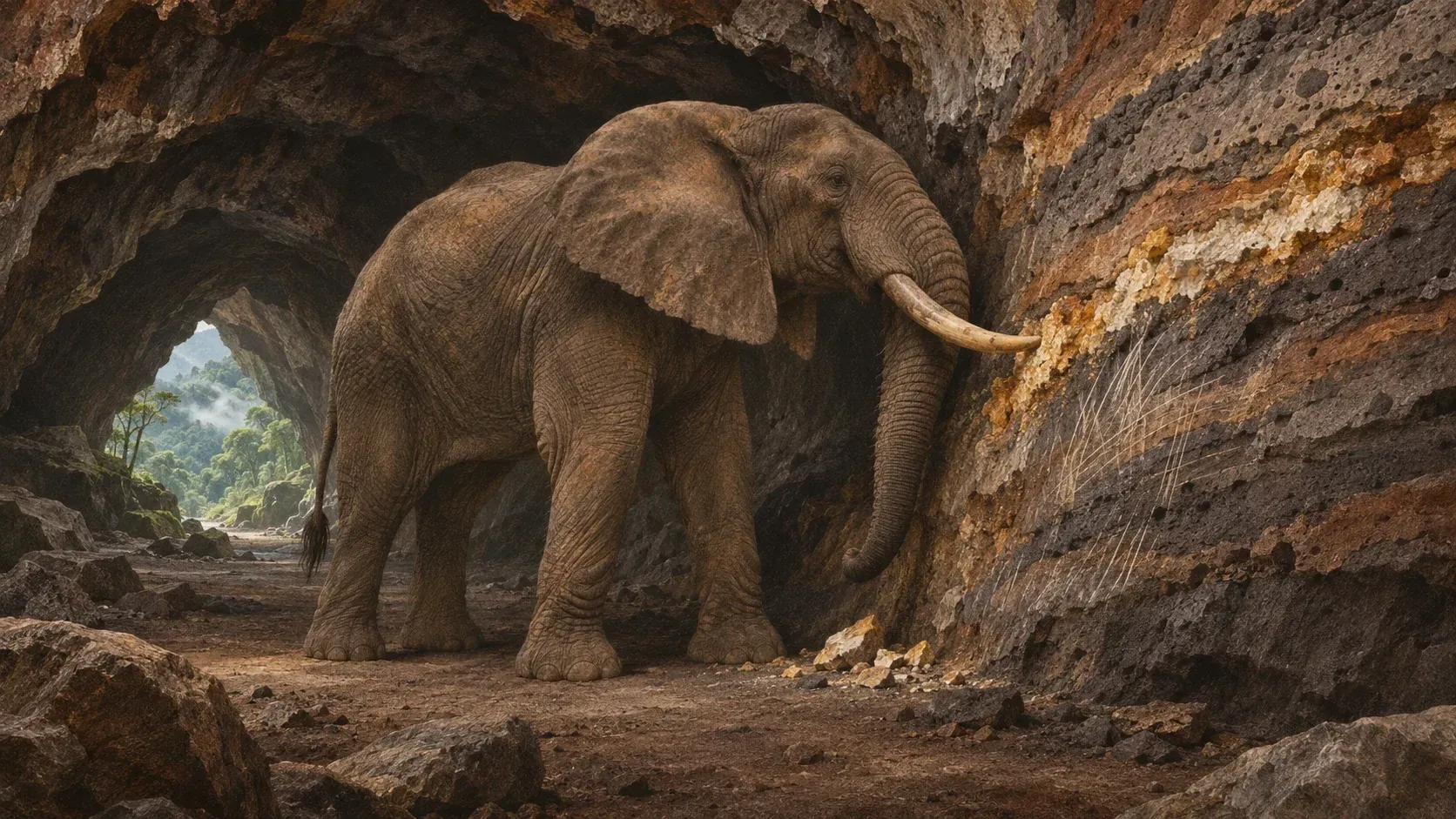
It is not a painting. There are no words, dates, or drawings of animals left by human hands. Instead, the surface bears marks made by the working end of an elephant's tusk. Somewhere in the darkness of Mount Elgon, a powerful animal has pressed ivory into rock, broken away a fragment, and eaten it.
The next elephant may work on the same surface. So may another after that. In time, the stone changes shape.
This is Kitum Cave, on the Kenyan side of Mount Elgon, near the border with Uganda. Kenya Wildlife Service lists the cave's salt-mining elephants among the national park's main attractions. Geological researchers have documented the minerals in the rock and the effect of animal excavation. The Mount Elgon Elephant Project has recorded cave use well beyond Kitum itself.
Why do elephants go into Kitum Cave? Primarily to obtain mineral-rich material, including sodium-bearing salts, that can supplement what they get from vegetation and water. They scrape or pry at cave surfaces with their tusks, gather fragments, and consume them. That behaviour is called geophagy: eating earth or rock. It is real, it has been studied, and it is much more interesting than a story about elephants merely hiding in darkness.
What is less certain is how much of the cavern they helped create, whether other benefits draw them there, and how a practice dependent on one mountain survives when the elephants themselves are under pressure.
A quarry with no machines
The word mine usually comes with a list of equipment: drills, trucks, explosives, helmets, lamps. Kitum has no industrial workforce of elephants. The word is an analogy, but an unusually good one. These animals are not merely licking a mineral stain from a wall. Researchers have described elephants using their tusks to dislodge rock and then swallowing the broken pieces.
The distinction matters. A salt lick might be a small exposed patch of soil visited briefly by an animal. At Mount Elgon, some elephants move far inside substantial caves to reach mineral-bearing material. The Mount Elgon Foundation says tusk marks can be seen as much as 150 metres into Kitum. Its wider research programme reports similar activity across at least 55 caves; that figure is a project report about documented cave-mining sites, not a claim that every opening on the mountain has been exhaustively surveyed.
A visitor accustomed to the slow apparent movement of a large elephant may struggle to picture the physical work. Tusks are useful tools, but they are also living anatomical structures, subject to wear and damage. A 2019 scientific review of how African savanna elephants select food discusses observations of uneven tusk wear at Mount Elgon that researchers associated with scraping mineral rock.
The animals are not built like miners, with interchangeable chisels. Each tusk belongs to the elephant for life.
The rock gives something back. In 1996, geochemists Rob Bowell, A. Warren and elephant researcher Ian Redmond published a study of Mount Elgon's cave salts. Their analysis described calcium-, sodium- and magnesium-rich material, with phosphorus and other minerals relevant to animal nutrition. Groundwater and other processes concentrate and redeposit salts in particular parts of the cave environment. The animals select and consume that material.
The scientific answer is not simply that elephants enjoy the taste of salt. It is that a landscape of weathered volcanic rock has made mineral resources available in a form these animals can reach—and apparently have a strong reason to seek.
Who excavated Kitum: water or elephants?
Some popular descriptions call Kitum an elephant-made cave. Others place it among Mount Elgon's lava tubes. Both shortcuts hide the geological story.
The Mount Elgon Foundation cautions that at least some of the mountain's caves lie in volcanic agglomerate, not within solidified lava flows. Agglomerate is made of fragments thrown out during eruptions and bound together by other volcanic material. It can contain layers of very different strengths. Water exploits those differences.
Geologists Joyce Lundberg and Donald McFarlane investigated the origins of the so-called elephant caves in work published in 2006. Their conclusion was not that elephants dug a tunnel into an intact mountain from scratch. Nor was it that chemical dissolution alone produced a cavern which elephants happened to visit.
The cave system developed through several interacting processes. Water moving across resistant layers helped erode the softer rock beneath, especially near waterfalls. Changes in groundwater and the behaviour of swelling clay encouraged undercutting. Sections of rock collapsed. Then animals, particularly elephants seeking minerals, removed loose material and attacked exposed surfaces, helping the chambers widen and change.
That is why the question did elephants make Kitum Cave? needs a careful answer. They have helped enlarge and shape it, but the evidence does not support attributing the entire cave to elephants alone. Geological structure and erosion were essential.
This changes the mental picture of a cavern. It is not simply the result of water working over a long time, interrupted occasionally by animals. At Elgon, living creatures can be participants in the physical development of the landform.
Ecologists call animals that substantially alter their surroundings ecosystem engineers. Beavers create dams; elephants can open paths, change vegetation and excavate mineral deposits. In this case, the engineering leaves marks on stone underground.
There is no need to give the elephant human intentions. It can change a mountain without understanding geology.
The mineral problem hiding in green leaves
An elephant spends much of its time eating plants. From a distance, Mount Elgon looks like an almost unlimited buffet: montane forest, bamboo and other vegetation spread across different altitudes. Yet having abundant plants does not mean getting every nutrient in the required proportion.
Plants contain minerals, but their composition depends on soil, climate, species and growing conditions. Rain and weathering can remove or redistribute soluble elements. A plant-based diet can provide large quantities of food while leaving an animal with strong reasons to seek particular nutrients elsewhere.
Sodium is especially important in maintaining normal fluid and nerve function. Calcium and phosphorus contribute to skeletal and other biological processes. A diet does not become balanced merely because its total weight is enormous.
This is the background to the 1996 chemical study. The researchers found that Mount Elgon's salt-bearing rocks could provide a substantial dietary supplement in an environment where some essential elements were less available near the surface. Subsequent work on elephant nutrition has discussed other elements, including iodine, while warning against treating every association as a proved cause of a particular behaviour.
A tusk scraping a cave wall is visible. The elephant's precise physiological motivation at that moment is not.
It would take more than observing consumption to demonstrate a particular deficiency in an individual elephant, or to calculate exactly how much of each mineral it absorbs. Researchers would need carefully designed dietary, physiological and behavioural evidence.
Still, the general explanation is strong. An animal with a plant-based diet has found a mineral resource. Its body gives it a remarkable tool for extracting that resource. Generations of elephants have used the place.
The mystery is no longer why an elephant would eat stone. The mystery is how it has learned exactly which stone to seek.
A discovery that did not end in 1996
For years, Mount Elgon's cave elephants were celebrated mainly as a geological and zoological curiosity. But recent work has extended the questions beyond mineral hunger.
A study published in Scientific Reports on 24 September 2026 examined whether elephants in the Mount Elgon region might deliberately consume certain plants for therapeutic purposes. Researchers worked with eight experienced observers from the Sabaot community—guides, scouts, elders and a retired ranger—who had spent many years watching local elephants.
The study documented reports involving dozens of natural resources, including plants and mineral substrates. Some informants described behaviours they interpreted as animals selecting plants when ill or giving particular plant material to vulnerable calves. These observations generated hypotheses about possible animal self-medication.
But the researchers were explicit about the limits. The work relied on a small group of knowledgeable interviewees, not controlled experiments proving a treatment worked. Interpretations of what an elephant was doing could be influenced by the medicinal uses of the same plants in local human traditions. The study did not establish that elephants possess a scientifically verified pharmacy or that anyone should imitate their diet.
And there was a particularly revealing finding for our story about Kitum: the interviewed observers did not identify the mineral and clay consumption as medicinal treatment. They generally understood it as a way to acquire minerals, including salt and iron, and sometimes as behaviour that elephants appeared to enjoy.
That distinction is valuable because popular accounts can be too eager to turn every unusual animal food into a medicine. Eating mineral soil and deliberately treating an infection are different claims. They may have overlapping physiological effects, but one cannot be substituted for the other without evidence.
The new work gives local observers an important place in the research record. People who spend decades sharing a landscape with elephants may notice patterns that a short scientific visit would miss. The task of science is to document those observations, test alternative explanations and distinguish knowledge from promising interpretation.
Mount Elgon is still teaching researchers new questions. That does not mean every answer has arrived.
Are the cave elephants a different kind of elephant?
A photograph of elephants inside a cave can make them seem almost like an unknown species discovered beneath the mountain. Some stories call them cave elephants or troglodyte tuskers. Those names refer to their unusual behaviour, not to a separately established species of underground elephant.
The animals are African elephants. What sets this population apart is its documented use of mineral-bearing caves. Behaviour can be extraordinary without requiring a new biological classification.
There is a more important difference between a population and an isolated spectacle. An elephant's life does not fit inside the cave where photographers hope to find it. The animal needs forest, movement routes, water, food and access to other elephants. The cave is one significant resource within a much larger living range.
The Mount Elgon Foundation warns that this population has faced severe pressure from poaching and conflict where elephants move beyond protected boundaries and encounter farms. Its account describes the historical loss of elephants from the Ugandan side of the mountain and continued conservation concerns on the Kenyan side. Those are the foundation's documented assessments; they should not be rewritten as a precise current census without a new survey.
It is easy to imagine protecting Kitum by fencing its entrance and calling the job finished. That would protect a hole in the mountain, not necessarily the animals that use it. A route to mineral deposits is only useful if an elephant can survive the journey.
Research into the elephants' behaviour therefore has practical value. Understanding which caves they visit, which routes they take, and what resources they seek can help people plan more effective ways to reduce dangerous encounters and preserve habitat.
The story of mineral mining begins with an individual mark in rock. Its future depends on decisions made across the landscape outside the cave.
The other reason Kitum became famous
Kitum appears in another category of internet story: accounts that call it one of the world's deadliest caves or connect it to Ebola.
The history is serious, but it is frequently muddled.
The US Centers for Disease Control and Prevention records human Marburg virus infections associated with visits to Kitum Cave in 1980 and 1987. National Geographic has also discussed these historical cases in reporting on investigations of viruses associated with bats. Marburg and Ebola are different viruses; a historical connection to Marburg does not establish that Kitum is where Ebola originated.
Nor should a documentary account pretend that an ordinary tourist visit today is known to carry a particular quantified risk. A reliable present-day risk assessment would require current public-health evidence and local access conditions. The CDC's general travel guidance warns against contact with bats and visiting risky cave environments, and Kenya Wildlife Service advises visitors to follow park safety requirements.
The elephants are not proven responsible for those human infections. Their mineral-feeding behaviour and the cave's history in disease investigations are separate subjects that happen to share a location.
This is one place where accurate labels matter. A dramatic article can make a mountain sound more dangerous by confusing two diseases, ignoring dates and suggesting an unverified origin story. Such a page may attract a click. It would give the reader less knowledge than before.
There are enough genuine mysteries at Kitum without inventing another.
What the mountain would lose
Consider the cave as a kind of archive.
The walls preserve the marks of feeding animals. The rock contains a record of volcanic eruptions, water movement and chemical change. Nearby caves have also attracted human use; the Mount Elgon Foundation describes archaeological work investigating evidence of people occupying mountain caves over long periods. Not all the information belongs to one place or one century, and no single interpretation captures the entire mountain.
A child might begin with the simplest question: Why would an elephant eat a rock? It leads directly to minerals, diet and geophagy.
Another question follows: Did the elephants dig the cave? That leads to geology, erosion, collapse and the work of animals over time.
Then comes a harder one: Could they be treating themselves? That demands the humility to distinguish a promising 2026 observational study from a demonstrated medical effect.
And finally: Will they still be able to reach these caves? That is no longer a puzzle about the past. It concerns conservation, land use and the relationship between the people living on Mount Elgon's slopes and the animals moving through them.
The elephants do not enter Kitum to become symbols of anything. They go there for something their bodies need. They have discovered a resource in the mountain and developed a way of reaching it with the tools nature gave them.
But those repeated visits have produced an unexpected second result. In the course of feeding, elephants have helped shape the place from which they feed.
The first clue was on the wall. It is also the answer to the final question: who is changing Mount Elgon?
Water, stone, time—and elephants.