Articles / LORQAI
The Shape That Keeps Coming Back
Why evolution has produced crab-like bodies again and again — and why some animals later abandoned the design.
Evolution has produced crab-like bodies several times, even among animals that aren't true crabs. The surprising part? Some evolutionary lineages later abandoned the design.
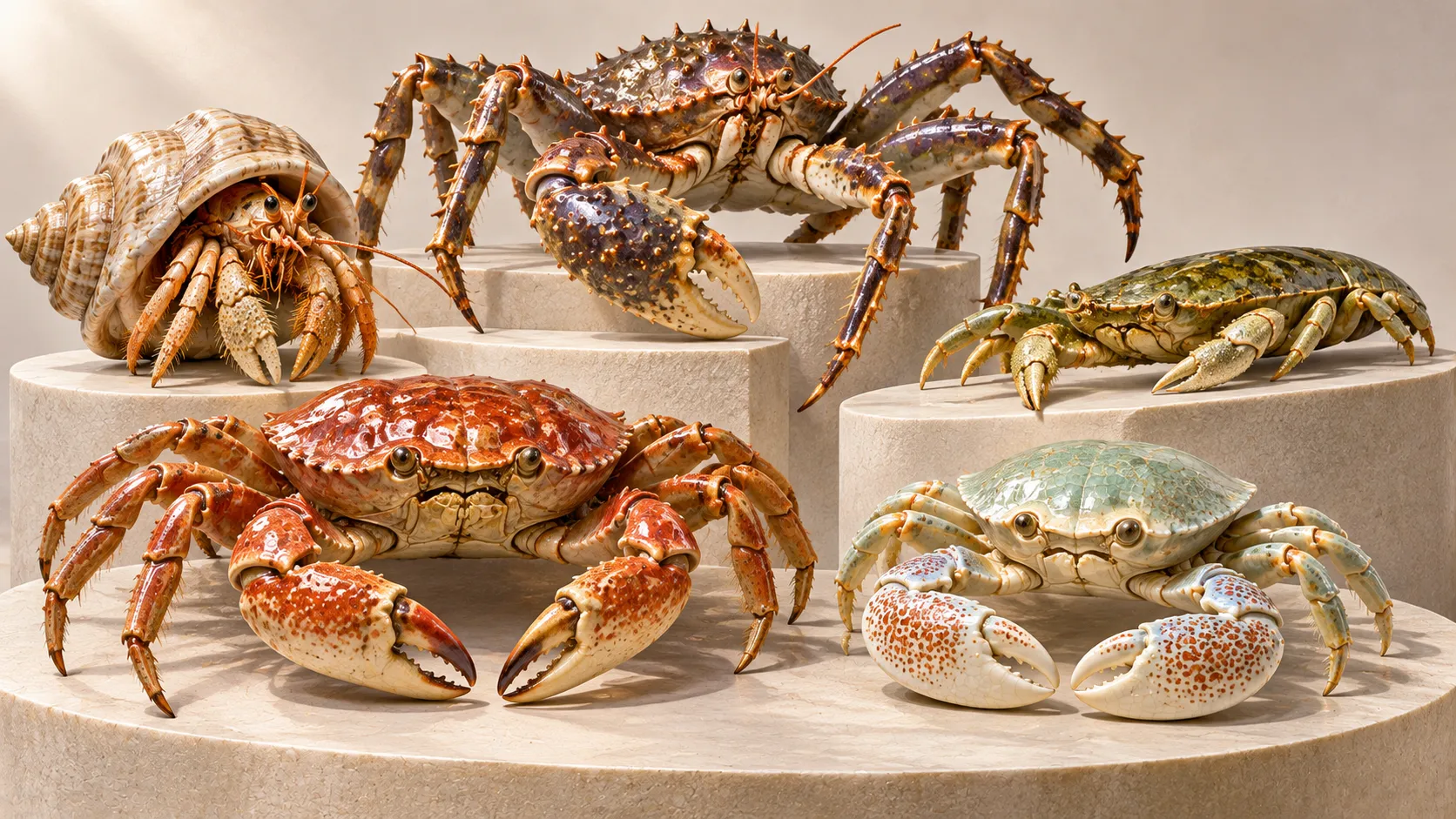
The Porcelain Crab
There is a problem with the porcelain crab.
It looks like a crab.
This is admittedly a poor beginning for a complaint about an animal called a porcelain crab. It has a broad, flattened body, a hard outer covering, two prominent claws and the general appearance of a creature that would object to being picked up.
Place one beside an ordinary shore crab and most people would put them in the same category without hesitation.
A zoologist might hesitate.
The porcelain crab is not what biologists call a *true crab*. It belongs to a different evolutionary branch, one that includes hermit crabs and their relatives. Its resemblance to a true crab is the result of a body shape appearing independently in different lines of descent.
And this has happened more than once.
Researchers have identified at least five independent evolutionary origins of crab-like body plans among decapod crustaceans. The process has a name: *carcinization*.
It is one of those scientific terms that sounds as though it should describe a chemical process performed upon an unfortunate animal. Instead, it describes the recurring evolution of a compact, broad-bodied form with a shortened abdomen folded beneath the body.
The phenomenon has inspired an entertaining idea: evolution keeps trying to make crabs.
The idea contains a real observation and a rather spectacular misunderstanding.
Different lineages have indeed evolved crab-like bodies. But evolution has no intention of producing crabs, no preferred final design and no reason to stop when one appears.
In fact, the strangest chapter comes after an animal has acquired the crab-like form.
Sometimes its descendants lose it again.
The Crab in the Wrong Family
To understand the problem, we need two different meanings of the word *crab*.
The first is a matter of ancestry.
True crabs belong to a group called Brachyura. It includes familiar animals such as shore crabs, fiddler crabs and many of the crabs found on reefs, beaches and the seafloor.
Membership in Brachyura is a question of evolutionary relationship. Its members share a history of descent, even when their bodies look very different.
The second meaning is descriptive.
A crab-shaped animal typically has a broad, flattened body covered by a hard carapace. Its abdomen is relatively short and held beneath the main body rather than extending behind it like the muscular tail of a lobster.
It may have large claws. Its legs project outward around the body.
To a human observer, that outline is immediately recognizable.
But body shape and ancestry are not the same thing.
Two creatures can resemble one another because they inherited a feature from a common ancestor. They can also resemble one another because similar features evolved separately in different lineages.
The second process is called convergent evolution.
We encounter familiar examples elsewhere in biology. Animals separated by long evolutionary histories can independently acquire streamlined bodies suited to moving through water. Different groups have evolved wings. Similar environmental challenges can favour similar structures, even when the organisms involved begin with different inherited arrangements.
The important phrase is *can favour*.
No organism chooses to develop an advantageous shape. Variations arise across generations, and natural selection can influence which inherited variations become more common in particular circumstances.
The result may resemble something that another lineage evolved independently.
The porcelain crab provides a useful example because the resemblance is convincing enough to hide the difference.
If all we had were the outside appearance, we might not suspect that something unusual had happened.
Fortunately, the animal has not concealed all the evidence.
A Pair of Legs That Gives the Game Away
Count the walking legs of a typical true crab.
Behind the front pair of claw-bearing limbs, you can usually see four pairs of walking legs.
Now look at a porcelain crab.
There are commonly only three obvious pairs of walking legs.
The fourth pair is reduced and tucked into the body, where the small appendages help with cleaning rather than ordinary walking.
This is not an infallible identification test for every unusually shaped crustacean. Evolution produces exceptions, and anatomy is more complicated than a counting game.
But it provides a clue.
So do the antennae, the abdomen and the way the animal uses its limbs.
Porcelain crabs can possess relatively long antennae and a mobile abdomen that differs from the arrangement familiar in many true crabs. Some can flick the abdomen to help propel themselves backward when escaping danger.
They also have an unexpected approach to dinner.
Despite those imposing claws, porcelain crabs often gather food using feather-like mouthparts. They sweep particles from the surrounding water, filtering suspended material rather than using their large pincers as their principal feeding equipment.
A visitor who judged the animal by its claws alone would be making several mistakes at once.
The claws are real. The crab-like outline is real. The filter-feeding equipment is real.
They simply do not belong to the same evolutionary story as the corresponding features of a typical true crab.
This is why biologists investigate internal structures, developmental features, fossils and genetic evidence instead of classifying animals entirely by their silhouettes.
Two organisms may arrive at comparable outward forms while retaining different anatomical details inherited from their respective ancestors.
Those details can expose the history that the silhouette conceals.
The porcelain crab is not pretending to be a true crab, of course.
It has no reason to care what a human taxonomist calls it.
It is getting on with being a porcelain crab.
The classification problem belongs to us.
The Hermit Crab's Unexpected Relatives
The king crab makes the question more entertaining.
King crabs can be very large, heavily armoured and equipped with impressive claws. They are among the animals most people would confidently identify as crabs.
And yet they are not classified among the true crabs of Brachyura.
King crabs belong to Anomura, the group containing hermit crabs and other relatives.
This relationship attracted scientific attention long before modern DNA sequencing.
Certain anatomical details suggested a connection between king crabs and ancestors resembling hermit crabs. Differences in abdominal structure and reduced walking appendages offered clues that were not obvious from the overall body shape.
A hermit crab is a useful animal to think about here.
Many familiar hermit crabs protect their relatively soft, often asymmetrical abdomens by occupying empty shells produced by gastropod molluscs.
The shell is not part of the hermit crab's body. It is borrowed accommodation.
As the animal grows, it may need to move into a larger shell.
That arrangement imposes practical limits. The abdomen must fit into the available shelter. The animal's size and activities are influenced by the properties of something another organism originally made.
King crabs, by contrast, have a strongly protected body and do not depend on living inside an abandoned snail shell.
Their crab-like anatomy represents a very different arrangement.
Research published in *Nature* in 1992 presented molecular evidence supporting the evolutionary connection between king crabs and hermit-crab lineages. Later phylogenetic studies have continued investigating the relationships and sequence of transformations involved.
This does not mean that a modern hermit crab grew tired of its shell and decided to become a king crab.
An evolutionary lineage is not an individual animal completing a makeover.
The changes unfolded through populations and generations over immense spans of time. Today's hermit crabs are living relatives, not the personal ancestors of today's king crabs.
The reconstruction of the precise ancestral forms and evolutionary pathways remains an active scientific question, with different phylogenetic analyses sometimes recovering different details.
But the broad lesson is striking.
A creature may carry a body plan that looks familiar while its evolutionary ancestry points somewhere unexpected.
The king crab does not need to be closely related to every animal that resembles it.
Evolution has more than one route to a wide carapace.
An Old Word for a Repeated Shape
Scientists noticed the recurring crab shape well before the internet found it amusing.
In 1916, the zoologist Lancelot Alexander Borradaile introduced the term *carcinization* in discussing crab-like features and evolutionary tendencies among certain crustaceans.
The subject continued to attract researchers because it posed a serious question about evolution.
Why should comparable body structures arise repeatedly?
A broad carapace, reduced abdomen and altered arrangement of limbs are not merely a colour pattern or a minor decorative feature.
They involve coordinated changes to the animal's overall architecture.
The abdomen must be reduced or rearranged. The body becomes more compact. Muscles, joints and the surrounding exoskeleton must function in the altered configuration.
And these features cannot change entirely independently without consequences.
A shorter abdomen affects the space available for internal structures. A wider body changes how limbs attach and move. A different carapace shape may influence protection, flexibility and the way the animal navigates its environment.
Evolutionary researchers therefore examine how multiple anatomical features change together.
A 2021 review by researchers including Joanna Wolfe, Javier Luque and Heather Bracken-Grissom considered evidence for at least five independent occurrences of crab-like body plans among decapod crustaceans.
The number is important, although it is not an eternal score engraved into biological law.
Counting independent origins requires a definition of what counts as sufficiently crab-like. It also depends on a phylogenetic tree: a reconstruction of how different groups are related.
Change the evidence, refine the evolutionary relationships or distinguish additional combinations of anatomical features, and the reconstruction can become more detailed.
In fact, one of the pleasures of studying carcinization is discovering how much complication fits inside a supposedly simple shape.
Some crab-like animals developed broad bodies through different intermediate forms. Some retain elongated or unusually arranged appendages. Some true crabs themselves have highly unconventional outlines.
The evolutionary tree is not a sequence of increasingly convincing crabs.
It is a branching history in which related organisms developed many different combinations of features.
Several branches acquired shapes we recognize as crab-like.
Others did something else entirely.
Why the Shape Might Be Useful
A compact body has plausible advantages.
A broad, flattened animal may be able to shelter beneath rocks or occupy crevices where a long-bodied crustacean would struggle.
A shortened abdomen, held beneath a protective carapace, may be less exposed to certain injuries or predators.
A sturdy body with limbs arranged around it may offer useful forms of movement and stability in particular habitats.
These possibilities are easy to picture.
Imagine moving through a narrow space between rocks. A long tail projecting behind the body may create difficulties. A more compact body could have different advantages.
Or consider an animal exposed to predators. Structures protecting vulnerable body regions could improve its chances of survival under some conditions.
These are reasonable hypotheses.
They are not universal demonstrations that the crab shape is always superior.
Different crustaceans occupy different environments, obtain food in different ways and face different dangers. A body that works well under one set of conditions can become inconvenient under another.
Nor can a researcher automatically infer the selective advantage of an ancient anatomical change simply from the fact that descendants possess it today.
Surviving species show what happened along particular lineages. They do not provide a direct experiment replaying all the alternatives that disappeared.
The 2021 scientific review discusses possible ecological benefits of the crab-like body, while emphasizing unresolved questions about how anatomical features evolve together and what makes the form repeatedly attainable.
A crab-shaped body may represent a useful solution available to certain crustacean lineages.
But a useful solution is not necessarily the best possible solution under every condition.
A submarine is well designed for travelling underwater. That does not make a submarine the ultimate form of transportation.
The comparison is imperfect, but it exposes the problem with the popular evolutionary joke.
The existence of a successful design does not establish that every other design is trying to become it.
And the strongest evidence against the idea of the crab as a universal destination comes from animals whose ancestors took the opposite direction.
The Crab That Changed Its Mind
Some crustacean lineages have lost a previously crab-like body form.
Researchers call this *decarcinization*.
The word sounds like a disappointing reversal. Having finally achieved a respectable crab shape, the animal's descendants apparently neglected to maintain it.
In reality, evolution does not hand out certificates for completing a particular form.
One particularly revealing example comes from the frog crabs.
Frog crabs belong to Brachyura. They are true crabs in terms of ancestry, but some have elongated bodies and specialized legs that differ sharply from the familiar broad, compact outline.
Their shapes are associated with life spent digging or moving through sediment.
Other decarcinized forms occur among mole crabs and certain burrowing crab groups.
These animals are not failed versions of conventional crabs.
They have different requirements.
An elongated body and specialized limbs can help an animal enter or move through sediment. A configuration that appears less crab-like to an observer may be suited to a different form of life.
Fossils help scientists investigate how such departures occurred.
A 2019 study involving paleontologist Javier Luque and colleagues examined unusual Cretaceous crabs, including forms with strikingly unconventional bodies and appendages. The research also compared repeated losses of crab-like anatomy among several lineages.
Some of these fossils provide evidence about changes in body proportions, limb positions and adaptations for swimming or burrowing.
Such specimens matter because living animals show only the branches that survived to the present.
The fossil record can reveal combinations of features that no longer occur, helping researchers test whether an apparently unusual modern body form represents a long-standing arrangement or a more recent transformation.
Decarcinization is therefore not an embarrassing exception to the story.
It changes the story.
If crab-like anatomy were the inevitable final product of crustacean evolution, repeated departures from it would be difficult to explain.
Instead, we see a history of changing forms, with different structures recurring or disappearing as lineages encounter different circumstances.
The same evolutionary process that can produce something crab-shaped can also produce something less crab-shaped.
There is no supervisor insisting that the animal return to the approved design.
Even the Sideways Walk Is Negotiable
Crabs have another famous characteristic.
They move sideways.
Or at least, many familiar crabs do.
For a person accustomed to walking forward, the sideways movement of a shore crab seems comically deliberate. Its legs are arranged in ways that make lateral movement effective, and it can appear to cross a beach without ever pointing its face in the direction of travel.
But even this familiar behaviour is not a guaranteed feature of a crab-like body.
Different crustaceans with crab-shaped bodies do not necessarily move in the same way.
Some king crabs predominantly move forward. Porcelain crabs may move backward. Among true crabs, locomotion also varies, including forms adapted to swimming, burrowing or other patterns of movement.
A scientific study published in *eLife* in 2026 examined the evolution of sideways locomotion using observations of living crabs and phylogenetic evidence.
It highlighted a distinction that seems obvious once someone points it out.
Having a crab-like shape and moving sideways are separate evolutionary characteristics.
One does not automatically guarantee the other.
A body may converge in its broad outline while retaining different movement mechanics. Conversely, closely related animals can acquire distinct locomotor habits as their anatomies and environments change.
This is one reason treating the crab as a single engineering design is misleading.
The recognizable silhouette conceals many anatomical arrangements and ways of living.
The popular image of a crab scuttling sideways has become almost a pictogram.
Actual crabs and their look-alikes have not agreed to obey the pictogram.
A Family Tree Is Not a Ladder
Much of the confusion surrounding carcinization comes from the way evolution is commonly illustrated.
A line of animals marches across a page. At the left is something primitive and inconvenient-looking. At the right stands a successful modern creature.
The sequence suggests progress toward a predetermined destination.
But evolutionary relationships form branching trees, not ladders.
An animal alive today is not an earlier stage of another animal alive today merely because one looks more compact or more specialized.
Hermit crabs are not unfinished king crabs.
Porcelain crabs are not practicing to become true crabs.
A frog crab has not gone backward in time by developing an elongated body.
Each is a modern organism descended from ancestors with their own evolutionary histories.
The shape of an animal is one part of that history, not a ranking of its evolutionary achievements.
There is a second complication.
The word *crab* can refer either to membership in Brachyura or to a set of anatomical characteristics. Scientists must keep those meanings separate when reconstructing convergent evolution.
An animal can be a true crab without possessing the typical crab silhouette.
Another can possess the silhouette without belonging to the true-crab group.
Fossils complicate the task further. A beautifully preserved specimen may show an unusual combination of features, but it does not automatically reveal which species were its direct descendants.
Researchers compare traits, geological ages and evolutionary relationships, making reconstructions that can be revised as new evidence appears.
Molecular evidence from living species adds another way of testing those relationships.
Together, anatomy, genetics and fossils help distinguish resemblance from common ancestry.
The result is less satisfying than a simple diagram showing a shrimp gradually becoming a crab and then congratulating itself.
It is also more faithful to how evolution works.
There are multiple branches, multiple histories and no final examiner.
What Repetition Actually Tells Us
The recurrence of a body shape is still an important scientific discovery.
It suggests that evolution may repeatedly explore comparable combinations of traits under certain biological and environmental constraints.
But not every possible organism is equally likely to arise from every ancestor.
Crustaceans inherit particular developmental systems, body segments and arrangements of appendages. Evolution modifies existing structures; it does not begin each new species with a completely blank design.
That historical inheritance influences the kinds of changes that can occur.
When related lineages share anatomical building blocks, it may be possible for some combinations of changes to recur.
Scientists are investigating how those changes depend on developmental pathways, genetics, body mechanics and ecology.
The question is not simply why a crab shape might be useful.
It is why certain lineages can arrive at that shape through different histories, how the relevant features evolve together, and why other lineages never take the same route.
There may not be one complete answer.
Different occurrences of carcinization may reflect different selective pressures or constraints. A useful trait in one lineage need not have developed for exactly the same reason in another.
And the departures from crab-like anatomy remind us that an evolutionary pattern can be real without being irreversible.
Repetition is evidence worth explaining.
It is not evidence of intention.
There is a considerable difference between saying that natural selection has repeatedly favoured certain anatomical combinations and saying that evolution wants everything to become a crab.
The first is a scientific proposition requiring evidence.
The second is a joke.
It is a good joke. It has unusually strong legs.
But it should not be allowed to reorganize the tree of life.
No Final Crab
We can return now to the porcelain crab.
It has not been incorrectly assembled.
Its broad body and conspicuous claws are part of an organism with a successful life of its own. Its smaller hidden walking appendages, mobile abdomen and specialised feeding structures reveal a history that the external silhouette does not explain.
Nearby, a true crab may possess a remarkably similar outline.
Elsewhere, a king crab carries another version of the form, while a frog crab demonstrates that even true-crab ancestry does not guarantee the familiar appearance.
Those differences are not flaws in the pattern.
They are the pattern.
Evolution has produced comparable body shapes more than once, but it has also generated enormous variation within and beyond them.
The crab-like form is neither an accidental illusion nor a universal answer.
It is a recurring possibility in the history of certain crustaceans.
And somewhere in that history, one lineage arrived at a crab-like shape while another began moving away from it.
Neither knew where it was going.
There was no finish line.