Articles / LORQAI
Where Did Lake Nakuru’s Flamingos Go?
In January 2006, more than 1.3 million Lesser Flamingos were recorded at Lake Nakuru. In January 2025, the count was about 500. Their disappearance from one of Africa’s most famous wildlife destinations has an explanation hiding in the chemistry of the water—and a second story unfolding far to the north.
Lake Nakuru once held more than a million Lesser Flamingos. A 2025 count found about 500. The birds' disappearance reveals a much larger story about Kenya's changing lakes.
Where Did Lake Nakuru’s Flamingos Go?
Imagine receiving a postcard from Lake Nakuru twenty years ago.
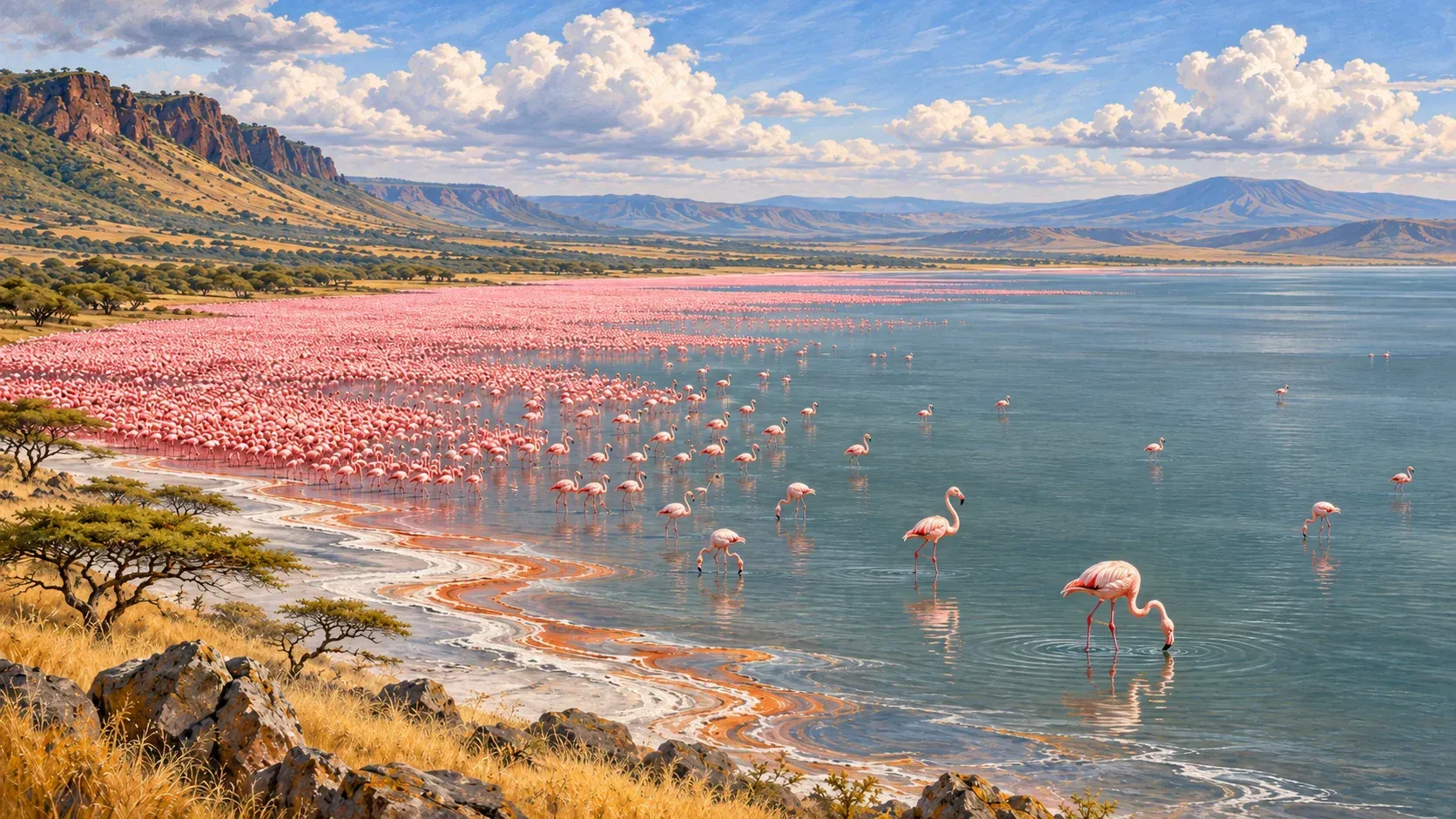
The lake is pink.
Not pink in the sense of a sunset reflected on water. Pink because thousands upon thousands of birds occupy the shallows, their long necks bending toward the surface, their bodies forming moving patterns along the shore. The famous photographs are almost difficult to believe until you understand that the colour is not part of the lake at all.
It can leave.
In January 2006, a waterbird survey counted 1,347,063 Lesser Flamingos at Lake Nakuru. In January 2025, the equivalent count was approximately 500.
Both figures were reported by the Kenya Wildlife Service in 2026. They describe birds recorded at one lake on two particular occasions. They do not describe the total number of flamingos living in East Africa, and they do not mean that more than a million birds died.
But the contrast is extraordinary.
The difference between those two snapshots is approximately 1.35 million birds. For a national park whose international identity was built in part around enormous flamingo gatherings, the disappearance of the familiar pink shoreline raises an obvious question.
Why did flamingos leave Lake Nakuru?
The principal explanation is that changing water levels have altered the lake's salinity and alkalinity, reducing the microorganisms on which Lesser Flamingos depend for food. The birds move through a network of Rift Valley lakes, following suitable conditions rather than remaining permanently at one site.
That answer is supported by Kenya's wildlife authorities and scientific monitoring organisations.
It also leads to a much stranger investigation: the birds may be moving through landscapes that are far less famous, far less accessible and, in some cases, less formally protected than the lake they left behind.
Exhibit One: The photograph that became a promise
Lake Nakuru sits within the Great Rift Valley, surrounded by a protected landscape of grassland, woodland and rising terrain. It became internationally famous as a place where visitors could see immense congregations of flamingos.
The spectacle was real. So was the mistake people made when looking at it.
A photograph captures birds at a particular moment. Tourism advertising has a habit of making that moment seem permanent.
Flamingos do not understand the agreement.
They are mobile birds, capable of moving between feeding sites as conditions change. A large flock may gather where food is abundant, then leave when water chemistry, food availability or other environmental circumstances become less favourable.
That movement is not a failure of the birds to behave as expected. It is part of their ecology.
The historical record makes this apparent even before the recent collapse in numbers at Nakuru. In the documentation supporting the Kenyan Lake System's World Heritage nomination, January 2006 stands out as an exceptional year for the lake. The following January, the recorded flamingo total was already dramatically lower.
Flamingo abundance has never been a perfectly stable number.
This matters because a story about disappearance can mislead in two opposite directions. One account treats every absent bird as dead. Another assumes the birds merely went somewhere else and therefore nothing serious has happened.
Neither conclusion follows from a count taken at one location.
We need to examine why Nakuru stopped offering the conditions that had made it so attractive—and whether the alternative places can support the birds indefinitely.
Exhibit Two: A lake changes its recipe
The mechanism begins with something less visually dramatic than a flock of flamingos.
Water.
Lake Nakuru is an alkaline lake. Under suitable conditions, its chemistry favours the growth of cyanobacteria, including Arthrospira, widely known as spirulina, which provide a major food source for Lesser Flamingos.
The birds are exceptionally well adapted to feeding on these tiny organisms. Their bills are specialised for filtering food from water. Where suitable microorganisms become abundant, birds can gather in enormous numbers.
But the biological productivity of an alkaline lake depends on a delicate combination of conditions.
More water does not necessarily mean more flamingo food.
When rainfall and inflows increase the volume of water, concentrations of dissolved salts can fall. Changes in alkalinity and associated chemical conditions can make the lake less suitable for the microorganisms that previously thrived there.
The Kenya Wildlife Service reports that Lake Nakuru's surface area has increased by an estimated 70 percent compared with its average for 1984–2009. Other Rift Valley lakes have also experienced major changes in water extent.
A larger water surface might look like an environmental improvement to someone accustomed to seeing shrinking lakes elsewhere. For Nakuru's Lesser Flamingos, the consequences can be very different.
The lake is not simply a container that has been filled with more water. It is a chemical and biological system whose balance has changed.
Kenya's Wildlife Research and Training Institute has examined the loss of spirulina and described efforts to investigate whether the food conditions that once supported large flamingo gatherings could be restored.
This gives us a more precise explanation than the familiar phrase climate change drove the flamingos away.
Changing rainfall and water levels are important. But the birds respond to the consequences of those changes: food availability, water chemistry and the conditions required for feeding.
That distinction is the difference between naming a broad environmental pressure and understanding the mechanism through which it affects an animal.
It is also why restoring a famous photograph may be more difficult than waiting for the next dry season.
Exhibit Three: The birds nobody can follow individually
When a flock leaves Nakuru, where does it go?
Common answers name Lake Bogoria, Lake Elementaita, Lake Magadi and Lake Natron in Tanzania. These places belong to the wider East African network of saline and alkaline lakes used by flamingos.
But there is a scientific problem with the question.
Unless birds are individually tracked, a survey at one lake followed by a survey at another does not establish that the same animals made the journey between them.
A million birds leaving one lake and hundreds of thousands appearing elsewhere may suggest a regional redistribution. It does not prove a direct route or identify what happened to every bird.
And the alternative lakes have their own environmental difficulties.
Nature Kenya reported in August 2026 that rising water levels at Nakuru, Elementaita and Bogoria had changed conditions for flamingo food production. In other words, moving to another traditionally important lake may not always solve the problem.
The system is interconnected. Its vulnerabilities can be interconnected too.
This is why wildlife authorities coordinate counts across several lakes rather than relying on an isolated observation from one familiar destination.
A coordinated survey provides a broader snapshot of how birds are distributed at roughly the same time. It does not eliminate every uncertainty: visibility, weather, access, movement during surveys and differences in counting methods can affect results.
But it is considerably more informative than looking at Nakuru alone and declaring the flamingos gone.
The correct answer to where did Lake Nakuru's flamingos go? is therefore not a single destination with an arrow drawn on a map.
They use a shifting regional network.
And one increasingly important part of that network lies in a place that rarely appears in old promotional photographs of Nakuru.
Exhibit Four: The surprise at Lake Logipi
Lake Logipi lies in the remote Suguta Valley of northern Kenya.
It is not the kind of place most visitors picture when imagining an easy wildlife excursion. The terrain is hot and isolated, and the surrounding geography is demanding.
But in December 2024, an aerial survey estimated approximately 737,000 Lesser Flamingos at Logipi.
For researchers examining the redistribution of East Africa's flamingos, that count was difficult to ignore.
The Kenya Wildlife Service subsequently highlighted Logipi as a possible important refuge, noting that its lake conditions appeared comparatively stable.
There was another reason for excitement.
Surveys in March 2025 and March 2026 recorded substantial proportions of juvenile birds, along with observations of old mud nests and hatched eggshells. The wildlife authority described this as evidence relevant to the possibility of breeding at Logipi.
That is significant because regular breeding sites for Lesser Flamingos are unusually limited. Lake Natron in Tanzania has long been the best-known major breeding site in East Africa.
But the Logipi numbers also contain a warning about easy conclusions.
A March 2026 count found approximately 50,000 flamingos there—not 737,000.
Does that mean Logipi suffered the same collapse as Nakuru?
Not necessarily.
The two counts were taken in different months and different years. Flamingos can move rapidly between lakes as conditions change. A lower count at Logipi on one date does not, by itself, demonstrate a local population disaster or the death of hundreds of thousands of birds.
This is precisely the lesson that Nakuru's history teaches.
A lake can appear to gain or lose an enormous number of birds without the same change occurring in the total population.
What matters is whether the entire network continues to provide enough suitable habitat for feeding, movement and reproduction.
Logipi may prove essential to that network. But researchers still need repeated monitoring to understand exactly how birds use it over time.
The irony is striking: a lake long celebrated by tourists may be losing its importance as another, far less famous lake becomes increasingly significant to conservation.
Exhibit Five: The pink birds are not all the same
There is another detail that often disappears from popular accounts.
Not every flamingo seen in Kenya belongs to the same species.
The Lesser Flamingo is the species most strongly associated with the vast, densely packed feeding flocks of alkaline lakes. It relies heavily on microscopic food such as Arthrospira.
The Greater Flamingo uses a more varied diet, including small aquatic animals, and may respond differently to changes in the same ecosystem.
This is one reason a description of flamingos disappearing is less informative than species-specific monitoring.
A lake might become less suitable for Lesser Flamingos while still providing habitat for other waterbirds. The shoreline may change colour without becoming biologically empty.
None of this means the changes are harmless.
Lesser Flamingos are classified globally as Near Threatened. Their dependence on relatively specialised feeding and breeding conditions makes them vulnerable when several key habitats change at once.
The problem cannot be reduced to whether tourists can still take a particular photograph.
A spectacular flock is the visible part of a much larger ecological system. The underlying condition of that system may matter most when the spectacle is absent.
Exhibit Six: Can the flamingos come back?
It is tempting to ask when Nakuru will become pink again.
There is no reliable date to give.
Flamingos are capable of returning when conditions become suitable, and their numbers at individual lakes can change rapidly. But a return depends on the chemistry and biology of the lake, not simply on a desire to restore the destination's former reputation.
Scientific and conservation work can help identify the obstacles.
The Wildlife Research and Training Institute has reported investigations aimed at understanding spirulina availability and whether the lake's former food conditions can be improved.
The Kenya Wildlife Service has also described a national conservation action plan for Lesser Flamingos covering 2026–2035, with attention to monitoring, habitat protection and regional coordination.
These initiatives matter, but none guarantees that Nakuru will again hold a million birds.
Restoration is especially complicated when changes affect an entire catchment.
Water flows into a lake from land around it. Rainfall, land use, erosion, pollution and management decisions can all influence what ultimately reaches the water.
Managing the lake requires more than protecting the visible shoreline.
And managing flamingos requires more than protecting Nakuru.
A bird that feeds in Kenya and may move across national borders cannot be effectively conserved through a single park's boundaries alone.
The story of the flamingos is regional, even when the most memorable photographs were taken at one location.
The uncomfortable mathematics of disappearance
Let us return to those two counts.
January 2006: 1,347,063 Lesser Flamingos at Lake Nakuru.
January 2025: approximately 500.
The difference is dramatic. The decline in the number observed at that one lake is greater than 99 percent.
But it is not scientifically correct to say that the East African Lesser Flamingo population declined by more than 99 percent over the same period.
That would require comparable population-wide evidence, not two counts from one site.
This distinction is easy to miss, and it changes the emotional meaning of the story.
The flamingos did not sign a permanent lease on Lake Nakuru. They were there because a particular combination of water and life made it useful to them.
When that combination changed, many stopped using it.
Elsewhere in the Rift Valley, other lakes have offered food, shelter or breeding opportunities at different times. Logipi's enormous 2024 gathering is evidence that remarkable flamingo concentrations still occur in Kenya.
But redistribution is not automatically resilience.
When the number of suitable places shrinks, a mobile species may survive by moving—until there are too few suitable places left.
That is the conservation concern hidden beneath the familiar question about missing pink birds.
A photograph from the future
A visitor arriving at Lake Nakuru today should not be promised the exact scene that appeared in a travel magazine twenty years ago.
The lake remains a remarkable landscape, with other wildlife, changing water, vegetation and the surrounding national park. Its identity is not exhausted by the flamingos.
Yet the absence of those immense flocks remains important. It tells us something about how quickly a celebrated natural spectacle can change when the conditions sustaining it no longer hold.
Perhaps future monitoring and ecological recovery will document a substantial return. Perhaps Logipi and other lakes will become enduring centres of the birds' lives. More likely, researchers will continue to find a complicated pattern of movement, changing numbers and local conditions that cannot be reduced to a single answer.
A postcard shows where the flamingos were.
A scientific count tells us where some of them were on a particular day.
A conservation strategy has to ask whether they will still have somewhere suitable to go tomorrow.
The most useful question, then, is not simply where did Lake Nakuru's flamingos go?
It is how many places can they still call home?