Articles / LORQAI
The Lake Where Boats Needed Permission
At Lake Bosomtwe, fishermen learned to cross the water on wooden planks. When scientists arrived with a research vessel, twenty-five chiefs helped decide whether it could enter. Beneath them lay a crater made by an asteroid—and a record of the region's changing climate.
On Lake Bosomtwe, fishermen crossed the water on wooden planks. When scientists wanted to bring a research vessel, they needed permission from local chiefs. This is the story behind a rule about boats, the science beneath the lake, and the struggle to protect it.
The Lake Where Boats Needed Permission
Before scientists could put a research boat onto Lake Bosomtwe, they needed something a survey instrument could not provide: permission from the people who regarded the water as sacred.
The vessel was called R/V Kilindi. It had fiberglass hulls, a steel framework and an aluminum deck, and it was built to carry equipment that could send sound through water and read the structures beneath the lakebed. Researchers assembled it at the shore with local assistance. Then came the less mechanical part of the operation. According to the scientific account published by Christopher Scholz and colleagues, traditional authorities—including twenty-five local chiefs—reviewed the plan and took part in a ceremonial dedication before the vessel was allowed onto the lake.
That was in connection with geophysical work at the turn of the millennium. It was not a newspaper tale about a mysterious object on the water. It was a documented negotiation over the arrival of a boat where boats had traditionally been restricted.
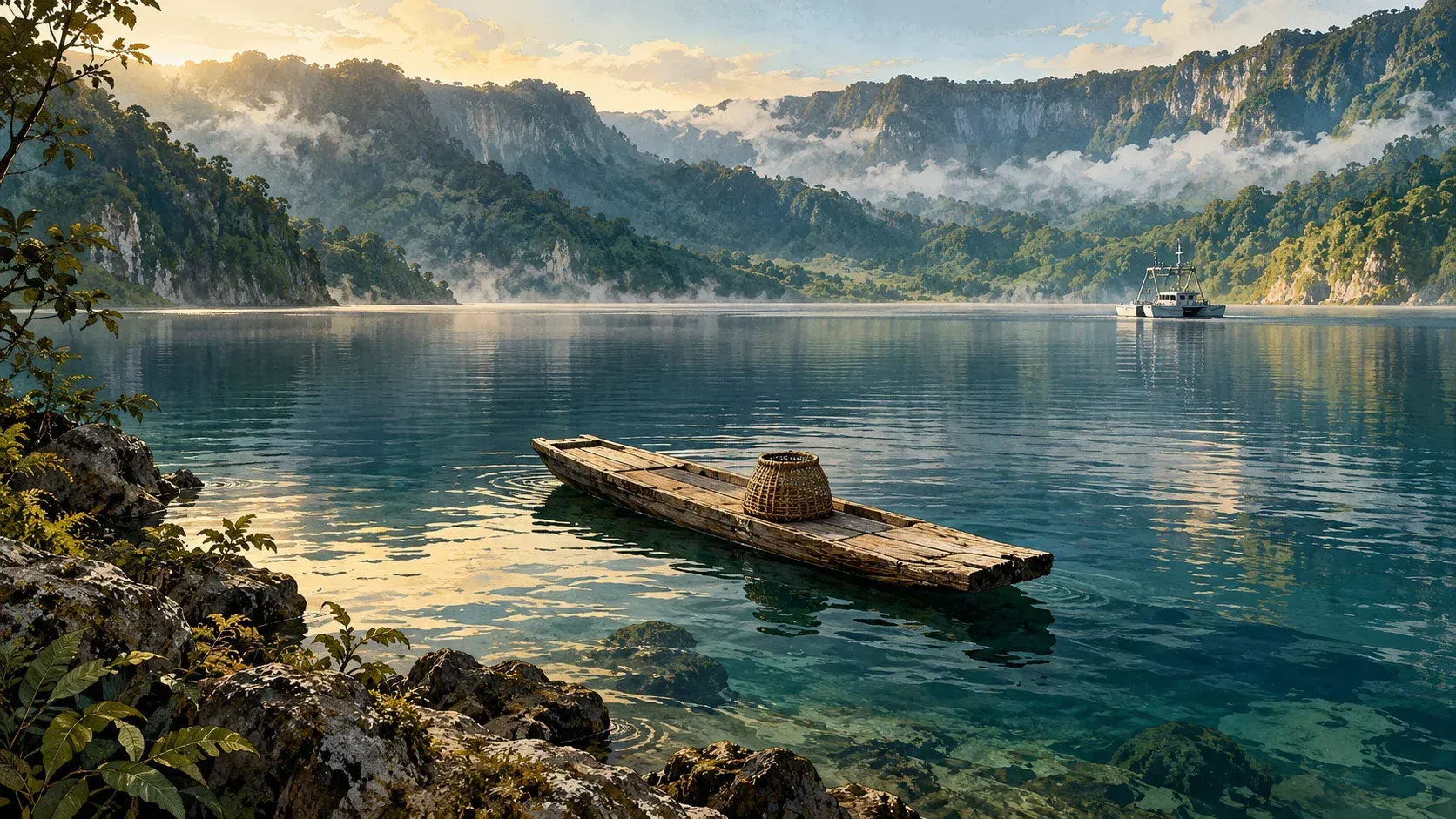
For generations, fishermen around this lake in Ghana's Ashanti Region had used a very different craft: the padua, a narrow wooden plank or roughly shaped log, propelled by hand or with a small calabash. A boat with metal fittings was not merely unfamiliar. In the traditional understanding of the place, metal and certain other fishing methods violated rules associated with the lake's sacred character.
Why were iron boats forbidden on Lake Bosomtwe? The short answer is that local religious rules historically prohibited iron from touching the water, alongside restrictions on canoes, fishing gear and particular fishing days. The padua allowed people to fish while observing those rules. The longer answer is more interesting, because the rules have never been only about metal. They concern who may use the lake, what may be taken from it and who has the authority to say yes when circumstances change.
The plank is not an unfinished boat
A padua can look almost absurdly spare beside a modern canoe. The fisherman has little above the water except a length of buoyant timber and his own balance. In historical descriptions, some fishermen lay along the wood and used their hands to propel themselves; other accounts describe sitting or using small calabash paddles. These are descriptions of skill, not instructions for an unprepared visitor to try the method.
The form matters. It is not a hollowed-out canoe with the sides forgotten. It is a distinct way of moving, developed within the limits of a particular fishing tradition. It puts a person close to the water and restricts the amount of equipment that can be carried. The craft is part of how the lake's rules become visible in everyday work.
Ghana's official tourism information still describes padua fishing and traces its use to a taboo against iron touching the lake. The same page, however, acknowledges that some modern boats have crossed the water. That qualification matters. A historical prohibition is not automatically a complete description of everything happening on the lake today.
Even the simple explanation—iron was forbidden, so people used wood—does not tell the whole story. An early ethnographic account listed ordinary canoes and hollowed-out logs among restricted objects too. The distinction was not merely between a metal hull and a wooden hull. It included the shape of the craft and the fishing techniques people were permitted to use.
To understand why a plank could be acceptable while a canoe was not, we have to leave the boat-building workshop and enter a much older story about the water itself.
An antelope reaches the lake before the geologists do
In an Asante tradition recorded by UNESCO, a hunter following an antelope discovered water where the animal disappeared. The lake revealed an unexpected abundance of fish. Versions differ over the hunter's name and how the water first appeared, but the encounter explains the place as something found through an unusual relationship between a person, an animal and the landscape.
The lake is also associated in traditional beliefs with a deity sometimes called Twi and with the journey of the dead. Some accounts describe departed souls coming to the water before continuing beyond the world of the living. These are cultural and religious traditions, not geological accounts of the lake's formation, and they should not be presented as if every resident interprets them in exactly the same way.
The geologists' explanation begins at an entirely different point on the calendar: about 1.07 million years ago.
A large asteroid struck what is now central Ghana, excavating a crater approximately 10.5 kilometres across. Over time, water accumulated in the basin. The resulting lake, about eight kilometres wide, occupies most of the crater interior. NASA and decades of geological research have documented evidence of the impact, including shocked and melted rocks and distant glassy debris associated with the event.
That evidence settled a scientific argument that once entertained other explanations, including a volcanic origin. The impact is not a legend dressed up in laboratory language. It is supported by measurable features of the rock and the crater's structure.
For a reader looking at the water from the rim, the timescales resist being held together in one picture. A hunter belongs to a human story whose versions have travelled through generations. The asteroid belongs to a period long before humans could describe the place. Both histories meet at a lake where people have fished, farmed, prayed and raised families.
The asteroid explains the bowl. It does not explain the etiquette of entering it.
What the oldest written rules actually say
In 1923, the colonial-era ethnographer R. S. Rattray published Ashanti, including a detailed account of Lake Bosomtwe's traditions and fishing methods. His work is a valuable dated record, but it also belongs to the viewpoint and assumptions of an outsider writing under colonial administration. It should be read as evidence of practices he recorded at that time, not a timeless rulebook speaking for everyone around the lake today.
The restrictions he documented went far beyond an iron boat. They included iron hooks, certain nets, conventional canoes, paddles, poles, hollowed-out logs and metal vessels used in fishing. Fishing on Sunday was prohibited in his account. He also recorded an exclusion affecting menstruating women. Stating that such a restriction was described historically is not an endorsement of it or proof that it applies today.
This list makes the popular shorthand—they were not allowed to use metal boats—both useful and incomplete. Some wooden boats would also have been unacceptable within the practices described. The padua was one accepted method among a larger set of rules governing activity on the water.
The restrictions were linked to reverence for the lake and to the belief that certain acts could offend its spiritual power. They also had practical consequences. A craft that carries less equipment, a rule limiting fishing days and prohibitions on some gear all affect how much fishing a community can conduct.
It would be too neat to claim that the rules were invented specifically as a modern environmental management plan. The people who maintained them understood them through religious and social obligations. But the ecological effects deserve study, and researchers have done exactly that.
A paper published in the Ghana Journal of Science, Technology and Development in 2019 examined the lake's traditional fisheries management. Its authors found that older rules could limit disturbance and fishing pressure, while warning that weakening observance and changes in fishing practices were associated with overfishing and declining fish stocks. Their proposed response was not to recreate the past unchanged. It was to combine useful traditional practices with modern management.
The important question is not whether a taboo sounds strange to a visitor. It is whether the lake has a working set of rules that fishers, local authorities and scientists can understand, negotiate and enforce.
The day a catamaran asked to come aboard
The Kilindi episode turns that question into a documented event.
Researchers wanted to investigate the shape of the crater concealed beneath water and sediment. Their survey required a vessel much larger and more complicated than a fisherman's plank, with equipment capable of recording seismic reflections. Scholz and colleagues described the vessel as a modular catamaran transported to the shore and assembled with local help. Its structure included metal, even though its twin hulls were fiberglass.
In their published account, the scientists did not pretend that the lake's restrictions had evaporated because the work was scientific. They reported seeking approval from traditional authorities. The eventual permission came after review and a ceremonial dedication involving twenty-five chiefs. The researchers could then proceed with the survey.
Notice what this does—and does not—establish. It documents an authorised exception for a specific scientific undertaking. It does not prove that the lake's customs were abandoned, that all later boats automatically received permission or that every community member approved. Nor does it mean the scientists secretly broke a rule and were forgiven afterward.
The vessel acquired seismic data around 2000, and the team subsequently removed it from the lake. In 2004, an international drilling programme undertook a different, much larger investigation, recovering cores of sediment and impact-related rock. Those are related chapters in the scientific history of Bosumtwe, but they should not be collapsed into a single boat trip.
The story could have been told as a clash: engineers versus religion, machinery versus tradition, a modern boat forcing its way onto old water. The scientific record offers a more useful account. Research required equipment; local people held authority over the place; permission had to be negotiated.
There is an editorial temptation to invent what the dedication looked like: the clothes people wore, the precise words spoken, the expressions on the chiefs' faces as the vessel touched the lake. The available paper gives no licence to reconstruct those moments. We know an exception was made and that it was not made casually. That is enough.
A second lake lies beneath the first
A boat on the surface could help scientists investigate a landscape almost nobody sees.
Beneath Bosomtwe's water lies a deep archive of mud and rock. Some sediment accumulated gradually after the impact, carrying traces of changing rainfall, vegetation and conditions around the basin. Deeper down are materials damaged and rearranged by the collision itself. The lake's geological interest is therefore double: it records a violent event that made the crater and the much slower environmental history that followed.
The International Continental Scientific Drilling Program reports that researchers recovered cores in 2004 at several locations in the lake. Some holes extended far into the sediment and underlying impact structure. Figures of around 540 metres refer to the depth of certain drilling operations below the lakebed, not the lake's water depth. The water itself is roughly 70–80 metres deep at its deepest, with published measurements varying by method and date.
That distinction matters because popular articles often move impressive numbers between a crater, a water column and a drill hole as though they describe the same thing. They do not. A crater about 10.5 kilometres across is not a lake 10.5 kilometres across. A drill hole hundreds of metres deep does not make the lake hundreds of metres deep.
In 2025, a scientific study using material from the 2004 drilling investigated how mercury cycles varied with hydroclimate in the lake's sediment record. The investigation had nothing to do with proving or disproving a religious tradition. It shows why the place attracts scientists: layers of mud can preserve questions about how the climate of tropical West Africa changed long before modern weather stations existed.
The historical prohibitions and the research expedition belong to the same landscape, but they describe different ways of knowing it. One concerns how people should behave at the lake. The other concerns what its sediments and rocks reveal about the past.
The modern problem is that good knowledge of both kinds does not necessarily keep the water healthy.
What the water needs now
In a description of the Lake Bosomtwe Biosphere Reserve, the Ghana Commission for UNESCO identifies familiar pressures: waste entering the lake, harmful activities near the shores and concerns about fish populations. It also describes local involvement in management and environmental education. UNESCO's Man and the Biosphere programme records the site as a biosphere reserve designated in 2016.
Designation matters. But it cannot collect rubbish, prevent a damaged slope from eroding or settle every dispute about access. Those are jobs for the people and institutions responsible for the place.
The 2019 fisheries study was blunt about declining stocks and the erosion of older management practices. More recent research into the lake's deep water, published in 2025, investigated gases and their possible connection to past fish-kill events. The scientists found that the concentrations measured did not support a dramatic scenario in which the lake was about to erupt dangerously with gas. They instead identified complex water-circulation and oxygen conditions, which require precise monitoring rather than sensational headlines.
Then, on 17 April 2026, the Ghana News Agency reported that the Ashanti Regional Minister had ordered a halt to unauthorised land clearing around the lake, following concerns about vegetation loss and possible erosion. The Environmental Protection Authority was instructed to investigate. This was an official response to a reported threat; it does not prove that every affected area had already been restored by October 2026.
Consider the change in scale. The old question was whether a metal hook, a canoe or a particular net could enter the lake. The present questions include what happens on the hillside: trees removed, soil exposed, runoff carrying material downhill, waste reaching the shore. A lake can be respected in ritual and still suffer environmental damage.
The padua is an ingenious answer to a rule about fishing. It is not an answer to unchecked clearing on the slopes above the water. Both kinds of problem now belong in any serious discussion of protecting Bosomtwe.
Who can say yes to the next boat?
There is a final distinction worth keeping in view. The boat restriction is frequently written in the present tense as an absolute statement: No metal boats are allowed on Lake Bosomtwe. Historical accounts demonstrate that a prohibition existed. Tourism sources acknowledge exceptions and modern craft. A scientific paper documents permission for a particular research vessel. None of these sources establishes a single, universally enforced rule applying to every boat on every part of the lake in October 2026.
The accurate answer is more specific. Iron and conventional boats were traditionally restricted because the lake was sacred; fishermen used padua planks as an accepted alternative. Some aspects of the customary system changed over time, and an important research exception was negotiated with local chiefs.
That answer is less convenient for a one-line travel caption. It is also more interesting, because it reveals a living relationship rather than a frozen superstition. A prohibition can have practical environmental effects. An exception can be granted without erasing the original obligation. Conservation can borrow what works from older rules while acknowledging that modern pressures need their own responses.
When the scientists launched the Kilindi, they did not make Lake Bosomtwe any less ancient. They brought a new instrument to a crater whose geological history had begun long before the first fisherman carried a plank toward the shore. They also had to recognise that the lake was not an empty laboratory waiting for their arrival.
The most telling object in this story may still be the padua: a length of wood small enough to miss in a panoramic photograph, yet important enough to explain why twenty-five chiefs were involved when a research boat wanted to cross the water.
One day another vessel may need permission. The harder question will be whether the people responsible for the lake have what they need to protect everything around it after that vessel has gone.
Sources and further reading
- Ghana Tourism Authority / Visit Ghana — Lake Bosomtwe (external platform)
- University of Ghana digital collection — R. S. Rattray, *Ashanti* (1923) (external platform)
- Scholz, Karp & Lyons — *Structure and Morphology of the Bosumtwi Impact Structure* (2007) (external platform)
- NASA Earth Observatory — An Explosive Beginning for Lake Bosumtwi (external platform)
- Ghana Journal of Science, Technology and Development — Traditional Fisheries Management of Lake Bosomtwe (2019) (external platform)
- International Continental Scientific Drilling Program — Bosumtwi Drilling Project (external platform)
- Ghana Commission for UNESCO — Water Resource Management at Lake Bosomtwe (external platform)
- Ghana News Agency — Minister Halts Illegal Land Clearing Around Lake Bosomtwe (17 April 2026) (external platform)
- Climate of the Past — Evidence for Millennial-Scale Interactions Between Hg Cycling and Hydroclimate From Lake Bosumtwi (2025) (external platform)