Articles / LORQAI
The Most Humiliating Battle in Medieval Art
Why medieval knights fought snails in illuminated manuscripts — and why nobody can quite agree what the joke was.
A medieval knight has armor, a shield and a serious problem: his opponent is a snail. Discover the strange artistic tradition that still puzzles historians.
By LORQAI
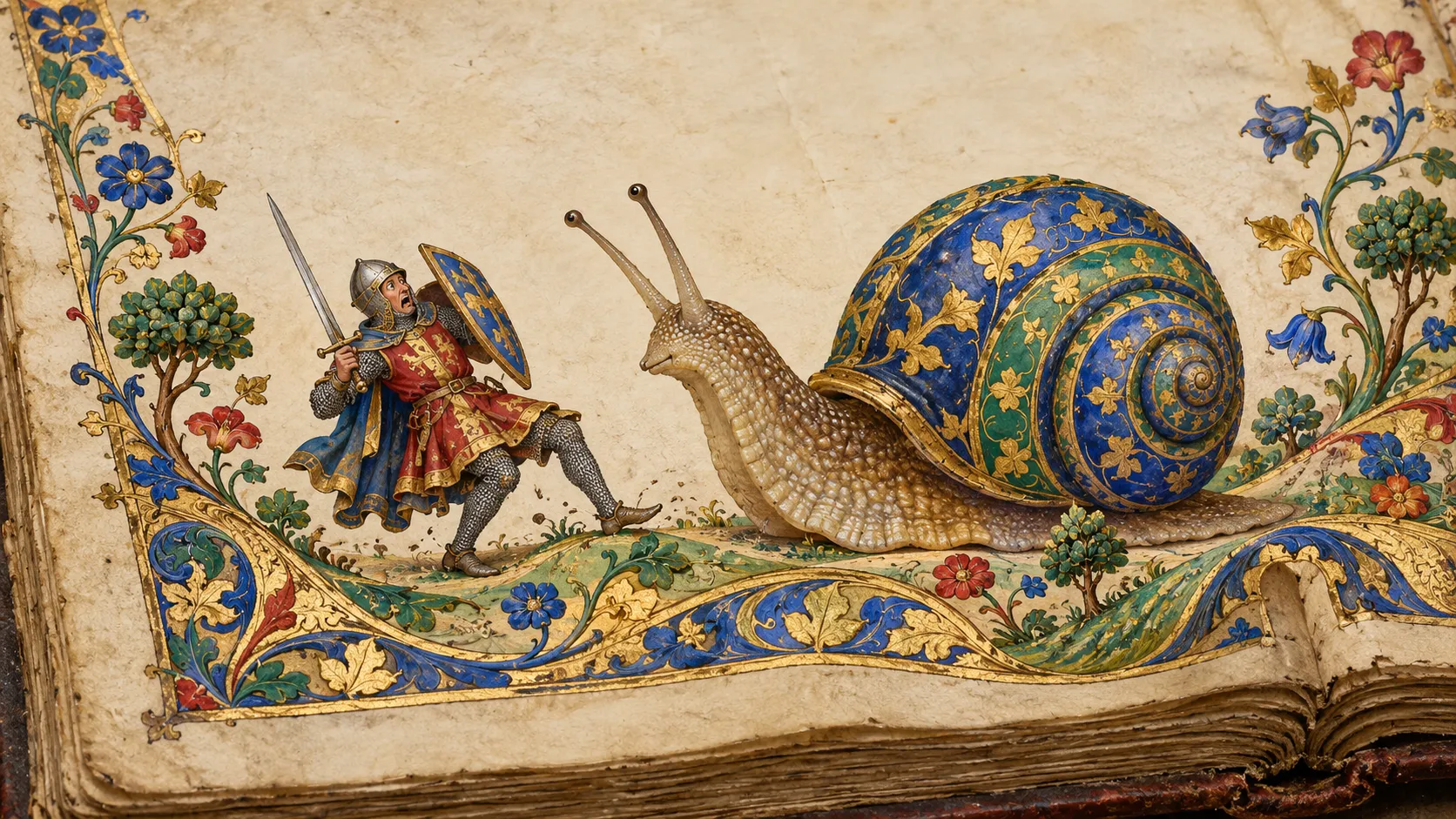
A Knight and a Snail
The knight is having a terrible day.
He has acquired the necessary equipment for a respectable medieval confrontation: a weapon, a shield, protective clothing and the general appearance of a man who has spent a considerable amount of time preparing to be dangerous.
His opponent has brought a shell.
There is no army. No fortress. No enemy cavalry waiting beyond the hills. The battlefield is a narrow strip of parchment, and the creature approaching the knight appears to have no particular ambitions beyond being a snail.
Nevertheless, the knight looks worried.
Sometimes he raises his sword. Sometimes he retreats. In one remarkable medieval illustration, an armed man has put down his weapons and appears to be begging for mercy.
The snail has not even had to move very far.
These scenes are not modern jokes added to old pictures. They belong to an actual tradition of medieval manuscript decoration. From the late thirteenth century onward, artists repeatedly painted armed men confronting snails in the margins of books. The motif appears in manuscripts produced in different parts of medieval Europe, including France and England.
Nobody has established a single explanation for why this particular confrontation became so popular.
That last detail makes the pictures considerably better.
An ordinary medieval mystery might involve a missing manuscript, an unreadable inscription or the disputed identity of somebody wearing a crown. This one asks why an artist took the trouble to depict a heavily equipped warrior losing his composure in front of a garden mollusc.
The surviving evidence offers several answers.
None has managed to defeat all the others.
And so the snail, after seven centuries, remains undefeated.
An Unexpected Discovery in the British Library
In September 2013, the British Library published a short account of an encounter with one of these extraordinary images.
A group of manuscript specialists had been examining medieval genealogical rolls. A colleague noticed a knight fighting a snail in an English roll dating from the final quarter of the thirteenth century.
The colleague found the picture surprising.
The medievalists found his surprise surprising.
For specialists familiar with Gothic manuscript decoration, the subject was not particularly unusual. Knights fighting snails appeared often enough that the encounter had become a recognizable feature of medieval visual culture.
This creates a delightful division between two kinds of expertise.
Most people see the picture and wonder what on earth is happening.
A specialist sees the picture and recognizes the genre.
The British Library's examples include a knight confronting a snail in the Gorleston Psalter, produced in England in the early fourteenth century. Another image from the same manuscript shows a kneeling knight near a snail, with the human figure apparently submitting rather than attacking.
A French manuscript of Brunetto Latini's Li Livres dou Tresor contains a mounted knight jousting against a snail. The Queen Mary Psalter offers a particularly lively variation involving snails, a knight and a dragon.
Each scene belongs to an individual manuscript, made for a particular purpose and within a particular artistic environment.
Yet the recurring ingredients are remarkably consistent.
A human combatant. A snail. An inappropriate level of alarm.
One might assume the artist was simply enjoying a private joke. Perhaps the page had become monotonous, the pigments were ready, and somebody decided that a little absurdity would improve the afternoon.
It is a tempting explanation.
It also makes assumptions about the artist's intention that we cannot demonstrate.
The pictures are funny to us. They may have been funny to medieval viewers too, but the historical question is more complicated than whether a tired illustrator wanted a laugh.
The image appears repeatedly, across places and manuscripts. Its popularity suggests that artists and audiences recognized something worth reproducing.
What they recognized is the puzzle.
The Serious Business of Making an Unserious Picture
A medieval illuminated manuscript was not an ordinary notebook casually filled during an unproductive meeting.
Producing a book could involve preparing parchment, planning the layout, writing the text, adding decoration, applying pigments and binding the finished pages. Depending on the manuscript, different specialists might undertake different stages.
The materials required care. The work required skill. A luxurious manuscript could represent a substantial investment.
That makes its decorative absurdities particularly interesting.
Someone involved in producing a valuable book devoted time and resources to drawing a snail confronting a warrior.
And not merely once.
The margins of manuscripts from the Gothic period contain an entire collection of strange visual inhabitants. Animals play musical instruments. Hybrid creatures combine body parts that nature never agreed to put together. Familiar animals behave in ways that would be alarming if encountered outside the safety of a painted page.
These figures are often called drolleries: amusing, whimsical or grotesque figures, especially those appearing around a manuscript's main text.
The word is useful because it prevents a common misunderstanding.
The illustration is not necessarily an accidental doodle.
A quick sketch made by a later reader is one kind of marginal mark. A carefully executed decorative figure created as part of a manuscript's artistic program is another. Both can appear near the text, but their histories are different.
An image painted in expensive pigments is not automatically a spontaneous act of boredom just because it depicts something ridiculous.
The J. Paul Getty Museum has described medieval marginal imagery as capable of amusing, delighting and sometimes educating readers. Decorative margins could contain playful scenes alongside subjects with more familiar religious or literary associations.
The boundary between serious and comic imagery was not as rigid as a modern viewer might expect.
This is especially evident in books used for devotion.
A Book of Hours, for example, contained prayers and texts arranged for religious observance. Yet the borders of such books could include visual jokes, animals performing impossible activities and confrontations that have no obvious relationship to the prayers nearby.
Imagine opening a beautifully decorated prayer book and finding, beside the carefully written text, an armored man who seems incapable of handling an oversized snail.
The combination is startling today.
It may have been one of the pleasures of the original object.
The book contained more than one kind of attention. Its text invited reading and devotion; its decoration invited looking. A reader's eye could move between the two.
And once an image occupied the edge of the page, the artist could do things there that might look completely inappropriate in the center.
Several Explanations, All Wearing Armor
The first mistake would be to announce that the snail definitely symbolizes one particular thing.
Scholars have been attempting to explain the motif for a long time, and the proposals are remarkably diverse.
One historical interpretation connects the snail with the Lombards, a group that became the target of negative stereotypes in parts of medieval European culture. In a well-known study published in 1962, art historian Lilian Randall investigated the possibility that the snail functioned as a hostile or mocking symbol.
This might help explain a warrior confronting a creature represented as an opponent.
It does not explain every variation.
Why, for instance, does the knight sometimes appear frightened? Why does he surrender? Why is the supposed threat allowed to look so impressively successful?
A symbol that accounts for the snail's presence must also account for what happens to the human being standing in front of it.
Other interpretations have connected the motif to social satire, moral allegory, the mockery of cowardice or the reversal of expected roles.
The last possibility is especially attractive.
Medieval knights were frequently represented through recognizable signs of martial status: armor, weapons, horses and shields. Even without knowing the identity of the figure, a viewer understands that this is someone equipped for combat.
The snail possesses none of those conventional advantages.
Its body is soft. Its movement is slow. It cannot hold a lance, command a formation or deliver a threatening speech.
It can, however, appear surprisingly successful in a painting.
Put the two figures opposite each other, and the artist can reverse the expected relationship between strength and weakness.
The person dressed for danger becomes the person in danger.
That reversal is a joke built into the composition itself.
It requires no dialogue.
Still, a satisfying visual joke is not necessarily the complete explanation for its historical popularity.
Some scholars have looked for connections with religious imagery. Others have considered symbolic associations with sexuality or the strange relationship between the snail's soft body and protective shell.
A more recent interpretation by art historian Emily Shartrand pays attention to the physical arrangement of the pictures: the ground on which the figures stand, the placement of the snail and the way the manuscript border becomes part of the battlefield.
This changes the question slightly.
Instead of asking only what the snail represents, we can ask what the artist is doing with the space.
The border of the page is no longer an empty strip awaiting decoration. It becomes terrain. A line of ornament becomes a hillside. A little patch of painted ground gives the creature somewhere to advance.
The knight must fight inside the architecture of the book.
That is a useful reminder that medieval images are not simply messages waiting to be translated into modern language. They are also works of composition, humor, visual invention and material design.
An artist may be playing with several meanings at once.
And a motif repeated by different workshops, for different readers, need not have retained exactly the same significance in every setting.
The proper historical answer is less satisfying than the sort offered by confident internet explanations.
We have plausible interpretations.
We do not have a universal verdict.
The Other Criminals in the Margins
The snail was not operating alone.
Medieval artists developed an impressive range of impossible encounters, many involving the world behaving exactly as it should not.
Consider the rabbits.
In ordinary life, a rabbit has good reasons to avoid hunters. In the margins of certain medieval books, the relationship is reversed. Rabbits carry weapons. They pursue their enemies. Sometimes they administer a form of justice that is spectacularly unsuitable for children's picture books.
The British Library has documented a series of scenes in the Smithfield Decretals in which armed rabbits capture, try and punish a human hunter.
An animal normally associated with being hunted has taken control of the entire proceeding.
Elsewhere, a fox appears as a preacher speaking to birds. Cats and mice engage in battles. Animals perform music with instruments they could never operate in nature.
The cumulative impression is that medieval artists discovered the usefulness of having absolutely no regard for the natural order.
A fox can teach.
A rabbit can become a huntsman.
A snail can terrify an armed warrior.
These images belong to a broader artistic fascination with inversion: a world in which expected relationships are temporarily turned upside down.
That need not mean every scene was intended as a profound criticism of medieval society. A funny picture can remain funny without being made responsible for a comprehensive theory of human affairs.
But reversal can also create a space for satire.
If a supposedly powerful figure is defeated by something absurdly weak, the result can make power itself appear ridiculous.
If the prey becomes the hunter, the audience sees familiar behavior from an unfamiliar position.
And if a person equipped for violence retreats from a creature that carries its house on its back, the artist has found an economical way of embarrassing the entire idea of bravery.
An ordinary joke might require several sentences.
The medieval version needs one knight and one snail.
The joke is not necessarily gentle, either. Some marginal scenes are violent or grotesque. Their humor may feel peculiar, uncomfortable or incomprehensible to modern viewers.
That is part of the attraction of these surviving images.
They offer evidence that people in the distant past could be imaginative and ridiculous, but they do not guarantee that we share every assumption behind their amusement.
A medieval joke can survive perfectly in pigment while losing some of the context that made it work.
The snail is still recognizable.
The punchline may not be.
Why the Snail Is Such a Good Opponent
There are practical advantages to selecting a snail as an enemy in a miniature painting.
Its silhouette is unmistakable.
Even at a small scale, a curved shell and extended body create a recognizable creature. Enlarged to the dimensions of a knight, the same form becomes unexpectedly imposing.
The shell is particularly useful.
It is the snail's protection, but it also resembles a kind of armor. The comparison becomes irresistible when the animal faces a warrior who has covered his own body in protective equipment.
One combatant has a suit of armor made for him.
The other grew its own.
This is not proof that medieval artists consciously developed a universal analogy between the two. But it is one of the visual relationships that scholars have explored.
It also helps explain why the pictures retain their effect without requiring us to know the precise identity of the combatants.
Imagine replacing the snail with a wolf.
The knight's fear would become reasonable.
Replace it with a dragon, and we have an ordinary medieval fantasy confrontation.
Replace it with another knight, and the scene might be heroic, tragic or merely routine.
But a snail changes the entire scale of the conflict.
It undermines the seriousness of the equipment.
The sword becomes excessive. The shield becomes suspiciously defensive. A mounted charge suggests a tactical response entirely out of proportion to the available threat.
And if the knight actually surrenders, the scene crosses from simple absurdity into a kind of visual humiliation that requires no further explanation.
The creature also introduces an unusual relationship with time.
A knight in a combat scene implies movement, danger and a decision that must be made quickly.
A snail implies an almost heroic refusal to hurry.
The two tempos do not belong together.
The knight appears ready for a decisive encounter. The snail looks as though it has made no commitment about when the encounter should begin.
That contrast is one reason the image works so well as a joke for modern audiences.
We supply the imagined movement.
The artist supplies the mismatch.
But the actual historical significance remains dependent on context. A snail in one manuscript may participate in a particular visual joke; in another, a similar shape might interact with surrounding imagery differently.
The mistake is to assume that a recognizable motif must carry a single message every time it appears.
Medieval artists were capable of repeating an image without reducing it to a fixed symbol.
They were also capable of changing the rules halfway through.
The Problem With Knowing Too Much
In 1962, Lilian Randall's influential study examined more than seventy examples of the snail-combat motif across twenty-nine manuscripts.
That is an impressive amount of scholarly attention for a creature that can be defeated by an ordinary garden trowel.
The study established that these encounters were not isolated accidents of medieval illustration. They belonged to a recurring artistic tradition whose distribution and variations could be examined systematically.
Later researchers have returned to the subject from different directions.
The British Library has displayed and discussed examples from its collections. Academic studies have reconsidered relationships between the motif, manuscript layout and broader traditions of visual inversion.
The research has become more detailed.
The central question has not become dramatically simpler.
This is not a failure of scholarship. Historical interpretation often works with evidence that is incomplete, unevenly preserved and separated from its original audience by centuries.
The artist who painted a particular snail may never have written down the meaning.
The owner of the book may have understood an allusion that was familiar at the time but is now difficult to recover.
A motif could be copied because it was fashionable, because it suited a decorative space, because it amused a patron or because its symbolic associations mattered in that particular context.
Several of those possibilities might be true at once.
It is especially difficult when the object under investigation is a joke.
A legal document may explain its purpose in language designed to be understood. A joke can depend on shared knowledge that the participants never think to record.
Nobody writes a detailed explanation beneath every funny picture.
If they did, most of the pictures would become considerably less funny.
The unanswered question is therefore part of the surviving artifact.
We can establish when certain manuscripts were made. We can examine pigments, borders, figures and related images. We can compare examples across collections and study interpretations proposed by generations of researchers.
But the original reader's reaction is not preserved beside the painting.
We do not know whether that person laughed, recognized an allusion, shook their head or simply turned the page to continue reading.
It would be convenient to have a medieval customer-review system.
Five stars: excellent manuscript, fine colors, prayers arranged correctly, unusually threatening snail.
Unfortunately, the surviving evidence is rather less cooperative.
The Battle Is Still in Progress
Consider the picture one final time.
A knight stands on a narrow patch of painted ground. His weapon is raised. His protective equipment has been carefully represented. The artist has supplied enough detail for the viewer to understand that this is a combatant who should know what he is doing.
In front of him waits a snail.
The scene occupies only a small part of a much larger book. There is text to read, decoration to examine and a page to turn. The battle does not control the entire manuscript.
It has merely taken over the margin.
That may be why the image remains so effective.
It is perfectly placed to interrupt the seriousness of the surrounding page without having to explain its presence. The viewer notices the contradiction before discovering that centuries of scholarship have failed to resolve it completely.
A modern museum can identify the manuscript, provide a date, describe its materials and summarize competing interpretations.
The knight will still look uncomfortable.
The snail will still possess no visible weapon.
And the modern visitor, armed with considerably more historical information than the average person who first encountered the image, may still be unable to say exactly what happens next.
We can only examine the surviving evidence.
The knight has not won.
The snail has not surrendered.
The manuscript has been closed, reopened, photographed, catalogued, digitized and studied.
The combatants remain precisely where the artist left them.
For the snail, this is probably an entirely satisfactory outcome.