Articles / LORQAI
The Movie Is Over. The Names Are Not.
Why movie credits are so long, what the strange job titles mean, and how cinema learned to acknowledge the people behind the illusion.
The story ends. The names don't. From gaffers and Foley artists to streaming autoplay, discover the surprisingly human story behind movie end credits.
By LORQAI
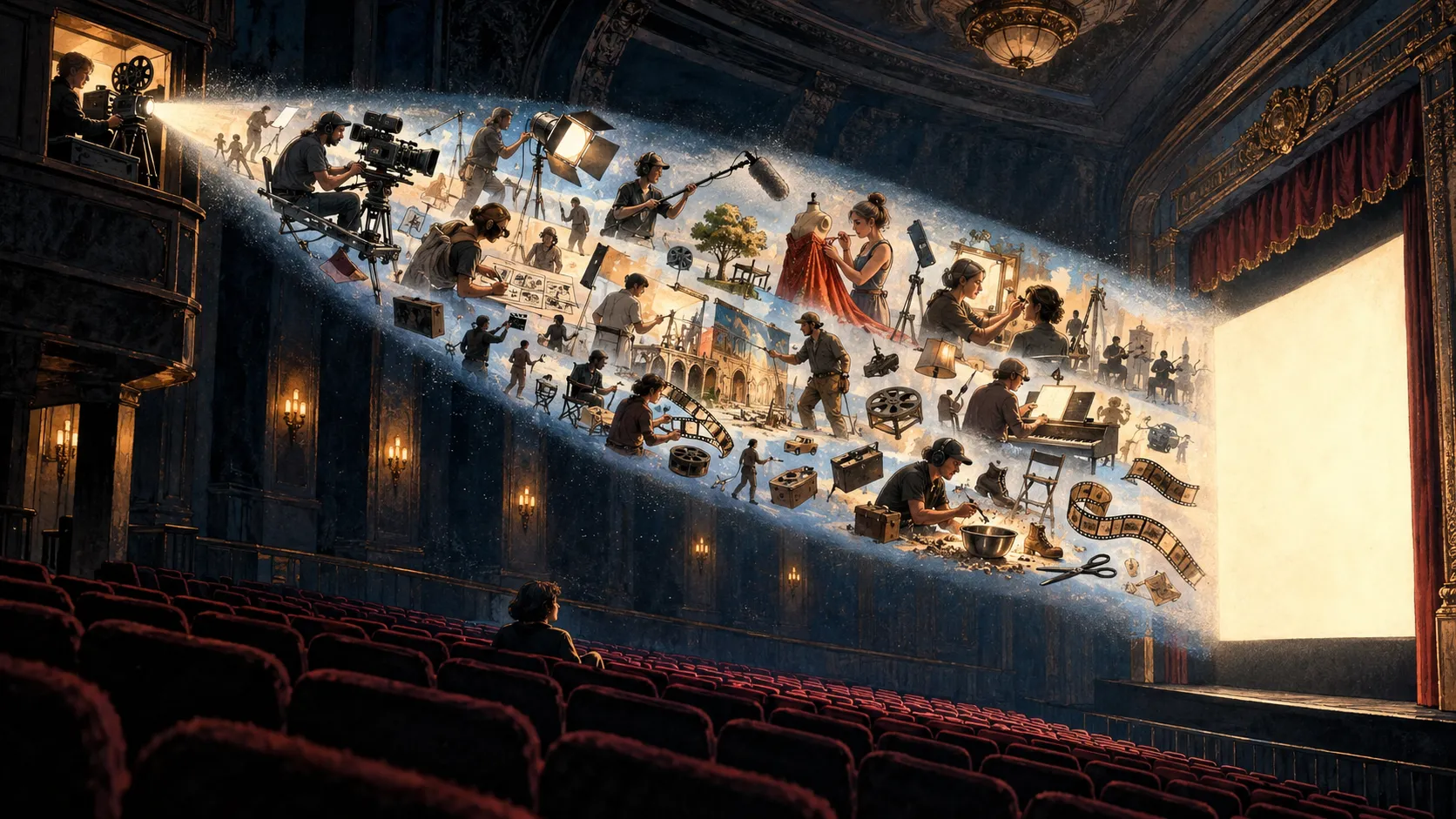
The Credits Begin
The hero has made it home. The villain has received the appropriate consequences. A couple who spent most of the film misunderstanding each other have finally managed a complete sentence. Somewhere, an orchestra has made a heroic effort to convince us that what happened was important.
Then the screen goes black.
Key Grip. Best Boy Electric. Foley Editor. Additional Compositing.
The movie has apparently become a list of people employed by a very unusual company.
You get up, perhaps. Or you remain seated because someone has assured you there will be one last scene after the credits. Either way, the names continue. You have watched fictional cities explode, entire families reconcile, and occasionally a dinosaur eat a car. Now the film wants you to know who handled transport, who mixed the sound, and which companies provided the visual effects.
It can seem like an administrative mistake: the story finished, but the paperwork accidentally made it into the release print.
It wasn't a mistake. The end credits are a second kind of record, attached to the first. The film tells you what happened to its characters. The names tell you, imperfectly, who helped make that happen. And although the ending of the story may take only seconds, the account of its construction has grown considerably longer.
A Cast of People Who Never Enter the Frame
If you enjoy movies, you probably know what a director does in broad terms. You might recognize the cinematographer's name, the composer, or a producer whose logo appears before the opening scene. There are familiar job titles at the top of the list, often accompanied by recognizable faces on posters.
Then the credits reach a neighborhood of professions that don't explain themselves.
The gaffer is the chief lighting electrician, not a distinguished elderly gentleman who has wandered onto the set by mistake. The best boy, despite sounding like a prize awarded at a dog show, is traditionally a senior assistant in the lighting or grip department; the title is not a statement about the worker's age or gender. The key grip leads the grip crew, whose work involves rigging, support and safe movement of camera-related equipment. A Foley artist creates or performs sounds to accompany pictures: footsteps, rustling fabric, the little physical noises that help a scene feel inhabited.
None of these names describes somebody whose work you are supposed to notice directly. Ideally, you watch a character enter a room, not a succession of lighting decisions. A door closes and sounds like a door. A camera follows somebody down a corridor without revealing the machinery that carried it. The work succeeds partly by making itself disappear.
That makes the credits an unusual form of applause. They acknowledge skills precisely because the finished result often conceals them.
Consider a quiet scene in which a character puts down a cup. It may look like nothing has happened. But someone chose the cup. Someone arranged the room around it. People handled light, camera, recording, continuity and later adjustments. If the sound of porcelain on the table was added or repaired in postproduction, another specialist may have contributed to the tiny event. You are not expected to remember these departments while watching. You are supposed to notice that the character has put down a cup, and perhaps what doing so means.
A film is full of apparently simple gestures whose simplicity has been manufactured.
This is why reading credits can feel like turning over a finely made watch and discovering a crowded workshop on the other side. It is also why the list is seldom a complete census. Different productions, contracts and credit policies determine who appears; some people contribute without receiving an on-screen name. The scrolling text is evidence of work, but it is not an infallible map of everybody who did it.
When the Ending Learned to Keep Talking
Older films did not routinely finish with the lengthy rolling lists familiar today. There were credits, certainly, but they were often concentrated at the beginning or presented in much shorter forms. A title card could announce the end without requiring the audience to spend several more minutes watching names move vertically.
That convention has changed markedly.
In an analysis published in 2026, film-industry researcher Stephen Follows measured end-credit sequences across 6,515 feature films released between 1920 and 2025. In his sample, the median length for films from the 1950s was well under a minute; for films released in the 2020s, it was about five minutes and forty-three seconds. His measure counted the time after credits began, including any scenes inserted into that period. The dataset also leaned toward familiar English-language films, so it should not be mistaken for an exact measurement of all world cinema.
Even with those cautions, the broad change is unmistakable in the films he studied. The credits have acquired room to breathe. Or, from the perspective of the person desperate to leave the cinema, room to establish an independent republic.
There is no single switch that caused it. Productions became more varied in how they were financed and staffed. Freelance careers made visible credit particularly valuable. The range of specialist work expanded, including increasingly elaborate visual-effects operations. And some prominent names moved away from the beginning of films, where they had once appeared, to the end.
It is tempting to explain the longer roll by saying films employ more people now, full stop. That may be true for particular kinds of productions, especially effects-heavy ones, but the story is not quite so tidy. Changes in credit customs matter too. People who once did substantial work without an on-screen acknowledgment might now be named. A production can also involve collaborators across several companies and locations, each with people whose contribution deserves consideration.
The credits show changes in how films are made, and in how the industry chooses to name the people making them. Neither half tells the entire story alone.
There is a marvelous visual absurdity in this. Filmmakers spend enormous energy making time contract and expand: a life-changing decision happens in a close-up, a journey crosses a continent in a few cuts, years pass while a photograph fades. Then comes a part of the film that refuses to compress anyone into a montage. Name after name, in roughly the time it takes to read it.
The audience has gone from an edited universe into an unhurried filing system.
One Name Can Be a Job Application
For a viewer, a screen credit may be a line of text that vanishes before it can be read. For a filmmaker, it can be part of a professional record.
Imagine applying for a new position after spending months helping to create a film. The work may have been technically demanding, physically exhausting or creatively significant. Yet there is no physical object to show an employer in the way a furniture maker might present a chair. There may be reels, portfolios, recommendations and project records, but an official screen credit offers a particularly visible acknowledgment that you worked on something released to the public.
This helps explain why credits are sometimes the subject of careful agreements rather than casual gratitude. The Writers Guild of America, for example, maintains formal rules for determining writing credits on covered productions. Those rules distinguish among types of contribution and provide procedures for resolving disputes. A person may have worked on a screenplay without ultimately receiving the relevant on-screen writing credit.
The distinction is important. A credit is neither a simple roll call of everybody who had an idea nor a prize automatically awarded to the person who worked hardest. Different professional arrangements govern different kinds of work, and the result may be contested. A short phrase such as Screenplay by can carry far more significance to the people involved than the audience realizes.
Other names may reflect negotiations with performers, production arrangements, or obligations attached to particular contracts. There is not one universal rule that orders every name in every movie. Even the phrase the credits disguises a patchwork of practices.
That patchwork is not especially cinematic. Nobody buys a ticket to see a legal and administrative process described in small type. But the arrangement makes sense once the movie is recognized as both an artwork and a workplace.
It can also be an imperfect workplace. The existence of a long credit roll does not prove that everyone was treated fairly, paid appropriately or acknowledged accurately. A list may be long and still omit someone. A grand title can obscure what the person actually did. Public recognition matters, but it does not replace decent conditions or honest accounting.
The point is not that viewers should turn every screening into an audit. It is simply that those little lines occupy a space where art, employment and reputation meet. They look like information; to somebody looking for the next project, they may be opportunity.
A Second Film, With Almost No Pictures
Credits have a design problem of their own: how do you keep a screen interesting after you have run out of story?
One answer is not to try. Black background, white type, a dignified pace. If the lettering is readable and the order is clear, the job has been done. Anything more is optional.
Another answer is to treat the credits as a continuation of the film's tone. They may appear over animation, still images, outtakes or a carefully constructed visual sequence. Sound can shift from dramatic score to playful music, or from music to silence. Some movies use the credits to release tension; others preserve it. An audience that has just watched a horror story may not welcome being immediately returned to ordinary lighting and a cheerful exit sign.
The credits therefore have an odd dual obligation. They are functional text, but they arrive at an emotionally delicate moment. The story is over. The viewer may be relieved, unsettled, amused or quietly devastated. The film still controls the screen, and the choice of what to put on it can shape those last few minutes.
Some franchises have turned that space into an additional attraction. A brief scene in the middle or at the end of the roll can make the credits feel like a corridor with a prize behind a distant door. People sit watching other people leave, calculating whether the promised extra moment will justify the wait.
This can be entertaining. It can also change the relationship between the audience and the names. The credits become an obstacle separating the viewer from the treat, rather than material worth seeing. When the extra scene finally arrives, the relief in the room can sound suspiciously like relief that the list has stopped.
There is no obligation to stay through every credit. A film ticket isn't a test of virtue. People have trains to catch, children to collect, aching knees, and perfectly legitimate reasons to go home. Watching a roll of names is not the only way to respect the labor of a crew.
Still, the end crawl has a quality few other parts of a movie permit. It leaves the spectator to decide what to do with the time. Sit and listen. Search for a familiar name. Discover an unfamiliar job. Let the music finish. Talk quietly. Leave.
It is the least choreographed portion of an art form built on choreography.
The Streaming Service Would Like to Suggest Something
In a cinema, the projection continues when you stand up. You have to physically walk away from the screen.
At home, the screen can decide to walk away from you.
Streaming interfaces are designed to keep people navigating through enormous libraries of material. The end of one item is a convenient point to recommend another. On some services and devices, the credits shrink into a smaller window while the interface suggests what to watch next. Netflix's own help documentation explains that viewers can select the reduced credits window to return them to full screen; it also provides controls for automatically playing the next episode of a series.
From the interface's perspective, this is sensible. Many viewers want a quick route to whatever comes next. A television episode ends, and the next one begins without requiring a household committee meeting about the remote control.
But it changes the ordinary meaning of an ending.
The final shot used to give way to darkness, music and names. Now it may give way to tiles, trailers, recommendations and a timer. The names are technically still available, but the screen has reassigned its attention before they are finished. The film is still trying to sign its work while another part of the service is already inviting you elsewhere.
This isn't necessarily a conspiracy against film crews. It is an interface decision serving one kind of viewing behavior. The viewer who likes continuous playback may be grateful. The viewer who wants to remain with a film for a few minutes must sometimes take an extra action to do nothing at all.
That may be the strangest design detail of the entire experience: staying until the end can require more deliberate participation than skipping ahead.
A credit sequence was never guaranteed an attentive audience. In theaters, people have always been free to leave. The difference is that a human departure and a platform minimizing the remaining picture are not quite the same event. One is a choice made by a person; the other is a default proposed by a machine.
Perhaps a good player can accommodate both. Let the impatient move on. Let the interested stay. Give the credits enough space to be legible without pretending everybody wants to watch them. Nothing particularly dramatic is required. Sometimes the most considerate interface is a button that means exactly what it says.
The Last Name
Try a small experiment after your next film. Don't promise yourself that you will watch every credit or attempt to memorize the crew. Just stay a little longer than usual.
Notice how many different kinds of activity emerge from the text. Someone handled locations. Someone kept track of costumes. Someone was responsible for a particular part of the sound. Someone coordinated people and equipment that the story had no reason to mention. In an animated or effects-heavy production, entire groups of artists may have helped build the things you believed you were seeing.
Then notice what the names cannot tell you. They can't explain which moment was difficult, which problem nearly stopped production, which person made somebody laugh, or which small decision saved a day of work. They can't tell you how the company felt to be part of. A list is not a biography, and a job title is not a life.
There is, at least, a particular elegance in the refusal to finish with only the famous people. The story was built to focus your eyes on a select few. The credits gradually move them out of the center and make room for other names. Not all of them, certainly. But more than the poster could ever hold.
Sometimes the music ends before the crawl. Sometimes a last logo arrives. Eventually the final line slides out of view, or the film settles onto a still card.
The screen is blank again.
At last, there is nobody left to introduce.