Articles / LORQAI
The Footsteps Were Added Later
Why movie footsteps are recorded after filming, how sound artists perform other people's movements, and why the most convincing noise isn't always the real one.
An actor walks across a room. Weeks later, another person may walk it again in a sound studio. Discover the remarkable, mostly invisible craft of Foley artists.
By LORQAI
The Room Before the Sound
A woman enters an empty room.
Her shoes make a soft clicking sound against the wooden floor. A coat brushes against her sleeve. She puts a set of keys on a table, pulls out a chair and sits down.
Nothing unusual happens.
There is no explosion, no dramatic announcement, no ominous figure waiting behind the curtains. The scene lasts perhaps fifteen seconds.
Yet an astonishing amount of work may have gone into making it sound like someone has simply entered a room.
The footsteps might have been recorded weeks after the woman finished filming. The coat might have been performed by someone handling a piece of fabric near a microphone. The keys may have belonged to a sound technician. The chair might not even have been a chair.
The room on screen could be hundreds of miles away from the room where its sounds were created.
The people responsible might never have met the actor.
And when you watch the finished scene, the whole thing will seem perfectly ordinary.
That is the achievement.
Film sound is full of carefully constructed illusions, but few are as wonderfully modest as the recreation of an everyday movement.
A spectacular explosion is allowed to sound spectacular. A monster may roar with a voice assembled from animals, machinery and creative imagination. Nobody expects a spaceship to provide its own original recording.
Footsteps are different.
We know what they sound like. We have been producing them all our lives. Most of us have extensive practical experience walking across floors.
Surely the easiest way to obtain a recording of a person walking is to record the person walking.
Sometimes it is.
But often the finished soundtrack requires something more controlled, expressive or precise than the sound captured during filming.
So the movie employs a second performer.
Someone who may never appear on screen but must learn exactly how the character moves.
The profession is called Foley.
And in one of cinema's quieter absurdities, an actor can finish a film only for somebody else to begin walking in their place.
Scene One: An Unexpected Silence
Let us return to our imaginary woman entering the room.
This time, remove the sound.
Her shoes touch the floor without making a noise.
The coat moves silently. The keys land on the table with no audible impact. The chair slides backward as though the entire room has been placed inside a vacuum.
Something feels wrong.
Not necessarily because the scene is impossible to understand. We can still see what the woman is doing.
But the objects seem to have lost some of their physical presence.
The keys look lighter.
The floor seems less solid.
The chair appears to move without resistance.
Now restore the sounds.
The keys make a brief metallic impact. The chair scrapes. A shoe presses against the floorboards.
Suddenly the room appears to have weight.
This is one of the remarkable properties of sound in cinema. It supplies information that the image alone may not convey.
A close-up of a hand touching a wooden table tells us that contact has occurred.
The accompanying sound can suggest whether the touch was gentle, nervous, impatient or violent.
A heavy footstep can alter our impression of a character's physical presence.
A hesitant series of steps can suggest uncertainty before the actor says anything.
None of this means sound always communicates emotion in one fixed way. Context matters, and different viewers may interpret the same scene differently.
But sound gives filmmakers another expressive tool.
During production, microphones are often positioned to capture dialogue as clearly as possible. The location may be noisy. The microphone may be too far away to record delicate movements effectively. Camera equipment, traffic, ventilation and other unwanted sounds can interfere.
Some useful effects are captured on location and retained.
Others are supplemented or replaced later.
The objective is not necessarily to make the scene louder.
It is to give the filmmaker control over what the audience hears.
In our imaginary room, perhaps the keys are important. Their little metallic impact will attract attention.
Perhaps the woman's footsteps should be almost inaudible because she is trying not to wake somebody.
Perhaps the chair should scrape unpleasantly because the moment is tense.
A microphone on the original set cannot always anticipate how those details will need to function in the final edit.
Post-production can.
Which is where the second pair of feet enters the picture.
Scene Two: A Warehouse Full of Impossible Places
A Foley studio is a peculiar kind of workplace.
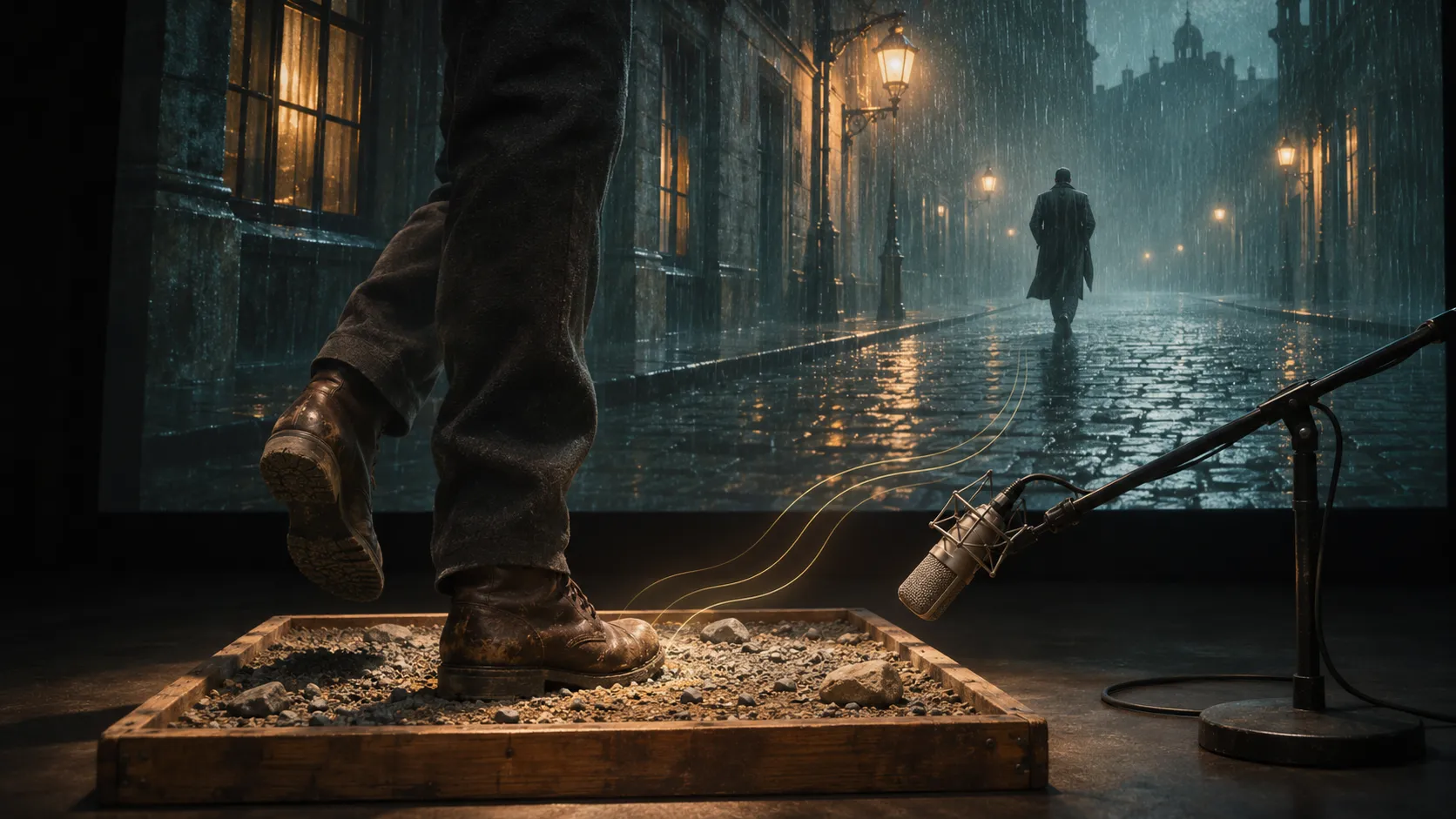
It may contain sections of wooden flooring, tiles, gravel, sand, dirt and other surfaces. There are microphones, recording equipment and a screen displaying the action.
There are also shoes.
Many shoes.
Boots, trainers, leather soles, heavy heels and footwear selected for the noises they produce rather than for their appearance.
Elsewhere, there may be cups, dishes, keys, bags, fabric, furniture and assorted objects whose value lies in the sounds they can make.
It is an inventory that would concern a very tidy person.
To a Foley artist, it is a collection of possibilities.
The artist watches a scene and performs actions in synchronization with the picture.
If a character walks across gravel, the artist may walk on a prepared surface that creates an appropriate crunch.
If someone adjusts a jacket, the artist may move cloth close to a microphone.
If a cup is set down, the artist produces the small sound of the object meeting a surface.
These sounds are recorded so that they can become part of the finished soundtrack.
The work is usually organized into recognizable groups.
Footsteps are one.
Clothing and bodily movement form another.
Smaller object interactions, often called spot effects or props, provide another category.
The exact organization varies between productions, but the basic craft is a performance of everyday physical activity.
It sounds simple until you consider the timing.
The artist cannot merely produce a pleasant sequence of footsteps.
The steps must match the movements on screen.
If the character hesitates, the sound should hesitate.
If the character turns suddenly, the sound must respond.
If an edit cuts from a wide shot to a close-up halfway through a movement, the timing and texture may need to remain convincing across the transition.
The sound can also change with perspective.
A person crossing a distant corridor should not necessarily sound as though their shoes are striking the floor directly beside the microphone.
The recording and subsequent mix must support the apparent space.
A skilled Foley artist therefore does more than identify the material under a character's feet.
The artist performs the character's movement.
A tiny studio surface becomes an enormous hotel lobby, a deserted street or a staircase that no longer physically exists.
It is one of the few jobs where a person can spend an entire afternoon walking through several different countries without leaving the room.
Scene Three: The Shoes Must Audition
Imagine a casting session for a pair of shoes.
The position is important.
The successful candidate must represent a character who has already been photographed, edited and approved.
The character may be confident, exhausted, frightened, elderly, impatient or determined not to attract attention.
The shoes will receive no close-up.
They may not resemble the footwear visible in the movie.
Only their voices matter.
It sounds ridiculous, but choosing the right shoe is a serious part of Foley work.
Professional Foley artists have described maintaining large collections of footwear because different soles, heels and materials produce different sounds.
A shoe that looks correct may sound wrong.
A heavy boot can create too much impact. A heel can sound excessively sharp. A sneaker may produce a more useful effect on a particular recording surface than the footwear apparently worn by the actor.
The artist experiments.
A recording is made.
The sound is compared with the picture.
Another pair may be selected.
Sometimes the answer is to change the surface instead of the footwear. Sometimes the artist changes how the foot lands, how much weight is placed upon it or how quickly the next step follows.
The goal is not to identify the most acoustically accurate combination under laboratory conditions.
It is to create a sound that belongs convincingly to the image.
And that introduces another important distinction.
A convincing movie sound is not always an exact copy of reality.
Imagine a character who is supposed to move silently.
In real life, soft shoes might produce almost no sound at all. But in a close-up, a filmmaker may still want a faint sense of contact with the floor.
The Foley artist might create a delicate movement that remains just audible.
Now imagine a character entering an unfamiliar building.
A slightly firmer footstep might help establish the material of the floor or the character's cautious movement.
The sound is not necessarily louder because reality demands it.
It may be more noticeable because the story benefits from it.
The best result is often the one the audience never questions.
Nobody leaves the cinema discussing whether the correct variety of leather was used for a character's left shoe.
They simply believe that the character was walking.
The shoe has passed its audition.
It may now retire to a rack until the next feature film requires an entirely different personality.
Scene Four: Acting Without Appearing
This is where the profession becomes more interesting than a technical demonstration of sound effects.
Foley artists have repeatedly described the importance of understanding a character.
Ruth Sullivan, interviewed by the Royal Television Society in 2020, explained how the job involves matching movements, clothing and small actions to the drama unfolding on screen.
She also described the usefulness of a background in acting and dance.
That makes sense.
Footsteps have rhythm, but rhythm alone does not explain them.
A person rushing to catch a train moves differently from somebody reluctantly approaching an uncomfortable conversation.
A tired character may drag their feet.
Someone trying to remain unnoticed may move with unusual care.
A confident entrance can contain decisive steps followed by an abrupt stop.
The Foley artist must interpret these movements and reproduce their audible characteristics.
It is a kind of acting in which the entire performance may be reduced to a few square metres of flooring.
The face is unnecessary.
The costume is largely irrelevant.
The audience never sees the artist's expression.
What matters is the physical intention conveyed through sound.
There is an additional difficulty: the artist is responding to an existing performance.
A traditional actor can decide to move more slowly or pause before opening a door. The camera can follow that decision.
The Foley performer does not ordinarily have that freedom.
The image has already established the sequence.
If the actor takes seven steps, the artist must work with seven steps.
If the actor pauses, the artist must pause.
The craft lies in creating a convincing second performance within the boundaries of the first.
This helps explain why a generic library recording cannot always provide the same result.
Pre-recorded footsteps are useful in many sound workflows. Editors can manipulate, synchronize and combine recorded effects to achieve excellent results.
But a library recording cannot necessarily anticipate a character's particular sequence of movement.
The difference between *someone walking* and *this person walking in this scene* may be small enough to escape conscious attention while remaining important to the finished illusion.
It is the kind of difference a performer can hear and respond to.
A Foley artist, in that sense, is a very unusual understudy.
They do not replace the actor in front of the camera.
They replace or enhance the sounds of the actor's physical behavior.
There is no applause for the understudy's entrance.
There should not be.
If the audience notices the substitution, something may already have gone wrong.
Scene Five: The Prop Department Has Lost Its Mind
Footsteps are only the beginning.
Consider the extraordinary challenge of making ordinary objects sound convincing.
A character removes a letter from an envelope.
What should we hear?
A delicate paper rustle, perhaps.
But what if the scene is tense? The production may want the paper to sound more prominent, drawing the viewer's attention to the action.
A character picks up a glass.
Should it make a little sound against the table?
What if the glass contains ice?
What if the character places it down carefully?
What if the character slams it down?
The screen may show the same basic object, but the action changes its meaning.
Foley artists select and manipulate props to reproduce those details.
Sometimes the object used in the studio is exactly what the audience sees.
Sometimes it is not.
Film history is full of examples of sound teams using unexpected materials to create effects.
A piece of cellophane can help imitate crackling flames. A vegetable can produce a suitably unpleasant crunch. Fabric, metal, water and ordinary household objects may be combined in ways their manufacturers never anticipated.
Not every such effect is strictly Foley. Large effects, designed sounds, ambience and mechanical recordings may be handled by other specialists within the sound department.
But the underlying principle of sonic substitution runs throughout film sound production.
The sound that best serves an image may come from something entirely different from the visible object.
A particularly charming example comes from filmmaker Mark Jenkin, who discussed the sound design of his film *Bait* in an interview with the British Film Institute.
For one effect involving fish being put down, he had experimented with a gas canister wrapped in a wet towel.
The object in the recording studio was not a fish.
The intended audible result belonged to the fish on screen.
This is the peculiar logic of cinematic authenticity.
An actual object may not produce the most useful sound under recording conditions.
A completely different object can sometimes create a more convincing impression.
A sound recordist's workshop therefore resembles a place where ordinary things are being considered for alternative employment.
A sheet of material is no longer necessarily a sheet.
A cup is not always a cup.
A box of gravel may become a mountain path.
And somewhere, a perfectly respectable household object is being asked to impersonate something much larger than itself.
Scene Six: The Profession Has a Name
The term *Foley* comes from Jack Foley, a film sound pioneer associated with Universal Studios during the early development of synchronized sound cinema.
As motion pictures developed recorded dialogue and more elaborate soundtracks, filmmakers needed ways to recreate everyday noises in synchronization with the image.
Live sound-effect techniques already had a history in theatre, radio and film exhibition.
Jack Foley did not single-handedly invent the idea of using an object to make a sound.
His lasting contribution was associated with the practical development of performing and recording synchronized effects for film scenes.
The method eventually became identified with his name.
But the history is larger than one person.
Film scholar Melanie Bell, writing in the journal *Screen* in 2017, examined the work of women in the British film sound industry, including the Foley artist Beryl Mortimer.
Mortimer worked across decades of British cinema and contributed to productions including *Lawrence of Arabia*.
Bell's research shows how important sound work could remain poorly documented or under-recognized, even when it contributed directly to the finished film.
This is a revealing aspect of the craft.
A film's most visible performers are normally recorded in exhaustive detail. Their names appear on posters, in interviews and in reviews.
The person who gives their footsteps a convincing sound may be far less visible.
Foley artists have sometimes received screen credits, but historical records and professional recognition have not always reflected the extent of their contributions.
The reason is partly structural.
Sound is created and refined through numerous stages involving different specialists. Production recording, sound editing, Foley performance, sound design and mixing are interconnected, and their contributions can be difficult for viewers to distinguish.
The finished work combines them.
That collaboration is essential.
It also makes some of the individuals involved easy to overlook.
Modern audio production has changed enormously since the early days of sound cinema.
Digital recording and editing have become central tools. Sound libraries contain an extraordinary range of effects. Computer systems allow precise adjustments to timing, pitch, perspective and texture.
Yet Foley studios still contain physical objects.
Artists still perform actions in front of microphones.
And a pair of shoes can remain more useful than a complicated digital effect when the job requires a particular human movement.
The technology has changed.
The problem is remarkably familiar.
Someone has to make the picture sound right.
Scene Seven: The Sound That Survives the Edit
There is one important misunderstanding to avoid.
Foley does not mean that every sound in every movie is fake.
A film's soundtrack may include original location recordings, specially recorded effects, Foley performances, environmental sound, dialogue replacement and many other elements.
Some directors place considerable artistic value on retaining imperfect or natural production sound.
In a 2024 British Film Institute interview, Christopher Nolan discussed preferring certain sounds captured on set rather than replacing everything with elaborately designed effects.
The choice is aesthetic as well as technical.
Sometimes the roughness of an original recording helps establish a scene's character.
Sometimes a carefully recreated sound gives the filmmaker more control.
Sometimes the most effective decision is to remove a sound entirely.
And that brings us to the final stage of our imaginary room.
The Foley artist has recorded footsteps.
The coat has acquired its rustle.
The keys have been placed on the table.
The chair has scraped.
But the sound mixer may decide that not all of these recordings should be heard.
Perhaps the keys are too prominent.
Perhaps the footsteps compete with dialogue.
Perhaps the coat sounds distracting in a scene intended to feel almost motionless.
The sound can be reduced, reshaped, combined with other recordings or removed.
This does not mean the Foley performance was unsuccessful.
Sound is only one component of the finished scene.
Its purpose is to support the overall experience, not to draw attention to every object the camera happens to reveal.
The final soundtrack is a selection.
A small movement can be emphasized.
A large action can be surprisingly quiet.
A natural sound can be replaced by an artificial one.
And a perfectly good recording may be left out because the scene works better without it.
The power of film sound lies partly in that freedom.
Reality does not offer a volume control for every object in a room.
Cinema does.
The Second Walk
Now return to the woman entering the room.
She crosses the floor.
Her shoes click softly.
Her coat moves against her sleeve.
The keys touch the table.
She sits.
The scene lasts fifteen seconds, and the audience barely notices the sound.
Somewhere in the production process, another person may have repeated those movements.
That performer watched the picture, selected materials, adjusted timing and made recordings. A mixer later decided how much of the work belonged in the final soundtrack.
None of the effort appears on screen.
There is no second figure in the doorway.
No mysterious person follows the actor across the floor.
No one steps out from behind the chair to announce that the shoes have been replaced.
The illusion is complete because all the separate performances appear to belong to one event.
This might be the most entertaining thing about Foley.
It is a profession devoted to creating sounds that an audience is not supposed to admire independently.
The better the work, the less reason the viewer has to investigate it.
A badly timed footstep can attract attention.
A perfect one disappears into the action.
So the next time a film character walks across a room, it may be worth listening more carefully.
Perhaps those are the actor's actual footsteps.
Perhaps they were recorded on a different day.
Perhaps the person making them wore different shoes, stood on a different surface and was never anywhere near the location shown on screen.
The actor has crossed the room once.
Somewhere else, another performer may have crossed it again.
And if both did their jobs well, you will never know which one you heard.