Articles / LORQAI
The Village That Followed a Snail Into the Water
The origin story of Nzulezu begins with a creature moving slowly through the forest. The story of how the village survives involves wooden piles, a school reached by canoe, and a flood that exposed the difference between being admired and being protected.
In western Ghana, a village stands on timber above a lake. A snail guided its ancestors, according to tradition. The real story spans hidden building skills, a devastating flood and the question of who gets to live safely on water.
The Village That Followed a Snail Into the Water
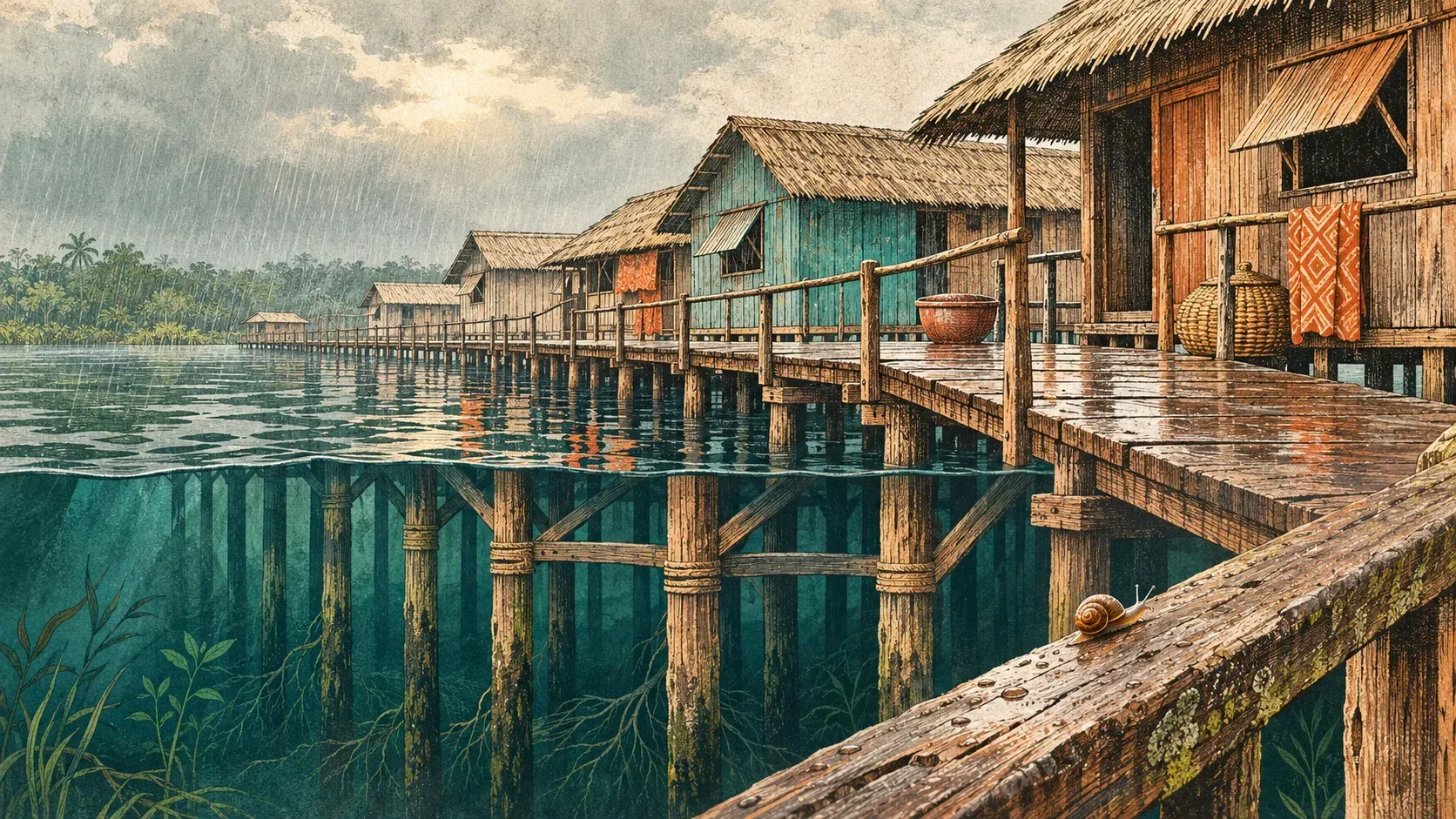
The road through Nzulezu is made of wood. So are the foundations beneath the houses on either side. Below the boards is water.
The settlement, near Beyin in western Ghana, is built on stilts over Lake Tadane, within the wider Amanzule wetland system. Its central walkway functions as a main street. Homes open onto it; community buildings, businesses and a school share the same narrow arrangement. A visitor approaches by canoe, then steps into a place that has kitchens, lessons, worship and the ordinary work of living, but almost none of the ground on which those activities usually stand.
One version of its origin is far stranger than the architecture. The ancestors of the village, the story says, were guided here by a snail.
This is not a recent invention by a travel website. Ghana submitted Nzulezu to UNESCO's World Heritage Tentative List in January 2000, and the official description records the snail tradition. The Ghana Museums and Monuments Board does too. Neither institution claims to have verified a historical migration led by an animal. Both document a story through which the community explains its beginnings.
Why was Nzulezu built on water? The traditional accounts speak of migration and the search for safety. The physical answer is that its inhabitants developed a way to build, travel and organise their lives in a wetland landscape. And the modern answer cannot end with either romance or engineering: in June 2023, serious flooding struck the settlement, and in July 2026 a Ghana News Agency reporter described children travelling to higher-level schooling by canoe without the protective equipment visitors might expect to receive.
The village is often called a wonder. Its residents have rather more practical questions for anyone who uses that word.
The first street has no roadside
From the shore near Beyin, the route to Nzulezu passes through water and vegetation. During the rainy season the journey can be made by canoe through a greater stretch of the wetlands; in drier months some approaches involve walking before boarding. Those descriptions come from tourism sources and vary with season and conditions, so they are not a promise about how a visitor could travel there on any particular day.
The name itself is usually explained as an Nzema expression meaning surface of water. The spelling is less settled. Nzulezu appears in the UNESCO World Heritage Tentative List and in Ghanaian heritage records; Nzulezo also appears in academic publications and some local material. That difference has produced two bodies of search results about the same settlement. It is not evidence of two different villages.
The settlement's main walkway is sometimes called Main Street in tourism descriptions. Researcher Joseph Pieterson, who conducted fieldwork there for a 2018 master's thesis at Central European University, records the local term Kpodaa for the connecting walkway. His research shows how spatial decisions follow practical knowledge: some buildings occupy shallower areas, and certain functions are positioned with the water level and prevailing wind in mind.
A photograph from above can make it look as though the village is floating. It is not. Its buildings rest on timber supports fixed into the bed below. That is an important physical distinction. A floating object rises and falls freely. A house built on piles has to withstand changing water around a structure that is fixed in place.
The photograph also hides the most important feature of the street. It is not only a way to reach a door. It is part of a building system that must be maintained, repaired and taught to the next generation. Lose the skills and the walkway does not preserve itself merely because it appears on an international heritage website.
The snail was a guide, not a map
The brief version of the founding story is straightforward: people travelled from Walata, associated with the history of the old Ghana Empire, and a snail guided them to the water where they settled. It is the version printed in the UNESCO description and repeated by Ghana's heritage authorities.
The more detailed versions are anything but straightforward.
Pieterson's 2018 research includes accounts in which the guiding presence is described as a Snail god, communicating through a spokesperson. In one telling, a migrating group moves across West Africa seeking safety from conflict, crosses water using a raft fashioned from available materials, and continues until it reaches a suitable place. Other versions involve a threatened golden stool, rival groups, a fisherman who discovers a sheltered location and a change of settlement after concerns about fire and strong wind.
These are not details to combine into one invented itinerary. The researcher presents different oral accounts, and their disagreement matters. One narrator might give the snail a role as spiritual protector; another emphasises the resourcefulness of a fisherman or the danger posed by pursuers. Each account may preserve a different explanation of why the ancestors left, why they kept moving or why the final site became significant.
The story is sometimes dated vaguely to four or five centuries ago. Ghanaian official descriptions refer to a roughly 400-year-old settlement; a 2026 Ghana News Agency feature describes migration more than 500 years ago. Such estimates do not establish a verified founding year. Even the route from Walata in today's Mali to a village in modern Ghana cannot be reconstructed simply by drawing a line between the names in the legend.
What the traditions share is a destination that could provide refuge. Water separated a settlement from dangers that could travel more easily over land. The water also offered fishing and routes through the wetlands. A 2026 Stanford history workshop advertised research arguing that the motivations for living there cannot be reduced to defence or economics alone: cultural and spiritual relationships with the aquatic environment mattered too.
The snail is therefore not a historical GPS device whose movements we can plot. It is part of a community's explanation of guidance, survival and belonging. The physical village is observable. Its earliest journey remains a history carried in stories, not a migration verified mile by mile.
The hardest part is underneath
A wooden house over water looks simple until someone has to put the first post in place.
Pieterson's fieldwork describes a process requiring a group of workers to position and drive timber piles into the underwater ground. His construction appendix records groups of at least five people working on the foundational supports; the piles were reportedly driven approximately five feet into the bed and levelled before the upper structure could be assembled. Experienced builders then directed the next stages, using timber and raffia materials suited to local practice.
The study was based on interviews and participant observation in 2017. It is evidence of techniques recorded at that time, not a statement that every house in Nzulezu has identical foundations or that construction methods have remained unchanged for centuries.
Timing matters as much as timber. The researcher describes dry-season work, when lower water makes installation possible. In his account, the proposed building day had to be made known to other residents so enough people could help with the demanding initial stage. Afterwards, less-experienced workers could learn by watching and taking part while knowledgeable builders assembled the upper structure.
This is not simply a picturesque tradition. It is a means by which technical knowledge survives without every measurement being written in a manual. Where should a building stand? Which wood will do the work? How far down should the pile go? Who can judge whether the supports are level? The answer may depend on experience embedded in families and community cooperation.
There is something revealing about the contrast between the opening myth and this construction record. A snail guides the ancestors to a place, according to tradition. But the first people living there still needed to solve a much harder problem: how to keep a house steady when its floor was separated from the earth by water and timber.
And every later generation has had to solve it again.
A village that puts its ordinary life above the lake
The official UNESCO account does not describe Nzulezu as an empty monument. It identifies schooling, cooking, religious observances, baptisms and burials as parts of village life connected with the lake. Ghana's tourism authorities describe homes on either side of the walkway, alongside community buildings and places of trade.
Some of those descriptions have barely changed for years. That should make a reader cautious. A website can preserve a convincing picture of village life long after individual buildings, institutions and local rules have changed. Nzulezu is a lived-in settlement, not a historical exhibit held still for tourists.
The lake has a sacred day in the community's traditions: Thursday. The UNESCO Tentative List says that ordinary activity is set aside, while the Ghana Museums and Monuments Board describes avoidance of strenuous work. Some oral versions specifically connect the day to a remembered escape from enemies and restrictions on fishing. We cannot assume that every old prohibition is currently enforced in exactly the way an older account states.
The same caution applies to the widespread claim that the lake protects people from fire. It is recorded as a belief. It should not be interpreted as a fire-safety guarantee. Pieterson's study describes the practical placement of kitchens, including consideration of prevailing winds. Wooden construction and fire remain a real risk even in a village surrounded by water.
The school introduces a different sort of distance. A visitor may notice a classroom in the village and conclude that education is available without leaving home. But the existence of a primary school does not mean every child can complete secondary education there. According to a Ghana News Agency report published on 28 July 2026, the community had schooling only through Primary Six, and children continuing to junior high had to travel to other communities by canoe.
The reporter observed a troubling imbalance: visitors could receive life jackets for organised boat trips, while many residents, including children making ordinary journeys, did not own them. That is a dated journalist's account rather than a verified inventory of every boat in October 2026. But it changes how the same water looks. For a visitor, a canoe crossing is part of an experience. For a child, it may be the route to the next school year.
The village has no conventional road out. That should not mean the people who live there receive a lower standard of safety.
The water that was supposed to protect the village
In the last week of June 2023, heavy rain and rising water turned Nzulezu's geography against it.
Ghanaian newspapers reported severe flooding across communities in the country's Western Region. Graphic Online described flooded structures, inaccessible approach areas and disrupted movement near the village. On 3 July 2023, the Ghana Tourism Authority said it had supplied emergency relief after residents were displaced and property damaged. Contemporary reports put the number evacuated to neighbouring Beyin at roughly five hundred, although estimates varied by outlet and reporting time.
This is not a legend about a lake swallowing intruders. It is a reported emergency involving people, possessions and the buildings on which ordinary life depended. It also occurred in June, in the Western Region. It should not be confused with the separate, widely reported Volta River flooding after Akosombo Dam releases later in 2023.
A study published in the Journal of Flood Risk Management in 2026 compared seven water-based settlements around the world. For Nzulezo, its authors reported that the 2023 event affected approximately 80 percent of dwellings, with water entering structures. The number is a finding presented by the study, not an independent household-by-household count conducted by LORQAI. The paper also compared satellite observations across years and discussed the challenges of adapting fixed stilt construction to changing flood risk.
Living over water can make seasonal change familiar. It does not eliminate the possibility of an exceptional rise that reaches floors and walkways. A fixed support needs sufficient clearance for the water expected around it, and even skilled local builders cannot control every upstream rainfall event.
That does not prove a single storm was caused by climate change. Assigning cause to one flood requires specific meteorological and hydrological analysis. What the disaster does demonstrate is that traditional knowledge and modern risk planning are not interchangeable. Knowing where to place a pile helps build a house. It does not supply an evacuation plan, emergency medical transport or enough life jackets for every resident.
In the founding stories, water was the place where people might escape danger. In 2023, people had to escape the water.
The UNESCO designation that never happened
Nzulezu has been connected to UNESCO since 17 January 2000. That date is real. It is also frequently misunderstood.
On that day, Ghana submitted the Nzulezu Stilt Settlement to the UNESCO World Heritage Tentative List, with reference 1394. A Tentative List is a country's inventory of places it may nominate. It is not the World Heritage List of sites formally inscribed by the World Heritage Committee.
The distinction is not bureaucratic trivia. Some travel accounts call Nzulezu a UNESCO World Heritage Site outright. The official Ghana entry at the World Heritage Centre continues to list it as tentative, while Ghana's actual inscribed properties are the country's forts and castles and the Asante Traditional Buildings. Calling a proposed site an inscribed site gives readers an inaccurate picture of its formal status.
There are other kinds of attention. UNESCO's online exhibition about water technologies highlights Nzulezo as an example of sophisticated pile-dwelling construction. That recognition supports the importance of the community's technical and cultural knowledge, but it does not silently promote the settlement from Tentative List to inscribed World Heritage status.
The question is Nzulezu a UNESCO World Heritage Site? therefore has a clear answer in the sources reviewed: no, it is on Ghana's Tentative List. The village's significance does not depend on inflating that status.
The uncomfortable issue is what recognition accomplishes for the people living there. Joseph Pieterson wrote in a 2023 heritage study that management had tended to prioritise tourism over the needs of residents and the surrounding environment. That was his assessment, not an audit establishing what every organisation has done since. But his concern is understandable alongside the infrastructure gaps described by the Ghana News Agency in 2026.
A site can be internationally known and locally underserved at the same time.
Who gets the best boat?
Tourist descriptions present Nzulezu as a place where the ordinary rules of geography have been suspended. A canoe moves between green wetland banks; buildings seem to stand directly on a mirror of water; the visitor steps onto a wooden street and finds a village continuing around them.
None of that is false. But the picture has an edge. The people being photographed must also get to clinics, schools, markets and family obligations in bad weather. They need repairs when a walkway weakens and help when floodwater rises. The community's building skills deserve to survive, and so do the people who hold them.
In its July 2026 feature, the Ghana News Agency described a clinic and community buildings with limited staffing and questioned the absence of adequate emergency transport. It called attention to residents travelling without life jackets even as tourists were equipped for organised excursions. These are specific reported conditions at that time. We have not independently verified whether additional equipment or services were provided later.
A heritage policy can protect a view and still miss a person. If visitors can travel safely to admire a place but a child cannot reliably reach the next level of schooling, the tourism system and the everyday transport system are serving different standards.
There is no sensible argument that the village must abandon the water to become modern. A community's choice to live in a wetland does not surrender its claim to safe transport, education, healthcare or a meaningful voice in how tourism income is used. Equally, treating the entire settlement as a fragile antique would deny residents the right to alter their buildings and services when their needs change.
The difficult balance is not between tradition and progress as abstract opposites. It is between preserving a place as outsiders enjoy seeing it and allowing the people who live there to decide how it should function tomorrow.
What the snail could not have predicted
There is a final detail in the founding traditions that makes the snail's role more interesting than a curiosity for travel writers. In some accounts, the migrants were not looking for the most beautiful view. They were looking for somewhere they could live without being driven away.
The water offered separation from danger. The community then learned to make that separation inhabitable: a walkway, a set of houses, a way to carry materials, the knowledge of where timber could stand and how neighbours could help one another build. The mythology of guidance and the engineering of survival are not rival explanations. One belongs to remembered origins; the other can be observed in the life and maintenance of the place.
Then came new circumstances the ancestors could not have planned for: tourists, heritage nominations, changing access to schooling and healthcare, and a flood severe enough to empty homes. The same adaptability that made the settlement possible is now being tested by different demands.
Perhaps someone will eventually resolve more of Nzulezu's earliest chronology. The migration traditions may be compared with archival records, languages and regional history. Their versions will not necessarily become one perfectly dated story. Nor should the most complicated parts be discarded merely because the snail makes the easiest headline.
The question worth carrying away from Nzulezu is not whether an actual snail once knew the route through the forest. It is whether a community that has kept its buildings standing over water can count on the rest of the country to help keep its people safe.
A wooden main street is impressive. A child getting home across the lake is more important.
Sources and further reading
- UNESCO World Heritage Centre — Nzulezu Stilt Settlement (Tentative List, 2000) (external platform)
- Ghana Museums and Monuments Board — Nzulezu Stilt Settlement (external platform)
- UNESCO Virtual Science Museum — Ghana: Hydro-technologies of Nzulezo (external platform)
- Joseph Pieterson — Safeguarding Indigenous Knowledge and Heritage: Nzulezo Stilt Construction (Central European University, 2018) (external platform)
- Joseph Pieterson — Waterworld: The Use and Reuse of Lake Tadane (Blue Papers, 2023) (external platform)
- Graphic Online — Nzulezu, Jomoro Communities Flooded (29 June 2023) (external platform)
- Ghana News Agency — GTA Supports Nzulezu Community with Relief Items (3 July 2023) (external platform)
- Feldzer et al. — Vernacular Flood Resilience in Seven Water-Based Settlements (Journal of Flood Risk Management, 2026) (external platform)
- Ghana News Agency — Nzulezu Deserves Inclusion, Not Just Admiration (28 July 2026) (external platform)
- Stanford University — Why Live on Water? Nzulezo and the Aquatic History of West Africa (May 2026 research talk) (external platform)