Articles / LORQAI
The Crocodile Whose Funeral Became a Warning
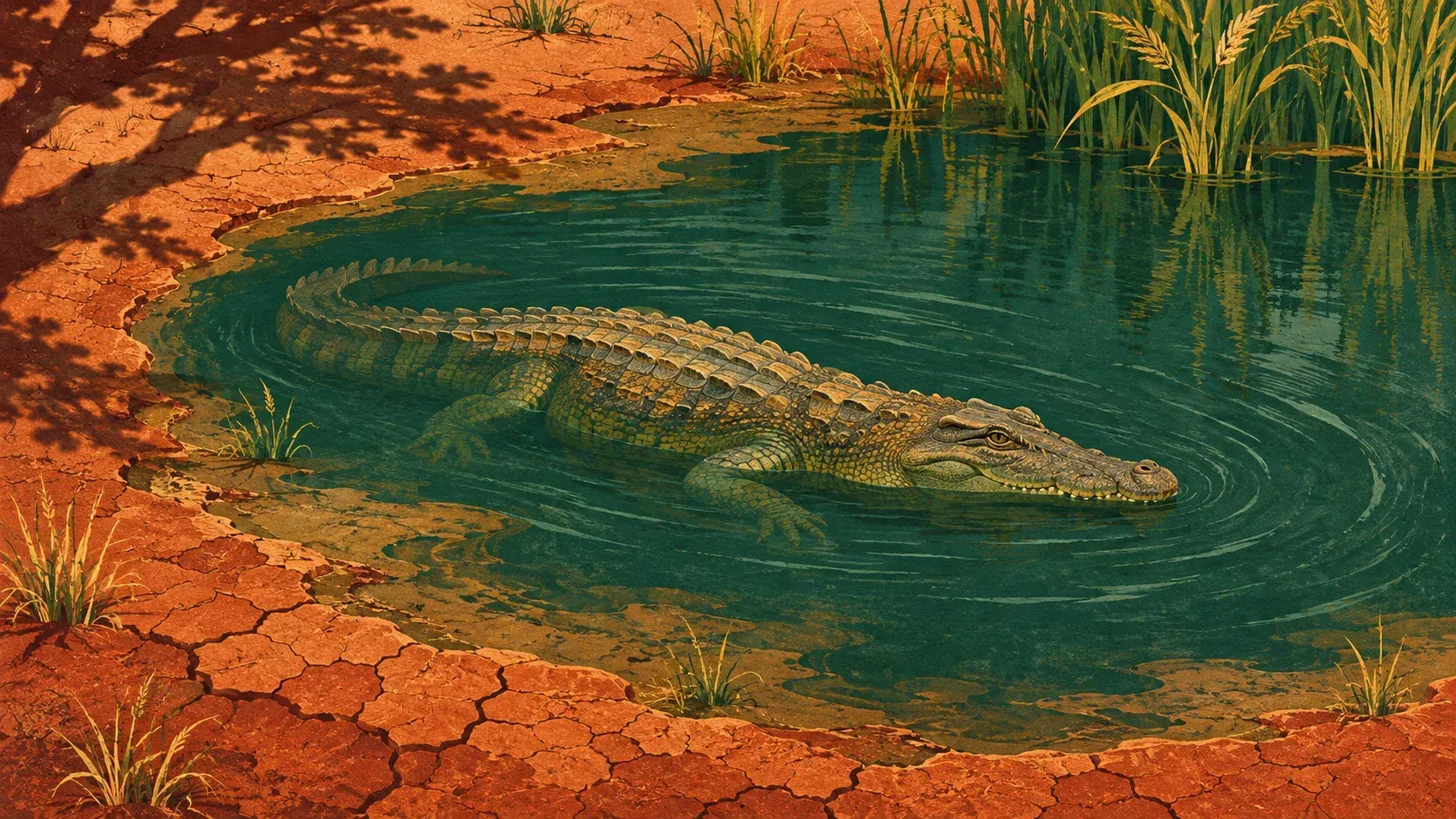
In Paga, Ghana, a crocodile named Yuu-Nyenga became a local celebrity and received a memorial after its death. The ceremony was also a warning: protecting an animal as sacred is not the same as keeping its pond alive.
A crocodile called Yuu-Nyenga died in December 2025. In March 2026, people in Paga gave it a public memorial—and asked a harder question about the pond the living animals still needed.
The Crocodile Whose Funeral Became a Warning
The crocodile died on Christmas Eve. Nearly three months later, a community gathered to remember it.
On 21 March 2026, residents of Zenga, in the northern Ghanaian town of Paga, held a public memorial for a crocodile called Yuu-Nyenga. Local news reports describe traditional authorities, young people, tourism officials and residents taking part. A tomb honouring the animal was unveiled beside a pond where visitors had encountered it for decades. A report published by Graphic Online says this was the sixth crocodile given a formal burial at the walled cemetery near the Paga-Zenga pond.
The animal was known for a horn-like feature on its head. Its name was explained locally as “horn on the head.” It had first been noticed by residents in 1963, according to the reports, and was believed by some to have lived for more than a century. There is no independently documented birth date or scientific age determination in the accounts reviewed here. The oldest-crocodile claim is an estimate, not a measurement.
Another date is more certain in the reports: 24 December 2025, when Yuu-Nyenga died.
This was not merely a strange funeral arranged to surprise outsiders. In Paga, crocodiles have long been regarded in local tradition as connected with human ancestry. The animals are protected by rules against killing or eating them. Their deaths can call for recognisable acts of mourning.
Why are crocodiles buried in Paga? In the community traditions recorded by journalists and researchers, crocodiles are more than dangerous animals occupying a convenient water source: they are bound to the lives and identities of the people who protect them. Burial expresses that obligation. But the memorial for Yuu-Nyenga carried another message, harder to fit on a souvenir postcard. The pond was losing water and needed attention.
To understand what a crocodile funeral meant in March 2026, we first have to understand how one of the world's most formidable predators became a neighbour.
The animal that had a name
Most tourist photographs of the Paga ponds have no names attached to the reptiles. A crocodile rests on the bank. A visitor crouches close to its tail. Someone presents a chicken. The photograph goes home as evidence of an extraordinary encounter.
Yuu-Nyenga had something more durable than a place in a stranger's camera roll. People recognised the individual. Its unusual head feature supplied a name, and its long presence at the Zenga pond gave residents and guides a particular animal to remember.
Graphic Online reported on 28 March 2026 that a tomb had been unveiled in Yuu-Nyenga’s honour. Its report also placed the event in a larger tradition of graves for crocodiles at the pond’s entrance and recorded the animal’s reported date of death, its association with the pond since 1963 and the community’s wish to mark its passing.
They also show how quickly an individual animal can become part of public history. Yuu-Nyenga was remembered as a visitor attraction, a source of local pride and an example of the relationship between people and crocodiles. Its story was being told by officials and community representatives, not just by guides trying to sell an experience.
The reports mention that the crocodile may have been harmed before it died. That remains an allegation from those speaking at the ceremony, not a veterinary finding established in the accessible coverage. We cannot identify a cause of death from it, and we should not turn the statement into an unsolved crime.
The official-sounding estimates deserve the same care. One speaker said the pond held more than two hundred crocodiles; the articles do not present a dated, independently conducted population count. A number delivered at a memorial is not automatically a scientific census.
What is firmly documented is the public act of remembrance. Someone had decided that this particular death needed a lasting place in the community's record.
The hunter who owed a crocodile his life
Paga lies close to the Burkina Faso border in Ghana's Upper East Region, where Kassena communities have maintained stories about their ancestors and the crocodiles living in local ponds. The best-known origin legend begins with a hunter called Nave, also written Naveh.
In one version, he followed an antelope and became trapped in an aardvark's underground burrow. A crocodile appeared and guided him out, then led him to water. In others, a man was dying of thirst when an animal showed him a pond. A more dramatic variation puts the hunter between a lion and the water, bargaining for his life.
The endings share a central promise: in gratitude for help, the man and his descendants would not harm crocodiles. Graphic Online recorded the detailed aardvark version in 2020 and 2021, while Ghana's official tourism site preserves the broader account of a crocodile leading a young man to safety centuries ago.
No one has independently established the day a hunter entered a burrow, a conversation with an animal or the precise age of this story. The often repeated figure of 600 years is a traditional chronology, not a date fixed by an archaeological record. Nor should several oral versions be stitched together into a single historical scene and presented as an eyewitness account.
An important distinction surfaced during Yuu-Nyenga's memorial. A local assembly representative told Graphic Online that the specific Zenga pond had been constructed by the Agricultural Department in 1960 for people and animals to use as a water source. That account does not mean every sacred crocodile tradition in Paga began in 1960, or that every pond is the same pond. It means that the modern history of one managed water body and the much older origin legend belong to different kinds of evidence.
The contrast is useful. A community can preserve a centuries-old story about the duty to protect crocodiles while also building, using and maintaining newer ponds. The relationship is older than the infrastructure around a particular patch of water.
The founding story explains why harming a crocodile can be understood locally as more than damage to wildlife. The promise was made by an ancestor, in the telling, and passed down to later generations. In that account, restraint is not an optional kindness. It is an inherited duty.
A cemetery, not a display case
The crocodile cemetery is one of the least understood details in Paga's tourism coverage. A visitor reading a short description might imagine a collection of curiosities arranged near the water for photographs. The 2026 memorial reports point in a different direction.
Graphic Online describes crocodiles being mourned, prepared for burial and interred in a designated place. Some graves can carry names. At the entrance to the Zenga pond, the report says, the formally buried crocodiles numbered six after Yuu-Nyenga's death. This is a reported count at one cemetery as of March 2026; it is not a statement that only six crocodiles have ever died in Paga, or that every animal receives the same ceremony.
Why would people put an animal into a grave?
Local accounts describe a spiritual relationship between crocodiles and human lives. Some people believe that individual crocodiles embody or carry the souls of community members, and that the death of an animal may be associated with the death of a person. A crocodile's unusual cries are sometimes interpreted as a warning of loss. These are beliefs recorded by journalists and researchers, not scientifically verified links between animal mortality and human death.
There is a difference between treating an animal as symbolic of an ancestor and believing it bears an actual connection to an ancestor's spirit. Outside descriptions often reduce both to the word totem, which is convenient but does not capture every local explanation. We should not pretend to settle religious interpretation on behalf of residents who may understand it differently.
Burial is a public action, whatever an observer believes about the spiritual explanation. A grave creates a place of memory. A name makes one animal distinguishable from another. A ceremony gives living people an occasion to acknowledge what has been lost.
At Yuu-Nyenga's memorial, that acknowledgement also became a forum for discussing the condition of the pond. Mourning did not remove the community from its practical responsibilities. It brought those responsibilities into the same gathering.
What the tourist photograph leaves outside the frame
Paga became internationally familiar for images that appear to challenge ordinary instincts about crocodiles. The Ghana Tourism Authority promotes visits to the Zenga pond and describes guides inviting people to approach the animals. Newspaper features from the 2000s onward have documented the practice of attracting crocodiles to the bank with poultry and taking photographs close to them.
But the words friendly crocodiles can mislead when they travel without context.
A crocodile that repeatedly encounters humans and receives food may become habituated to a particular routine. That is not the same as being domesticated. It does not mean a visitor can predict its behaviour, or that the animal has ceased to be a powerful predator. The fact that people have posed near particular crocodiles is not a safety guarantee for a different person, animal or occasion.
A dated incident also puts the language of harmlessness in perspective. On 13 March 2006, the Ghana News Agency reported that a documentary film crew had been attacked while recording crocodiles at Paga. A tourist guide reportedly suffered deep cuts to his leg and needed hospital care. The account came from a statement by the film crew, rather than an independent medical report, but it directly contradicts the comfortable claim that no Paga crocodile has ever injured anyone.
Crocodiles remain wild predators even when some individuals become accustomed to people. The documented 2006 incident involving a guide at Paga is reason enough not to mistake visitor photographs for a guarantee of safety. LORQAI does not encourage approaching, touching or sitting on crocodiles for photographs.
There is another question in the familiar photograph. Who is doing the work?
Guides know the pond, the animals they encounter and the local expectations around access. Tourism brings income into a community that has protected these reptiles for generations. Yet a short video of a visitor beside a crocodile rarely explains how fees are used, what guides are paid, who bears the costs of maintenance or what happens when visitors are scarce.
A 2009 report carried by Modern Ghana recorded caretakers asking for support because the animals' care and the ponds themselves could not depend on visitor purchases of chickens alone. That problem reappears in later sources with different details. A successful tourist attraction can be visible internationally while remaining financially fragile at home.
Yuu-Nyenga drew visitors for decades, according to the memorial coverage. After its death, the community lost an animal associated not only with belief but also with livelihoods. The photograph no longer had its most recognisable subject. The pond still needed water.
The water has its own obituary
A crocodile's death makes a compelling headline. A pond becoming shallower is slower news.
A study published in the African Journal of Hospitality and Tourism Management in December 2024 examined how managers of the Paga crocodile ponds responded to environmental pressures. Researcher Lydia Kwoyiga drew on interviews with guides, traditional leaders, an earth priest and others involved in managing two tourism sites. The study reported concerns about declining water levels, higher water temperatures and crocodiles leaving suitable habitat. Interviewees also described crocodiles from elsewhere entering the ponds and attacking resident animals.
These are findings and accounts from that research design, not continuous sensor measurements of every pond or a verified species-by-species census. The paper demonstrates that people responsible for the sites regard environmental change as an operational problem. It does not establish the cause of any one animal's death.
A separate study published in Environment, Development and Sustainability investigated the water quality and vegetation of a Paga crocodile pond. Its authors sampled water and reported concerning bacterial and physical water-quality measurements, linking them in part to human activities around the site. They recommended improved sanitation, monitoring and protection of vegetation in the catchment.
These results turn the promise in Nave's legend into a harder modern problem. Not killing a crocodile is one way to protect it. What about allowing its pool to fill with sediment, losing surrounding vegetation or permitting wastewater to reach the place where it lives?
A crocodile can be protected from hunting while exposed to an unhealthy habitat. A pond can remain sacred while the conditions sustaining its animals deteriorate. The two statements are compatible, and the research makes them difficult to ignore.
The different studies examine different dates, methods and locations; their findings cannot be added together into a complete current environmental audit. We do not have an independent, up-to-date assessment of all Paga ponds as of November 2026. But there is enough documented concern to reject the notion that cultural protection alone solves every practical threat.
One can honour an animal in death and still fail it in life. The cemetery makes the first duty visible. The water-quality results ask whether the second is being met.
Six graves and a request for a fence
The March 2026 ceremony did not end with speeches about a remarkable animal. Community representatives called for the Zenga pond to be desilted, protected from encroachment and better maintained. Tourism officials discussed rehabilitation and tree planting. Youth representatives questioned how money collected at the site was being reinvested.
Graphic Online’s account of the ceremony emphasised a consistent message: Yuu-Nyenga’s memorial became a demand for the living crocodiles to have a better future.
The requests were not new. In December 2020, Graphic Online reported calls to improve protection and facilities at Paga's crocodile ponds. At the Chief Pond, guides wanted fencing and removal of accumulated sediment. The story also mentioned cattle approaching sections of the water and the difficulties caused by reduced tourism during the pandemic.
Those reports concern more than one named pond, which is why the locations must not be blurred. Paga is associated with Chief Pond and Zenga Pond, among other water features in local descriptions. A complaint about fencing at one location cannot automatically be treated as a condition observed at the other. Likewise, the six reported formal burials belong to the Zenga cemetery, not to a hypothetical town-wide crocodile registry.
The requests are ordinary but substantial. Dredging changes a water body and needs appropriate ecological assessment. A fence may protect an area while affecting how people and livestock reach water. Better sanitation requires arrangements extending beyond a ticket booth. Each proposal needs local decisions, technical knowledge and resources; saying save the pond is not itself a maintenance plan.
The 2026 articles document public appeals, not completed works. We cannot report that the pond has been successfully restored without a later verified account. That distinction matters for a site whose story is so often told in the timeless present tense.
The memorial photograph may preserve a moment of respect. The question behind it is what happens after the visitors leave and the pond still needs attention.
A promise older than the ticket booth
Paga's sacred crocodiles occupy several worlds at once. To researchers they are wildlife living in a pressured habitat. To guides they are animals whose behaviour and routines must be understood. To some residents they are connected with ancestors. To visitors they may be an astonishing sight encountered for a few minutes before a journey continues.
These relationships need not be enemies. Cultural obligations have helped protect animals that might otherwise be hunted or feared. Tourism can support local employment and make the ponds visible to officials. Research can identify conditions that neither a legend nor a visitor's photograph can measure.
Trouble comes when one description is allowed to replace all the others.
If the crocodiles are called harmless, people may forget they are wild predators. If they are treated only as tourist attractions, a slow decline in their habitat becomes an inconvenient expense. If a religious tradition is reduced to something quaint for outsiders, the people responsible for interpreting it lose their voice. And if a funeral is praised without asking what led to the death, respect risks becoming purely ceremonial.
Even the name of the famous animal is a reminder not to flatten what happened. Yuu-Nyenga was not a stand-in for an anonymous species. It had a distinctive physical feature; people recognised it over years; a public ceremony remembered it. Yet the available reports cannot tell us its exact age or establish precisely why it died. The documentation permits an individual story, not an omniscient biography.
At one end of the record stands a traditional promise: do not harm the crocodiles. At the other stands a 2026 request for desilting, fencing, better habitat care and accountability over resources. The two are separated by centuries of storytelling and by decades of modern tourism, but they describe the same responsibility from different directions.
A promise does not survive because someone repeats the words. It survives when the things those words were intended to protect are still there.
The grave beside the water
It is possible to visit Paga with the wrong question. Can I sit on a crocodile? is an invitation to chase an image already taken thousands of times. The animal may become little more than a prop, and the visitor may leave without knowing its name, the people who care for it or the condition of the pond.
A different question begins with the small cemetery: Why did this community give a crocodile a funeral?
The answer leads through a hunter's remembered promise, traditional beliefs about the relationship between human and animal lives, and generations of people who chose not to treat the reptiles as meat or enemies. It also leads into modern research, drying or degraded water bodies, disputes over resources and the practical limits of a tourist economy.
Yuu-Nyenga's tomb is not proof that a crocodile carried a human soul, or that the animal lived a hundred years. It is proof, through documented community reporting, that its death was publicly important enough to mark with a memorial.
On 21 March 2026, the people gathered to remember a crocodile that had died on 24 December 2025. The reports tell us who organised the ceremony and why it mattered. They also tell us what participants asked for next: a safer, better-maintained home for the crocodiles still alive.
The most urgent question at Paga is therefore not whether the dead animal will be remembered. The community has already seen to that.
It is whether the pond beside its grave will be cared for as seriously as the grave itself.
Sources and further reading
- Graphic Online — Preserving Cultural Heritage: Residents Hold Durbar in Honour of Deceased Crocodile (28 March 2026) (external platform)
- Graphic Online — Human Connection to Paga's Crocodiles (2 October 2021) (external platform)
- Graphic Online — Paga Crocodile Ponds Begging for Development (5 December 2020) (external platform)
- Ghana Tourism Authority — Zenga (Paga) Crocodile Pond (16 April 2025) (external platform)
- University of Cape Coast Journal — Lydia Kwoyiga: Climate Change Adaptation of Paga Crocodile Ponds (2024) (external platform)
- RePEc / Springer — Douti et al.: Water Quality and Ecological Sustainability of Paga Crocodile Pond (2023) (external platform)
- Ghana News Agency via Modern Ghana — Paga Pond Crocodiles Attack Film Crew (13 March 2006) (external platform)