Articles / LORQAI
The Stone That Made the Road Turn
At Larabanga, a road is said to have changed direction because a stone refused to stay moved. The story appears in heritage publications, newspaper interviews and academic research. Its strangest detail may be how the date of the roadworks keeps changing.
Road builders are said to have moved Larabanga's sacred stone three times, only to find it back in place each morning. The famous detour is part of local tradition—but published accounts disagree on when it happened and who built the road.
The Stone That Made the Road Turn
The road approaching Larabanga has a bend with an explanation that takes three mornings to tell.
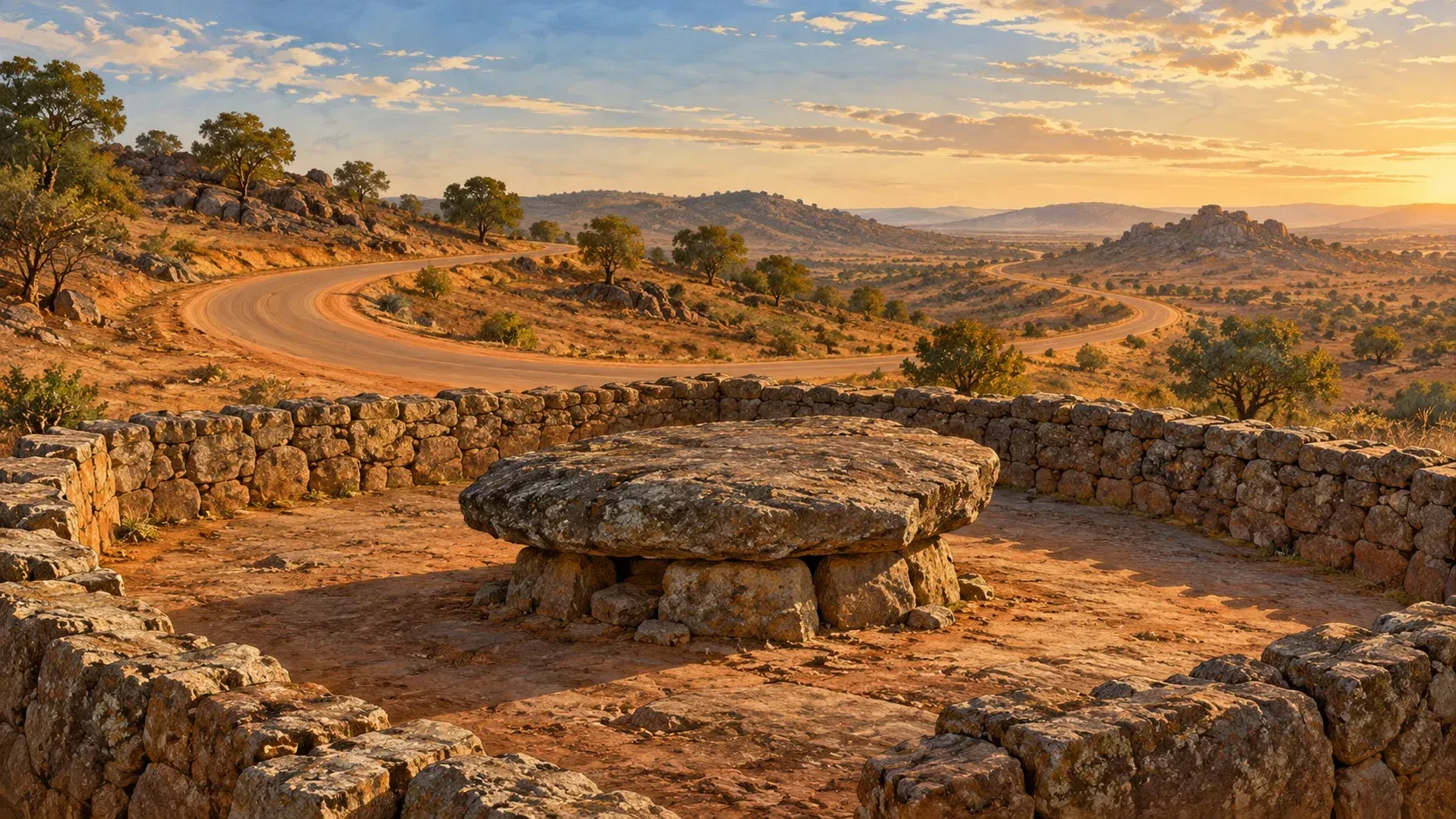
According to local tradition, workers laying a road through the settlement moved a large stone out of their way. They returned the next morning to find it exactly where it had been. They removed it again. The following morning, it was back. After a third attempt, the road builders abandoned the straight route and took the road around the stone.
The object acquired a name that leaves little room for uncertainty about how it is regarded locally: the Larabanga Mystic Stone. It remains a place of cultural and religious significance outside the village in Ghana's Savannah Region. Visitors have been photographed beside its weathered, roughly horizontal upper surface, which rests on a stone base inside a modest enclosure. Local caretakers tell the story and explain its importance.
Why did the road bend around the Larabanga Mystic Stone? According to the widely recorded tradition, workers could not permanently remove a sacred stone, so they changed the route. But the story of its repeated returns has not been independently established by road-construction records or contemporary photographs in the sources reviewed for this article. The stone and its place in community life are real. The extraordinary movement remains a claim preserved in local accounts.
This distinction becomes more interesting when the accounts are compared. For a stone famous for staying in one place, its history has proved unexpectedly mobile.
Three attempts, one very patient stone
The fullest familiar version follows a tidy pattern: attempt, return, attempt, return, attempt, surrender. It is a story suited to oral retelling because every morning repeats the problem and makes the outcome more inevitable.
A heritage guide published in 2006 under a cooperation programme involving UNESCO and the French research organisation CRATerre records the road builders' alleged difficulties. In its account, a road linking Tamale and Wa was being constructed in the 1950s. Workers using bulldozers supposedly moved the sacred stone, but the object reappeared at its former position each morning. The road was finally redirected in a broad loop.
In a 2023 feature for Graphic Online, journalist Mohammed Fugu spoke to Mahama Abubakari, identified as a caretaker of the site. Abubakari also described British road builders in the 1950s and three unsuccessful attempts to relocate the stone. After that, he said, the contractors changed the road's course. This is valuable because it is an attributable, contemporary interview about a remembered tradition rather than an anonymous website repeating a miracle as fact.
Yet the interview took place decades after the alleged event. No surveyor's diary or signed engineering report accompanies the story. It identifies a person responsible for explaining the site in 2023, not a named witness who watched the moving rock in the 1950s.
There is a small visual surprise here. The Mystic Stone is not a mountainous boulder whose sheer mass would obviously defeat machinery. Photographs show a substantial, flattened rock on a more compact support. Its exact weight has not been verified in the sources used here. The question is therefore not solved by declaring it either too heavy to move or easy to shift. We would need measurements, the earlier physical setting and a reliable record of the attempts before making either claim.
Other versions become more ambitious. In a scholarly account published in 2016, Michelle Moore Apotsos notes a telling in which the stone was supposedly carried all the way to Côte d'Ivoire, only to return. That addition demonstrates how an already extraordinary report can accumulate a still more extraordinary journey. It does not document an international transport operation.
The route may bend. The number of attempts is remarkably consistent. The distance the stone travelled, and even the decade of the episode, are less settled.
A road built in the 1950s — or the 1960s?
This is where the papers stop agreeing.
The CRATerre/UNESCO-associated guide places the attempt in the 1950s, when the territory was still the British Gold Coast for most of the decade. Graphic Online's 2023 interview likewise attributes the works to British authorities during that period.
But Apotsos, writing in the journal African Arts in 2016, describes a different setting. In her presentation of local narratives, the Ghanaian public works department planned a road between Bole and Tamale in the 1960s. Surveyors were said to have routed it through a sacred area connected with the community's founder. Workers repeatedly found the stone back in the construction zone. The road was eventually curved around the place.
Ghana became independent in 1957. That makes this discrepancy more than a trivial rounding error: the two versions attribute the episode to different administrations and potentially different projects. They also give different descriptions of the wider route. A road between towns can be improved, extended or realigned more than once; some accounts may be referring to different phases. But we cannot assume that explanation is correct without documentary evidence.
The responsible answer to when was the road diverted around the Larabanga Mystic Stone? is therefore that the reviewed sources disagree. The exact year, construction authority and original road alignment are not established by the material currently available to us.
This does not invalidate the community's cultural attachment to the stone. Oral history and engineering documentation preserve different kinds of information. A story may reliably express what a place means to its keepers while leaving the dates and administrative sequence uncertain. At the same time, an investigator should not resolve a contradiction by silently choosing whichever year makes the better headline.
One could spend a long time looking for photographic evidence of a disappearing stone. The first practical discovery worth making might be a stamped road plan.
What a UNESCO publication does — and does not — prove
The legend sometimes circulates with a powerful credential: UNESCO has written about it.
That part is true, with an important qualification.
The 2006 heritage guide is a real publication prepared in a France–UNESCO cooperation context. Its page on Larabanga describes the sacred stone and the road diversion, explicitly presenting the story through oral tradition and local beliefs. The guide includes the place as an example of how cultural heritage can influence land use and development.
This is meaningful recognition. It shows that a protected cultural landscape was important enough to be included in professional discussions about planning, and that the community's account had been recorded. It does not mean UNESCO engineers verified a rock that returned overnight, or that the stone was individually declared a UNESCO World Heritage Site. Those would be different claims requiring different evidence.
The guide also records other beliefs associated with the stone. It describes the place as protective of Larabanga and recounts a tradition involving the horses of the nineteenth-century figure Samory Touré. These are presented as community narratives, not as authenticated physical incidents. They reveal that the site mattered well before anybody began writing tourism headlines about road construction.
There is a useful distinction between a source's authority and the type of claim it supports. A respected conservation publication can be authoritative about which traditions were collected, the purpose of a heritage project and how local planning was discussed. It does not become a laboratory report on supernatural movement merely because its logo appears above the text.
The story has often been reprinted without this distinction. One page says the road was diverted, another says the stone moved, and a third changes the latter into an established fact. The language grows more confident with each retelling while the primary evidence remains the same.
The stone's importance needs no such promotion. For Larabanga, it has never been merely an obstacle encountered by road builders.
The place was important before the road arrived
Larabanga is known for a small historic mosque built in an earthen architectural tradition shared across parts of West Africa. Its sculptural buttresses, protruding wooden elements and pale exterior are among the most recognisable forms of Ghana's northern architectural heritage. The stone lies apart from the mosque, but the two are linked in stories about the community's origins.
Ghana's Museums and Monuments Board recounts a founding tradition in which a travelling Islamic scholar, often called Ayuba, dreamed that a mosque should be built. When he woke, its foundation had appeared. Popular descriptions give the date 1421, although the Board itself acknowledges disputes about when and by whom the mosque was constructed.
Apotsos's historical research offers a more complex account centred on Ibrahim Braimah and local chronicles, placing the settlement and mosque within a history often associated with the seventeenth century. One tradition describes Braimah throwing a spear and locating the community where it landed. Another connects a sacred place outside the mosque with prayers for a Qur'an. These are not all interchangeable versions of one precisely documented founding moment.
The point is that the Mystic Stone belongs to a wider geography of significance. In Graphic Online's interview, caretaker Mahama Abubakari linked the stone to the mosque's founder, who instructed others to protect it. Visitors were reported placing their hands on the rock and offering prayers. A community heritage organisation, LECLARA, continues to identify the stone and the mosque as central places to visit in Larabanga.
A traveller may see two attractions listed on the same itinerary. Their meanings are not reducible to two stops. The mosque is a working place of worship. The stone is part of a living account of the settlement and its protective landscape. How a visitor approaches either matters to those who live there.
This helps explain why the idea of bulldozing through the sacred area is so potent in local memory. Whether or not a rock physically returned during construction, the story insists that the ground could not simply be treated as an empty corridor for a road.
The building that really did have to be remade
There is another remarkable construction story in Larabanga, one for which the technical record is much clearer.
By the end of the twentieth century, the historic mosque had suffered from inappropriate repairs. Cement-rich coating applied to its earthen walls in the 1970s trapped moisture, causing deterioration and contributing to damage within the structure. A storm in the early 2000s brought down important sections, including its minaret and prayer-niche area. The conservation sources differ on the storm’s exact year. Restoration work followed with assistance from the Ghana Museums and Monuments Board, CRATerre, the World Monuments Fund and members of the local community.
The technical publications describe removing the incompatible coating, repairing damaged timbers and restoring earthen surfaces. They also show that conservation is not as simple as replacing old materials with newer ones. A material that performs well in one building may create serious problems when added to an earthen structure with a completely different way of handling moisture.
The contrast with the stone is striking. In the popular road legend, workers try to move something old and fail. In the documented restoration, workers deliberately replace a modern intervention because it was damaging something older. Both stories concern the terms on which development meets an established place, but only one has the kind of technical documentation needed to reconstruct what happened.
The restoration history also complicates the idea of a monument preserved forever in one perfect appearance. Earthen architecture requires regular care. A restored building has been changed; skilled maintenance is part of how it survives. An old community can preserve what matters while its physical fabric is altered over time.
For that reason, a supernatural story about a stone staying put should not distract us from the ordinary and demanding work of conserving the places around it.
Who gets to tell the story of the stone?
The Mystic Stone is no longer simply an unmarked feature beside a road. Images and reports show it within a stone enclosure, presented to visitors by people associated with its care. The object has become part of a local heritage economy.
That creates questions that do not require an explanation involving invisible forces. Who takes responsibility for its protection? Who explains its history? Who receives visitor contributions? How should money raised from an attraction help maintain the site and benefit the community?
Apotsos's 2016 article discussed tensions at that time over the management of visitor access and the distribution of proceeds connected with historic sites in Larabanga. Graphic Online reported in 2023 that local disagreements over ownership and management were complicating plans to improve tourism facilities. These are dated observations, not evidence that precisely the same disputes remain unresolved today.
They do show why turning a sacred place into a tourist destination is more complicated than putting up a sign. The rock may be physically small, but it sits within obligations and relationships larger than any single visitor can see. A careful guide interprets those relationships. A sensational article may erase them in favour of the promise that the stone can perform a trick on demand.
There is no basis for telling visitors to try moving it themselves. Such a stunt would be disrespectful to the community and could damage the site. Nor should anyone assume that access rules, prices or visitor arrangements found in an old article are still current. Local custodians and community organisations are the appropriate sources for up-to-date guidance.
One can appreciate the legend without asking somebody to recreate it. The story is already part of the stone's public life.
The record that could settle the bend
Suppose a researcher wanted to establish the documented history of the road rather than the provenance of the legend. What would be needed?
An original survey drawing would be a strong beginning. It could show the alignment proposed before construction and the line eventually used. A dated engineering file might identify the responsible department, the contractor, the reason for any change and the financial or geological considerations behind it. Contemporary photographs could locate the stone in relation to the works. Oral interviews with people who remembered the project could add detail, especially if recorded separately and compared with the paperwork.
None of those materials was independently established in the public sources reviewed for this article. That is a statement about the reach of our research, not a declaration that such records do not exist. Some may remain in archives that are not digitised; others may never have been kept. Without them, the narrative cannot be turned into a verified engineering case study, even when a present-day curve in the road is visible.
A bend proves that a road bends. It does not, by itself, identify the meeting at which engineers approved the alignment or establish why they made the decision. Geology, drainage, land ownership, existing settlements and practical construction costs can all influence a route. Naming one as the cause at Larabanga without evidence would replace a miraculous guess with an ordinary guess.
We can still make a careful finding. The Mystic Stone is a real cultural landmark. The tradition of its repeated returns was recorded by professional heritage writers in 2006, studied in scholarship published in 2016 and retold by a named caretaker in 2023. The accounts disagree about the decade and authority behind the roadworks. No independently verified demonstration of the rock's alleged movement emerged from the material examined.
That is a more useful answer than either declaring the miracle proven or dismissing an entire community's tradition with a shrug.
The curve that stays on the map
The rock has a remarkably simple job in the story: remain where it belongs. The road has the more difficult assignment. It must find its way through a place that already has names, memories, obligations and people who care about them.
There are readers who will arrive at Larabanga looking for evidence of a stone that walked back overnight. What they can encounter is a stone still being kept and explained, a mosque whose conservation required the recovery of old building skills, and a community whose stories have accompanied the landscape into the present.
The road's precise construction history remains unresolved in the sources reviewed. The stone's meaning as a protected place does not depend on solving every part of that history.
And the curve? It is still worth asking about. A road plan from the correct decade might tell us exactly why the line changed. Until then, the stone has the best-known explanation, and Larabanga has the responsibility of telling it in its own voice.
---
Sources and further reading
- CRATerre / France–UNESCO Cooperation — *Cultural Heritage & Local Development*, “The Sacred Stone of Larabanga Deviates the Road” (2006) (external platform)
- Michelle Moore Apotsos — “New Meanings and Historical Messages in the Larabanga Mosque,” *African Arts* 49(4), 2016 (external platform)
- Graphic Online — “Larabanga: Home of Oldest, Iconic Mosque” (3 July 2023) (external platform)
- Ghana Museums and Monuments Board — Ancient Mosques of the Northern Region (external platform)
- Ghana Museums and Monuments Board — Larabanga Mosque (external platform)
- CRATerre — Conservation of the Larabanga Mosque (2002–2004) (external platform)
- LECLARA — Larabanga Community Heritage and Visitor Information (external platform)