Articles / LORQAI
The World's Worst Perfume Is Working Perfectly
A botanical fragrance review for an audience that would rather smell a dead animal.
A giant flower smells like something has died. For certain insects, that's the attraction. A witty scientific journey through nature's most outrageous perfume.
By LORQAI
The Perfume and Its Audience
There are perfumes that suggest fresh linen, ocean air, orange blossom or a walk through a forest after rain.
And then there is the titan arum.
Its signature fragrance opens with the unmistakable suggestion that something has died and that the person responsible for removing it has taken an exceptionally long lunch break.
There are notes of decomposing flesh. Something reminiscent of rotten cabbage. A distinctly unpleasant impression of fish, old onions and materials that have been allowed to develop beyond the point at which any sensible kitchen would permit them to remain.
It is not subtle.
It is not refreshing.
It would be extremely difficult to recommend for a first date.
And among the insects it is designed by evolution to attract, it is a remarkable success.
The titan arum, *Amorphophallus titanum*, belongs to the arum family and grows naturally in the rainforests of Sumatra. Its enormous flowering structure can reach approximately three metres in height. When it blooms, it releases an odor so offensive to the human nose that the plant has acquired the popular name *corpse flower*.
The name is not a poetic exaggeration.
The smell really does imitate aspects of decomposing animal matter.
But the perfume comparison presents an immediate problem. We are judging the product from the wrong side of the transaction.
A human visitor smells decay and wonders whether the greenhouse requires attention from the health department.
A carrion-associated fly may receive an entirely different message.
Food.
A possible breeding site.
An opportunity worth investigating.
The plant is not trying to win approval from passing humans. Its odor is part of a reproductive strategy that exploits the sensory preferences of particular insects.
And the engineering behind that strategy is considerably more sophisticated than the word *stink* suggests.
So, in the interests of botanical criticism, we shall review the fragrance according to its actual purpose.
The results are going to be uncomfortable.
The Packaging Is Ridiculous
Before discussing the perfume, we must examine the bottle.
The titan arum has disregarded nearly every principle of convenient packaging.
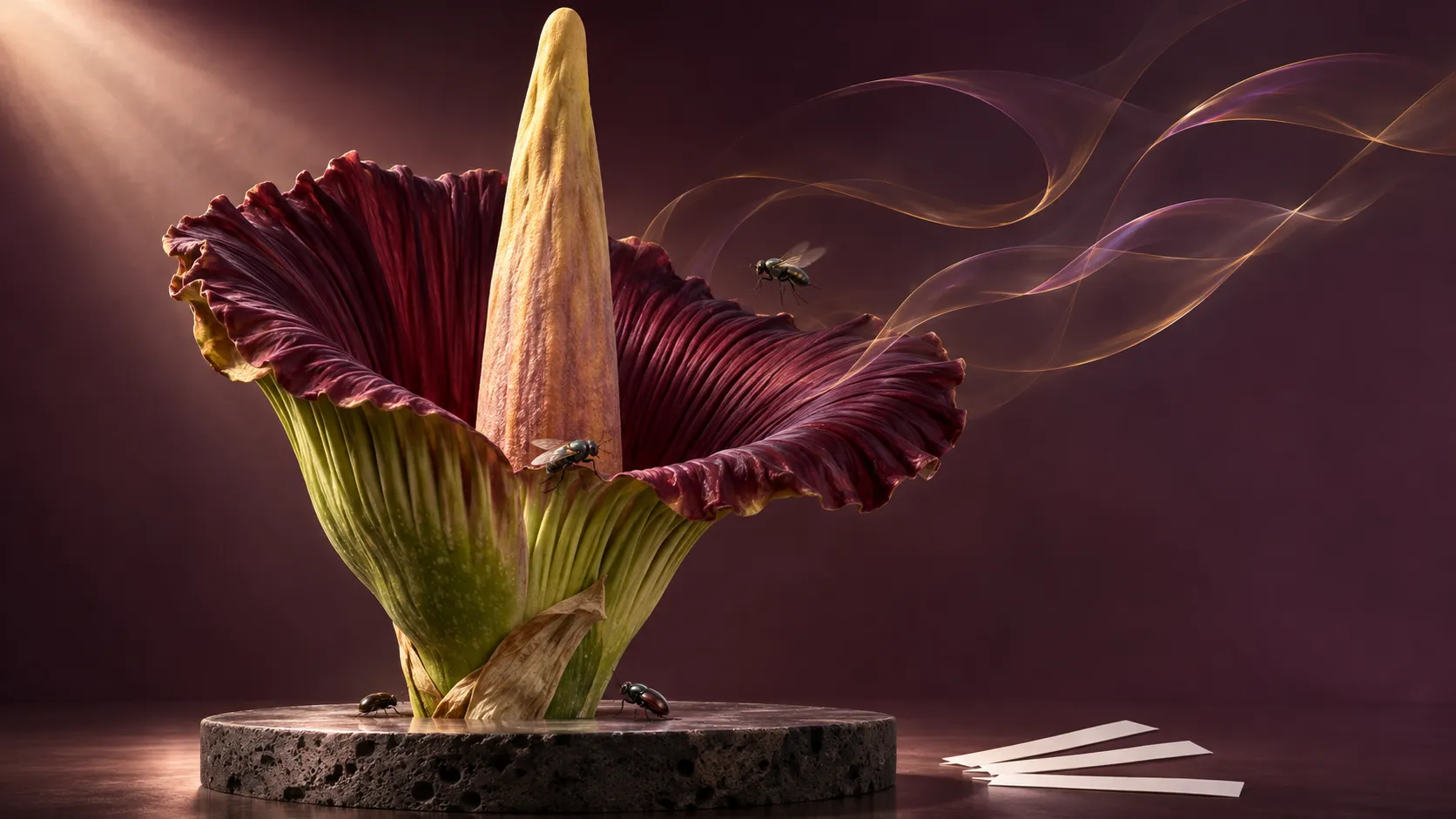
A mature flowering structure can stand taller than many people. At its center rises an enormous upright spike called the *spadix*. Around it opens a large, folded structure called the *spathe*, greenish on the outside and a rich, dark burgundy within.
The effect is theatrical.
It resembles something between an enormous sculptural vase and an architectural installation created by a designer who had become deeply interested in the color of raw meat.
The scale is not accidental to the plant's reproductive biology, although no conscious design decision has taken place.
The visible structure is also not technically one giant flower.
This is an important distinction, particularly because popular descriptions of corpse flowers often become botanically confused.
The titan arum produces an *inflorescence*: a structure containing numerous individual flowers. The small female and male flowers are located near the base of the central spike, largely hidden from the casual observer.
What visitors photograph is therefore a collective floral apparatus rather than one extraordinarily large blossom.
The real flowers are almost embarrassingly modest compared with the structure surrounding them.
The arrangement is rather like constructing a magnificent concert hall around a group of performers who have decided to remain entirely out of sight.
Why build such an extraordinary display?
The answer involves attracting pollinators during a brief and biologically important period.
The dark interior adds a visual suggestion of decaying tissue. The central spike contributes to the release and movement of odor. The structure creates a space in which visiting insects can encounter the actual reproductive flowers.
Together, these features produce a convincing presentation of something the plant is not.
A carcass.
The illusion is imperfect, of course.
There is no real animal.
There is no edible meat hidden beneath the burgundy surface.
And the plant has absolutely no intention of feeding the insects a satisfying meal.
That last detail will eventually become relevant to our customer-satisfaction assessment.
Opening Notes: An Unpleasant Achievement
A perfume is not one smell.
It is a mixture of volatile chemical substances that evaporate into the surrounding air and reach the sensory systems of whoever encounters them.
The titan arum operates according to the same physical principle.
Its flowering structure releases a complex collection of volatile organic compounds. Some of these molecules are responsible for the characteristic impression of rotting animal material.
Among the especially important compounds are dimethyl disulfide and dimethyl trisulfide.
Both contain sulfur.
Sulfur-containing molecules are prominent in the chemistry of many decomposition-related odors. They are among the reasons a decaying object can announce itself before it becomes visible.
Titan arum uses this chemical resemblance to produce an airborne signal associated with material attractive to certain carrion-feeding or carrion-breeding insects.
Other substances contribute additional notes.
Researchers have identified compounds such as trimethylamine, associated with a fishy smell, and isovaleric acid, often compared with sweaty clothing or unpleasantly aged cheese.
The final experience is not the product of one villainous molecule.
It is an ensemble performance.
In fragrance criticism, one might describe the opening as aggressively animalic, the middle as sulfurous and the finish as a firm request to leave the room.
But the scientific question is more interesting than whether humans find it revolting.
Does the chemical mixture provide the right signal to the intended insects?
Different insects respond to different combinations of odor, color and other environmental cues. A chemical signal that seems disgusting to a human may be highly relevant to an insect searching for food or a location suitable for its offspring.
The distinction cannot be reduced to the idea that flies simply like bad smells.
What matters is the information that a particular odor carries within an insect's ecology.
A fly associated with decaying animal material may use certain chemical cues to locate a carcass.
A flower that produces a sufficiently convincing imitation can redirect that search toward itself.
And unlike many familiar flowers, it may not need to advertise nectar.
The attraction is the apparent promise of something entirely different.
This is one reason the perfume metaphor works so well.
The titan arum has a remarkably precise target audience.
It has simply failed to consider the opinions of everybody else.
The Heating System
The next feature would be considered unnecessarily extravagant in an ordinary perfume.
The titan arum can warm itself.
During flowering, portions of its central spike become noticeably warmer than their surroundings, approaching the temperature of a human body under favorable conditions.
This process is called *thermogenesis*.
Heat production is familiar in animals. Human bodies continually generate heat through metabolism, and many animals regulate their temperature through physiological processes.
Plants also release energy during respiration, but pronounced heat production associated with flowering is unusual.
The titan arum belongs to a group of plants capable of this remarkable behavior.
Its warming is linked to metabolic activity.
In 2024, researchers published a study in *PNAS Nexus* examining the molecular mechanisms involved in the titan arum's thermogenesis and production of volatile odor compounds.
They investigated gene expression and metabolic changes during flowering, paying particular attention to pathways involved in cellular respiration and sulfur metabolism.
The results implicated an alternative route in the plant's mitochondrial electron-transport system, particularly activity involving alternative oxidase.
The details are complicated, but the basic principle is understandable.
Cells obtain usable energy through metabolism. Different respiratory pathways influence how that energy is handled. In the titan arum, particular metabolic processes are associated with the release of energy as heat during flowering.
The plant does not contain a miniature furnace.
It does not borrow electricity from the botanical garden.
It uses biochemical reactions.
And the heating serves a function.
Warmer tissues can help volatile odor compounds evaporate and disperse through the surrounding air.
The plant is therefore doing two things at once.
It is producing a convincing odor.
And it is helping that odor travel.
Some scientists have also discussed the possibility that warmth contributes to the illusion of an animal body, making the signal more persuasive to particular insects.
The precise contribution of heat can depend on the species and context, so it should not be treated as a universally proven trick that works identically for every carrion-scented flower.
For the titan arum, however, its thermogenesis and odor production are closely connected features of flowering.
This is an extraordinary investment in what amounts to a very short advertising campaign.
Most flowers provide something attractive and allow pollinators to discover it.
The titan arum manufactures the impression of decomposition and turns up the heating.
It is difficult to accuse the plant of lacking commitment.
The Intended Customer
Let us imagine the experience from the perspective of a fly.
This is a literary thought experiment, not a transcript of insect decision-making.
The fly is searching for a resource.
It encounters an airborne chemical signal containing compounds associated with decomposing matter.
Following such signals can be useful in environments where decaying animal tissue provides food or opportunities for reproduction.
The fly approaches the source.
There is a large, dark, reddish structure.
There may be warmth.
There is a powerful odor.
So far, the evidence looks promising.
Then the fly arrives.
No carcass.
No feast.
Just a rather elaborate plant.
From a human perspective, this resembles false advertising.
From an ecological perspective, it is a form of deception.
Scientists describe related strategies as *brood-site deception* or *brood-site mimicry*. Certain flowers imitate the sensory cues of substrates insects use for feeding, mating or laying eggs.
The insects may visit in response to those cues without obtaining the resource they expected.
While exploring the flower, they can transfer pollen.
For the plant, that is the useful event.
For the insect, the outcome may be considerably less rewarding.
There are important qualifications.
Not every carrion-scented plant uses exactly the same method.
Not every fly responds to the same compounds.
Some deceptive flowers have elaborate temporary trapping systems; others attract insects without comparable confinement. The relationships between odor, insect behavior and successful pollen transfer differ among species.
The titan arum should not be treated as the universal model for every unpleasant-smelling flower.
But the general principle is well established.
A plant can benefit from producing signals that resemble something an insect is already motivated to find.
This is not evidence of botanical dishonesty in any moral sense.
Plants do not possess marketing departments or make conscious ethical choices about their advertising.
Their characteristics have evolved through interactions with the organisms that pollinate them.
A scent that attracts effective pollinators can contribute to reproductive success, even if the visiting insect has been misled.
The system works because the flower and its audience do not need to agree about what is being offered.
One needs pollen transported.
The other is searching for something that smells promising.
And the two activities meet, briefly, inside an enormous burgundy structure.
An Extremely Limited Release
Most luxury perfume launches try to maintain public interest for as long as possible.
The titan arum takes the opposite approach.
It may spend years accumulating resources before producing a flowering structure. Then the main display opens, releases its extraordinary odor and begins declining after a very short period.
The most intense smell is often concentrated around the opening phase, particularly during the first evening or night.
This narrow schedule makes sense in light of the plant's biology.
The underground storage organ accumulates resources that allow the plant to produce its enormous inflorescence.
Flowering is costly.
There is little benefit in maintaining an extravagant display indefinitely if reproduction can be accomplished in a concentrated period.
There is another important timing mechanism.
The titan arum has both female and male flowers within the same inflorescence, but they do not become reproductively active at exactly the same time.
The female flowers are receptive first.
Later, as that phase passes, the male flowers release pollen.
This separation of phases is one mechanism that reduces opportunities for self-pollination and favors pollen transfer between different plants.
Insects drawn to the opening-stage odor may bring pollen from another titan arum and deposit it on receptive female flowers.
As the flowering cycle progresses, insects can come into contact with pollen produced by the male flowers.
When they depart and visit another receptive plant, they may carry pollen onward.
An investigation published in 2025 described evidence consistent with insects being retained within the floral chamber during part of this sequence, helping coordinate their departure with the later release of pollen.
It would be too much to claim that every visiting insect is caught, or that every visit ends with successful pollination.
But the sequence is unusually elaborate.
First, the attraction.
Then the visitor's exploration of the floral chamber.
Then a change in reproductive phase.
Then the possibility of departure carrying pollen.
All of this takes place while the enormous display is already approaching the end of its brief appearance.
A typical perfume brand would call this an exclusive launch.
A botanist would describe it as a reproductive event.
The insects have probably not received a press release.
What the Laboratory Actually Smelled
The scientific investigation of the titan arum has accelerated as researchers have gained access to blooming plants in botanical collections.
This is not an easy organism to study on demand.
A scientist cannot simply order the plant to bloom next Tuesday at nine in the morning.
Flowering may be separated by years, and the most interesting chemical changes can happen during a remarkably short period.
Researchers must therefore prepare equipment and sampling procedures around an event whose exact timing may remain uncertain until relatively late.
In 2025, a team published a study titled *Efficient Pollination Stinks: Corpse Flowers Use Floral Trapping and Persistent Emissions* in *Geophysical Research Letters*.
The measurements had been collected during a titan arum bloom at Colorado State University in May 2024.
The researchers continuously monitored volatile compounds during the bloom, combining sampling techniques with mass-spectrometric analysis.
They were not merely trying to settle a debate about whether the plant smelled horrible.
That had been established to everyone's satisfaction.
They wanted to know which chemicals were released, how their concentrations changed over time and how those emissions behaved in the surrounding atmosphere.
The results revealed a striking difference between the reproductive phases.
During the female phase, sulfur-containing compounds dominated the emissions.
Methanethiol was particularly prominent in the measured bloom, alongside other sulfur-containing molecules.
During the later male phase, emissions were smaller and more chemically varied.
This is a useful reminder that the titan arum's scent is not one fixed recipe maintained throughout its flowering period.
Its chemical profile changes with time.
A 2023 study had already documented substantial variation in volatile compounds between female and male flowering phases.
The newer research added detailed measurements of emission rates and atmospheric behavior.
It also raised questions about how air pollution might alter the odor plume.
Some compounds react in the atmosphere. If the signal changes before reaching an insect, its effectiveness could potentially change.
The study investigated this possibility, but its findings should not be mistaken for direct proof that air pollution has already caused a measured decline in wild titan arum pollination.
That would require additional field evidence.
The important established result is more immediate.
The plant's odor is a measurable and changing chemical output, with distinct characteristics during different stages of reproduction.
What humans experience as one overwhelming stink is actually a complex event.
It has timing.
It has chemistry.
It has spatial distribution.
And it has an intended biological audience.
The fragrance is considerably more sophisticated than its reviews would suggest.
Other Houses, Similar Fragrances
The titan arum is not the only member of the botanical world producing a scent reminiscent of animal decay.
It does not even have exclusive rights to the name *corpse flower*.
Consider *Rafflesia arnoldii*.
This extraordinary parasitic plant produces the world's largest individual flower. Unlike the titan arum, it does not create a giant structure composed of many small flowers.
Its enormous blossom is a single flower.
It is also associated with a smell resembling rotten meat and with the attraction of insects involved in pollination.
The distinction matters because descriptions of the two plants are frequently confused.
A titan arum has the largest unbranched inflorescence.
*Rafflesia arnoldii* has the largest individual flower.
They belong to different botanical families and have different life histories.
Their similar odors reflect related ecological problems rather than a shared identity.
There are also more modest examples.
Some carrion flowers belong to the milkweed-related group of succulents commonly called stapeliads. Their unusual star-shaped flowers can have fleshy textures, mottled colors and odors that attract flies.
Certain orchids have evolved comparable chemical imitations.
A study of the South African orchid *Satyrium pumilum*, for example, found that its flowers attracted particular flesh flies using an odor resembling carrion. In experiments, the flies responded to the floral scent in ways consistent with attraction to the imitated resource.
This is one of the remarkable features of evolutionary biology.
Organisms that are not particularly close relatives can develop broadly similar solutions when they face comparable challenges.
A plant needs pollination.
Certain insects are especially responsive to signals associated with decomposing material.
The plant evolves a floral display that exploits those signals.
Different lineages can arrive at versions of the same strategy.
The resulting flowers need not look alike.
Some are enormous.
Some are small.
Some rely on striking colors and highly specialized structures.
Others achieve much of their effect through chemistry.
The shared feature is not ugliness, and certainly not a deliberate effort to offend humans.
It is communication with a particular audience.
A pleasant fragrance is not necessarily the most effective fragrance.
That depends entirely on whom the flower needs to attract.
Customer Satisfaction and Repeat Business
At this point, an uncomfortable question arises.
If insects are deceived by the flowers, why would they keep responding?
Wouldn't natural selection eventually produce insects that avoid the false signal?
The answer is not simple.
Insect behavior is influenced by evolved sensory responses, experience, environmental conditions and the availability of resources. Different deceptive plants exploit different combinations of these factors.
A signal resembling something useful may trigger an approach even when the individual encounter does not result in the expected reward.
Whether a particular deception remains effective depends on many ecological details, including the insects involved and how common or recognizable the false signal becomes.
It would be inaccurate to claim that insects never learn.
It would also be inaccurate to insist that every insect fooled by one flower will permanently avoid all future flowers of the same kind.
Those questions require species-specific experiments.
For the plant, success is ultimately measured in reproductive consequences, not in whether the visiting insect leaves satisfied.
Did pollen reach a receptive flower?
Did fertilization occur?
Can the plant produce viable seeds?
A spectacular smell is useful only insofar as it contributes to that process.
This is why the enormous displays and powerful odors of carrion-mimicking plants should not be judged as isolated curiosities.
They are components of ecological relationships.
And those relationships can be vulnerable.
The titan arum grows naturally in Sumatra, where habitat loss and forest degradation threaten its wild populations.
Botanical gardens conserve living plants, study their biology and sometimes coordinate the movement of pollen between collections to support reproduction.
The enormous, smelly flowering events that attract crowds to conservatories can also create opportunities for research and public engagement.
Visitors may arrive out of curiosity about the odor.
They encounter a plant with a remarkable reproductive strategy and an increasingly complicated conservation story.
The fragrance is spectacular.
But preserving the species requires more than arranging for another spectacular bloom.
Final Verdict
We can now deliver our assessment.
**Appearance:** Monumental. An extraordinary burgundy-and-green flowering structure with a theatrical sense of proportion.
**Opening notes:** Unforgiving. A complex impression of decomposing animal material, produced partly through sulfur-containing compounds.
**Performance:** Impressive. The plant can warm its flowering structure and release a strong airborne chemical signal during a concentrated reproductive window.
**Target audience:** Specialized. Carrion-associated flies and beetles are considerably more relevant than human fragrance enthusiasts.
**Value for money:** Difficult to evaluate. The plant invests substantial stored resources in a display that lasts a relatively short time.
**Repeat purchase potential:** Uncertain. The customer's experience may not include the resource that initially attracted it.
**Overall rating:** Extremely successful on its own terms.
The titan arum is not trying to smell beautiful to us.
It is not even trying to smell like a flower in the familiar sense.
It is reproducing a set of sensory clues that certain insects associate with something they want to investigate.
The odor is not evidence of failure.
It is part of the mechanism.
And this leaves us with a final piece of practical advice for anyone visiting a botanical garden during one of these rare blooming events.
If the plant smells terrible, there is probably no need to complain.
The manufacturer considers that a feature.
Not a defect.