Articles / LORQAI
Before Saturn, There Was a Sewing Machine
Why spacecraft wear gold-colored blankets, what the shiny material actually does, and the extraordinary craft behind keeping a machine alive in space.
Before Cassini reached Saturn, somebody had to sew its protective blankets. Discover why satellites look covered in gold and the surprising craftsmanship behind spacecraft insulation.
By LORQAI
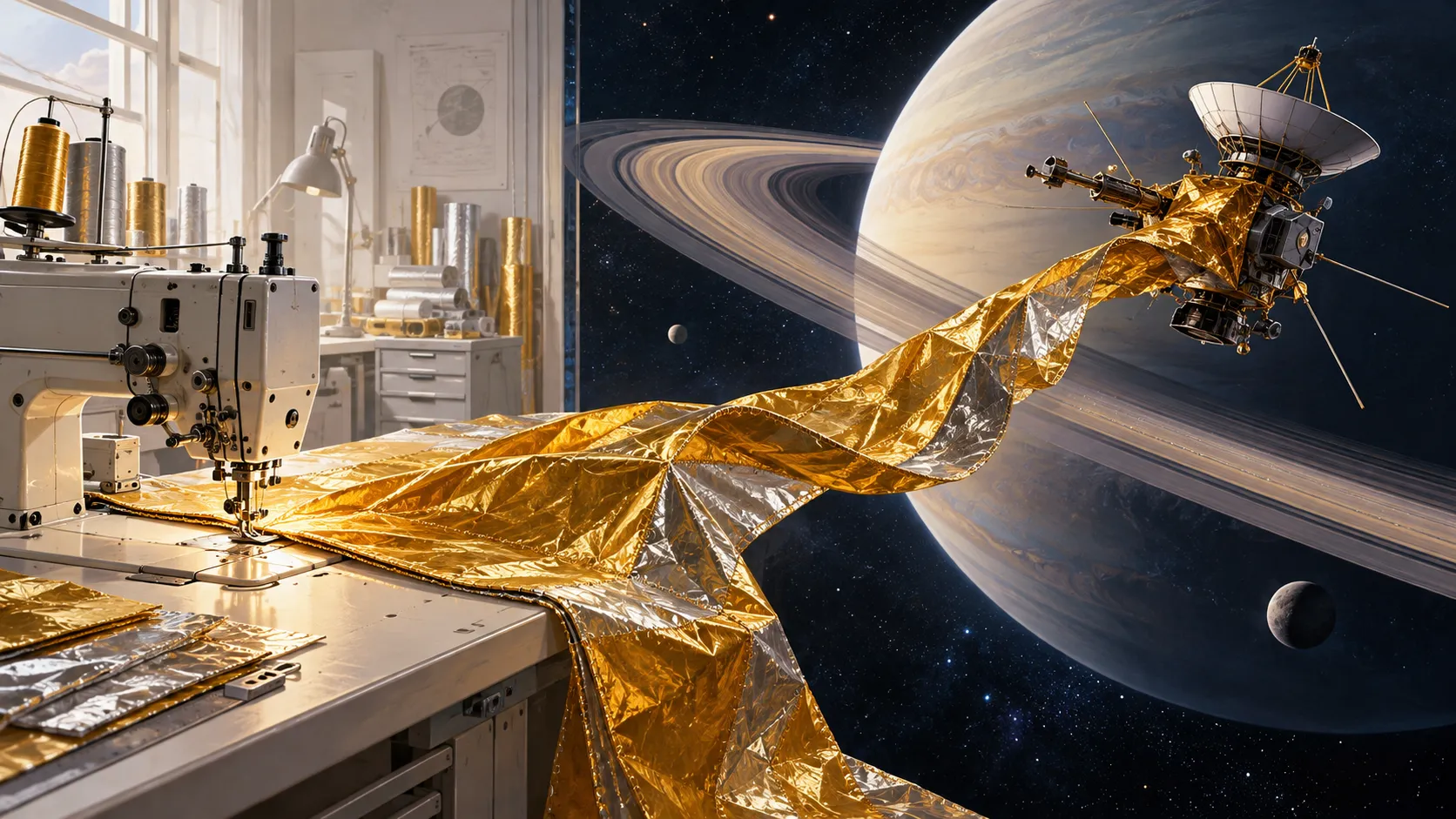
Before Saturn: The Cutting Table
In January 1997, NASA's Jet Propulsion Laboratory announced that technicians had spent part of the holiday season working at sewing machines.
There was nothing especially remarkable about sewing machines being used in California. The remarkable part was the customer.
Cassini, a spacecraft being prepared for a journey to Saturn, needed an extensive new wardrobe.
The garments were gold-colored, black, astonishingly thin in places, and made to measurements that would have defeated most clothing shops. They had to fit around instruments, structural components and equipment that had never been designed with fashion in mind. Some sections contained as many as twenty-four layers of different materials.
The people making them used industrial sewing machines, cutting tables and paper patterns.
The finished product would eventually leave Earth on a rocket.
NASA described the work in a news release dated January 3, 1997. It was not a publicity stunt involving an experimental spacesuit or a particularly ambitious costume designer. The blankets had an essential job: protecting a complicated machine from the thermal conditions it would encounter during years of interplanetary travel.
You have almost certainly seen the result of similar work.
In photographs, satellites often look as though someone has wrapped expensive scientific instruments in crumpled gold foil. The material catches the light unevenly. It gathers around corners in suspiciously ordinary-looking folds. Sometimes it resembles a kitchen experiment that became much more ambitious than intended.
The appearance is misleading.
There is usually little or no actual gold in that shimmering outer covering. What looks like decorative wrapping is a carefully engineered thermal system. It helps equipment survive environmental conditions that would make an ordinary electronics warranty rather difficult to enforce.
And the story of how it is made leads to a place surprisingly far from the romantic image of rocket science.
It leads back to the cutting table.
The Gold That Isn't Gold
Take a typical photograph of a satellite being assembled.
Ignore the antennas, the solar panels and the scientific instruments for a moment. Look at the wrinkled metallic material covering much of its body.
The first impression is gold foil.
The actual object is usually something called multi-layer insulation, or MLI.
The term does not improve the romance of the image, but it explains the engineering.
A typical MLI blanket contains multiple thin, reflective sheets, separated by lightweight materials. Depending on its purpose, these may include films such as Mylar and Kapton, both widely used names for specialized polymer materials, along with aluminum coatings and spacer layers.
The gold color is frequently an optical trick produced by materials that are not gold.
A thin aluminum layer provides a reflective surface. An amber-colored polyimide film lies over it. Seen together, they create the familiar metallic gold appearance.
The United States National Oceanic and Atmospheric Administration has explained this distinction explicitly: many satellites appear to be wrapped in precious metal when the visible material is actually aluminized polymer insulation.
The outermost layer need not even be gold-colored. Different spacecraft can use silver, white, black or other finishes depending on the thermal and electrical properties required.
This means a spacecraft's color scheme can be considerably more practical than its photographs suggest.
Gold-colored sections are not automatically more important. Black sections are not necessarily unfinished. White panels may be carrying out a job that a gold-looking blanket would perform badly.
A spacecraft is not dressed according to a coordinated seasonal collection.
Its surfaces are chosen to control what happens to heat.
That is the part worth understanding before returning to the sewing machines.
A Blanket for a Place Without Air
On Earth, keeping something warm often means slowing the movement of heat through air or other materials.
A winter coat traps layers of air near the body. Building insulation restricts heat transfer through walls and ceilings. A hot drink loses heat to its cup, to surrounding air and by emitting thermal radiation.
Space changes the arrangement.
In the near-vacuum surrounding a spacecraft, there is essentially no surrounding air available to carry heat away through ordinary convection. Heat can still move by conduction through parts of the spacecraft that touch one another, and radiation can travel across the vacuum.
Radiation becomes particularly important when considering how the spacecraft exchanges heat with its surroundings.
Sunlight can heat an exposed surface. The spacecraft's own electronics produce heat while operating. At the same time, surfaces radiate energy away.
A satellite may therefore face apparently contradictory problems.
One section receives direct sunlight. Another remains in shadow. An instrument needs to be kept relatively cool. A nearby electronic component must not become too cold. The battery has its own operating requirements. The structure must not change temperature so unevenly that sensitive equipment loses alignment.
There is no universal instruction to make the entire machine as cold as possible.
Nor is there a universal instruction to keep everything warm.
The European Space Agency describes spacecraft thermal control as the management of incoming heat, heat generated internally, and energy rejected to space. Reflective insulation is one part of that system; radiators and, where necessary, heaters or other active controls are also involved.
An MLI blanket reduces unwanted radiative heat exchange.
Its reflective layers help limit the amount of energy entering or leaving protected parts of the spacecraft. Thin spacer materials keep the reflective sheets separated, reducing direct thermal contact between them.
Simply piling metal films together without regard for how they touch would not produce the same result.
This explains an odd feature of the blankets.
They can look loose, wrinkled and rather badly fitted compared with the beautifully smooth surfaces of ordinary consumer electronics.
Yet smoothness is not the goal. The layers must meet thermal, mechanical and installation requirements. A blanket designed to protect a delicate instrument is not trying to win approval from somebody who dislikes creases.
It is trying to maintain a controlled temperature.
And there is another complication.
The heat generated inside the spacecraft must sometimes be allowed to escape.
Cover every surface with insulation, and you might preserve energy in places where it needs to be removed. Leave everything exposed, and external heating and cooling can become much harder to manage.
Thermal engineers therefore choose which surfaces receive blankets, which serve as radiators, and how different components interact.
The result is closer to designing a building's entire heating and cooling system than to putting a coat on a cold object.
Except the building is traveling through space, nobody can open a window, and replacing a badly positioned piece of insulation may be impossible.
The Shield Shop
Return to the Jet Propulsion Laboratory in the late 1990s.
Cassini was a substantial spacecraft. Its protective coverings needed to fit real hardware, not an elegant artist's impression of a satellite.
NASA's contemporary account described technicians using industrial sewing machines, butcher-paper patterns and large cutting tables to fabricate the blankets. The workplace had a wonderfully unceremonious name: the shield shop.
There are many kinds of expertise involved in building a spacecraft. Propulsion engineers design systems that change its motion. Scientists develop instruments to make measurements. Specialists test electronics, software, structures and communications.
And somebody has to make the protective covering fit.
A folded sheet must follow an irregular shape. A seam has to go somewhere. An attachment point must remain accessible. A blanket needs to accommodate the equipment beneath it without obstructing something that still has to move, open or function.
Fabrication matters because the theoretical thermal properties of a material are not enough by themselves.
The finished assembly must work when installed on a real spacecraft.
For Cassini, some blankets consisted of as many as twenty-four layers, using combinations of aluminized Kapton, Mylar, Dacron and specialized fabrics. Certain sections included materials intended to provide additional protection against tiny high-speed particles.
There were also electrical requirements.
During its mission, Cassini would encounter charged-particle environments. NASA described how its blanket layers needed electrical grounding to reduce the risk of arcing. Conductive connections were incorporated into the coverings as part of the fabrication process.
A casual observer might see a few untidy layers of gold wrapping.
The technicians saw dimensions, materials, mechanical interfaces, electrical behavior and thermal specifications.
They also saw the practical difficulties of working with thin, awkward substances that were never intended to behave like ordinary cotton.
The craft did not disappear after Cassini.
In 2016, NASA's Jet Propulsion Laboratory published an interview with Lien Pham, a technician who had worked on spacecraft thermal blankets for sixteen years. Before joining the shield shop in 2000, she had worked on spacecraft cabling, including work associated with Cassini.
Pham described using Mylar films, Dacron netting, Kapton and other specialized materials. She also described the tools of her trade: commercial sewing machines, scissors, scalpels, punches, scales and heat guns.
One of the materials she discussed was Teflon.
Tape did not stick to it reliably, which created a problem during fabrication. Her team developed an approach involving a folded and sewn hem, much as one might use in conventional clothing.
That is an extraordinary little engineering detail.
The solution to a problem involving a material chosen for aerospace performance was recognizably related to a technique familiar from dressmaking.
It was not an abandonment of advanced technology.
It was advanced technology benefiting from a very old skill.
There is a tendency to imagine spacecraft emerging entirely from computers, robotic equipment and enormous clean rooms filled with instruments that would be difficult to identify.
Those things matter enormously.
But the photographs and interviews from JPL show another part of the process: people measuring, cutting, folding, sewing and checking the fit of protective coverings.
Space engineering has room for skilled hands.
The Fitting Must Survive the Journey
Cassini's wardrobe had to perform across a journey that would change its thermal circumstances dramatically.
The spacecraft was launched in 1997 and eventually arrived at Saturn in 2004.
It did not travel directly from Earth to the ringed planet along a simple route. Its trajectory involved planetary gravity assists, including encounters with Venus, Earth and Jupiter, to gain the energy needed for its journey.
That created a demanding thermal problem.
The spacecraft would experience different sunlight conditions during different phases of the mission. Its equipment had to continue operating while moving between environments that did not resemble one another.
Near Venus, sunlight is much more intense than in the distant reaches of the Solar System.
At Saturn, solar illumination is much weaker.
Meanwhile, components inside the spacecraft generate their own heat. Some instruments need a particular temperature range; others have different operating requirements.
The blanket does not decide which component should be warm or cold.
Engineers do.
Thermal design requires understanding the spacecraft's whole mission, not merely selecting a material that performs well in a laboratory demonstration.
That is why testing becomes so important.
NASA's 1997 account described preparations for placing Cassini in a thermal vacuum chamber, where aspects of the space environment could be simulated before flight.
A test chamber cannot reproduce every event that will occur during a long mission. But it can expose problems in materials, temperatures, assembly and system behavior while the spacecraft is still on Earth.
That last part is rather important.
A loose seam discovered during testing is an engineering problem with a possible solution.
A loose seam discovered only after launch becomes a much less convenient subject for discussion.
The blanket also has to survive the launch process itself, handling during assembly and the conditions encountered on the mission.
The covering is therefore a component in its own right, even if it lacks the glamour of an engine or scientific camera.
One could describe it as clothing, but ordinary clothing is removed, repaired, washed and replaced.
Cassini's protective coverings had to remain effective for a journey measured in years.
The fitting was final in a way that would make most tailors understandably nervous.
When Gold Really Is Gold
There is, however, a complication in the story.
Sometimes the gold-colored material on a space instrument really is gold.
The James Webb Space Telescope is a famous example.
Its large primary mirror is made of eighteen hexagonal segments. Those segments are built from beryllium and coated with a very thin layer of actual gold.
The gold is not there to make the telescope more expensive-looking in photographs.
It serves an optical purpose.
Webb is designed to observe infrared light, and gold reflects the relevant wavelengths extremely well. The coating helps direct that incoming light toward the telescope's instruments.
According to NASA, the gold layer on the mirror is approximately one hundred nanometers thick.
That is an almost absurdly small measurement when compared with the scale of the telescope.
NASA estimates the total amount of gold used on the mirror surfaces at about fifty grams.
Imagine the size and engineering complexity of the telescope, then consider how little precious metal is required to give its enormous mirror the optical properties it needs.
That is a different use of gold from the shiny material on many spacecraft bodies.
One is a specialized optical coating made from actual gold.
The other is usually a multilayer thermal covering whose color can result from aluminum and amber-colored polymer film.
The visual resemblance is considerable. The technical purpose is different.
Gold also appears in other space applications, including some astronaut helmet visors and electronic components, where its particular physical properties are useful.
The lesson for anyone examining a spacecraft photograph is therefore not simply that the gold is fake.
It is that appearance alone cannot tell you what a material is doing.
Two surfaces may look similarly golden and have very different functions.
And two materials performing similar thermal tasks may look entirely different.
A satellite is not a jewelry display, although some photographs make a convincing case that it has been shopping in one.
The Last Piece of the Pattern
If there is a particularly good image to remember from this story, it is not the familiar photograph of a golden spacecraft floating against black space.
It is a cutting table.
An enormous mission begins with a vehicle designed by specialists in hundreds of disciplines. That vehicle must survive launch, travel, extreme temperatures and years of operation beyond ordinary human reach.
Somewhere in the process, a technician studies a piece of material and determines how it should be cut.
The decision is small enough to be made with a pattern, a measuring tool and a practiced hand.
But its consequences travel with the spacecraft.
The space industry has produced elaborate robotic systems, remarkable cameras, highly sophisticated computers and machines capable of visiting other worlds. None of that makes the elementary problem of fitting one material around another disappear.
A corner still needs to be covered.
A seam still needs to hold.
A component still needs room to function.
And if a particular film refuses to cooperate with adhesive tape, somebody may have to invent a better hem.
This combination of industrial precision and familiar craft is easy to overlook because the final spacecraft attracts so much attention.
By the time the machine is photographed in space, the sewing machines are nowhere to be seen.
The people who operated them are back on Earth.
The pattern paper is no longer part of the spacecraft, and the cutting table has another job.
What remains is the finished blanket, folded around equipment exactly where it needs to be, continuing a task that few people watching the mission will ever think about.
The next time a satellite appears on a screen, look closely at the crumpled gold-colored covering.
It is not necessarily gold.
It is not merely foil.
And somebody had to make it fit.