Articles / LORQAI
Please Put the Holes Back
How cleaner milk changed Swiss cheese, why scientists started scanning it, and how a missing ingredient led to an extraordinary argument over Emmentaler.
Switzerland made its milk cleaner, and its famous cheese began losing its holes. The astonishing true story of bacteria, hay dust, CT scans and a court ruling about Emmentaler.
By LORQAI
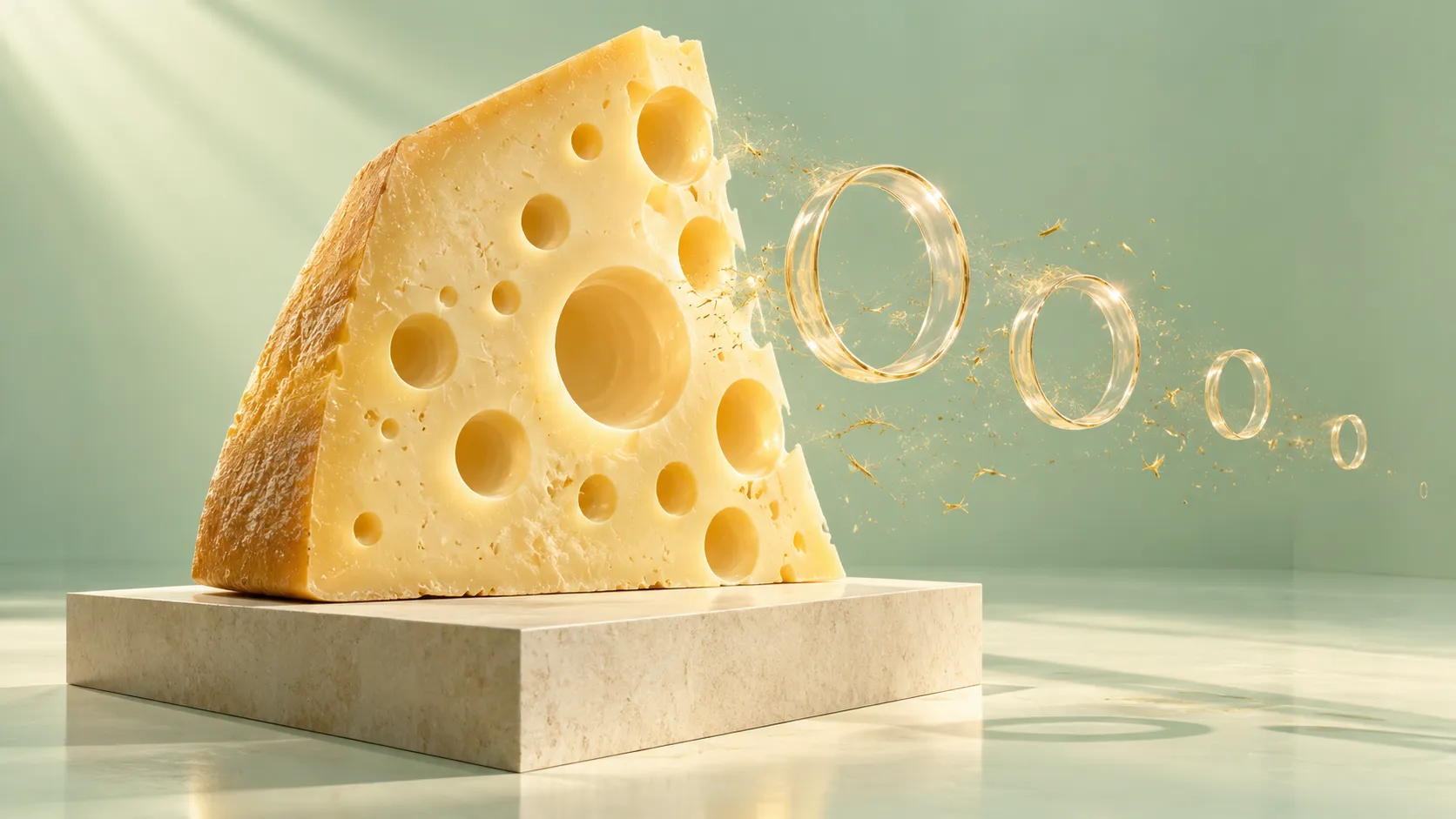
Introduction
On April 11, 2025, Switzerland's Federal Administrative Court announced the outcome of a dispute concerning holes in cheese.
The situation deserved a moment's consideration.
Switzerland, a country with an established reputation for taking cheese seriously, had reached the point where the number and size of holes in a particular cheese had become a matter for judicial intervention.
The cheese was Emmentaler.
The problem was that its holes were getting smaller and less numerous. Producers wanted permission to use a specially prepared hay-flower powder to encourage their formation. The Federal Office for Agriculture had rejected the proposed change to the rules governing the protected cheese. The producers appealed.
The court ruled in their favor.
Its official press release described the need to preserve the characteristic qualities of Emmentaler, including the holes that had helped make it recognizable around the world.
There is something wonderfully unusual about an institution having to determine whether a manufacturer should be permitted to create more empty space inside a food product.
Most industrial processes spend money preventing unwanted gaps. Engineers worry about voids in concrete, cracks in metal and air pockets trapped in components. A hole can suggest that something has gone wrong.
In Emmentaler, the hole is part of the achievement.
And for years, that achievement had been quietly disappearing.
The culprit was not a new disease, a disastrous change in the weather or a shortage of enthusiastic bacteria.
It was cleaner milk.
The Curious Value of an Empty Space
Cut open a wheel of Emmentaler and the interior is immediately recognizable.
A pale, firm body contains rounded openings of different sizes. Some appear as near-perfect circles in a slice. Others are more oval. Depending on the cut, a hole may look enormous or barely noticeable.
Cheesemakers and dairy scientists call these openings eyes.
The expression makes an ordinary cheese sound like something being examined by a rather poetic anatomist, but it is useful terminology. Eye formation is an established part of the science and quality assessment of several cheese varieties.
For Emmentaler AOP, the eyes matter to the identity of the finished product. Their number, size and distribution are influenced by the way the cheese is produced and ripened.
The holes are not drilled.
Nobody inserts a device into a mature wheel and removes little cylinders of cheese. There is no secret factory tool responsible for punching out circles before the product reaches a supermarket.
They form inside the cheese as it develops.
Emmentaler spends part of its maturation in conditions favorable to a particular fermentation. Bacteria convert compounds produced during the earlier stages of cheesemaking into other substances, including propionic acid, acetic acid and carbon dioxide.
The acids contribute to the characteristic flavor. The carbon dioxide is essential to the famous holes.
A particularly important organism is Propionibacterium freudenreichii, a bacterium associated with the ripening of Swiss-type cheeses.
Its name is considerably longer than its contribution is visible.
As the bacteria carry out their work, carbon dioxide accumulates in the cheese. Under suitable conditions, gas gathers into cavities, which expand as ripening continues.
The resulting spaces remain when the cheese is cut.
This is why the holes are associated with fermentation rather than with some improbable technique involving specialized kitchen equipment.
But the presence of carbon dioxide is only part of the explanation.
Gas must also find suitable places to gather. The cheese has its own structure, with particular physical properties that determine whether a cavity can begin, expand and remain intact.
A large quantity of gas does not automatically produce a beautiful collection of round holes.
It might escape.
It might create cracks.
It might collect in undesirable ways.
That distinction would eventually turn out to be the essential clue.
A Small Problem with Progress
For much of its history, dairy production took place much closer to the everyday environment of the farm.
Milking equipment, vessels, buildings and handling methods changed over time, but older systems frequently exposed milk to the air of the barn.
Barns contain hay.
Hay contains tiny plant fragments and dust.
Some of those particles could enter the milk during handling.
Modern dairy production has become far more controlled. Closed milking systems and improved filtration limit exposure to the surrounding environment. The changes serve important purposes, including reducing opportunities for contamination.
In the middle of that entirely sensible improvement, something unexpected happened.
Emmentaler began to develop fewer of its characteristic eyes.
For producers, this was not merely a cosmetic inconvenience. The appearance and internal structure of a traditional cheese are part of what distinguishes it from other varieties. Irregular gas formation can also be associated with undesirable cracks and defects.
The trend became sufficiently noticeable that researchers began investigating the problem.
There was a plausible explanation for what had changed.
The milk was cleaner than before.
That sounds like the beginning of a complaint nobody should take seriously. Surely a food producer would want cleaner milk. Surely removing stray material from a food ingredient should be regarded as progress.
And, in terms of hygiene, it is.
The researchers were not proposing that dairy producers abandon food-safety standards or return to careless practices.
The question was more specific.
Could the disappearance of microscopic plant particles have unintentionally removed something necessary for predictable hole formation?
A traditional production method can contain features that nobody originally introduced on purpose. Some are undesirable and should be eliminated. Others may turn out to contribute to a valued characteristic of the finished product.
Distinguishing between the two requires experimentation.
Otherwise, the producer faces an awkward choice: preserve the original conditions without fully understanding them, or modernize production and risk changing the product in ways that were never intended.
For Emmentaler, the answer involved quantities of material so small that they would be easy to overlook.
And a piece of equipment more commonly associated with medical imaging.
The Cheese Goes Through a Scanner
In May 2015, the Swiss agricultural research institute Agroscope and the Swiss Federal Laboratories for Materials Science and Technology, known as Empa, announced findings that clarified the mystery.
Researchers had examined how microscopic particles of plant material influenced the formation of holes in Emmental-type cheese.
They prepared experimental cheeses using specially treated milk and added carefully measured quantities of powdered hay.
Then they followed what happened during maturation.
One of their tools was X-ray computed tomography.
A CT scan allows investigators to examine internal structures without having to destroy the object at every stage of observation.
It can reveal features hidden beneath a surface and help researchers measure how those features change.
For the cheese experiment, the method allowed scientists to study the developing eyes over a ripening period of 130 days.
The experimental approach was elegant.
If hay particles were relevant to hole formation, changing their concentration should produce measurable differences in the finished cheese.
That was exactly what the researchers found.
The quantity of plant particles influenced the number and size of the eyes. The relationship was sufficiently clear to show that these microparticles were doing more than merely accompanying the process.
They were helping determine where cavities began.
This was a crucial addition to the older explanation based on bacterial gas production.
Scientists already understood that fermentation produced carbon dioxide. The research demonstrated the importance of microscopic starting points in the cheese's structure.
The plant particles could contain minute air-filled spaces. Those spaces provided locations into which carbon dioxide could move and gather.
As gas accumulated, a cavity could expand.
In suitably prepared cheese, the process eventually produced the characteristic rounded openings.
Remove most of those starting points, and much of the familiar eye formation could disappear, even though fermentation continued.
The implications were remarkable.
A change introduced to improve one aspect of dairy production had accidentally altered the physical architecture of the cheese.
The bacteria had not collectively resigned.
They were still capable of producing gas.
The gas simply had fewer appropriate places to establish itself.
Agroscope's 2015 announcement made another striking point: only extremely small amounts of suitable plant material could be sufficient to influence hole formation.
The amount involved was microscopic relative to the quantity of milk.
It is difficult to think of many food products whose internationally recognizable appearance depends so visibly on something present in such a tiny concentration.
And the discovery did not require anyone to invent an imaginary ingredient.
It required scientists to understand the function of something that had been there for a very long time.
The Argument About a Pinch of Hay
Identifying the missing ingredient was one problem.
Deciding whether producers should deliberately introduce it was another.
Emmentaler AOP is not simply a generic name for any pale cheese containing holes.
Its protected designation of origin is associated with defined geographical and production requirements. Products sold under that protected name must follow specified rules.
Those rules protect identity and quality. They also constrain how producers can change their methods.
The researchers' discovery therefore raised a question that could not be settled entirely in a laboratory.
If traces of hay particles had traditionally entered milk during production, was deliberately adding prepared hay-flower powder a legitimate way to preserve a traditional characteristic?
Or was it an unacceptable change to the established manufacturing rules?
Emmentaler Switzerland, the producers' organization, sought permission to amend the specifications.
The Swiss Federal Office for Agriculture opposed the proposal.
Its concern, as described in later reports of the dispute, involved preserving the traditional character of the product and preventing unnecessary industrialization of the process.
There was a genuine tension here.
Protected food designations exist partly to prevent products with a strong regional identity from being transformed into something unrelated to their traditional methods.
But what happens when a modernization intended to improve production changes a characteristic that people regard as essential to the traditional product?
The old process allowed certain particles to enter the milk incidentally.
The newer process removed much of that incidental material.
The proposed change would reintroduce a controlled version of it.
This is not quite the same as returning to the old method. Nor is it necessarily a rejection of tradition.
It is an attempt to reproduce a particular result by using a more explicit understanding of the process.
That distinction became central to the legal argument.
The Federal Administrative Court issued its judgment on April 2, 2025, and announced the result publicly on April 11.
It upheld the appeal by the producers' organization and allowed the proposed addition of hay-flower powder to be included in the protected product specification.
The court emphasized the need to preserve the originality and quality of products with a protected designation of origin.
It also addressed concerns that permitting the ingredient would make production too standardized. The possibility of excessive hole formation remained, so control was still necessary.
The judgment was subsequently left without a further challenge by the federal agricultural authority, allowing the specification change to proceed.
The result was an unusual combination of modern food science and traditional-product protection.
Researchers had identified a previously underappreciated role for tiny plant particles. Producers wanted to use that knowledge. A regulatory dispute determined whether the technique could be accepted within the rules protecting the cheese's identity.
The court did not order anyone to fill every wheel with enormous holes.
Nor did its ruling establish that every Emmentaler producer would immediately use the newly permitted material.
It created a permitted option within a regulated production framework.
That is less dramatic than imagining a judge specifying the minimum diameter of a cheese hole with a ruler.
It is also more accurate.
The Experiment Gets Stranger
The story might have ended with the 2015 discovery and the 2025 court decision.
Instead, the research continued.
A study published in the International Dairy Journal in 2026 examined the mechanism of eye formation more closely.
The new work returned to a deceptively simple question.
What exactly makes the plant particles effective?
Is there something chemically special about hay? Is the material itself essential? Or is the important feature the microscopic structure that it provides?
The researchers investigated whether objects with small air-trapping cavities could serve as starting points for the formation of cheese eyes.
Their experimental approach included synthetic hollow fibers and small tube pieces with defined capillary structures.
This sounds like a research project invented by someone who had been asked to find the most complicated possible explanation for a sandwich.
But the question mattered.
If the physical structure of a particle is central to eye formation, then the original observation about hay can be understood more precisely.
Tiny hollow spaces can trap air. Carbon dioxide produced during fermentation can diffuse into those spaces, allowing cavities to grow inside the cheese.
The 2026 experiments supported that mechanism.
The researchers found that the synthetic structures could initiate eye formation. Cheeses without the corresponding starting points tended to develop very few normal eyes and could exhibit cracking instead.
This does not mean synthetic fibers are being recommended as ingredients in commercial Emmentaler.
The structures were experimental tools used to test a physical explanation.
Their purpose was to establish what properties made a starting point effective.
The distinction is worth keeping clear, particularly because the story is already unusual enough without implying that cheesemakers plan to fill dairy products with pieces of laboratory tubing.
The new finding provided a stronger explanation for the earlier discovery.
Hay particles were not magical.
They were useful because their structure could help provide the microscopic conditions from which a gas-filled cavity could develop.
The study moved the explanation from an observed connection toward a more detailed account of the underlying mechanism.
For a product with such a familiar appearance, that is a surprisingly recent refinement.
People had been making and eating cheeses with eyes for generations before researchers established these particular details.
How Much Nothing Is Enough?
There remains a problem that might be described as quality control over emptiness.
The best Emmentaler does not necessarily contain the maximum possible number of holes.
The appearance should fit the characteristics expected of the product. Eye size, distribution and the integrity of the cheese body all matter.
Gas formation and the development of cavities must be controlled.
Too few starting points may lead to inadequate eye formation. Under some conditions, gas can contribute to cracks rather than desirable rounded openings.
Too many or poorly distributed cavities can create other defects.
A cheesemaker therefore has to manage a process involving living microorganisms, changes in the cheese's physical structure and the movement of gas through a material that is gradually maturing.
Temperature matters.
The composition of the cheese matters.
The fermentation cultures matter.
The availability of suitable microscopic nuclei matters.
According to the Emmentaler AOP producers' organization, its cheese undergoes a maturation period of at least 120 days, with an important phase of propionic fermentation taking place in a warmer cellar.
The process requires monitoring and care. The enormous wheels are turned during maturation, and conditions are managed to develop the desired flavor and structure.
It is work that depends on both accumulated experience and technical knowledge.
A mature wheel of cheese is not just milk that has been left alone for several months.
It is a product whose development has been deliberately guided.
The holes are part of that development.
And here a final distinction is useful.
Different cheeses have different standards. A cavity admired in one variety might be considered a defect in another. A perfectly smooth interior is desirable for some products and unexpected for others.
There is no universal rule stating that more holes make better cheese.
There is only the question of what the cheesemaker intended to produce, and whether the finished result meets that expectation.
For Emmentaler, a recognizable pattern of eyes belongs to the product's established character.
A wheel that loses them may still contain perfectly edible cheese.
But it may no longer resemble the cheese that its makers set out to create.
An Entirely Reasonable Amount of Absurdity
The history of this particular problem contains almost everything one could reasonably ask of a scientific curiosity.
There is a traditional food with an instantly recognizable appearance.
There is a technological improvement that produces an unexpected side effect.
There are scientists who discover an important role for microscopic particles.
There is a CT scanner examining the interior of maturing cheese.
There is a court deciding whether a carefully prepared ingredient may be used to preserve a traditional product.
And there is a later experiment showing that the secret lies, in significant part, in tiny structures capable of trapping air.
The facts are already strange enough. There is no need to invent a secret laboratory, a rebellious cheesemaker or an emergency meeting of dairy cows.
The result also changes the way an ordinary slice of cheese looks.
A hole seems like an absence. You can see straight through it. It contains none of the material for which the customer has paid.
But making that empty space in the correct place, at the correct time and in the correct shape requires a rather elaborate chain of events.
The milk has to be prepared.
The microorganisms have to behave as intended.
The cheese must develop a suitable structure.
The gas needs somewhere to gather.
And the manufacturer must know enough about all of this to produce something that looks reassuringly familiar when the wheel is finally cut.
The next time you encounter a slice of Emmentaler with a particularly impressive hole, it may be worth giving that empty space a second glance.
It is the result of a process involving bacteria, microscopic cavities, controlled maturation and more research than its appearance suggests.
Someone may have spent years working out why it was there.
Someone else may have gone to court to make sure it could stay.
All this effort, so that the cheese can continue to contain precisely the right amount of nothing.