Articles / LORQAI
The Hiss Before the First Serve
Why tennis balls come in pressurized cans, what that familiar hiss really means, and the peculiar engineering required to preserve a good bounce.
A tennis ball can opens with a hiss. Why? Discover the strange physics, century-old inventions and invisible pressure that keep tennis balls ready for their first serve.
By LORQAI
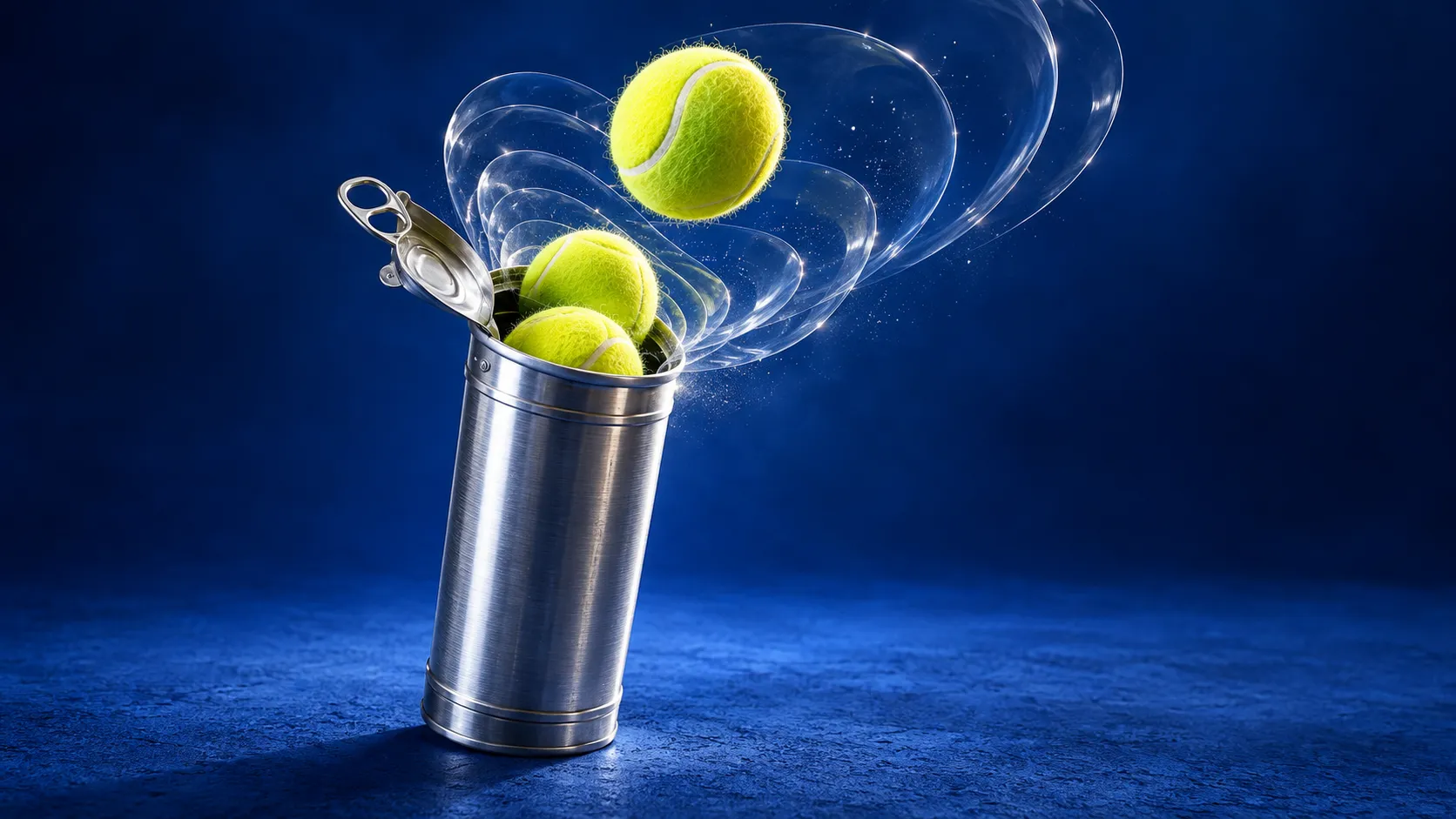
The Hiss Before the First Serve
There is a small ceremony that takes place on tennis courts all over the world.
A player reaches into a bag, removes a cylindrical container and pulls off its plastic lid. Beneath it is a metal seal with a ring attached.
The ring is lifted.
The seal begins to separate.
Psssssssh.
For a brief moment, a tennis court sounds like somebody opening a very small spaceship.
Three yellow balls are released from captivity. They look exactly as tennis balls should look. Round, fuzzy, bright enough to be discovered in the grass, and completely unaware of the elaborate industrial arrangements that have preserved their condition.
One is squeezed experimentally. Another gets dropped onto the court. The third may escape and roll beneath a bench.
Nobody seems particularly impressed by the sound. It is simply what happens when a fresh can is opened.
But consider the arrangement.
These are balls.
Not chemicals. Not carbonated drinks. Not emergency medical supplies requiring protection from ordinary air.
They are objects specifically manufactured to be hit repeatedly with considerable force, sometimes by people whose entire professional lives have been devoted to hitting them harder and more accurately than everyone else.
Yet before the first shot, they must be protected inside a pressurized container.
It seems an oddly delicate beginning for such violent equipment.
And the reason is even stranger than it first appears.
The can is not primarily protecting the balls from being crushed or scratched during transportation. It is helping preserve something that nobody can see.
The air pressure inside them.
The moment that seal breaks, an invisible arrangement ends. The balls are still perfectly usable, of course. That is why the can was opened in the first place.
But the clock has started.
The tennis ball, unlike most of the equipment used in the sport, is already engaged in a slow argument with the atmosphere.
The atmosphere intends to win.
The Sound of a Container Doing Its Job
Let us begin with the hiss.
It does not come from the tennis balls suddenly deflating.
That would be an extremely disappointing product demonstration.
The sound comes from gas escaping from the container itself.
Inside an unopened can of conventional pressurized tennis balls, the gas surrounding the balls is held at a pressure above that of the outside atmosphere. When the seal is broken, the gas escapes until the pressure inside the can approaches the surrounding atmospheric pressure.
The hiss is the audible result of that sudden change.
It is evidence that the container was sealed and pressurized.
A tennis ball is not a solid rubber sphere. A conventional pressurized ball has a hollow rubber core containing gas. That internal pressure contributes to the ball's stiffness, its response to impact and its characteristic bounce.
The rubber also contributes through its own elasticity. The ball's behavior is a combination of materials, structure and pressure rather than an achievement performed by compressed air alone.
Here is the difficulty.
Rubber is not perfectly impermeable to gas.
Even when a tennis ball is sitting quietly on a shelf, gas molecules can gradually move through its rubber wall. If the pressure inside the ball is greater than the pressure outside, there is a driving force for gas to diffuse outward.
Over time, the internal pressure declines.
This is not necessarily a manufacturing defect.
It is a property of the materials involved.
The tennis ball needs an elastic shell that deforms when struck and recovers afterward. The rubber compound is engineered to balance several requirements, but it does not function as a permanent, absolutely airtight container.
So the manufacturer places the pressurized ball inside another pressurized container.
By raising the pressure around the ball, the can greatly reduces the pressure difference across the rubber wall. That slows the loss of gas from the ball during storage.
It is essentially a small artificial atmosphere designed to help the contents retain their original characteristics.
The arrangement is rather like keeping an inflated object in an environment that does not encourage it to lose its inflation.
An ordinary cardboard box cannot do this.
It can protect the ball from dust, accidental damage and an enthusiastic warehouse employee dropping something heavy on it. But it cannot maintain the pressure of the surrounding gas.
The pressurized can solves a problem that the cardboard box cannot.
And when the lid is opened, that protection ends.
Not because the tennis ball instantly becomes useless.
But because the pressure outside the ball has returned to ordinary atmospheric conditions.
The slow escape can begin again.
The first sound of a new tennis ball, therefore, is not a bounce.
It is a pressure difference disappearing.
The Ball Is a Small Engineering Project
Cutting a tennis ball in half reveals an object considerably more complicated than its cheerful appearance suggests.
Under the bright felt is a rubber core.
The core is typically formed from two hemispherical shells that are joined together. Manufacturing processes use carefully selected rubber compounds, controlled heating, adhesives or bonding materials, and methods for introducing pressurized gas.
According to the International Tennis Federation's technical description of ball manufacture, one inflation method uses compressed air trapped as the two rubber halves are brought together.
Another uses chemical reactions that generate nitrogen during production.
The objective is to create a sealed, pressurized core with suitable mechanical properties.
That is already a substantial amount of technology for something commonly abandoned behind a garden shed.
But the manufacturer is not finished.
The outer fabric must be attached.
Tennis-ball felt is not simply decorative clothing. It affects how the ball interacts with the racket strings, court and surrounding air. The characteristic fuzzy surface is part of the ball's performance.
The International Tennis Federation describes the use of specially cut fabric pieces attached to the rubber core. The material is bonded and treated so that the finished ball acquires its familiar appearance and texture.
A tennis ball therefore has two important personalities.
The interior helps determine how it compresses and rebounds.
The exterior influences its contact with other surfaces and its movement through the air.
Neither can simply be ignored.
A ball made from excellent rubber but covered in unsuitable material would not behave like a conventional tennis ball.
A beautifully felted ball with badly controlled internal pressure would be similarly unconvincing.
The challenge is to make the two systems work together.
The result must also be repeatable.
A manufacturer cannot produce one wonderfully lively ball followed by another that responds to a racket like a slightly damp potato.
A tennis match depends on the equipment behaving within expected limits.
The players may be unpredictable.
Their emotional condition may vary from extraordinary confidence to public despair within a single game.
The balls, ideally, should not introduce comparable surprises.
This is why the question of internal pressure matters so much.
It is not a cosmetic detail.
It is one of the variables that helps determine the physical behavior of the object.
And for most of the time between factory and tennis court, the pressurized container helps keep that variable under control.
When Tennis Balls Came in Ordinary Boxes
The pressurized can was not always part of tennis.
In the late nineteenth and early twentieth centuries, balls were sold in various containers, including paper bags, cardboard boxes and metal boxes.
Some packages held three or four balls. Others held six or twelve.
There was no universal cylindrical container that everybody recognized as the natural home of the tennis ball.
This is one of the pleasures of browsing the International Tennis Hall of Fame's collection of historical packaging.
Some containers look like stationery supplies. Others resemble tins of biscuits or carefully presented gifts. Their labels advertise championships, quality, durability and famous players.
The history of tennis appears on objects whose original purpose was simply to get the balls into a customer's hands.
But the introduction of pressurized balls created a problem that ordinary packaging could not solve.
The balls could begin losing pressure before the buyer ever opened the package.
Imagine purchasing a product that had already been growing less effective while waiting in a shop.
The customer might have done everything correctly. The manufacturer might have made the ball correctly. The shopkeeper might have stored it carefully.
Nevertheless, the passage of time would be changing the equipment.
By the late 1920s, manufacturers including Thomas E. Wilson & Co. and the Pennsylvania Rubber Company were introducing pressurized metal containers.
The solution was ingenious in its simplicity.
If the balls needed a higher-pressure environment to slow gas loss, the package itself could provide that environment.
Suddenly the container became part of the engineering system.
It was not merely a convenient shape in which to arrange round objects.
It was a protective chamber.
The early versions were also wonderfully inconvenient by modern standards.
Some were opened using a small metal key.
The user attached the key to a narrow strip of metal and wound the strip around it, gradually separating part of the can.
If this sounds familiar, it is because similar opening methods were used for certain preserved foods.
The tennis player had to perform something resembling a modest industrial procedure before beginning the game.
Some early containers were more reusable than others. The Hall of Fame notes that particular American designs could leave sharp edges after opening, while some British containers had lids suitable for reuse.
Modern players may complain when a pull tab breaks.
Their predecessors had more substantial reasons to approach the packaging cautiously.
The container's history also reflects events far beyond sport.
During the Second World War, shortages of steel and natural rubber affected the production of tennis equipment. Manufacturers used substitute materials and returned to alternative packaging, including cardboard tubes and paper bags.
The war had not made pressure irrelevant.
It had made materials scarce.
Afterward, metal cans returned, and the industry continued refining how they were manufactured and opened.
By 1972, Penn was advertising an easy-opening can with a pull-tab metal seal beneath a reusable plastic lid.
The essential ritual of modern tennis was taking shape.
A plastic cover.
A metal tab.
A short hiss.
Then the balls.
The sound was the same physical event as before, but the packaging had become considerably less demanding.
A player could finally begin a match without first operating a small winding machine.
A Very Strict Definition of Bounce
For most people, deciding whether a tennis ball is good requires little equipment.
Pick it up.
Squeeze it.
Drop it onto a hard surface.
If the ball feels unusually soft or barely rises, something is probably wrong.
This is a reasonable informal test.
It is not how international tennis establishes its standards.
The International Tennis Federation maintains technical requirements for approved balls, including properties such as size, mass, deformation, rebound and durability.
These are measurable quantities.
A tennis ball cannot receive official approval merely because a manufacturer describes it as exceptionally responsive and produces an attractive photograph.
The ITF operates a specialized technical testing facility to evaluate ball performance.
This is an excellent example of the distance between the apparent simplicity of a sport and the precision required to organize it.
Two people need a racket, a net, a court and a ball to play tennis.
But if those two people compete at the highest level, somebody must ensure that the equipment satisfies an agreed specification.
A ball is dropped under controlled conditions.
Its rebound is measured.
Its deformation under an applied force can be evaluated.
Its dimensions and mass must fall within specified ranges.
The idea is not to make every individual ball physically identical down to the last microscopic detail.
It is to maintain consistency within an accepted set of limits.
This matters because players make decisions based on what they expect the ball to do.
How high will it bounce?
How quickly will it leave the racket?
What kind of response will it produce after striking the court?
A small change in equipment can influence timing, movement and the feel of a shot.
Pressure is one of the reasons those characteristics change.
If the internal pressure falls, the ball's mechanical response can alter. A ball that has spent too long outside its pressurized packaging may no longer behave like a fresh ball of the same type.
That does not mean every loss of pressure can be diagnosed by watching one bounce.
Surface, temperature, ball construction and wear also matter.
A ball can behave differently for several reasons.
But pressure is measurable, and the manufacturer has good reason to protect it.
This brings us back to the unopened can.
The point of the container is not simply to give the customer a dramatic opening experience.
It is to preserve the conditions under which the balls are expected to perform when they finally reach the court.
In a way, the package is an extension of quality control.
The ball leaves the manufacturing process with carefully established properties.
The can helps carry those properties through storage and transportation.
Only when the player breaks the seal does the final, uncontrolled chapter begin.
The Two Ways a Tennis Ball Gets Old
A tennis ball can become less suitable for play in at least two different ways.
It can lose internal pressure.
And it can wear out physically.
These processes interact, but they are not the same thing.
Consider a ball that has been removed from its can and then left in a drawer for an extended period.
It has not been struck.
Its felt may still look clean.
The printed markings may remain sharp.
Yet the pressure inside can gradually decline.
The ball may no longer have the rebound characteristics it possessed when the can was first opened.
Now consider another ball that has spent a long afternoon being hit across a hard court.
Its felt becomes worn or altered. The rubber core experiences repeated deformation. The surface is exposed to abrasion, and the ball's physical condition changes.
Even if its internal pressure could be maintained, wear would still matter.
This distinction helps explain why a fresh tennis ball feels so different from one recovered from the bottom of an old practice basket.
The difference is not always immediately visible.
And appearance can be misleading.
A bright ball is not necessarily a properly pressurized ball.
A worn-looking ball is not automatically suitable for competition simply because it can still bounce.
The word dead, often used informally for a ball that has lost its liveliness, compresses several possible problems into a single unflattering judgment.
There is another complication.
The speed of deterioration is not identical for every ball in every situation.
Construction, storage conditions, time and amount of play all affect performance.
It would be misleading to declare that every pressurized tennis ball becomes unusable a fixed number of hours after the can is opened.
Some remain suitable for casual play well after they would no longer be preferred for a competitive match.
Different players also have different expectations.
A professional may require consistent responses under demanding conditions.
Someone hitting a ball against a wall may be perfectly content with equipment that would not be selected for a tournament.
A dog may have no interest whatsoever in the technical distinction.
The dog would probably prefer the ball to be thrown immediately.
That is a legitimate recreational priority, although it does not appear among the ITF's approval criteria.
The important point is that the sound of a can opening marks the beginning of ordinary exposure, not an instant failure.
The useful life of the balls depends on what happens afterward.
The Tennis Ball That Doesn't Need a Can
At this stage, the entire arrangement may seem unnecessarily complicated.
If pressurized balls gradually lose gas, why not make tennis balls that don't depend on internal pressure?
Manufacturers have done exactly that.
Pressureless tennis balls are an established alternative.
Instead of relying on elevated gas pressure to the same extent as conventional pressurized balls, these designs obtain more of their bounce and stiffness from the properties and construction of the rubber core itself.
They can retain a more consistent response over extended periods of storage and use.
This makes them useful in certain training and recreational situations.
But there are trade-offs.
Pressureless balls may feel firmer or respond differently from the pressurized balls commonly preferred in high-level competitive play.
They are not automatically better merely because they avoid one particular problem.
The sport needs equipment with specific characteristics, and different designs serve different needs.
The Lawn Tennis Association distinguishes between pressurized and pressureless balls in its equipment guidance, noting the differences in feel, longevity and typical uses.
The ITF also recognizes different ball categories and publishes requirements for approved products.
The existence of pressureless balls is therefore not evidence that the traditional pressurized design is obsolete.
It is evidence that there is more than one way to make an object bounce.
The historical record is revealing here too.
According to the International Tennis Hall of Fame, pressureless-ball technology developed significantly in the postwar period, including work patented by the Swedish company Tretorn in 1954.
This created another route through the same engineering problem.
One approach protects a ball's internal gas pressure with packaging.
Another adjusts the ball's construction so that pressure loss is much less important.
Neither approach abolishes the need for good materials, consistent manufacturing and sensible performance standards.
Nor does either eliminate the consequences of physical wear.
The felt can still deteriorate.
The rubber can still age.
The ball can still roll into a place from which no responsible adult wishes to retrieve it.
Technology can solve the storage problem.
It cannot guarantee that the last shot of a long rally will remain within the court.
That responsibility belongs entirely to the player.
A Brief Life, a Rather Long Afterlife
The familiar pressurized can offers a final irony.
A great deal of engineering is involved in preserving the balls until they are needed.
But the equipment is consumable.
Once the balls no longer meet the player's needs, they are often replaced.
The discarded balls then become another kind of engineering problem.
A tennis ball is a composite object containing rubber and textile materials. Separating and processing those materials is more complicated than recycling a single uncomplicated substance.
The packaging creates additional waste.
Depending on its design, a can may contain plastic, metal or a combination of both. Whether its components can be recycled depends on local collection systems and material requirements.
The tennis industry has begun developing ways to keep used balls out of ordinary waste streams.
Organizations such as RecycleBalls collect used tennis balls and process material for other applications, including certain sports surfaces.
These programs do not mean every old ball can be turned into a new competition ball.
Nor are all recycling and recovery schemes available everywhere.
But they show that the ball's story does not necessarily end when it stops being useful on a court.
There are also systems designed to preserve or restore pressure in used balls.
The underlying principle is related to that of the original package: gas pressure outside the rubber core can be managed to influence the movement of gas through it.
Such methods cannot reverse every form of deterioration.
A container cannot manufacture new felt onto a ball whose covering has worn away.
Nor can restored pressure repair an extensively damaged rubber core.
But pressure preservation can be part of extending the useful life of equipment where its physical condition permits.
The distinction is important because the sport's environmental challenges cannot be solved by pretending that one clever device will make every tennis ball last forever.
Longer use, appropriate equipment selection, collection programs and changes in materials may each contribute differently.
A successful solution must still produce a ball that behaves as required for its intended use.
There is little benefit in keeping a ball indefinitely if it no longer performs the job for which it was made.
On the other hand, replacing an otherwise suitable ball solely because the pressure has been neglected is an avoidable kind of waste where practical maintenance options exist.
The extraordinary little can has therefore led us to a larger question about product design.
How much of an object's lifetime should be determined by its packaging?
For conventional tennis balls, the answer is surprisingly significant.
The manufacturer can protect the ball for storage.
The player determines what happens after opening.
The equipment's useful life is divided by a thin metal seal.
It is a rather dramatic responsibility to place upon a pull tab.
The Next Can
Return to the tennis court.
The old balls have been collected.
A player opens another container.
There is the familiar resistance of the metal seal, the brief movement of the ring and the release of gas.
Psssssssh.
The sound lasts only a moment.
It has almost nothing to do with the game the spectators are about to watch.
Nobody awards a point for opening a can correctly. There is no official prize for the most satisfying hiss, although anyone who has opened several cans will admit that some are noticeably more impressive than others.
Three fresh balls emerge.
One is tested against the court.
Another is passed to the player preparing to serve.
The game resumes.
The manufacturer has done everything possible, within the design of the product, to preserve the balls until this moment.
The next part is out of its hands.
A racket rises.
The ball is tossed into the air.
And a carefully manufactured, pressurized, tested, packaged and transported object receives an extremely violent introduction to its new working conditions.
The can, having completed its assignment, remains beside the court.
Empty.
Unpressurized.
And, for the first time since the factory, entirely relaxed.