Articles / LORQAI
The Machine That Said No
A strange little machine has only one purpose: to undo your decision to turn it on. The playful history of Claude Shannon's Ultimate Machine—and the enduring comedy of a box that refuses to cooperate.
Introduction
The machine had one switch.
That was its entire invitation to the world. No screen, no instructions, no promising list of features. A small box, a switch, and the reasonable assumption that something would happen if you turned it on.
Something did happen.
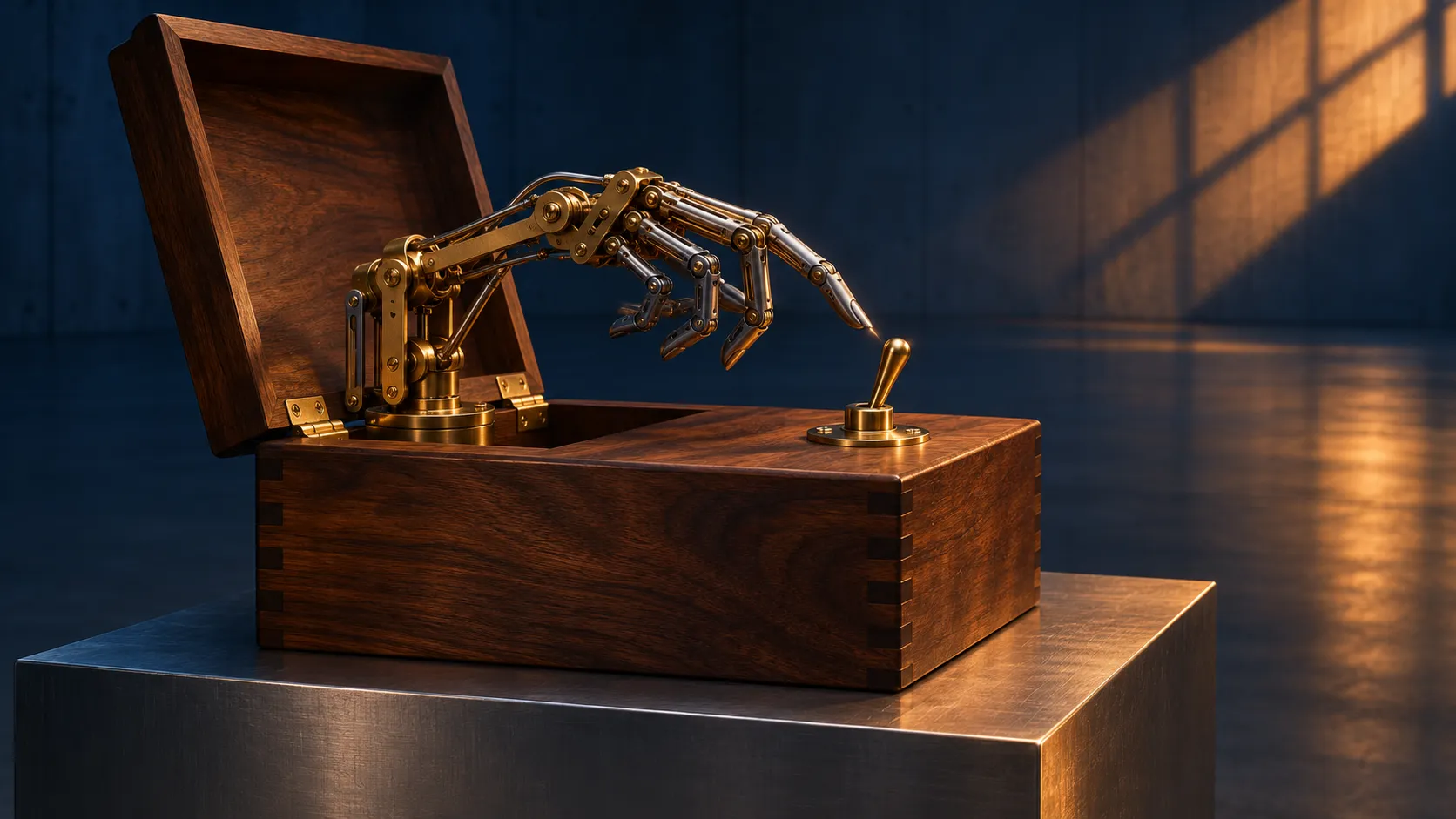
The box began to make a noise. Its lid opened. A little mechanical hand emerged, reached toward the switch, and flicked it back to OFF.
Then the hand disappeared, the lid closed, and everything became quiet again.
You had accomplished absolutely nothing.
Worse, the machine seemed rather pleased about it.
There was no complicated task to complete, no information to process, no object to manufacture. The machine existed for the sole purpose of reversing your decision to operate it.
This was the Ultimate Machine, a delightful contraption associated with Claude Shannon, one of the people whose work helped make our digital world possible.
It was also, in a very particular sense, the least cooperative machine imaginable.
And people loved it.
1. A Small Box With a Disagreeable Personality
Most machines have an understood relationship with their operators.
You press a button and the elevator comes. You turn a handle and a window opens. You select a program and the washing machine attempts to persuade your clothes to become cleaner.
The arrangement is straightforward. You request an action. The machine performs it.
The Ultimate Machine introduced a slight disagreement.
You turned it on.
It turned itself off.
The interaction was technically successful. Every component had performed exactly as intended. The switch worked. The mechanism worked. The machine responded to your input. Nothing was broken.
Yet the experience was difficult to distinguish from being rejected by a box.
That distinction is what makes it funny.
A malfunctioning toaster is merely annoying. A toaster carefully engineered to eject your bread before you put it in would suggest a more interesting problem.
Someone had designed this refusal.
The machine wasn't confused about your intentions. It wasn't struggling to perform a difficult task. It wasn't awaiting further instructions.
It had received an entirely understandable request and responded by cancelling it.
The effect depends on timing.
If the box switched itself off instantly, it might resemble a faulty electrical connection. If the hand took too long to appear, the surprise might collapse into impatience.
Instead, the machine creates a tiny drama.
First comes the switch. Then a sound. Then the opening lid.
Something is approaching.
Something is going to happen.
A hand appears.
For a moment, the box seems to possess an occupant.
Then the hand performs the least ambitious act possible, and the performance is over.
The machine has taken the familiar grammar of mechanical assistance—switch, movement, result—and rearranged it into a joke.
There is no punchline written anywhere on the box.
You supply it yourself, usually by reaching for the switch again.
2. An Unusual Idea at Bell Labs
The history of this machine belongs to an unusual corner of twentieth-century technology.
In the summer of 1952, Marvin Minsky worked with Claude Shannon at Bell Telephone Laboratories. Minsky later recalled proposing the idea of a machine that would undo the action of switching it on. Shannon liked the concept, and versions of the device were subsequently constructed.
The distinction matters. The Ultimate Machine is frequently described as Shannon's invention, but Minsky's contribution to the idea should not disappear from the story.
Shannon was already an extraordinary figure in the history of engineering.
In 1948, he published A Mathematical Theory of Communication, a paper that helped establish the foundations of modern information theory.
At its heart was a radical simplification: information could be studied mathematically, independently of the particular meaning a message happened to carry.
This helped establish the principles behind the efficient transmission and storage of digital information.
Shannon also had a rather less formal relationship with machinery.
He liked to build things.
His inventive experiments included mechanical puzzles, unusual unicycles, chess-related devices, and a robotic mouse designed to find its way through a maze.
His scientific career was full of serious questions. His workshop, apparently, was also a place where a question could be pursued simply because it was entertaining.
The Ultimate Machine sat somewhere between those worlds.
It was a functioning electromechanical device, constructed with genuine ingenuity, whose practical achievement was to ensure that it stopped functioning.
The joke was not that the engineers lacked the ability to build anything useful.
Quite the opposite.
These were people who understood switches, circuits, machines, and computation exceptionally well. They understood them well enough to play with the expectations attached to them.
A person unfamiliar with machinery might imagine a box that refuses to cooperate.
An engineer could build one.
That is a considerable difference.
The device eventually caught the attention of Arthur C. Clarke, the science-fiction writer and technology commentator.
In a description published in 1958, Clarke recalled seeing the machine on Shannon's desk at Bell Labs. He found the spectacle funny, but also strangely unsettling.
His account dwelled on the deliberate movement of the little hand and the final silence after the lid shut.
He used the phrase unspeakably sinister.
It seems an extravagant description for an object whose main accomplishment is switching off.
Until you imagine encountering it without any explanation.
A mechanical hand emerges from a box and immediately rejects the only thing you have asked it to do.
One can understand why the device stayed in his memory.
3. The Most Successful Failure Ever Designed
There is something deeply satisfying about a machine that succeeds by failing to remain switched on.
Ordinarily, we measure machines against the purposes assigned to them.
A clock should keep time.
A refrigerator should stay cold.
A navigation system should know where it is sending you, preferably before you reach the sea.
The Ultimate Machine turns that relationship inside out.
Its purpose is to eliminate the condition that makes it active.
The moment it finishes its job, it must become inactive.
Success and shutdown are the same event.
This is an elegant design constraint, although perhaps not one likely to impress a product development committee.
Imagine the engineering brief.
Objective: Build a machine that turns itself off whenever someone turns it on.
Success condition: The machine is off.
Secondary success condition: The person who turned it on is mildly offended.
Future improvements: None required.
The comedy becomes even more precise when you consider what would count as a defect.
Suppose the lid opens, the hand emerges, but the switch remains on.
The machine has failed.
Suppose the mechanism jams before the hand appears.
Also a failure.
Suppose the box refuses to switch on in the first place.
That might seem philosophically appropriate, but it would ruin the trick. Without your initial action, the machine has nothing to contradict.
For the machine to behave uselessly, it must first operate with admirable precision.
It needs a dependable mechanism and a perfectly clear sequence of events.
A poor-quality Ultimate Machine would simply be a broken box.
A good one behaves like a broken relationship.
You make the first move. The other party withdraws.
You try again.
They withdraw again.
It is possible to imagine spending several minutes repeating this exchange, despite knowing exactly how it will end.
That is another of the machine's peculiar achievements.
Although it accomplishes nothing beyond its own shutdown, it can remain entertaining through repetition.
Its behavior never changes.
Our response somehow does.
The first activation is surprise.
The second is confirmation.
The third is a challenge, though there is nothing to challenge.
By the fourth, the operator may have begun to suspect that the box has won.
4. A Clever Mechanism Is Not a Thinking Machine
The Ultimate Machine invites a tempting misunderstanding.
Because it appears to reject a human request, it is easy to describe it as stubborn, antisocial, independent, or even intelligent.
It is none of those things in any demonstrated technical sense.
The effect does not require the device to understand what a person wants. A simple mechanism can detect or respond to a switch being activated, perform a predetermined sequence, and return the switch to its original position.
There is no need for resentment.
There is no need for self-awareness.
There is certainly no evidence that the machine has developed an objection to being disturbed.
Its apparent personality arises from the way we interpret its behavior.
We are used to understanding purposeful movement through human actions.
A hand reaches toward an object.
We assume somebody intends something.
The hand changes a switch.
We recognize a decision.
The hand retreats.
We read the withdrawal as a refusal.
In the Ultimate Machine, those movements are mechanically arranged. The operator supplies the intention that makes them seem personal.
It is a small lesson in how easily we can give character to an object.
That doesn't make the character meaningless.
A cartoon drawing can communicate embarrassment without containing a real person. A puppet can appear impatient without experiencing impatience. A door that swings shut immediately after someone enters can look as though it has made up its mind.
The Ultimate Machine belongs to this family of theatrical objects.
It is a performance constructed from engineering.
And its connection to Shannon and Minsky makes it particularly interesting.
Both men were involved in a period when questions about intelligent behavior, computation, and machines were becoming increasingly important.
In 1955, Shannon and Minsky were among the four authors of a proposal for the Dartmouth summer research project on artificial intelligence, held the following year.
The Ultimate Machine was not itself a demonstration of artificial intelligence.
But it sat close to an intellectual world increasingly interested in what machines could do and how their behavior might be interpreted.
The little hand made no claim to intelligence.
People did the interpreting.
That may be why the joke survives so easily.
We do not need to believe the machine is alive to experience it as disagreeable.
We only need to recognize its action as something that, if performed by another person, would be unmistakably rude.
5. A Product Meeting That Would Not Go Well
The modern world has become exceptionally good at explaining why machines are useful.
A new device promises to simplify a task.
A new application promises to organize a task.
An update promises to improve the application that organized the task.
A subscription promises to unlock the advanced features that allow us to perform the task more efficiently than we did before the application existed.
Sometimes all of these promises are justified.
Sometimes the task has become organizing the applications.
The Ultimate Machine would have difficulty entering this market.
Its promotional presentation could be remarkably short.
It has one button.
It responds immediately.
It automatically returns to its original state.
No account is necessary.
No updates are planned.
There are no premium features.
And, most impressively, its entire interface can be understood by someone who has never read a user agreement.
The difficulty is that it cannot improve your productivity.
It cannot optimize your morning.
It cannot manage your calendar, summarize your documents, predict your purchasing decisions, or recommend a healthier relationship with your refrigerator.
It is unwilling to participate.
In another sense, however, the device is unusually honest.
Its interface makes a promise, and its mechanism keeps that promise.
There is no mystery about what happens after you touch the switch. There is no hidden process designed to prolong your engagement.
If you are still using the machine ten minutes later, the responsibility is entirely yours.
This is not an argument against useful technology. A functioning dishwasher deserves more gratitude than a box that refuses to remain on.
The comparison is interesting because the Ultimate Machine removes nearly everything we normally associate with technological ambition.
It is not faster than a previous model.
It does not produce a superior result.
It does not improve an existing workflow.
Instead, it offers a very small experience with an unusually clear beginning and ending.
The machine is activated.
The machine disagrees.
The machine is finished.
It demands nothing further.
You may leave it alone.
Whether you actually can is another question.
6. Why We Keep Making Useless Things
The word useless sounds like a verdict.
In a workshop or factory, it usually is.
A useless tool cannot perform its intended task. A useless component takes up space without contributing anything. A useless instruction may make a straightforward process less understandable.
The Ultimate Machine complicates that definition because its intended task is precisely what appears to make it useless.
It performs successfully.
It simply produces no practical benefit beyond the experience of watching it.
But practical benefit is not the only reason human beings make objects.
A sculpture does not need to repair a roof.
A toy does not need to organize a filing cabinet.
A magic trick does not need to alter the laws of physics.
Some objects exist because their makers have discovered an interesting possibility and want to share it.
The Ultimate Machine is closer to a joke, an artwork, and a mechanical demonstration than to an ordinary household appliance.
Its mechanism matters because it makes the idea tangible.
You can describe the machine in a sentence, but the sentence is not as funny as turning the switch yourself.
A written joke can be understood immediately.
A mechanical joke makes you participate in your own embarrassment.
You become the cause of the machine's response.
That relationship is difficult to reproduce with words alone.
And there is something attractive about a complicated skill being used for a completely modest purpose.
The engineer could have built a mechanism to open a door, sort an object, or trigger an alarm.
Instead, the engineer built a mechanism to cancel a switch.
The work is serious.
The result is ridiculous.
There is a long tradition of imaginative construction in which the pleasure lies in the ingenuity rather than the utility. Puzzle boxes, kinetic sculptures, mechanical automata, and elaborate practical jokes all occupy different corners of that territory.
The Ultimate Machine fits comfortably among them, while managing to be unusually economical.
It needs neither an elaborate story nor a surprising final transformation.
The entire trick consists of a box returning to its previous condition.
What changes is the person watching.
Not necessarily in any profound way.
Perhaps they laugh.
Perhaps they try the switch again.
Perhaps they begin wondering how the little hand works.
Perhaps they decide to build a version of their own, which would be a wonderfully disproportionate response to an object that has just demonstrated its lack of usefulness.
The machine has nevertheless inspired another act of making.
That seems an interesting consequence for something designed to accomplish nothing.
7. The Last Word Belongs to the Switch
The Ultimate Machine is sometimes described as an invention that represents the final absurdity of automation.
That is one way to see it.
A machine designed to perform tasks has been given a task whose completion cancels its own operation.
Automation has reached a point where the only service left to provide is the refusal of service.
But the little box is more playful than such a grand interpretation requires.
Nobody needs to agree on an elaborate theory of technology to understand why it works.
You see a switch.
You switch it on.
The machine switches it off.
The act is immediate, precise, and faintly insulting.
More than seventy years after the idea emerged, the same sequence can still make people smile.
Perhaps this is because the machine behaves with a clarity that larger and more sophisticated systems rarely possess.
It knows exactly what it is going to do.
It does it.
Then it stops.
The box does not celebrate its success.
It does not ask whether you enjoyed the experience.
It does not offer a survey.
The lid closes, the motor falls silent, and the switch rests once again in the OFF position.
If you want anything more from it, you will have to start the argument yourself.