Articles / LORQAI
The Mountain You Can See but Never Visit
Why video games have invisible walls — and why the edge of a fictional world can be the strangest place in it.
A magnificent mountain stands just beyond your reach. There’s no fence, no cliff, and no explanation — only an invisible wall. A funny, curious exploration of why video game worlds end where they do.
By LORQAI
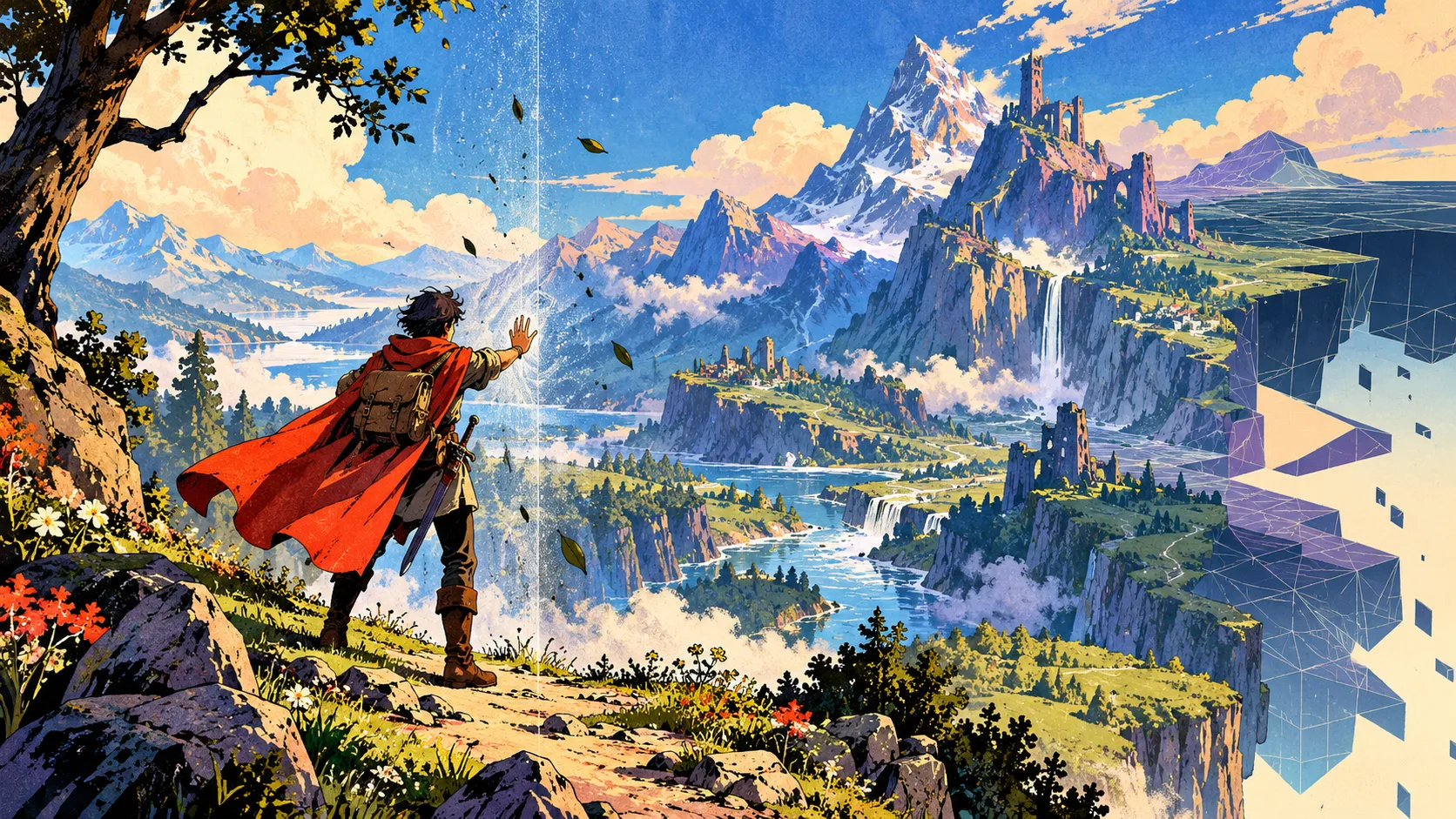
The Unreachable Mountain
The mountain is magnificent.
It rises beyond a valley of silver grass, with snow caught in the cracks of its cliffs and a ruined tower balanced on one impossible-looking ridge. A waterfall spills down its eastern face. At sunset, the entire summit turns gold. Whoever designed this place clearly wanted you to look at it.
So, naturally, you decide to go there.
You have crossed poisonous swamps, defeated creatures with more teeth than basic engineering should permit, and learned to jump from rooftops without breaking a single ankle. You are carrying a sword that glows blue when danger approaches. Reaching a modest hill does not seem like an unreasonable ambition.
You follow the river, climb a gentle slope, and approach an ordinary patch of air.
And stop.
There is nothing in front of you. No fence, no cliff, no locked gate, no stern guard who can be distracted with a wheel of cheese. Your character simply refuses to move. You try running. You try jumping. You turn sideways, because every player knows that sometimes sideways is the answer. You charge the obstruction on horseback, if the game has been generous enough to provide a horse.
The horse has the decency to look embarrassed.
Somewhere beyond the screen, an invisible wall has informed you that this is as far as civilization goes.
The mountain is still there. It is still magnificent. You just aren't allowed to visit it.
This is one of gaming's funniest contradictions. A digital world can invite us to imagine an enormous, continuous landscape while being built from carefully limited places where play is actually possible. Invisible walls are one way to maintain that illusion. They are also among the quickest ways to puncture it.
To understand why they exist, it helps to look at a video game not as a world that happens to be on a screen, but as a performance that must somehow survive an audience determined to wander backstage.
The Scenery Has No Passport
In an actual mountain range, the distant mountain does not need anyone's permission to continue existing once you reach it. It has rocks on all sides, more terrain behind it, weather above it, and a distressing number of places where a person might slip.
A mountain in a game has a different employment contract.
It may exist to make a valley feel enormous. Its shape gives you a sense of direction. Its peak catches the light at the right moment. From the path the designers expect you to walk, the mountain may look wonderfully convincing. But the far slope may have little detail. The path up may not exist. There may be no creatures, no sounds, no quests, no tested collision, and nothing interesting to do when you arrive.
That is not necessarily a flaw. It is often a sensible choice.
Game environments require labor: building terrain, creating assets, placing interactive objects, tuning navigation, checking for bugs, and making sure the player's peculiar talent for getting stuck behind furniture doesn't ruin the afternoon. Expanding a world is not only a question of drawing more land. It can mean adding more of everything that turns land into a playable place.
An invisible boundary lets designers show more than they have made traversable. It can preserve a beautiful view without requiring a playable continent behind every ridge.
Films perform a related trick. A street visible through a window may be a painted background. A grand palace might have an impressive entrance and no second-floor bedrooms. An audience watching a film accepts this arrangement because the camera has an itinerary.
Players do not.
Show a player a palace, and somebody will try to enter the kitchens. Show them a staircase, and somebody will investigate whether the banister can be climbed. Put a suspiciously large tree beside a fortress wall and the tree immediately becomes an engineering proposal.
A game designer has to account for these experiments, or decide where the experiments must end.
That is what makes the invisible wall both useful and awkward. It solves a production problem by creating a fictional problem. The artist says, “Look at that mountain.” The player replies, “Excellent. I shall go and inspect the mountain.” The game answers, “Please appreciate the mountain from your current location.”
The disagreement is perfectly reasonable on both sides.
The Most Powerful Object in the Kingdom
An invisible wall does not have to look like a wall because, mechanically, it is the rule that matters. In a three-dimensional environment, designers can define regions that block a character's movement even when no visible object appears at that location. The player encounters a collision boundary without encountering a convincing reason for one.
This can produce astonishing changes in the laws of a fictional universe.
A wooden door is vulnerable to fire, explosives, keys, or at least a sufficiently persistent quest. A dragon can be defeated. A stone fortress might be breached. Meanwhile, an empty section of meadow is absolutely indestructible.
Your character, who has recently survived being hit by a meteor, cannot walk through a gap between two flowers.
The invisible wall has no backstory. It does not explain its motives. It is immune to dialogue options. And, unlike most villains, it cannot be persuaded to reveal the location of its headquarters.
Its real offense, though, is not that it stops you. Games have to stop players all the time. Doors are locked. Bridges collapse. Storms make travel difficult. A mission can ask you to stay within a particular area. In each case, the world offers a reason that belongs to the world.
An unexplained invisible wall does something different. It turns the player's attention from the landscape to the software behind it. A moment ago you were a traveler crossing a valley. Now you are a person operating a character whose movement permissions have been revoked.
The shift can happen in a fraction of a second.
There is a special irritation when a game teaches you that an action is possible and then quietly withdraws the permission. Perhaps you have spent ten hours climbing rocks. You reach a low ledge that appears easier than everything you've climbed so far. Your character refuses it. There is no clue that the ledge is different. Only the rule has changed.
This is a problem of expectations, not merely difficulty. A hard obstacle can be an interesting challenge. An obstacle whose existence cannot be detected until you collide with it is harder to interpret. Should you search for a new tool? Is this a puzzle? Are you missing a button? Or has the world simply run out?
The most powerful object in the kingdom is sometimes a thing that isn't there, enforcing a decision nobody bothered to explain.
The Player Who Wouldn't Turn Around
Imagine a fictional player named Ellis, who finds an invisible wall at the edge of a desert.
Ellis could turn around. The central quest is in the other direction. There is a village with merchants, an ancient temple, and a character who has been standing in the rain for weeks waiting to deliver important information.
But Ellis has discovered the wall, and this changes everything.
First comes the polite test: walk forward. Then the scientific test: walk forward again, slightly to the left. Next is the athletic phase, involving jumps, rolling, and a series of maneuvers that would be regarded as alarming in a public park.
The wall holds.
Ellis travels along it, looking for the corner. After twenty minutes, the map reveals a coastline. Surely a boat can get around this nonsense. The game does provide a boat. Ellis acquires one, sails toward a distant island, and encounters a message asking for a return to the playable area.
The ocean, it turns out, has an opinion.
All of this is imaginary, but the curiosity behind it is easy to recognize. A visible edge can become a challenge in itself. Players explore because the game has trained them to notice openings, hidden routes, alternative solutions, and secrets that reward persistence. A boundary can resemble exactly the sort of thing the game has encouraged them to question.
There is also a mischievous pleasure in testing a fictional universe. In ordinary life, people are generally discouraged from discovering whether a hedge can be jumped, a roof can be reached, or a municipal fountain contains treasure. Video games allow that curiosity to become harmless experimentation.
Why wouldn't a player try the impossible route?
Sometimes it works. A clever maneuver may get a character into an unintended area. A gap in collision, an unusual jump, or an overlooked interaction can turn a forbidden corner into a discovery. Players who enjoy exploring a game's limits may find that more exciting than the official treasure chest waiting in the approved direction.
Of course, reaching the other side does not promise a secret kingdom. It may reveal unfinished geometry, an empty landscape, a building with no interior, or a fall through a place that was never meant to support a human-shaped bundle of polygons.
Ellis might cross the wall and discover that the magnificent distant city has the structural integrity of a stage backdrop. No market stalls. No streets behind the skyline. No villagers enjoying their virtual lives while the main character is away.
One can imagine Ellis taking a commemorative screenshot anyway.
Some discoveries are valuable precisely because they are disappointing in such an informative way.
A Better Way to Say No
An invisible wall is not the only way to draw the boundary of a playable world.
A cliff can mark an edge without suggesting a walkable path. A steep mountain face may make the limit feel like part of the terrain. A river too dangerous to cross, a locked city gate, or a road blocked by construction can all communicate that the traveler is not supposed to proceed.
These are not universally better solutions. Players will still attempt to climb the cliff, swim the river, and dismantle the construction site with whatever weapon is available. Once a game allows extraordinary feats, its supposedly convincing barriers must compete with those feats. An unclimbable fence is not convincing if the hero has just climbed a cathedral.
Other games are franker. Travel too far, and a warning appears. Continue, and a countdown begins. Turn back or be returned to the permitted area. The boundary may be no less artificial, but at least it is legible. Nobody spends fifteen minutes inspecting the sand for an invisible boulder.
Then there are boundaries that hardly feel like boundaries at all. A city street bends out of sight. A train carries the player to a new area. A canyon narrows into a dramatic entrance. The surrounding scenery steers attention toward the playable route. The designer has still made choices about where movement is possible, but those choices are communicated through the shape of the place.
Some of the best limits are also part of the story. A character may refuse to abandon a companion. A vehicle may not have enough fuel for the open sea. A passage may open only after an event changes the world. These choices can make restriction feel purposeful rather than arbitrary, provided the game has earned them.
And sometimes the right answer is simply to allow the player to go farther. A small patch of explorable ground beyond the expected route can be enough to reward curiosity. It need not contain an epic quest. A ruined cart, a viewpoint, or one strange object can make the world feel less like a corridor disguised as a wilderness.
None of this means every destination must be accessible. That would be an enormous and often tedious demand. A convincing game is not one where you can visit every house, enter every room, and conduct a census of every goat.
It is one where the world communicates what kind of freedom it offers.
If the game promises a tightly directed adventure, most players can accept a carefully shaped path. If it promises boundless exploration, the invitation creates a different expectation. The trick is to avoid letting the scenery promise what the rules immediately deny.
Beyond the Edge of the Painting
There is a lovely, slightly ridiculous thought hidden inside all this: every fictional world is larger in the imagination than in the machinery that displays it.
A painted road can suggest a town beyond the hill. A sound of distant bells can make a valley feel inhabited even when the village is never shown. A ship passing on the horizon can create the impression of trade routes, passengers, arguments over luggage, and a captain who has probably misplaced a map.
The player need not see any of those things for the world to feel expansive.
Indeed, showing everything may spoil some of the effect. Mystery needs places that remain unseen. A distant tower can be more intriguing before it becomes another interior full of breakable pots. A dark forest may be more convincing when its depths are suggested rather than catalogued.
The trouble begins when the game invites an action it cannot honor. A mountain meant to be admired is not necessarily a mountain meant to be climbed. But if the mountain has a gentle trail running straight toward it, the game is sending two incompatible messages: come closer, and stay away.
We are remarkably willing to participate in an illusion when it plays fair. We understand that an animated character is not alive, that a fantasy continent is not geographically complete, and that no actual tavern owner is standing behind the counter waiting for us to finish sorting inventory. The pleasure lies in choosing to treat those inventions as real for a while.
An abrupt, unexplained barrier asks us to stop choosing.
It exposes the edge of the painting without letting us see the frame, which is perhaps the least satisfying combination. The world becomes neither fully convincing fiction nor honestly presented stagecraft. It is just air that refuses to negotiate.
But there is also a generous way to see the unfinished space beyond the boundary. It is not proof that the imagined world is fraudulent. It is evidence that somebody made a world at all: artists chose the horizon, designers chose the paths, programmers chose the rules, and testers tried to catch the places where the whole arrangement might unravel.
A beautiful vista can be real as an artistic decision, even if it isn't real as walkable terrain.
We just wish the game would tell our feet.
One Last Attempt
Eventually, the sensible player returns to the quest.
The ruined tower remains on the mountain. The sunlight still moves across its stones. Far below, the valley fills with mist. From the trail, everything looks exactly as it did before the collision with nothing.
The invisible wall hasn't destroyed the landscape. It has changed the player's relationship to it. What looked like a place is now partly a promise, partly scenery, and partly a very firm editorial decision.
Ellis, our imaginary explorer, has finally accepted this. The boat is back in its harbor. The desert has been abandoned. The rain-soaked quest giver can resume waiting for a more cooperative hero.
Then Ellis notices a small wooden shed on the other side of the village.
It has a perfectly ordinary door. There is nothing grand about the building. No luminous mountain, no mysterious ruins, no sign that it contains the world's greatest secret. Perhaps there is a broom inside. Perhaps there is nothing at all.
Ellis walks over and tries the handle.
The door does not open.
There is no interaction prompt.
Ellis circles the shed once, checks the roof, and climbs onto a nearby barrel.
Somewhere, a game designer feels an inexplicable chill.