Articles / LORQAI
The City That Left Its Wells Behind
Why was Gedi abandoned? On Kenya's coast, a Swahili city survived centuries of trade, built walls within walls and engineered its own water supply. Its last residents left no account of why they went. The answer may lie in the things they kept rebuilding.
A prosperous Swahili trading city stood behind coral-stone walls. Then its residents left. A deepened well, changing streets and troubled trade routes reveal what can—and cannot—be known.
The City That Left Its Wells Behind
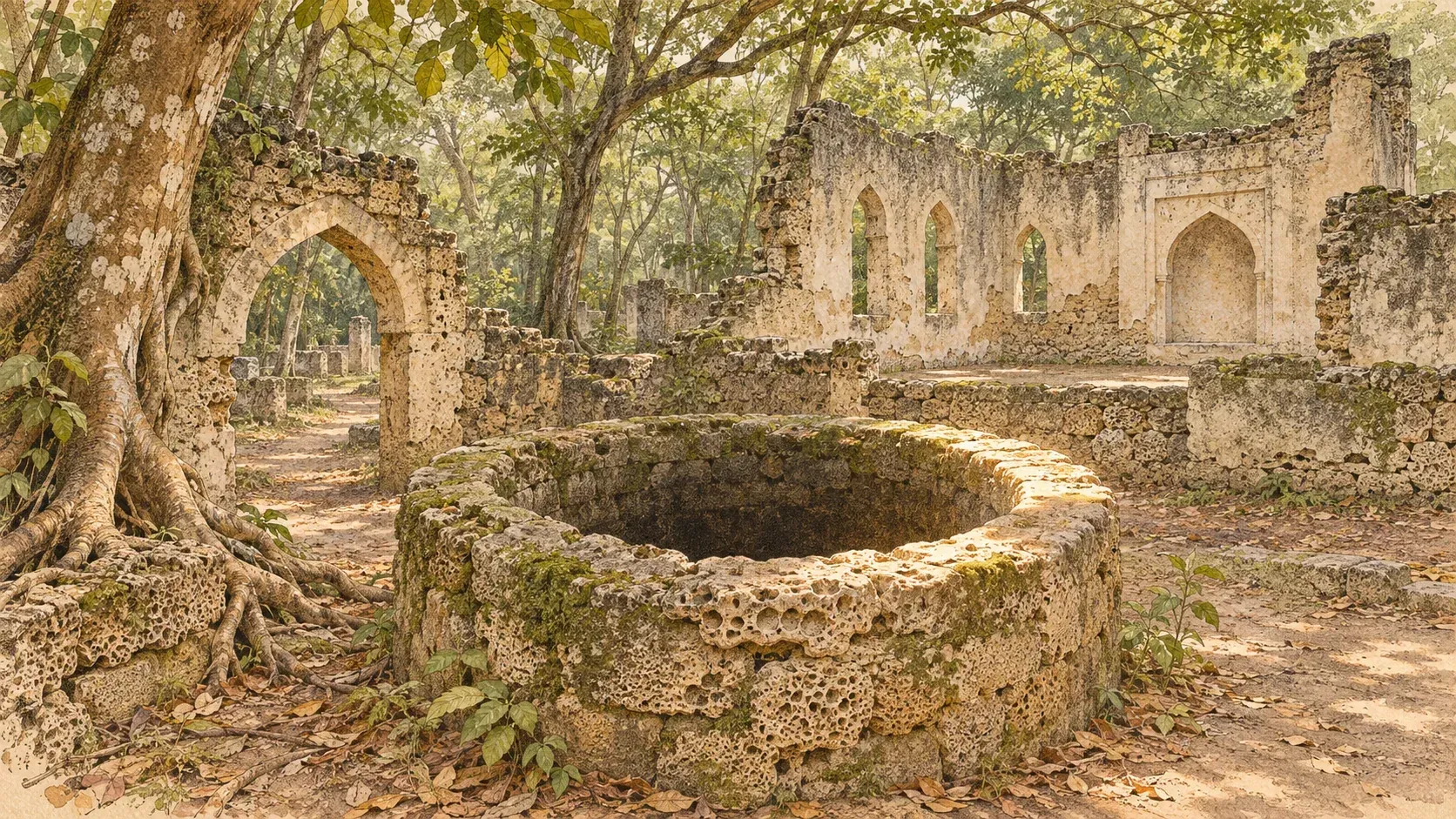
There is a well beside the Great Mosque at Gedi. It is one of the least theatrical clues in a place that seems designed for mysteries.
Forest roots thread around the remains of coral-stone buildings. Doorways open into houses without roofs. A palace, mosques and the outlines of streets remain, but the households that once animated them are gone. The town stands several kilometres from the Indian Ocean, inside the coastal forest near Watamu, Kenya.
The well is not merely picturesque. Archaeologists have pointed to evidence that it was deepened during the town's occupation. If people had to dig further down to reach water, something may have been changing beneath their feet.
Why was Gedi abandoned? The most defensible answer is that no single cause has been proved. Researchers have proposed growing difficulty obtaining fresh water, disruption of Indian Ocean trade, regional conflict and population movements. Archaeological work also suggests that occupation changed and contracted over time, making the familiar story of a prosperous city that vanished overnight misleading.
This is the unusual part of Gedi's mystery. It is not a place with no evidence. It is a place with several kinds of evidence—and none of them is a signed explanation from its last residents.
The well gives us somewhere to begin.
A city improbably far from its ships
Gedi, also spelled Gede, was a Swahili town connected to the Indian Ocean trading world. The UNESCO World Heritage Centre places its occupation broadly between the tenth and seventeenth centuries, with particular importance from the fifteenth to the seventeenth. The National Museums of Kenya dates its emergence more narrowly to the twelfth century. Those statements reflect different ways of defining the site's earliest occupation and developed urban phase; neither supplies an exact founding day.
The setting is surprising. UNESCO places the ancient settlement approximately 6.5 kilometres inland, rather than immediately on the coast like many other Swahili trading centres. Yet objects excavated here testify to connections much farther away: Chinese porcelain, Islamic ceramics and other imported goods reached its inhabitants through networks extending across the Indian Ocean.
The town's prosperity did not mean every resident lived behind the same door. Two irregular stone walls marked areas with different architecture. Inside the inner ring stood substantial stone residences, religious buildings and the palace. Between the walls, archaeological evidence points to more modest homes; beyond the monumental core, lighter building materials leave much less visible evidence today. The surviving map favours the people who could afford to build in stone.
UNESCO describes the remains as a sophisticated example of Swahili urban planning. Excavations also recovered signs of exchanges involving gold, ivory, timber and other goods. Those networks included slavery, an important part of the historical record that a romantic account of a wealthy trading city should not hide.
Standing among the ruins today, it is easy to picture an isolated kingdom overtaken by jungle. That image gets the direction of the story wrong. For centuries Gedi was connected to other people, other cities and the economies of the coast. The harder question is what happened when those connections became less reliable.
The problem beneath the mosque
The well near the Great Mosque has an unusually direct bearing on the city's decline. National Museums of Kenya identifies a falling water table, inferred from the deepening of that well, as one possible contributor to abandonment. Scholars studying water management on the Swahili coast have likewise cited it as evidence that obtaining water became more demanding.
The inference makes practical sense, but it is worth slowing down before calling it a solved case.
Deepening a well suggests that the usable water level changed or that the existing access was no longer adequate. By itself, it cannot establish the exact extent of regional drought, the condition of every well or the date at which a whole town became uninhabitable. Nor does it tell us whether changing rainfall, local geology, salinity or growing demand was the decisive pressure.
Gedi was not short of engineering ideas. Its inhabitants built wells, water-storage facilities, drainage channels and sunken courts. UNESCO specifically recognises water management among the outstanding features of the site. Archaeological work on other Swahili settlements illustrates how carefully water was integrated into urban design: a 2023 study by Monika Baumanová discusses the social and practical roles of wells, cisterns and related structures, and cites 13 wells in a seven-hectare studied portion of Gede. That figure is a scholarly comparison for a defined area, not a current inventory of every well in the World Heritage property.
Water also had roles beyond drinking. Mosques required arrangements for washing, homes needed facilities for everyday use, and roofs and streets had to withstand runoff. A city could build impressive infrastructure precisely because reliable freshwater required sustained effort.
Imagine the maintenance involved—not as a reconstructed scene with imaginary workers, but as a continuing obligation visible in the masonry. Wells must be kept usable; channels must be cleared; water supply must be adequate for people whose daily routines depend on it. A deepened shaft could be an adaptation that worked for years. It might equally be a sign that adaptation was becoming more expensive.
The distinction matters to our search question. Did Gedi run out of water? Water stress is a serious proposed explanation, but the available evidence does not establish a single moment when its last source went dry and everybody left.
An abandoned well can tell us that a problem existed. It cannot testify alone about what finally drove people away.
The city changed its shape before it disappeared
Another clue is found above the ground, in the arrangement of the walls.
A visitor might imagine the outer and inner enclosures as one fixed design. Archaeologist Stéphane Pradines offers a more complicated history. His research divides Gedi's development into successive spatial phases: an earlier settlement in the northeast, a broader fifteenth-century town, and occupation concentrated within the inner wall toward the end of the sixteenth century.
That chronology changes the emotional meaning of the ruins. The city did not simply remain at its maximum size until a single disastrous afternoon. Its urban centre moved; new walls and buildings altered what counted as the heart of the settlement. Some areas were occupied differently at different times.
A shrinking or rearranged town is not proof of famine, invasion or financial collapse. People rebuild cities for many reasons, including changing political authority, trade, defensive needs and religious life. Pradines also questions an overly simple division of Gedi into wealthy stone-house residents and everyone else, emphasising more complicated changes in the city's layout.
Still, the archaeological sequence sets a limit on the most dramatic version of the story. If habitation shifted across generations, then the headline a city vanished overnight is not a safe description of what researchers have demonstrated.
Other historical accounts describe a decline, some reoccupation and eventual abandonment in the early seventeenth century. Timelines differ because the evidence distinguishes phases of activity more readily than it identifies the last night a household was occupied.
The ruins record a series of decisions to build, move, reinforce and sometimes stop using a place. They do not record the reasons for every decision.
This leaves an intriguing possibility: the departure people now call a mystery may have been the final stage of a longer adjustment, rather than the beginning of a disaster.
The trade routes that could not be defended by walls
A well can become harder to use. A commercial route can become harder to trust.
Gedi belonged to a world of Swahili towns whose prosperity depended on exchange across the coast and the Indian Ocean. From the late fifteenth century, Portuguese fleets and armed commercial interventions changed political and trading conditions in the region. The National Museums of Kenya lists major upheavals near the end of the sixteenth century among factors thought to have affected Gedi: a Wazimba raid along the coast in 1589 and the relocation of Malindi's sheikh and Portuguese interests to Mombasa in 1593.
The wording is important. These are historically situated regional events and hypotheses about their influence on Gedi. They are not proof that the Wazimba destroyed the site in 1589 or that a particular Portuguese decree closed every merchant's stall there.
A town need not be attacked directly to suffer from turmoil along its supply routes. Merchants can choose different ports. The cost of bringing goods inland can change. A regional authority can shift its attention elsewhere. Political instability can make a formerly convenient meeting point less attractive.
This is a plausible mechanism, not a completed ledger of lost income. The excavated porcelain tells us imported goods arrived at Gedi during its life. It does not tell us how many transactions failed in its final decades. Walls can mark property, power and protection; they cannot guarantee the continuation of trade.
Some popular explanations treat the arrival of Europeans as a single switch that turned off East African prosperity. That flattening ignores the complexity of Swahili cities and their earlier histories. Gedi's African residents shaped the town's architecture, urban routines and regional relationships. External trade mattered deeply, but it was not the entirety of urban life.
To understand the end, we must hold several scales in mind: a household needing water, an urban centre changing its layout, and a regional economy becoming less predictable. None can be substituted for the others.
The names in old explanations—and what they conceal
Museum accounts also refer to the approach or movement of groups historically labelled the “Galla.” This is an outdated term found in older historical writing; Oromo is the appropriate contemporary name for the people often meant by it.
That clarification is not merely etiquette. Old invasion narratives can present an entire ethnic community as a single threatening force, turning complex migrations and regional encounters into a convenient villain in a lost-city story. The fact that such an explanation appears in early accounts does not establish precisely who fought whom at Gedi, or when.
Conflict and insecurity remain possible factors. Archaeologists and historians have discussed shifting relations among coastal towns and populations from the interior. Yet a credible article should separate a proposed historical pressure from a proven final attack on Gedi.
The same discipline applies to dramatic suggestions about epidemics or a mass flight. They may be hypotheses in some discussions, but without secure local evidence they should not appear here as established events. No single documented witness records an order to evacuate. No verified last-day journal explains why the gates were closed.
This absence is sometimes marketed as though nobody had ever known Gedi existed. That would be wrong. The place remained within the memory and practices of nearby communities, and the forest around it has cultural significance. The loss of a written explanation for the historical urban centre is not the loss of all local knowledge of the landscape.
The question is not why an entire civilisation mysteriously ceased to exist. It is why one particular urban settlement ceased to function as it had.
A trial with four suspects
There is a simple way to test the popular explanations without pretending we can select a definitive culprit.
Water stress. The deepening of a well near the Great Mosque provides physical evidence consistent with water supply becoming more difficult. It supports investigation of groundwater and climate conditions. It does not prove that every household faced terminal water failure at the same time.
Trade disruption. Gedi's imported goods and regional connections are documented, and sixteenth-century maritime politics changed substantially. The mechanism is credible. The evidence available in the reviewed sources does not quantify a final commercial collapse uniquely responsible for abandonment.
Conflict and insecurity. Regional raids, political changes and population movements figure in museum explanations. They could have made the town less safe or less attractive. But a regional event should not automatically be promoted into a documented assault on Gedi itself.
A long urban contraction. Archaeological studies find changes in Gedi's spatial organisation and different phases of occupation. This strongly challenges a neat overnight-disappearance story. It does not, on its own, identify the pressures that caused residents to reorganise or leave.
The four explanations are not mutually exclusive. A loss of trade could weaken a town's ability to maintain its wells and buildings. Difficult water conditions could make commercial uncertainty harder to survive. Political insecurity might encourage relocation to a better-connected settlement. The archaeological record may preserve the combined result without recording the precise order of every cause.
This is the strongest answer we can give without inventing a verdict: Gedi's abandonment was probably multifactorial, and the relative importance of the proposed causes remains unresolved.
A search result that announces Gedi was abandoned because its wells dried up gives readers a tidy ending. It also goes further than the evidence allows.
What the forest kept—and what it hid
The forest has made Gedi one of Kenya's most memorable archaeological landscapes. Trees shelter surviving walls; animal calls now accompany spaces once organised around courtyards, streets and worship.
The same setting complicates how we read the town. Coral-stone structures remain strikingly visible. Lighter homes made of earth and plant materials are less likely to survive as standing ruins. The physical record is therefore uneven. If we use only the buildings that survived, we can mistake the wealthiest stone-built centre for the whole society.
UNESCO notes the presence of more modest residences between the walls and identifies Gedi as a sophisticated, socially differentiated settlement. That description resists the familiar fantasy of a mysterious empty palace. There was work here: hauling water, repairing buildings, preparing food, making and selling goods, maintaining sacred places, and caring for families.
A city is not only the beautiful structures that remain when its residents leave. It is the ordinary human activity those structures depended on. Archaeology can recover parts of that activity, but never all of it.
A 2025 conservation survey by heritage professionals working with the National Museums of Kenya identified current threats to the standing ruins: roots pressing into coral-stone walls, wind erosion and the growth of fungi, moss and lichens. These are observations about the care of the site now. They do not establish what caused people to leave four centuries earlier. The two problems should not be merged just because both involve the environment.
Gedi became a protected historical monument in 1927, and on 27 July 2024 UNESCO inscribed it on the World Heritage List. This is not a tentative nomination: it is an inscribed World Heritage property, recognised for its exchange of cultural influences, Swahili traditions, architecture and urban planning.
The protected property covers 20.81 hectares, with a separate 22.61-hectare buffer zone. These are modern conservation boundaries, not estimates of the precise medieval population or of every area ever occupied. The inscription recognises what survives and the importance of protecting it. It does not mean the committee discovered a final answer to the abandonment mystery.
In fact, the unusual preservation of Gedi is partly a consequence of its abandonment. Later intensive building did not overwrite the old street plan. The absence that fascinates visitors also preserved information archaeologists could study.
The last thing a well can tell us
It would be satisfying to end with a newly discovered letter, found beneath a stone, announcing why Gedi's final residents left. There is no such letter among the evidence assembled for this article.
Instead, there is a deepened well; an evolving arrangement of walls; imported objects showing far-reaching commerce; regional upheavals; and archaeological evidence that occupation shifted across the town. The explanation most consistent with that combined record is not a supernatural disappearance or one confidently dated catastrophe. It is a place facing pressures and changes over time, until the urban life it had supported could no longer continue in its old form.
Why those pressures became decisive remains open. That uncertainty is a research question, not permission to fill the gap with fiction.
The well beside the Great Mosque does not contain a confession. It contains the trace of an effort: people altered something vital because their city needed it to work.
Centuries later, the shaft remains. So do the questions. The residents are gone, but one of their attempts to stay is still visible in the stone.