Articles / LORQAI
The Library Where Books Faced the Wrong Way
Why valuable books were once chained to shelves, how readers used them, and why the pages faced out instead of the spines.
Medieval books were sometimes chained to shelves, but the strangest consequence was how they faced. Follow the ironwork of Hereford Cathedral's Chained Library to discover how readers, desks and windows shaped the architecture of knowledge.
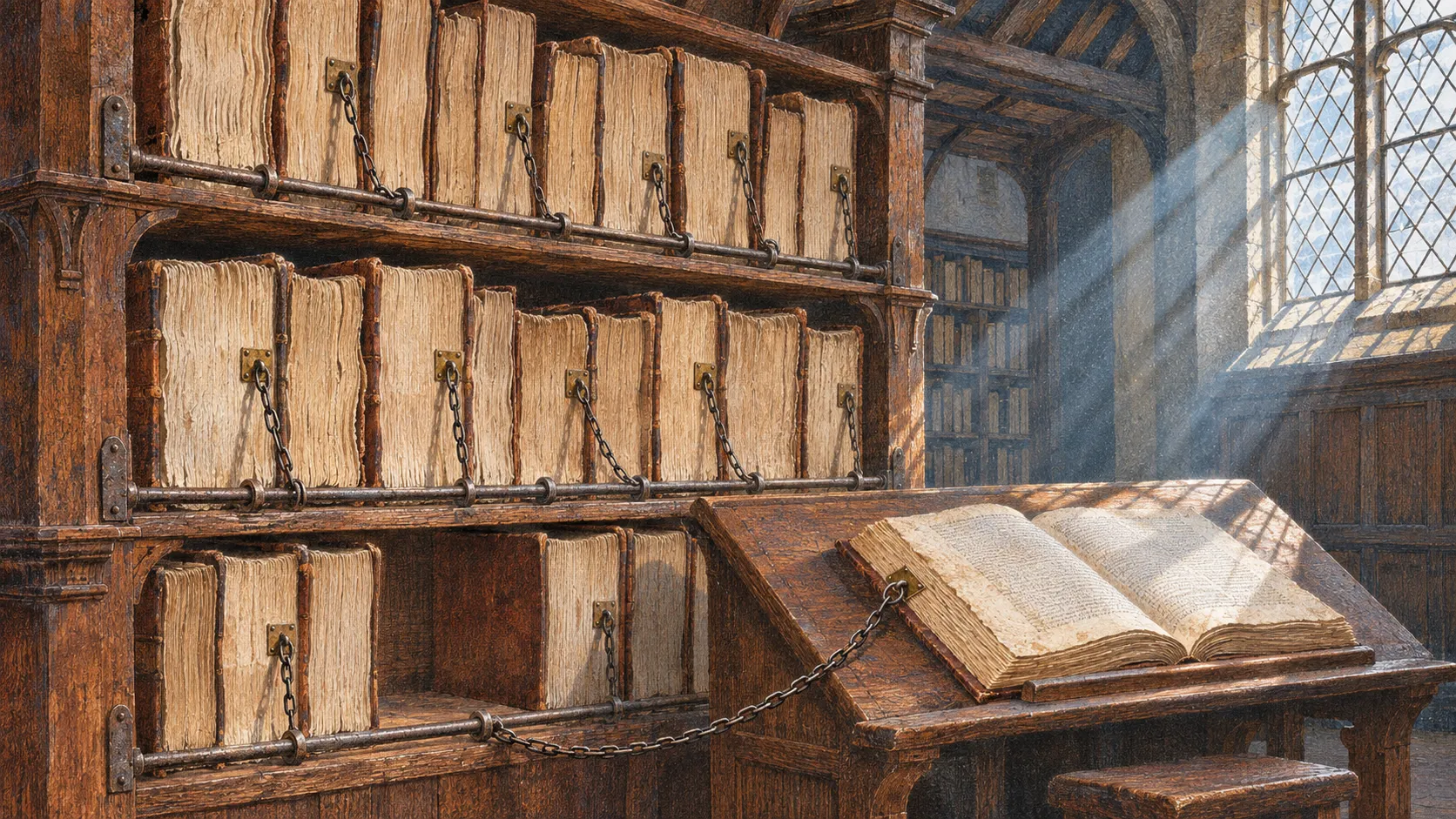
The Books Face Backward
The first thing wrong with the bookshelf is the books.
They are facing backward.
Where a modern reader expects a procession of leather spines, the shelves display the pale, irregular edges of pages. Some volumes are narrow; others are broad enough to look capable of surviving a minor collision with furniture. Metalwork hangs in front of them. Each book has a chain, and each chain leads to an iron rod.
A photograph of the Chained Library at Hereford Cathedral can make an ordinary bookshelf seem like a comparatively trusting piece of furniture.
Yet the books in Hereford's surviving arrangement were meant to be read. The chain did not hold a volume permanently shut. A reader could lift it down, bring it to the desk and open it. The difficulty began only when someone proposed taking it any farther.
This distinction matters. A chained library looks, at first, like an institution that has declared war on its readers. Its actual design presents a more interesting problem: how do you allow someone to consult an expensive, useful book without letting it disappear before the next reader arrives?
To answer that question, it helps to stop looking at the books as decorations and start looking at the entire room as a machine.
A Reference Book with an Address
Imagine needing to consult a particular passage in a book that has taken months of skilled work to produce. You do not need to own the volume. You may not even need to read all of it. You need a desk, enough light and permission to open it at the right page.
For many medieval European institutions, those requirements presented separate difficulties. Collections belonged to monasteries, cathedrals, colleges and other communities whose books served teaching, worship, study and administration. Manuscripts were copied by hand. Their materials, labor and bindings cost money, and a lost volume could be difficult to replace. Some were lavish objects; others were heavily used working books. It would be misleading to assign them all a single value.
Books also lived in different places. Some were kept in locked cupboards or rooms. Others were available for consultation on desks. As collections developed, institutions had to decide which works could move and which ought to stay where readers could find them.
By the late thirteenth century, chained reference collections were already in use in some European scholarly institutions. A book could be attached to a reading desk, allowing consultation while limiting removal. A scholar who needed an argument, a legal passage or a theological reference did not necessarily require the entire volume to travel across town.
The chain gave a physical answer to what we would now call a circulation policy. This particular copy belonged here. Its pages could travel a short distance; the book itself could not change address.
That answer was neither universal nor perfectly fair. Institutions differed in their rules and in whom they admitted. A chain tells us how a volume was secured, not who was entitled to approach it. Nor did every manuscript in a medieval collection live under iron restraint.
But for a book designated for shared reference, staying in the room had an advantage that is easy to underestimate. Tomorrow's reader had a reasonable chance of finding it there.
An Engineering Problem Made of Iron
At Hereford, the surviving mechanism is wonderfully direct. One end of a chain is fixed to the front cover of a book. The other end runs to a ring on an iron rod secured to the bookcase. The chain has enough reach for the book to be lifted onto the adjacent desk. It does not have enough reach for the book to be carried away from its case.
A lock protects the rod. Without that precaution, the library would have provided an unexpectedly convenient method for stealing several books at once: simply remove the bar and take everything attached to it.
Now consider what the arrangement demands of the furniture maker.
A chain long enough for a volume on one shelf may be hopelessly inconvenient for a volume on another. The distance to the desk determines how far each book must be able to travel. It must have room to move without dragging across the reader's work, snagging a neighboring book or twisting itself into a stubborn knot.
The historian John Willis Clark recorded variations in chain length, sliding rings, swivels and locking arrangements in older libraries. These were solutions to real mechanical problems. A swivel could help a chain turn without tangling; a ring sliding on a rod let the book move along a limited path; a lock controlled who could release a volume completely.
The whole arrangement was calculated around one ordinary action: taking a book down and reading it.
That calculation had consequences. A chain strong enough for security added weight. Fittings attached to covers could damage bindings. Moving, rearranging or replacing a book was more complicated than slipping a modern paperback between two neighbors. Someone might need to unlock a rod and shift other chains before the right volume could be freed.
The system protected an object by making its movements predictable. It also gave the librarian a substantial amount of ironwork to manage.
Still, there is a certain elegance to the design. No reader had to submit a request each time a page was turned. The book could be handled within a defined working area. The furniture enforced the boundary quietly, without having to interrupt the act of reading.
Except, perhaps, when the reader tried to turn the book around.
The Backward Shelf
Take a volume from an ordinary bookshelf. Its spine faces the room. Your hand grips the book, pulls it outward and usually turns it before placing it on a table.
Now attach a chain near the front cover and connect its other end to a fixed rod.
That casual half-turn becomes a nuisance. The chain must follow the rotation of the book. Depending on where the metal lies, it may twist, pull against the binding or become involved with another chain. A simple movement has become unnecessarily complicated.
Hereford's solution was to reverse the usual view. The books stand with their *fore-edges* facing the reader. The fore-edge is the exposed side of the page block opposite the spine. With that side facing outward, a book can be lifted from its place and opened on the reading desk without first being turned around.
From the perspective of the ironwork, the arrangement is entirely sensible.
This is why the familiar description of old libraries having their books 'backward' needs a qualification. They are backward relative to the way most of us now shelve books. For the people designing a chained reading room, putting the fore-edge outward made the mechanism work better.
The appearance also reminds us that today's spine-out convention was not always dominant. Across the history of book storage, volumes were stacked, laid on their sides, stood upright and arranged in various directions. When page edges were visible, they sometimes acquired identifying marks: a title, a writer's name or a shelf reference written directly on the exposed paper or parchment.
So the book's outer edge could do a job that a printed spine label usually does now. In some early collections it was useful even without chains. The evolution toward routine spine-out shelving was gradual, and there was no single day when librarians across Europe agreed to turn every book around.
Look again at the Hereford shelves. What first appears to be bad organization is actually the visible trace of a decision about how an object should move. The place to grip the book, the location of the desk and the route of the chain have all influenced what the visitor sees.
A modern shop could certainly display its stock like this, although the customers might be surprised to discover that the books came with a prescribed radius of travel.
The Window Was Part of the System
A chain limits a book's movement. Once you have done that, you must pay closer attention to the place where the reader sits.
In medieval and early modern reading rooms, daylight was a practical resource. You could not pick up a large chained volume and casually carry it to whichever corner offered the best illumination. The desk had to be positioned where the book could be used.
University of Chicago Library's account of medieval library architecture describes chained reference desks placed close to windows, commonly at right angles to an exterior wall. John Willis Clark also documented long rooms with desks and benches arranged in relation to repeated windows. A room designed this way did not merely contain books; it organized the work of reading around available light.
The difference matters when we look at historic library furniture. Heavy wooden shelving can seem almost ceremonial to a modern visitor. It invites photographs. But a desk was not there solely to make the room look scholarly. A person had to support a substantial volume, keep it open, follow the text and perhaps compare passages or make notes.
The relationship between window, desk and shelf constrained the entire arrangement. Put the books too far from the desk and the chains become impractical. Put the desk in a dark position and the volume becomes harder to consult. Crowd too many readers into one area and the convenience of a secured common collection begins to dissolve.
There were several historical solutions: books could be attached directly to reading desks, or housed in shelves beside them. Their precise layouts varied by institution and period. A medieval lectern system should not be confused with the surviving seventeenth-century furniture at Hereford simply because both made use of chains.
But the design question was similar. How do you arrange a room around books that cannot go very far?
Sometimes the answer worked elegantly. Sometimes the readers themselves became the problem.
The Student Who Occupied Four Books
In 1444, the University of Oxford appealed to Humphrey, Duke of Gloucester, for help with a new library. The crowded conditions of the existing one were part of the complaint.
John Willis Clark, writing about historical library fittings, preserves a particularly revealing detail: when one student studied a chained volume, the close arrangement could keep three or four other books out of reach for everyone else.
Imagine the irritation. You have come to consult a specific text. The volume you need is physically present. You can see approximately where it belongs. But someone has been reading the book beside it for an hour, and the chains and desks have effectively turned several works into one person's private territory.
The library has not lost the book. It has merely made it temporarily unusable.
This is a much more interesting failure than theft. The same design that made a reference work reliably available in the long term could restrict access at the exact moment someone needed it. An institution could protect every volume and still leave its readers waiting.
As books multiplied, the difficulty became harder to ignore. Lecterns occupied space, readers needed room to work, and closely chained volumes were awkward to consult simultaneously. Historical library design gradually developed alternative arrangements for storing more books and accommodating more people.
It would be an exaggeration to say that one complaint in Oxford changed every library. The development was neither instantaneous nor uniform. Yet the complaint exposes the central trade-off of the whole system in a few sharply practical terms.
Preservation and access were not opposing teams with permanent uniforms. They were two requirements competing for the same desk.
A successful library had to keep the books safe and make them usable. A chain could help with the first requirement and, under certain circumstances, obstruct the second.
The Books That Were Allowed to Leave
There is another complication to the image of the chained library: some institutions kept books that could be borrowed as well as books that could not.
The medieval Sorbonne in Paris offers a useful example. Its collections included a *magna libraria*, a major chained reference library, and a *parva libraria*, a smaller collection associated with lending. The division was not a modern public-library service. It operated within the rules of a scholarly institution, and access depended on membership and regulations. Nevertheless, the contrast is unmistakable.
Some books were assigned a permanent place for shared consultation. Others could circulate under conditions.
The distinction was not simply between good books and bad books, or between texts that authorities wanted read and texts they wanted hidden. Copies mattered. Frequency of use mattered. The need for common reference mattered. A volume particularly useful to several scholars could be more valuable on a desk where all of them might find it than in the room of whoever borrowed it first.
In *The Destruction of Medieval Manuscripts in England* (2025), historian Krista A. Milne also describes religious institutions with separate reference and lending collections. Chaining was one technique among several, and it brought disadvantages: metalwork cost money, comparing volumes could be awkward and an attached book could not be lent out in the ordinary way.
It is tempting to apply a simple moral to historical security measures. Chains look repressive; free shelves look enlightened. Actual library practice was more complicated. A chained book could be more accessible to on-site scholars than a theoretically borrowable book that had been absent for months.
Conversely, keeping a reference text in one building did little for someone who was never admitted to the building in the first place. The chain solved a property problem. It did not resolve questions about education, social privilege or institutional authority.
The surprising feature is that librarians were already making distinctions we still recognize: reference collection, lending collection, restricted material, shared workspace. The names and the rules have changed. The problem of deciding where an important book belongs has not entirely disappeared.
A Seventeenth-Century Library with Much Older Books
Hereford is an unusually good place to understand the arrangement because so much of its hardware survives together. The cathedral describes its chained library as the largest surviving example with its chains, rods and locks intact. Its preserved arrangement dates to the seventeenth century and represents the form the library had from 1611 to 1841.
That chronology deserves attention.
Hereford's library tradition is older than the surviving fittings. The cathedral's collection includes the eighth-century Hereford Gospels, among 229 medieval manuscripts described by the institution. The older manuscript did not begin life in a seventeenth-century bookcase, and the age of a book does not automatically tell us the age of its chain, binding or shelf.
The surviving bookcases are now displayed in a specially designed chamber in the New Library Building, where environmental conditions can be controlled. The collection can be seen in its historic arrangement without pretending that nothing has happened to the building, the books or their conservation since 1611.
This is an important difference between a historical object and a historical scene. Old books remain in a reconstructed arrangement of original fittings, cared for under modern conditions. Their survival provides evidence about how a particular system worked; it does not give us a licence to invent what an individual reader said, thought or did on a particular afternoon.
Nor should the scene be used to claim that every medieval library looked like Hereford. Chaining took different forms, from volumes fastened to desks to books held on shelving rods. Other libraries used different storage methods. Some survived with traces of hardware rather than complete chains. Hereford's importance lies in the unusually coherent mechanism, not in being a universal model for centuries of reading.
And the presence of printed books in chained collections is a useful reminder that the practice did not vanish the moment European printing expanded. Books became more plentiful over time, but value, institutional habits and patterns of access changed at different speeds. The chains stayed in some places long after many volumes ceased to be handwritten.
What the Bookshelf Was Designed to Remember
Return to the shelf and perform one last imaginary experiment.
Take away the chains but leave every volume exactly where it stands. The room would still seem peculiar. The page edges would face outward, while the spines hid toward the wood. A visitor would be tempted to correct them, turning each book around in the name of common sense.
Do that, however, and you erase the explanation of the furniture. The reversed books show where the chain needed to run. The rods reveal the limits of a reader's movement. The desk identifies the distance the volume was intended to travel. The windows help explain where that desk belonged.
Together, these details form an instruction manual written in wood, paper and iron.
That manual also records a compromise. Historical librarians wanted useful books within reach of readers, but available for the next person too. Their solution was sometimes clumsy, expensive or frustrating. It could make one scholar's work obstruct another's. It did nothing by itself to determine who was welcome inside. Yet it preserved a shared resource by refusing to let the resource wander away.
The most curious part of the library, then, is not that somebody chained the books. Valuable objects have been secured in far less ingenious ways.
It is that the chains changed the direction of the shelves, the arrangement of the desks and, for some readers, the choreography of an entire afternoon.
The books were facing exactly the way their library needed them to face.