Music / LORQAI
A DAY WITHOUT A NAME — The First Monday Without a Schedule
A LORQAI song from OUT OF ORDER, IN TUNE, accompanied by “The First Monday Without a Schedule,” an original fictional story inspired by the track.
Listen to A DAY WITHOUT A NAME by LORQAI from OUT OF ORDER, IN TUNE, and read “The First Monday Without a Schedule,” an original fictional story inspired by the song.
Before the old route
The kettle clicked at seven, three minutes before the alarm.
For a moment, everything happened in the right order. I turned off the kettle, reached for the blue work shirt hanging over the kitchen chair, and put my hand into one sleeve. Only then did I remember there was nowhere I needed to wear it.
I stood in the middle of the kitchen with half an arm dressed for a day that wasn't going to happen.
My badge lay in a saucer beside the spare front-door key. I had set it there on Friday, intending to put it somewhere more sensible. I hadn't decided where that would be. For years it had belonged on a cord around my neck, or in the small pocket of my bag. Every other place seemed temporary.
On the wall, a calendar showed Monday as an empty white square. I had been looking forward to that square for weeks. In my imagination it had felt like the opening of a window.
In the kitchen, it looked like a mistake somebody had forgotten to correct.
The old route
I'd left the job on Friday. I didn't have a new one waiting and I hadn't made a holiday plan. The decision and everything that led to it were still too complicated for a sentence I could offer people at a bus stop.
I had expected to feel either released or bereft. Instead, I put on a different shirt, washed the same cup twice, and went outside at eight.
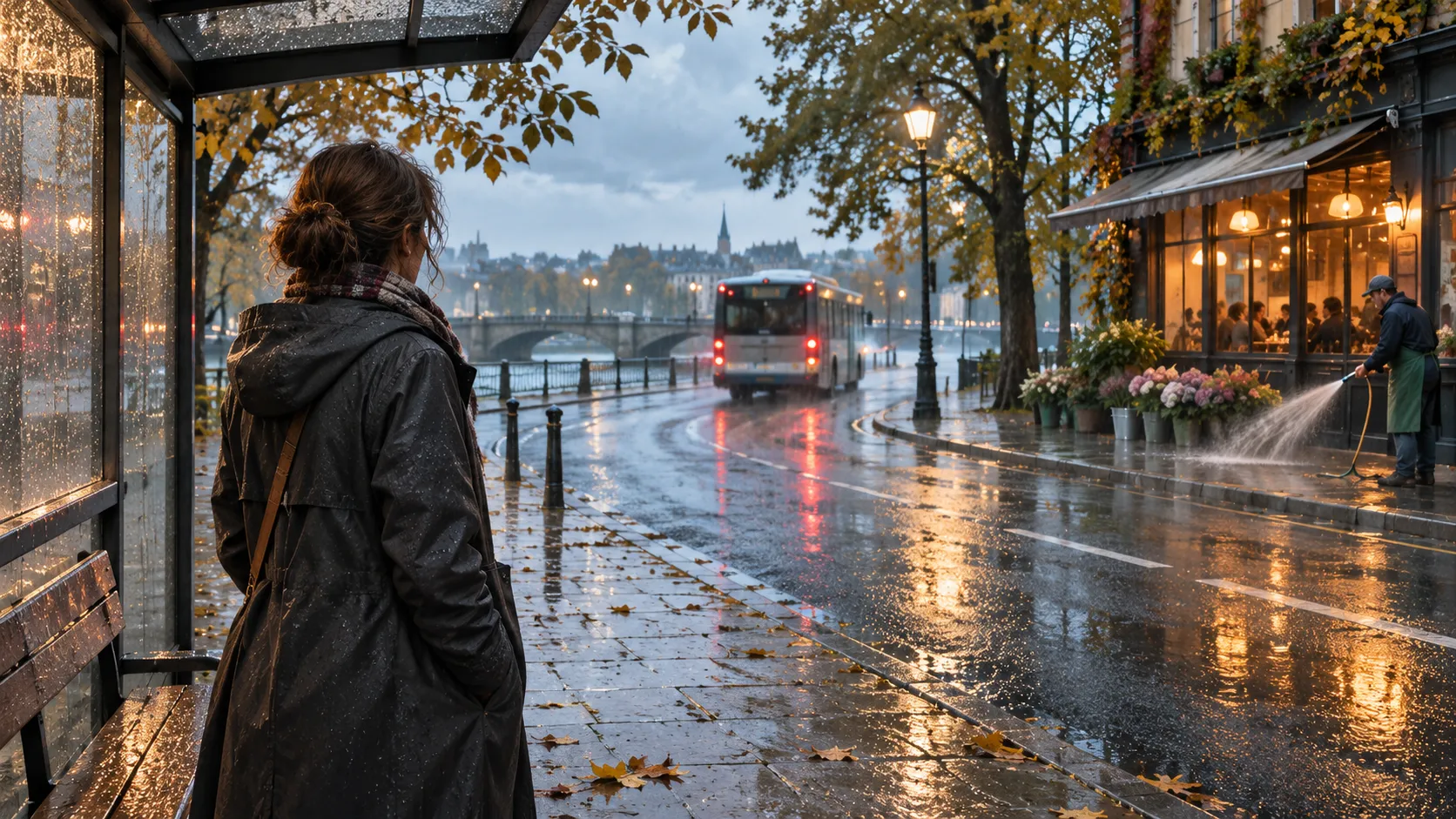
My feet chose the old route. Past the bakery shutters, past the florist who hosed down the pavement, to the shelter opposite the river road. Rain rested on the timetable behind its scratched plastic cover. I had waited there in every season, carrying wet gloves in winter and a paper cup in summer, sometimes drafting messages in my head before I'd even reached the office.
The bus arrived with its familiar tired hiss. The driver glanced at me through the glass. I knew him well enough to recognize his gray moustache and not well enough to know his name.
The doors folded open.
A woman with a shopping trolley climbed aboard. The driver kept the doors open another moment. He was waiting for me.
I raised my hand, not quite a wave. “Not today.”
He nodded, closed the doors, and pulled away. The bus crossed the river, carrying its passengers toward jobs, appointments, lessons, errands—every destination that could be named and entered into a calendar.
I felt no sudden rush of freedom. There was a little embarrassment, as though I had failed to do something in public. Then there was the peculiar relief of watching the bus disappear without needing to chase it.
Across the street, Mara's café was turning on its lights.
Not anymore
Mara knew my order and the speed at which I used to collect it. For years I'd appeared at her counter before work, always looking at the clock on the wall even though I wore a watch.
“Your usual?” she asked.
I nodded.
She reached for a takeaway lid, then stopped. “Are you late?”
“Not anymore.”
I had meant it as a simple answer. Mara smiled as though it were a joke I hadn't quite finished telling.
“Then you can use a real cup.”
She set it on a saucer and pointed to the corner table overlooking the street. I had never sat there. I knew its view only in pieces, from waiting behind customers who were in no hurry.
From the chair, the buses appeared twice: once in the road and once, narrower and slightly crooked, in the rain-streaked glass. A delivery cyclist balanced a parcel under his coat. Two children argued about who would press the crossing button. A man stood outside the pharmacy, reading a note he'd folded so many times it no longer lay flat.
Nobody seemed to notice that I was missing from my usual place on the bus.
I took out my phone. On the calendar, there were no meetings and no colored blocks to tell me when I was allowed to eat lunch. I could put something there. I could make a list, schedule the next three weeks, call people, choose a course to take, begin becoming someone with an answer prepared for the question What do you do?
I opened a blank note and typed Monday.
Under it, I wrote Buy milk.
Then I stared at the words. They were the only instructions I'd given myself, and they weren't urgent.
I deleted the heading but left the milk.
Ten o'clock
At ten, I looked up so sharply that Mara turned from the counter.
“What is it?” she asked.
“Nothing. Sorry.”
My body had remembered a sound that wasn't there.
At the office, the printer used to jam around ten. Not every morning, but often enough to make it part of our shared routine. The screen would flash an unhelpful message. Somebody would open the wrong compartment. A sheet of paper would emerge accordion-folded and hot.
Mira, who sat two desks away, always got there first. She had a way of laughing at the machine without making the person who needed it feel foolish. Once, while we were both kneeling beside the lower tray, she announced that the printer was applying for early retirement and we ought to respect its decision.
I laughed so hard I dropped the little plastic latch.
I had forgotten that moment until ten o'clock on a Monday when the printer could not possibly interrupt me.
There were things I didn't miss: the requests that arrived marked urgent after six, the meetings about arranging more meetings, the peculiar anxiety of being needed by five people at once. I didn't miss carrying unfinished tasks home in my head.
But I'd mistaken those things for the whole place. I'd been so busy trying to decide how I felt about leaving that I hadn't asked myself whom I would want to see on an ordinary Tuesday.
Mira knew the answer to that, though she didn't know I was asking.
I scrolled through our messages. The most recent was from Friday: a photograph of a crooked paper crown someone had left on my chair, followed by Mira's message: For when you become queen of doing absolutely nothing.
I almost replied with a joke. Instead, I put the phone down. I didn't want to hide behind one.
Save my place
By eleven-thirty the rain had thinned. Mara changed the little table near the door from breakfast things to lunch menus. I still had plenty of time, and that was beginning to feel less like an abundance than a question.
I picked up the phone again.
Lunch, if you've got a break?
The message went through before I could rewrite it as something casual. I watched the small space beneath it, already preparing an apology for interrupting her day.
The reply arrived almost at once.
I'll be there. Save my place.
There was nothing grand in those six words. She hadn't offered me a future or a plan. She had asked me to keep a chair empty.
I shifted my bag off the seat beside me.
When Mira arrived, she was damp from the rain and carrying an office folder under one arm. I recognized her from half a street away by the way she stopped to free one hand before pulling open a door. She had always insisted on opening doors properly, even when late.
“Tell me you aren't going to make a list of everything you're accomplishing with your freedom,” she said, taking the chair.
“Already did.”
“Oh no. How many items?”
“One. Milk.”
She considered that. “Ambitious.”
We ordered soup. She told me about a new printer jam and a colleague who had tried to fix it by unplugging the wrong machine. I told her about the bus driver holding the doors open for a passenger who had no intention of boarding. We laughed, and then we talked about less amusing things: the unease of leaving, the awkwardness of not knowing what came next, the fact that the job had been difficult and the people had still mattered.
Mira didn't tell me what to do with the rest of my life. I was grateful for that. She had an afternoon to get back to, and I didn't need her to pretend otherwise.
A square left blank
When she checked the time, her soup bowl was empty and my coffee had gone cold. She stood, settled the folder under her arm, and asked whether we could do this again next week.
“Even if I still haven't done anything impressive?” I asked.
“Especially then. But buy the milk.”
At the door, she lifted a hand through the glass. The buses kept crossing the river. Mara wiped down the counter. A fresh customer came in, shaking water from an umbrella.
I could have put lunch with Mira into the blank square on my calendar. I could have called the day a beginning, or a rest, or a setback, or a victory. All those names would have been a way of asking it to explain itself before it was finished.
So I left the square empty.
I picked up my bag and went out into the ordinary afternoon. There was milk to buy. Next Tuesday was still unclaimed. I had no idea what I would say when somebody asked me what I did.
But I knew who I wanted to ask to lunch.
About the Song
- Released
- Album
- OUT OF ORDER, IN TUNE