
Music / LORQAI
A SEAT FOR THE WEATHER — A Chair for a Stranger
An original short story inspired by LORQAI’s “A SEAT FOR THE WEATHER,” from the album OUT OF ORDER, IN TUNE.
An original LORQAI short story inspired by A SEAT FOR THE WEATHER: a rain-soaked stranger, a late bus, and a chair offered to someone who needs it.
Introduction
The first thing the woman brought into the café was the rain.
It came off her coat in dark drops, gathered at the toes of her shoes, and spread across the little tiles beside the door. She stood still to let the worst of it fall. The umbrella in her hand looked less like something that had protected her than something she had rescued from the storm.
The café was nearly full. Two men shared a newspaper at the counter. A woman was feeding a small child pieces of toast. At my table by the harbour window, the chair opposite me held my coat and a paper bag from the bakery.
I moved them before I knew whether the newcomer wanted to sit.
“There's room here,” I said.
She looked over as if the invitation might have been meant for someone behind her. Then she smiled, not broadly, but with the relief of a person who no longer had to stand and make decisions with wet feet.
“Are you sure?”
“It's a chair. It won't miss me.”
She came over, leaving a trail of small, honest puddles.
The second cup
I went to the harbour café on Thursdays because the buses changed drivers outside it. For ten minutes around half past two, the street filled with engines at rest and people who suddenly had nothing to do but wait. I liked watching the pause. It made the town look less certain of itself.
I usually stayed long enough for one cup of coffee and the crossword in the back of the local paper. I wasn't good at crosswords. I enjoyed the part where there were still possibilities in every empty square.
The woman placed her little bus map on the table. Rain had softened the folds, and the printed green route had run into the blue line of the harbour. She pressed it gently with both palms, making it flatter and wetter.
“The bus is late,” she said. “Or I've missed it. I can't tell.”
“They often run late.”
The waitress arrived carrying a cup on a saucer. Then, without asking me, she turned and fetched a second.
I raised my eyebrows.
“You looked as though you were expecting company,” she said.
“I wasn't.”
“You are now.”
The woman laughed. We both did, and something about the table changed. My newspaper no longer occupied the center. The cups did.
She ordered tea. I asked for a little more hot water. Outside, a gull landed on the stone rail, shook itself, and seemed offended to discover it was still raining.
We did not exchange names.
Eight spokes, then three
The woman rested her umbrella against the wall. Its canopy sagged to one side; the handle pointed up like an accusing finger.
“Do you think that can be fixed?” I asked.
“It used to have eight spokes,” she said, opening it just enough to demonstrate. “Now it has three. So perhaps, but it would be a different umbrella.”
She turned it once between her fingers, a strange black flower with most of its petals gone.
Across the road, a small dog stopped at the edge of a puddle. Its owner gave the lead a patient tug. The dog planted all four feet, refusing to cross an amount of water barely deep enough to cover a shoe sole.
The owner stepped into it first. The dog waited to see whether this would cause a disaster.
“Well,” the woman said, “at least somebody has standards.”
I laughed into my coffee. The owner scooped the dog into his arms, walked three paces, and put it down safely on the other side. The dog continued with its dignity restored.
For a few minutes we talked about the rain: the way it made bus timetables unreadable, how every umbrella in a crowded doorway seemed to choose somebody else's face, and the peculiar confidence of people who said it would clear by lunchtime.
I nearly asked where she was from. The question came to me the way questions often do when a conversation has gone pleasantly quiet and I feel required to fill the space.
But she was studying the stubborn dog through the window, and I let the silence remain.
There was no mystery to solve. She was wet, the chair was dry, and the tea was hot.
A route that had moved
She unfolded the bus map again.
“I thought I needed the harbour road,” she said, pointing to the green line. “But the stop isn't there anymore.”
“They changed it last week.”
“Of course they did.”
The new route was easy enough to describe and almost impossible to explain with the old map. The bus crossed the bridge, doubled back past the library, and stopped by a row of buildings that all looked alike in the rain.
I borrowed a pen from the waitress and turned the map over. On the blank side I drew the bridge as two parallel lines, the library as a square, and the stop as a little circle. My drawing was not accurate enough to hang on a wall. It was accurate enough to find a bus.
“Here,” I said. “Don't get off when you see the market. Wait until you've passed it.”
The woman traced the line with a fingertip.
“And the return?”
“Same side of the street, but farther down. The shelter has a crooked blue roof. You can't miss it unless they've repaired it.”
“Then I'd better go before they do.”
She folded the new map carefully, keeping my drawing on the outside. The paper made a soft sound, like a piece of clothing being put away.
“Thank you,” she said.
It was a small thing to have done. I was pleased, nevertheless, in that faintly ridiculous way one can be pleased with a tidy drawing.
The rain came harder. Neither of us moved.
The person at the door
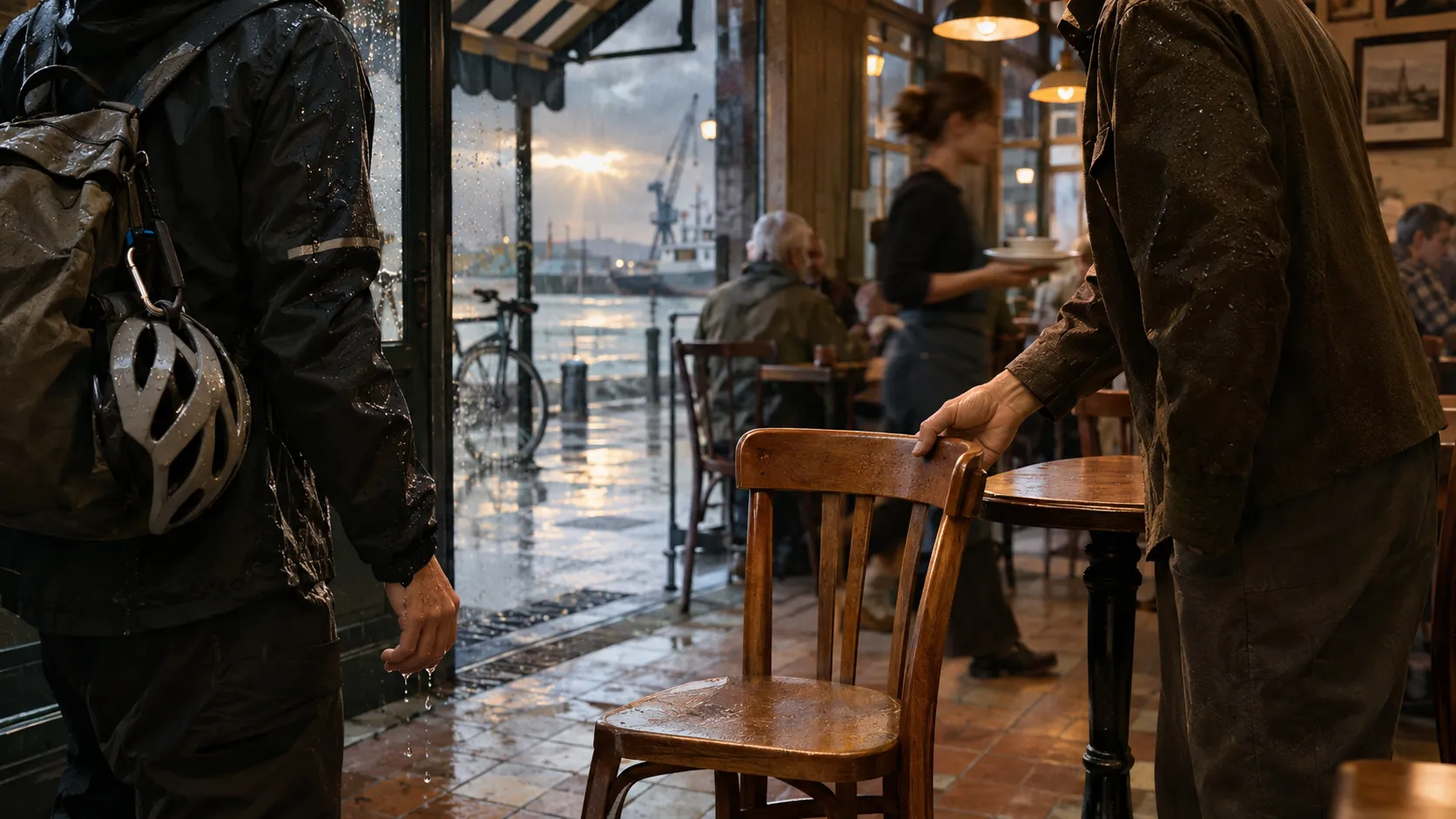
A cyclist pushed into the doorway with his bicycle still half outside. His jacket was dark with water. He had to lift the front wheel over the threshold, then pull it back again when the waitress told him there was no room for bicycles indoors.
“Sorry,” he said, breathing hard. “I just need somewhere dry for a minute.”
He leaned the bicycle beneath the awning, where its rear light kept blinking at the rain, and returned with water dripping from his sleeves.
The counter stools were occupied. The woman with the child was gathering crumbs into a napkin. One of the two men folded their newspaper without getting up.
I looked toward the little stack of spare chairs by the kitchen, calculating whether I could carry one through the narrow aisle without spilling anybody's drink.
Before I stood, the woman opposite me slid her chair backward.
“Here,” she told the cyclist. “Take this one.”
He shook his head. “I don't want to put you out.”
“You won't. I was just leaving.”
She said it so easily that I almost believed she'd planned the timing. She finished her tea, tucked the hand-drawn bus map into her coat, and gathered up the umbrella with its three remaining spokes.
The cyclist sat down slowly, as though accepting the chair involved a promise he hadn't heard the terms of.
“Are you sure?” he asked again.
“The sky is almost finished,” she told him with a smile.
Through the window, a strip of pale light had opened above the harbour cranes. It wasn't exactly sunshine yet. But the heavy rain had begun to thin, and for the first time that afternoon we could see the opposite bank clearly.
She left before I could ask her name.
For a moment I felt the odd impulse to follow her outside, to make the encounter into something larger by learning where she was going, or whether she had someone waiting for her at the other end of the bus route.
Instead I held the door while she stepped over the puddle she'd made on arrival.
She lifted the broken umbrella in a small salute and went out into the brightening street.
An unasked question
The cyclist had a helmet clipped to his bag and a narrow scrape on one knuckle. I pushed the unused saucer toward him so he would have somewhere to set his wet gloves.
“Long ride?” I asked.
“Long enough.”
He glanced toward the door. “That was kind of her.”
“Yes.”
“Do you know her?”
“No.”
He looked puzzled, then amused. The waitress returned with a towel for the floor and took his order. He wanted something hot and, after studying the menu for too long, chose the soup.
I went back to my crossword. The clue I'd been stuck on was six letters long. I could see that the third letter had to be an R, but the other squares were still blank.
I no longer minded.
He ate the soup and dried his gloves by turning them inside out. Every few minutes he glanced at the bicycle outside, making sure it was still leaning where he'd left it. We didn't have much to say. I told him the rain was moving east. He told me the bridge was slippery. I told him to be careful going back across it.
Our conversation was exactly as unremarkable as it sounds.
At four
By four o'clock the harbour glass was almost dry. The boats beyond the windows had turned from gray shapes into objects with ropes, chipped paint, and names along their sides. Sunlight reached the end of the counter and caught in the metal teaspoon the waitress was carrying.
The cyclist had gone. The chair opposite me stood slightly away from the table, as if somebody might still be on the way back.
I had finally solved the crossword clue. The answer was an ordinary word. I filled it in and folded the paper, not feeling particularly victorious.
Another stranger came through the door. This one wore a light coat that had failed at keeping out the rain and shook the water from its cuffs before approaching the counter. Every seat was taken again. I watched the person check the room and begin to turn away.
I moved the chair before they could speak.
“There's room here,” I said.
Outside, the sun crossed the wet stones by the harbour, and the day went on without requiring either of us to explain where we'd been.
About the Song
- Released
- Album
- OUT OF ORDER, IN TUNE