Music / LORQAI
ECHO OF THE HILLS: When a Voice Becomes a Landscape
An editorial reading of ECHO OF THE HILLS by LORQAI: wordless voices, imagined distance and the mysterious feeling of a sound returning changed.

A sound without a sentence
Some sounds arrive with an explanation already attached. A name, a date, a line of lyrics: each tells us what we are supposed to hear. An echo does something less certain. It brings back a sound we thought had left us, and it returns that sound changed by the space between departure and arrival. ECHO OF THE HILLS invites a listener into that interval, where recognition and mystery can exist together.
The piece uses voices without conventional words. There is no sentence to translate, no storyline to follow from one verse to the next. That absence is not a missing ingredient. It creates room for attention to move elsewhere: toward the shape of a phrase, the feeling of distance, and the moment a voice seems to belong as much to its surroundings as to the person who made it.
Two voices, an open space
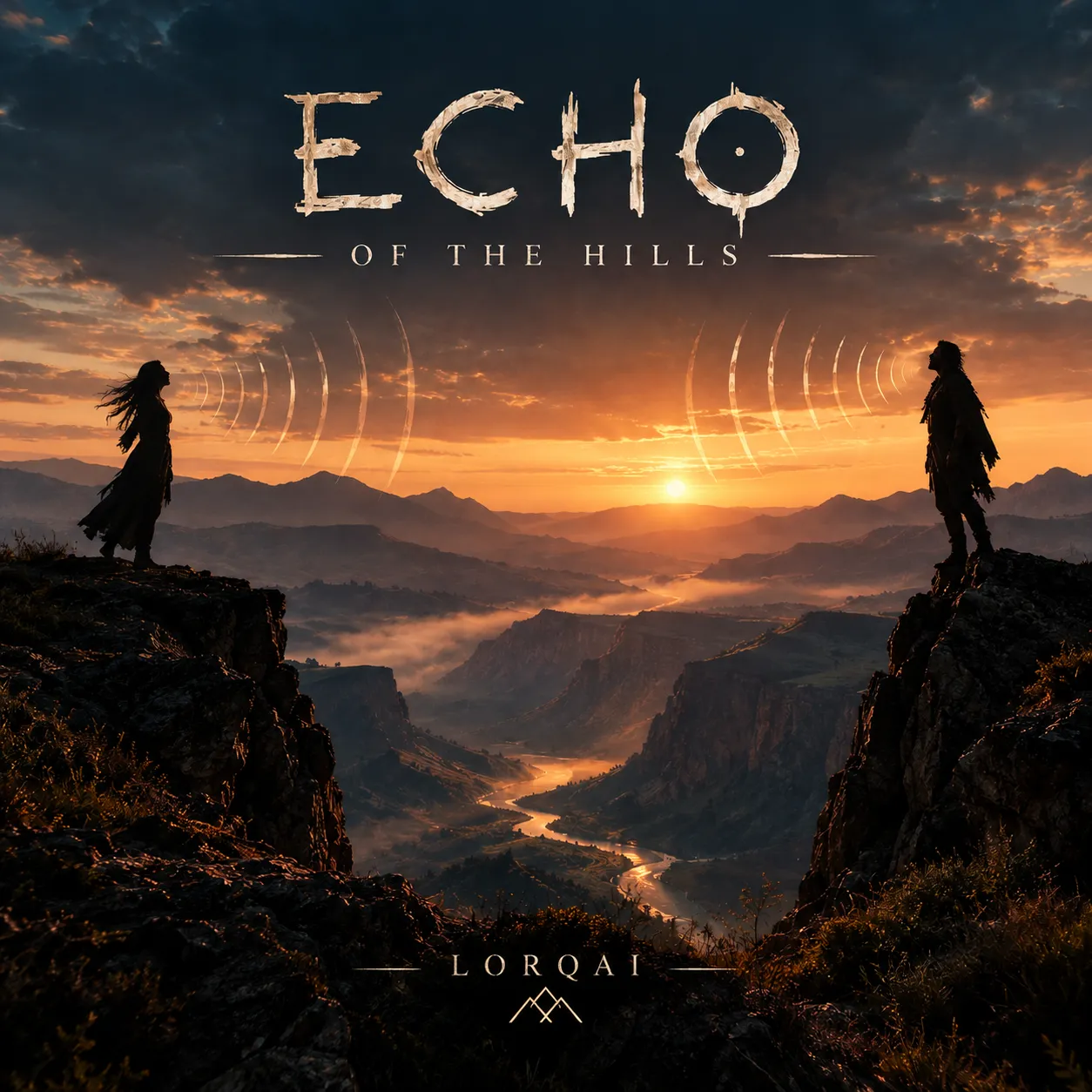
Female and male vocal sounds give the work more than one human presence. Without ordinary lyrics, they do not have to play named characters or explain a relationship. A listener might hear a call and a reply, a question that has no need of an answer, or simply two ways of occupying the same space. Those are possible readings, not a hidden plot that the music demands we uncover.
That openness changes how we listen. We may notice the breath behind a note, the edge of a sound before it settles, or the way one voice makes us newly aware of the other. What matters is not decoding an imaginary language. It is allowing expression to remain expression, even when nothing is spelled out.
Distance has a shape
The title offers hills, but it does not give us coordinates. A hill can be a physical place, of course; it can also be the distance between two people, or the space between a memory and the present moment. Thinking of an echo this way turns a landscape into a question: what returns when something has gone beyond our sight?
Often, the answer is not the original thing. A memory keeps its outline while losing details. A familiar voice can seem different after time apart. Even a song changes according to the room, the day, and the listener bringing their own history to it. In this reading, the hills are not an illustrated backdrop. They are the form that separation takes.
Echo in the mountains: when the landscape answers
Imagine calling across a mountain valley and hearing your own voice return. The sound has travelled away, reflected from the landscape, and found its way back. Yet an echo in the mountains can feel like more than a physical phenomenon. For a moment, the hills seem to answer.
ECHO OF THE HILLS by LORQAI explores a similar feeling through wordless female and male vocals. The voices leave space for the listener to imagine distance, memory, connection, or a call that finally finds its way home. Rather than describing a particular mountain landscape, the music invites us to create one in our minds.
What remains unspoken
Wordless singing can feel unusually direct because it does not ask us to agree with a statement. It invites us to respond before we have decided what the response means. The music may suggest wonder to one person and longing to another. Someone else may find a moment of calm. Those reactions do not compete for the status of a correct interpretation.
There is a quiet discipline in leaving that freedom intact. An editorial story about a song can help describe possible meanings, but it should not close them down. ECHO OF THE HILLS has a title that points outward, into space, while its vocal presence draws attention inward. Between those directions, a listener can discover a landscape of their own.
The return is yours
An echo is never just repetition. The sound comes back through a changed path, altered by distance, surroundings, and the time it took to return. That makes it a useful image for listening itself. We bring something to a piece of music; later, when we hear it again, we may find that we have changed.
ECHO OF THE HILLS does not need a fixed destination to be worth following. Let the voices pass through the space they create. Listen for what feels familiar, what remains unresolved, and what returns unexpectedly. The song leaves the last part of that journey to you.