
Music / LORQAI
I ASKED YOU — The Light We Left On
After someone leaves, an ordinary apartment continues its familiar routines. A glass, an empty chair, and a light in the hallway hold the traces of an unanswered plea.
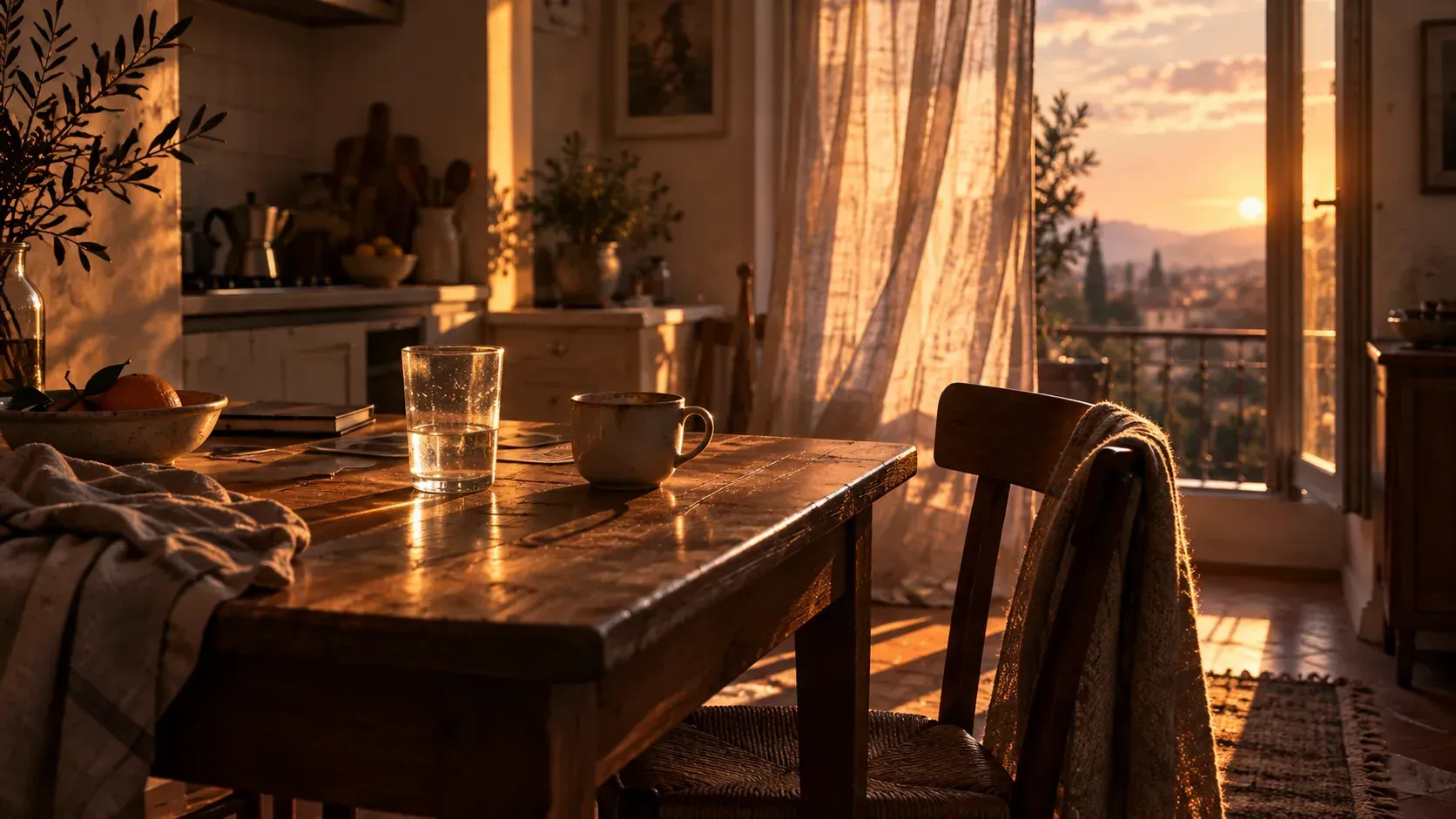
The Glass Beside the Wall
The glass stayed beside the wall for nineteen days.
I know because I counted.
It was an ordinary drinking glass, one of six we had bought years earlier because neither of us could agree on anything more interesting. Thick at the bottom, slightly cloudy from the dishwasher, with a tiny scratch near the rim.
You had left it on the small table beside the kitchen wall.
There was still a little water in it.
On the first morning, I walked past without touching it.
On the second, I noticed that the water had begun to evaporate.
By the fourth, a pale mineral ring had appeared along the inside.
I could have washed it.
There were plenty of reasons to wash it. It was dirty. It was in the way. It had no particular value.
But every morning I found another reason to leave it where it was.
There were more pressing things to do.
The refrigerator needed cleaning. The electricity bill had arrived. One of the kitchen drawers was sticking, and I had been promising to repair it for months.
Besides, there was nothing wrong with a glass sitting on a table.
The trouble with ordinary objects is that they have no understanding of what has happened around them.
The glass did not know you were gone.
Neither did the curtains, which continued to move whenever the window was open.
Neither did the refrigerator, which produced the same tired mechanical hum in the middle of the night.
The building settled around me with all its familiar noises. Pipes clicked in the walls. Someone upstairs moved furniture at unreasonable hours. A door slammed two floors below.
At half past six every morning, the heating made a sound like a small animal trapped behind the radiator.
I had complained about that sound for years.
Now I waited for it.
It was proof that something in the apartment was still operating according to schedule.
I had expected a much greater disturbance.
In films, when somebody leaves, the world has the courtesy to change its lighting. Rain begins. A train pulls away. A photograph falls from a shelf. Something breaks at exactly the right moment.
Our kitchen was not interested in cinema.
The morning after you were gone, the sun came through the window at precisely the same angle as the day before.
It illuminated the glass.
The table.
The chair.
A narrow strip of floor.
By the time the light reached the kitchen cupboard, the coffee had gone cold.
I drank it anyway.
That became another habit.
There were several things I began doing without ever deciding to do them.
The Chair
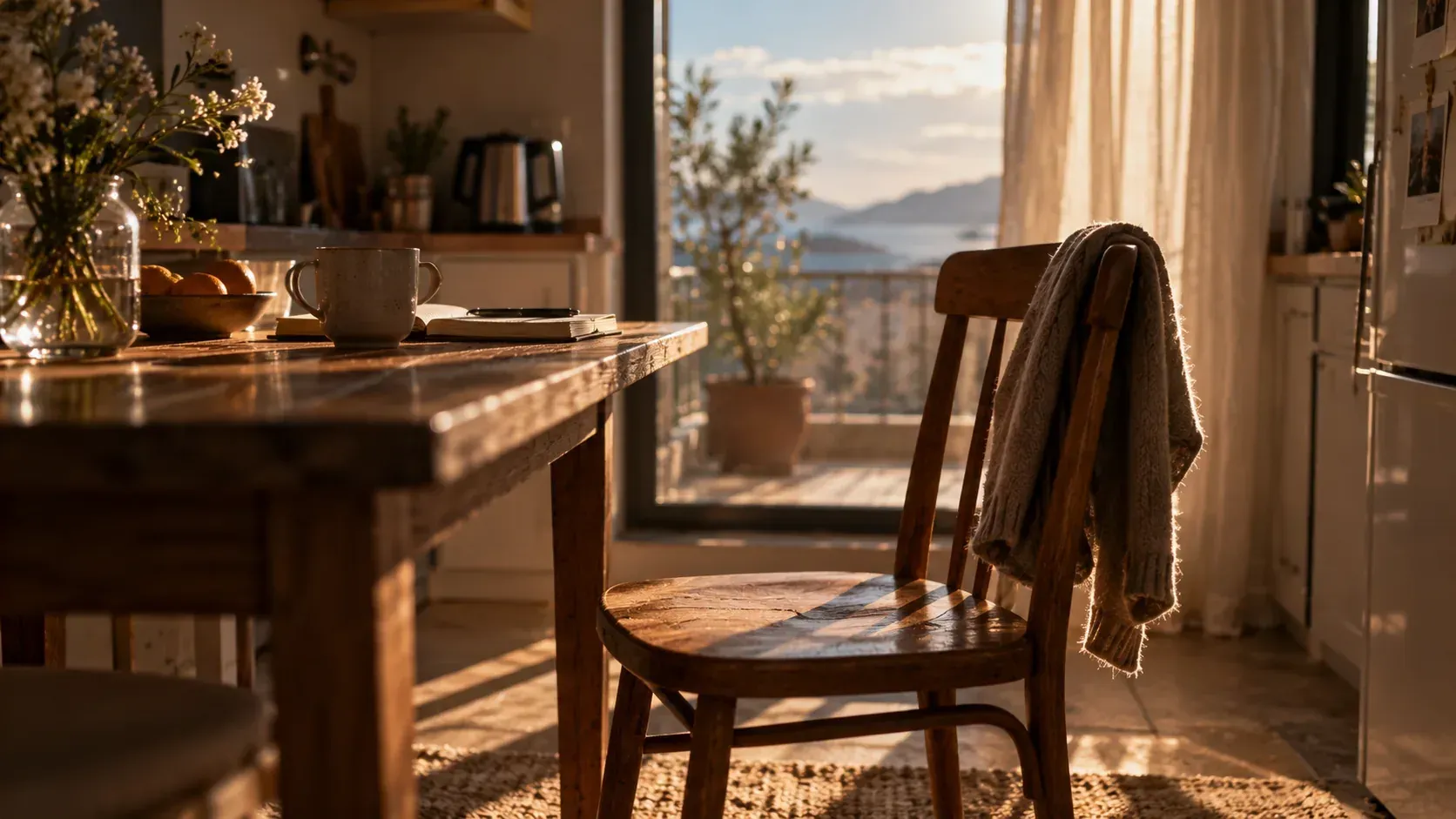
The chair was my first mistake.
I moved it back the morning after you left.
It had been standing at an awkward angle, one leg caught against the edge of the rug.
I straightened it and pushed it beneath the table.
Then I pulled it out again.
I couldn't remember exactly where it used to stand.
It was an absurd problem.
For years we had lived in the same apartment, eaten at the same table, argued over the same small domestic inconveniences. Yet I couldn't reconstruct the position of one chair.
You had a habit of sitting sideways.
One foot on the floor, the other tucked beneath you.
You said it was comfortable.
I said it would eventually destroy your knees.
You said I was beginning to sound like a particularly dull medical pamphlet.
The chair was almost never where it belonged.
I had spent years pushing it back.
Now that nobody was going to pull it out again, I couldn't remember where to put it.
I tried three positions.
In the fourth, the chair looked right.
I left it there.
That evening, returning from the supermarket, I found myself glancing toward it before I had even taken off my coat.
For a fraction of a second, I expected you to be sitting there.
I didn't actually see you.
There was no ghost, no shadow, no extraordinary sensation of your presence.
Only the familiar expectation that somebody would occupy that particular space.
The mind is an efficient creature.
It learns routines quickly and objects when they change without warning.
I had spent so many evenings entering that kitchen and finding you there that my body still anticipated the next part.
A glance.
A greeting.
A question about dinner.
Perhaps a complaint about the weather.
There were hundreds of possible conversations.
And not one of them happened.
I put the groceries away.
The refrigerator door stuck, as usual.
I ate standing beside the counter.
Later, I moved the chair again.
Just slightly.
I told myself it was because the rug needed straightening.
What I Asked
People are curious about final conversations.
They imagine that the last words exchanged between two people must somehow contain the meaning of everything that came before.
They ask what was said.
Whether anyone raised their voice.
Whether there was a goodbye.
Whether somebody knew, at the time, that the conversation would never happen again.
I have learned that people rarely ask these questions out loud.
Instead they say things like:
"Was everything all right?"
Or:
"Did you talk?"
Or, worst of all:
"At least you had a chance to say what you needed to say."
I never knew how to answer that one.
We had talked.
Of course we had.
There had been ordinary conversations, difficult conversations, conversations we postponed, and conversations we began too late in the evening.
There had been things I thought you understood.
Things you thought I understood.
There were moments when one of us was speaking and the other was already preparing a reply.
Sometimes we laughed in the middle of disagreements because we both recognized how ridiculous we sounded.
Other times neither of us laughed.
Our last conversation did not make a particularly impressive story.
No broken furniture.
No dramatic speech.
No sudden revelation that explained everything.
There was a light on in the hallway.
There were keys near the door.
At some point, I asked you something.
Then I asked again.
Perhaps the second time I believed that different words might change the answer.
Perhaps I simply hadn't accepted the first.
Eventually, asking became begging.
I remember the feeling more clearly than the sentences.
That terrible narrowing of the world, when everything seems to depend upon the next thing another person says.
I remember watching your face.
I remember how long the silence lasted.
And I remember realizing that there are questions we can ask with our whole lives and still have no right to demand an answer.
For a long time afterward, I replayed the conversation.
I imagined different words.
A calmer voice.
A better moment.
Some perfect arrangement of language in which every misunderstanding could be repaired.
I became remarkably skilled at arguing with a person who wasn't there.
In these imaginary conversations, I was eloquent.
Patient.
Wise.
I always knew when to stop speaking.
If only you had met that version of me.
The real one had stood beneath a hallway light and begged.
And then the room had gone quiet.
The Kettle
The kettle became a problem during the second week.
It was an old electric model with a loose lid and an unnecessarily theatrical whistle.
You hated it.
You said the noise was unbearable.
I said a kettle was supposed to make noise.
You said there were quieter kettles.
I said there were also quieter people, but you had chosen to live with me.
That particular joke had stopped being funny quite early in our life together.
I continued making it.
The kettle continued whistling.
We never replaced it.
On a Wednesday afternoon, I put it on and went into the hallway to find a clean towel.
The sound began while I was looking in a cupboard.
I heard it and immediately thought, That will annoy you.
Then I remembered.
The cupboard was open.
A towel hung from one hand.
The whistle grew louder.
I stood there listening until the kettle switched itself off.
It was the first time I understood how many small thoughts had been addressed to you without my knowing it.
Somebody cuts in front of you at the supermarket, and you imagine telling a person about it.
You see a ridiculous advertisement, and you begin composing a joke for them.
A television programme announces something surprising, and you turn your head before remembering there is nobody beside you.
You hear a strange noise from the refrigerator.
You discover that the shop has stopped selling a particular kind of bread.
You remember a story from years ago.
You find a sock that belongs to neither of you, which is surely one of the great unsolved mysteries of domestic life.
All these thoughts begin their journey toward another person.
Then they have nowhere to go.
I started collecting them.
Not deliberately.
They simply accumulated.
The man at the corner shop had dyed his hair.
The street outside the library was closed.
The upstairs neighbour had acquired something heavy enough to drag across the floor every night.
The kettle was still unbearable.
I knew exactly which observations would have made you laugh.
They stayed with me.
Occasionally I said them aloud.
The first time I caught myself doing it, I stopped in embarrassment.
There was nobody there to hear.
Then I wondered who I was embarrassed in front of.
The kettle clicked.
The afternoon continued.
An Ordinary Thursday
My friend Daniel came over after work.
He brought groceries because I had apparently given the impression that I was no longer capable of shopping.
There was bread, cheese, fruit, soup, and an impressive quantity of pasta.
"Are you expecting a siege?" I asked.
"I didn't know what you had."
"I have food."
He opened the refrigerator.
There was a jar of mustard, half a lemon, three eggs, and something in a plastic container that neither of us wished to identify.
"Clearly."
He began putting things away.
I told him he didn't have to.
He ignored me.
Daniel had always been good at ignoring people when they were being foolish.
We made dinner.
Or rather, he made dinner while I contributed occasional advice that he did not request.
We ate at the kitchen table.
He sat in your chair.
I noticed immediately.
Then I noticed that I had noticed.
He was talking about his job, an endless sequence of minor disasters involving a man who insisted on scheduling meetings about meetings.
I listened.
I laughed at the right places.
At one point I even forgot to think about the chair.
Then Daniel leaned back.
The chair made its familiar little scraping sound against the floor.
My stomach tightened.
He looked at me.
"Sorry."
"It's fine."
He shifted forward.
We ate for another minute.
Then he said, "Do you want to talk about it?"
I stared at the plate.
"Not really."
"Okay."
He didn't argue.
I was grateful for that.
Later, while we washed the dishes, he asked whether I wanted to come to dinner on Saturday.
"Maybe."
"That means no."
"It means maybe."
"You've said maybe three Saturdays in a row."
"I've been busy."
"Doing what?"
I looked around the kitchen.
There was the clean counter, the folded towel, the half-empty dish rack.
"I don't know."
He handed me another plate.
"Well, you're invited anyway."
When he left, the apartment seemed unusually quiet.
For a while I thought his visit had made things worse.
Then I noticed the saucepan drying beside the sink.
Two plates.
Two forks.
Somebody had been here.
We had eaten dinner.
We had laughed about an entirely unimportant person who scheduled too many meetings.
The evening had contained something other than absence.
I wasn't sure what to do with that information.
So I finished drying the dishes.
The Name
It happened in a shop.
I was standing beside a shelf of coffee, trying to work out whether a larger packet was actually better value, when somebody behind me said your name.
Not loudly.
Not with surprise.
Just a name spoken in the middle of an ordinary conversation.
I turned.
Two strangers stood near the entrance.
One was looking at a phone.
The other was talking about where they should go next.
They hadn't noticed me.
They were not looking for you.
They were speaking to somebody else entirely.
I realized, with a peculiar feeling of disappointment, that a name could exist in the world without belonging exclusively to the person I associated with it.
Other people had that name.
They answered when it was called.
They appeared in photographs and made appointments and ordered sandwiches.
They lived full lives that had nothing whatsoever to do with mine.
I stood there holding a packet of coffee.
The stranger laughed.
The conversation moved on.
Nobody knew that anything had happened.
I put the coffee back on the shelf and left the shop without buying it.
Outside, I stopped beside a parked bicycle.
There was no reason to cry.
That was the particularly irritating part.
Nothing terrible had happened in the shop.
Nobody had been unkind.
Nobody had asked me a difficult question.
Someone had simply spoken a name.
And for a moment I had expected the world to give something back.
I walked home slowly.
At the pedestrian crossing, a little boy was trying to persuade his father that traffic lights should be purple.
"Why purple?" the father asked.
"Because red and green are boring."
It was a reasonable argument.
I almost smiled.
Then I remembered that I would have told you about it.
I continued across the road.
How a Room Changes
The apartment began changing without my permission.
Nothing dramatic.
The plants grew.
The pile of mail beside the door got smaller because I finally opened the envelopes.
A light bulb in the bathroom failed.
I replaced it.
The loose kitchen drawer became impossible to ignore. One Saturday I removed it, discovered a screw had worked itself free, and repaired it in seven minutes.
I had been putting off that task for nearly a year.
I felt an unreasonable amount of pride.
Then I wondered whether you would have been impressed.
Probably not.
You would have asked why it had taken so long.
By the third month, some of the objects had moved.
Not because I was trying to erase anything.
Simply because they were in inconvenient places.
The spare blankets went into the upper cupboard.
A stack of old magazines was recycled.
I found a missing teaspoon behind the refrigerator.
I returned the books on the shelf to the wrong order and discovered that the world continued functioning.
Eventually I washed the glass.
I didn't plan it.
I was cleaning the kitchen and reached for it before remembering that it was supposed to be different from the others.
For a second I stood holding it.
Then I placed it in the sink.
Warm water ran over the rim.
The mineral mark disappeared beneath my thumb.
I washed it carefully.
Dried it.
Put it back with the other five.
I expected to feel something enormous.
Relief.
Guilt.
A sudden collapse.
Perhaps the final closing of some invisible door.
Instead, I noticed a chip in the cupboard shelf.
I wondered whether I had any wood filler.
That was all.
Later, I felt guilty about not feeling more.
Then I felt foolish for being guilty.
It seemed there was no correct way to wash a glass.
The Coat on the Railing
In the autumn, rain began falling so heavily that the pavement outside the building disappeared beneath a moving sheet of water.
I came home carrying a bag of groceries and an umbrella that had surrendered almost immediately.
The hallway smelled of wet wool.
Someone had left a coat over the stair railing.
It was dark, heavy, and roughly the same shape as one you used to wear.
I stopped.
The coat was wet around the shoulders.
One sleeve hung lower than the other.
For a moment I could almost see the familiar movement of someone taking it off.
Then a door opened upstairs.
A man I had never met came down the steps, holding a small child by the hand.
"Sorry," he said, gathering up the coat. "Forgot that."
The child looked at me.
"Your umbrella's broken."
"Yes," I said.
"Why?"
"It was a very optimistic umbrella."
The child considered this.
"That's silly."
"Completely."
They went out into the rain.
I remained in the hallway, carrying my groceries.
I had not been waiting for you to appear.
At least, I didn't think I had.
But something in me still recognized certain shapes before the rest of my mind had time to object.
A coat.
A pair of shoes.
A figure walking ahead at the wrong distance.
A laugh from another room.
It was exhausting, sometimes, how quickly memory could arrive without being invited.
I climbed the stairs.
Inside, I took off my wet shoes and placed them beside the door.
Rain tapped against the kitchen window.
I left the groceries on the counter.
Then I found a towel, dried my hair and made tea.
The old kettle whistled.
I turned it off before it finished.
That was new.
The Sound From Next Door
The neighbours changed in November.
The people who had lived next door for years moved away.
I knew almost nothing about them, despite having heard enough of their daily lives to recognize their arguments through the wall.
The new neighbour was a woman called Ruth.
She introduced herself in the hallway while carrying a cardboard box marked BOOKS, which was clearly far too heavy for one person.
"Do you need help?" I asked.
"No, I'm fine."
The box slipped.
"Actually, yes."
We carried it upstairs.
She was moving in with her teenage son, who played some kind of musical instrument.
"What kind?" I asked.
She sighed.
"He says it's a keyboard. At the moment it sounds more like a complaint."
I laughed.
She looked relieved.
"I promise we'll keep the noise down."
"Don't worry about it."
I meant it.
The first evening, the music began just after seven.
A few uncertain notes.
A pause.
The same notes again.
A longer pause.
Then a sequence played too quickly, followed by a frustrated exclamation I could hear through the wall.
It was terrible.
Not permanently terrible.
The sort of terrible that suggests somebody is trying.
For the next two weeks, the same melody returned.
Sometimes in the afternoon.
Sometimes after dinner.
Sometimes just when I had settled down to read.
The boy improved.
Not quickly enough to impress his mother, judging by the conversations audible through the wall, but enough that I could begin to recognize what he was attempting.
One evening, he played the entire passage without stopping.
There was a pause.
Then his mother applauded.
I found myself smiling.
I had spent months thinking about silence as though it were something that belonged to me.
Something the apartment had been forced to hold.
Now there was music next door.
A woman calling her son to dinner.
Someone laughing at a television programme.
A cupboard door closing.
Life entering the building through other people's walls.
At first, every sound had reminded me of what was missing.
Gradually, some sounds began to exist for themselves.
The Evening That Was Easy
The first easy evening caught me by surprise.
I came home on a Friday.
The day had been unremarkable, except that I had managed to spill coffee over a document I needed for work.
I bought groceries.
Forgot the bread.
Went back for it.
Then discovered that I'd left my keys in the other pocket.
A thoroughly ordinary series of small failures.
When I entered the apartment, I turned on the kitchen light.
Put away the groceries.
Opened a window.
Started making dinner.
The neighbours were watching something funny.
Their laughter came through the wall in occasional bursts.
I put on music.
Not anything particularly meaningful.
Just something I liked.
I washed some vegetables, opened a cupboard, found the wrong pan, put it back and took another.
Dinner was good.
I ate at the table while reading an article that made me laugh.
Afterward, I washed the dishes.
Then I sat on the sofa and watched a film.
Halfway through, I realized I had not thought about you for several hours.
The realization was immediate and unpleasant.
As though I had failed some test without knowing one was taking place.
I stopped the film.
The apartment was quiet.
I tried to remember the last time your absence had entered my mind.
Was it when I came home?
When I made dinner?
When I washed the vegetables?
I couldn't say.
I had simply been living.
For a few minutes I sat there feeling ashamed.
Then I grew angry at the shame.
You had mattered.
You still mattered.
A single pleasant evening couldn't alter that.
Yet somehow I had begun behaving as though remembering you required constant attention.
As if love, or pain, or whatever remained between those two words, could be measured in the number of minutes I spent thinking about you.
I had no idea where I had learned that rule.
I only knew that it had become exhausting.
The film was still paused.
I pressed play.
I watched the rest.
At the end, I made a cup of tea.
One cup.
Without thinking about the number.
Sunday in the Kitchen
By Sunday, the rain had stopped.
The morning was bright and cold.
Sunlight crossed the kitchen floor and climbed the wall beside the table.
Ruth's son was playing music next door.
The same melody, now almost recognizable as something a person might have intended to play.
Somewhere outside, a delivery van reversed with a long mechanical beep.
A dog barked.
The radiator clicked.
I was making breakfast when I noticed the chair.
It had been pushed beneath the table at an angle.
Not the original angle.
Not any of the carefully reconstructed positions I had tried during those first weeks.
Just the position in which I had left it after dinner.
I considered moving it.
Then decided not to bother.
I took a plate from the cupboard.
The glass was there with the others.
Clean.
Ordinary.
Perfectly suited to holding water.
I filled it from the tap.
The water tasted faintly metallic, as it sometimes did in the morning.
I drank half.
Then I set it beside my plate.
The old kettle began to whistle.
I turned it off.
Through the wall, the boy next door played a wrong note.
He started again.
I thought about how much had happened since the evening you left.
Not extraordinary things.
The repaired drawer.
The changing neighbours.
Daniel's terrible jokes about his colleagues.
The man with the wet coat.
The child who wanted purple traffic lights.
The first meal I cooked without remembering to make enough for two.
A surprising amount of life, when I considered it.
None of it had asked permission to happen.
It had arrived with the same indifference as the morning sunlight.
I ate my breakfast.
Read a few pages of a book.
Then washed the plate.
When I finished, I looked toward the window.
It had been open a little since the night before.
A cold draft crossed the floor.
I went over and closed it.
The latch clicked.
It was a small sound.
Ordinary.
The kind of sound a room makes when somebody takes care of it.
The Question That Stayed
There is something I haven't told you.
After you were gone, I spent a long time believing that the last conversation was unfinished.
I thought the right answer must exist somewhere.
In the words I should have chosen.
In a question I hadn't thought to ask.
In an explanation that would make the whole thing bearable.
I imagined that one day I might finally understand why the conversation had ended as it did.
That I would remember it differently.
That something would arrive to explain the silence.
Nothing arrived.
Or perhaps nothing that I recognized as an answer.
The conversation remained where it had always been.
In the past.
I could revisit it.
I could change its meaning in my imagination.
I could invent better versions of myself and kinder versions of the evening.
But I couldn't go back into that hallway and make another person say something they hadn't said.
I could only return to the kitchen.
Put on the kettle.
Buy groceries.
Let somebody sit in the chair.
Repair things that were broken.
Ignore things that didn't matter.
Listen to bad music becoming slightly better through the wall.
And experience the strange, unwelcome, occasionally wonderful business of continuing to be alive.
Some evenings were still difficult.
There were days when a familiar sound unsettled me.
There were moments when I turned my head before remembering that nobody was there.
I still had thoughts I wanted to tell you.
Sometimes an entire conversation would form before I realized it had no destination.
But those moments were no longer the only things that happened in the apartment.
The room had acquired other memories.
The light had fallen across other mornings.
The table had held other meals.
I had begun to know the place in a way that didn't depend entirely on your presence or absence.
It didn't make the past smaller.
It made the present possible.
That Sunday evening, I finished reading on the sofa.
The neighbours had stopped playing music.
The building was settling into its familiar nighttime sounds.
I took my empty glass into the kitchen.
Washed it.
Turned it upside down in the dish rack.
There was a little water left on the counter.
I wiped it away with a cloth.
Then I stood for a moment beside the kitchen doorway.
The hallway light was on.
The same light.
Perhaps even the same bulb.
I remembered standing beneath it with you.
I remembered the question.
I remembered asking again.
And I remembered begging.
I had spent so much time trying to understand that moment that I had almost forgotten everything surrounding it.
The quiet kitchen.
The open window.
The familiar chair.
All the perfectly ordinary things that had been waiting for morning.
I looked around.
The apartment was neither happy nor sad.
It wasn't waiting.
It wasn't remembering.
It had no opinion about what had happened.
It was simply the place where I lived.
There was a glass drying by the sink.
A book on the table.
Some clean plates in the cupboard.
Tomorrow I would go to work.
There would be groceries to buy and small problems to solve.
Ruth's son would probably practise the same difficult passage again.
Daniel might call.
The refrigerator would make its peculiar noise.
Perhaps I would have a good day.
Perhaps not.
There was no way to know.
I reached for the switch.
And turned out the light.
The room became dark.
Nothing remarkable happened.
I could still find my way through it.
About I ASKED YOU
What remains after someone leaves?
Sometimes there are photographs, letters and meaningful keepsakes.
Sometimes there is only a familiar apartment, an old kettle, a chair in the wrong place and a glass that nobody has washed.
I ASKED YOU by LORQAI explores absence through the ordinary details of everyday life: a cooling cup of coffee, a moving curtain, voices in a hallway, rain against a window, and the gradual return of familiar routines.
The song does not explain everything about the person who is missing or the request that went unanswered.
That uncertainty is part of its emotional power.
This original fictional story imagines one life unfolding inside that silence.
It is a story about longing, unanswered questions, the traces people leave in everyday objects, and the surprising difficulty of allowing an ordinary evening to feel ordinary again.
The final act is small.
A light is switched off.
The room goes dark.
And the memory remains.
An original AI-assisted literary story inspired by I ASKED YOU by LORQAI. The narrative and its characters are fictional; the story is not presented as a factual account of the artist's life or the song's creation.
LORQAI — Music Beyond Boundaries.