
Music / LORQAI
IT NEVER STOPPED — The Address Written in Pencil
After leaving their hometown, a family waits years for a decision about their future. Their daughter grows up in a place they call temporary and discovers what makes an address a home.
The Temporary Address
They left with two sleeping children, a few bags, and a future they couldn't predict. Years later, the children had grown, the suitcases were gathering dust, and the answer still hadn't arrived.
The first time Mara wrote their new address on a school form, she used a pencil.
She was seven years old, and her father had explained that they might not be staying very long.
"How long?" she had asked.
"We don't know yet."
"A week?"
"Longer than a week."
"A hundred days?"
"Maybe."
She considered this. A hundred days sounded enormous. It was more than all the days until her next birthday, and her birthday was so far away that she had stopped counting.
"Then I'll write it in pencil," she said.
Her father looked confused.
"Why?"
"So I can rub it out when we leave."
He smiled, although something about her answer made him look away for a moment.
"Good thinking."
And that was how Mara began her first year at a new school, with an address written carefully in pencil and the understanding that everything around her was temporary.
The apartment.
The school.
The strange streets.
The children in her classroom whose names she couldn't yet remember.
Even the little table in the kitchen, which her parents had bought secondhand from a man who insisted it was practically new despite one leg being noticeably shorter than the others.
They were only staying until they knew what would happen next.
That was the plan.
It seemed perfectly reasonable at the time.
The Morning They Left
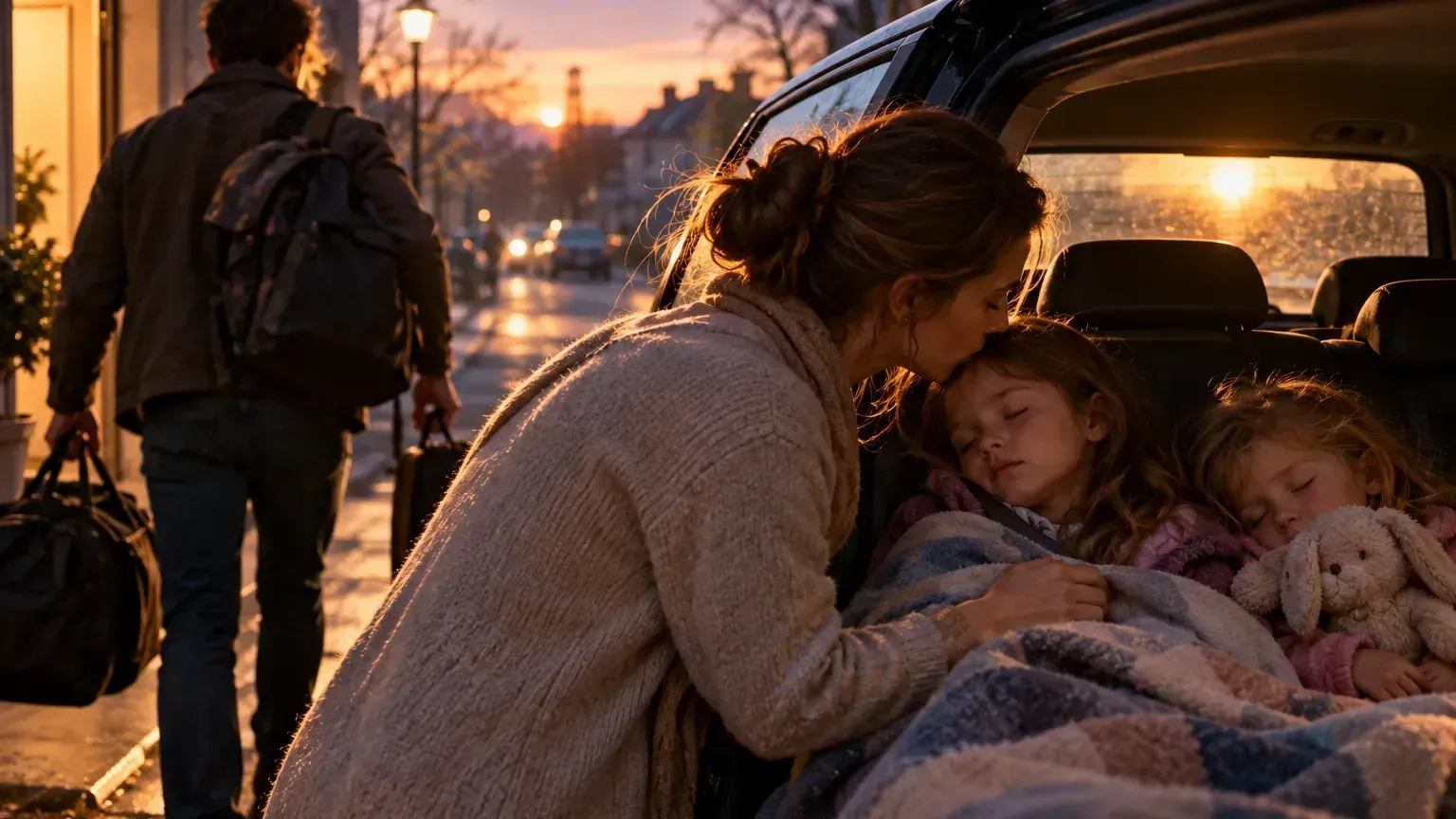
Mara remembered almost nothing about leaving their old town.
She remembered a dark window.
A cold car.
Her younger sister, Kit, asleep beside her with a stuffed rabbit pressed against her face.
And her father carrying bags through the front door while everyone else seemed to be whispering.
It had been too early for morning.
The streets were empty. The buildings looked asleep.
Her mother tucked a blanket around them, kissed Mara's forehead, and told her to close her eyes.
"Where are we going?" Mara asked.
"Somewhere new."
"Is it far?"
"A little."
"Will there be breakfast?"
Her mother laughed.
"Yes. There will be breakfast."
That was enough information for Mara.
Adults had an unfortunate habit of turning simple things into complicated conversations. If they were going somewhere with breakfast, she saw no immediate reason for concern.
She slept through most of the journey.
Later, her father would tell the story of that morning differently.
He remembered the bags.
The documents.
The money they had counted twice.
The roads they had checked on a map.
He remembered trying not to wake the children while carrying them to the car.
He remembered the feeling of driving away without knowing exactly when, or whether, they would return.
Mara remembered a service station where she bought a packet of biscuits.
Kit remembered nothing at all.
Families rarely agree on which parts of history are important.
The Table With the Short Leg
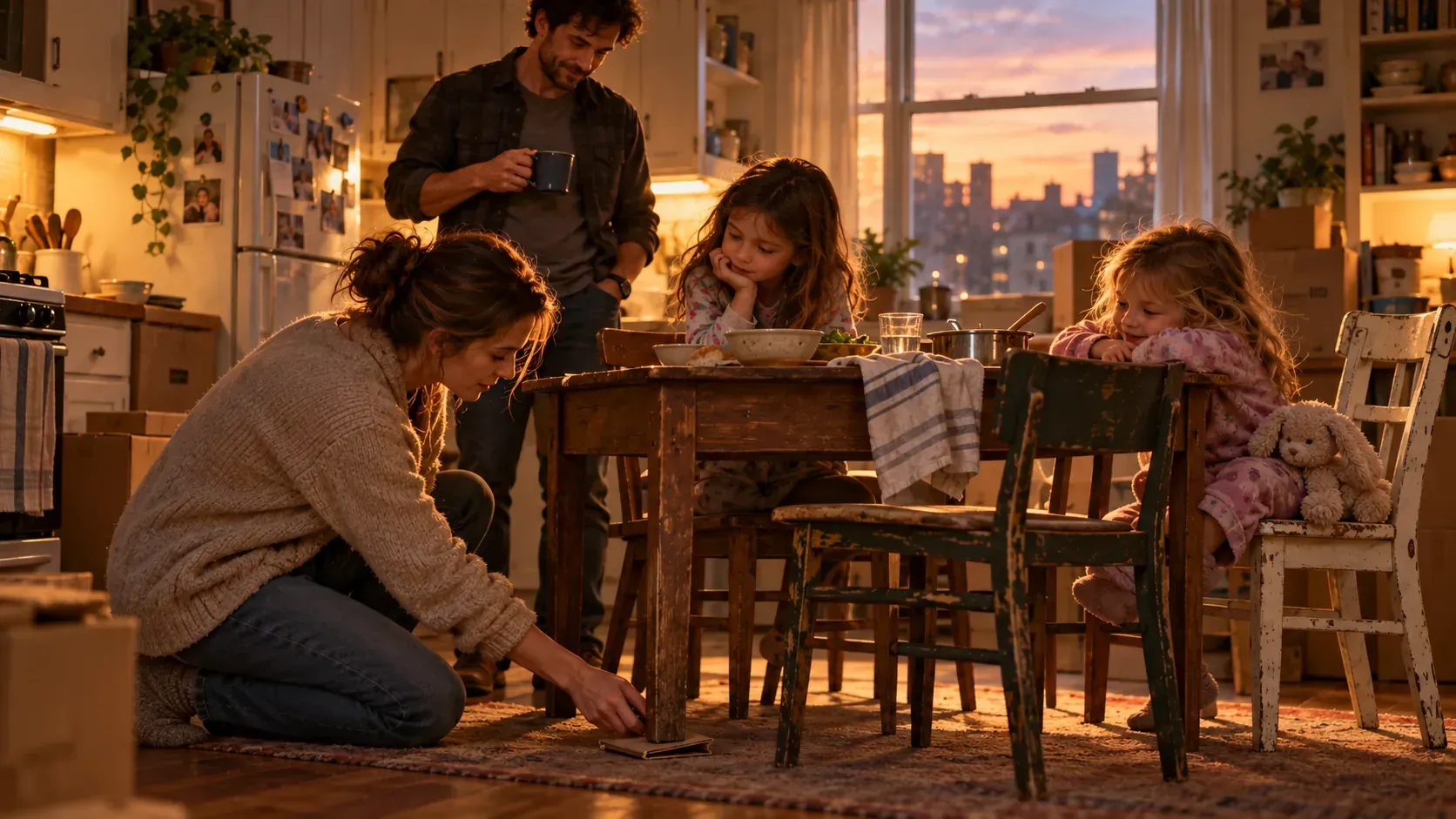
Their first apartment was on the third floor of a building with a lift that worked when it felt like it.
The kitchen was small, the bathroom door didn't close properly, and the bedroom window faced another building so closely that Mara could see a stranger watering plants across the gap.
She waved to the stranger once.
The stranger waved back.
By the end of the week, they had become friends, although neither knew the other's name.
Her parents bought the table on their second Saturday.
It was wooden, rectangular, and scratched along one edge.
The seller called the scratches character.
Mara's father called them damage.
The seller refused to reduce the price.
Her father bought it anyway.
They discovered the short leg when they tried to eat dinner.
Every time somebody leaned on the wrong corner, the table rocked.
Her mother folded a piece of cardboard and pushed it underneath.
"Fixed," she announced.
"For now," her father said.
That phrase appeared frequently in those early months.
For now, they would use the old chairs.
For now, they wouldn't buy curtains.
For now, they would keep some things packed.
For now, they would wait.
The apartment was never supposed to become a permanent home.
But permanent homes and temporary homes have something in common.
People still get hungry in them.
Children still lose their socks.
Someone still has to wash the dishes.
And a badly balanced table will continue to demand attention regardless of how uncertain the future may be.
By the end of the first year, Mara knew exactly which corner she could lean on without spilling her drink.
Kit never learned.
Year Two: The Birthday Cake Incident
On Mara's eighth birthday, her mother tried to bake a cake.
There were two problems.
The first was that their oven had developed an unusual relationship with temperature.
The second was that her mother had misunderstood the instructions on a packet of baking powder.
The resulting cake rose impressively, collapsed dramatically, and emerged from the oven looking like an archaeological discovery.
Mara stared at it.
"Is it supposed to look like that?"
"Yes," her mother said.
Her father leaned over to examine it.
"No," he said.
They laughed.
Then they bought a small cake from a shop around the corner and decorated it with eight candles.
Three children from Mara's class came over.
One spilled juice.
Another accidentally broke a balloon.
Kit cried because she wanted presents too.
It was a perfectly ordinary birthday party.
That evening, Mara's father sent photographs to relatives who lived far away.
She heard him on the phone afterward.
"Yes, we're doing fine."
A pause.
"No, nothing yet."
Another pause.
"We're still waiting."
Mara was sitting under the table, trying to rescue a toy she'd dropped.
She looked up at the underside of the wood.
There was a number written there in black marker, probably from when the table had been sold.
She wondered whether the people waiting for her family knew about the birthday cake.
Probably not.
Somewhere, apparently, people were looking at their names on a screen.
Mara imagined a large room full of desks, with serious-looking adults deciding things.
She wondered whether they had birthdays.
Whether they ever burned cakes.
Whether they knew that Kit could now count to twenty, although she regularly skipped seventeen.
She wanted to ask her father.
But he sounded tired on the phone.
So she stayed beneath the table and listened to the quiet creak of the wood whenever someone leaned on it.
Year Three: A Very Important Competition
By the time Mara was nine, she had made friends.
Real friends.
Not the kind adults arranged for you because someone else had a child of approximately the same age.
Her best friend was a girl called Rosie who talked constantly, hated mushrooms, and believed she could become an astronaut if she could convince her parents to let her keep a telescope in the bedroom.
They entered a school competition together.
The assignment was to build something useful from discarded materials.
Rosie suggested a rocket.
Mara suggested a machine that could locate missing socks.
They compromised by building a rocket that contained a small compartment for socks.
It was not particularly useful.
But it was extremely popular.
They won second prize.
Mara ran home holding her certificate above her head.
Her father picked her up and spun her around.
Her mother stuck the certificate on the refrigerator with a magnet shaped like a pear.
Then they all went out for ice cream.
Nothing happened that day to change their future.
No message.
No decision.
No news.
But Mara would remember that afternoon for years.
The ridiculous rocket.
Rosie laughing so hard she couldn't explain how the sock compartment worked.
Her father buying ice cream for everyone even though he had said that morning they needed to be careful with money.
The certificate remained on the refrigerator until the paper curled at the edges.
When they finally took it down, Mara put it in a drawer.
She didn't want to lose it.
Some things from temporary places, she was discovering, were surprisingly difficult to throw away.
Year Four: The Question
One evening, Mara found her parents talking quietly in the kitchen.
The laptop was open.
Her father was reading something.
Her mother had both hands wrapped around a cup of tea that had gone cold.
"Anything?" she asked.
He shook his head.
"Same as before."
"Did you check the date?"
"Yes."
"And the messages?"
"Twice."
He closed the laptop.
Mara stood in the doorway.
"What are we waiting for?"
Her parents looked at each other.
She had asked versions of this question before, but usually the answers involved plans, places, opportunities, or grown-up words she couldn't quite follow.
This time she was older.
She wanted to understand.
Her father pulled out a chair.
"Come here."
She sat down.
He explained that they had asked for permission to make another move. There were people who needed to review things before they could give an answer.
"Why?"
"Because that's how the process works."
"Have they lost our papers?"
"I don't think so."
"Are they very busy?"
"Probably."
"How busy?"
Her mother smiled faintly.
"Very."
Mara considered this.
"Couldn't they just say yes or no?"
Her father laughed without much amusement.
"That's an excellent question."
"Can we go if they say yes?"
"We'll have to make some decisions. But it would give us a choice we don't have right now."
"And if they say no?"
For a moment nobody answered.
"Then we'll figure out what comes next," her mother said.
Mara looked at the laptop.
"So someone we don't know gets to decide where we might live?"
"Part of it, yes."
"That's stupid."
Her father opened his mouth.
Then closed it.
"Sometimes," he said, "it does feel that way."
She looked around the kitchen.
At the cupboard with the loose handle.
At the refrigerator covered in drawings and school photographs.
At the table that still rocked if Kit leaned too heavily on one corner.
She had spent most of her childhood in this apartment.
She knew which stairs were broken.
She knew the sound of the lift.
She knew the bakery where the woman behind the counter sometimes gave her an extra biscuit.
She knew which classroom windows stuck in summer.
And now she was beginning to understand that a decision made somewhere else might change all of it.
"Do we have to go?" she asked.
Her mother reached across the table.
"We don't have to decide that tonight."
It wasn't quite an answer.
But Mara was beginning to understand that adults didn't always have answers either.
Year Five: The Things That Happened Anyway
Kit learned to ride a bicycle.
She fell off it six times.
On the seventh attempt, she managed to travel the entire length of the courtyard without touching the ground.
Her father ran behind her, shouting instructions she couldn't hear.
When she finally stopped, she looked furious.
"Why didn't you tell me you let go?"
"Because you were doing it."
"That's not the point!"
Mara took photographs.
At school, she started learning guitar.
She was terrible at first.
Her fingers hurt, the strings buzzed, and she developed an impressive ability to make even cheerful songs sound vaguely threatening.
Rosie told her she was improving.
Rosie was a loyal friend, although not necessarily an honest music critic.
Her mother changed jobs.
Her father started wearing glasses when he worked at the computer.
The old neighbor across the gap moved away.
A new family arrived and put bright yellow curtains in the window.
Mara grew taller.
Kit stopped carrying her stuffed rabbit everywhere, although she still kept it beside her pillow.
There were birthdays, school trips, small arguments, good dinners and bad dinners.
There were rainy Sundays when nobody wanted to go outside.
There were evenings when the family watched films together and everyone pretended not to notice that their father had fallen asleep halfway through.
There were hard days, too.
Money was sometimes tight.
Work could be exhausting.
Her parents occasionally argued in low voices when they thought the children couldn't hear.
And every so often, the laptop appeared on the kitchen table late at night.
The same screen.
The same checking.
The same silence afterward.
The answer had not arrived.
But nearly everything else kept happening.
Year Six: The Concert
When Mara was thirteen, her music teacher announced a performance at the end of the school year.
Every student could participate.
Solo performances were optional.
Rosie immediately signed up.
Mara hesitated.
She had improved at guitar.
Not enough to impress a professional musician, perhaps, but enough that people no longer asked whether the instrument was broken.
Her teacher encouraged her.
"You should try."
"I might not be here."
"Are you moving?"
"I don't know."
"When?"
"I don't know that either."
The teacher looked at her for a moment.
"Well, the concert is in June."
Mara nodded.
"You can put your name down now. If things change, we'll deal with it."
It sounded so simple.
Mara took the form home.
That evening, she found her mother preparing dinner.
"Can you sign this?"
Her mother read it.
"A concert?"
"Yes."
"That's lovely."
"It's in June."
Her mother stopped smiling quite so easily.
"June."
"Yes."
"Well, we don't know what might happen before then."
Mara felt something unpleasant rise in her chest.
She knew what was coming.
"Can't you just sign it?"
"Of course I can. I'm only saying—"
"That we might leave."
Her mother looked at her.
"Mara."
"That's what you're going to say, isn't it?"
"We have to be realistic."
"We've been realistic for six years."
The kitchen went quiet.
Kit, who had been doing homework at the other end of the table, slowly lowered her pencil.
Mara looked at her mother.
"I don't want to spend another year not doing things because something might happen."
Her mother didn't answer immediately.
Mara continued, louder now.
"You keep saying we're going somewhere. But I've been going to school here. I have friends here. This is where everything happens."
Her father came into the kitchen.
"What's going on?"
"Nothing," Mara said.
Which was, by any reasonable standard, untrue.
She picked up the form and went to her room.
For the first time, she was angry about the waiting.
Not simply bored or impatient.
Angry.
She understood that her parents wanted something important.
She understood that they were trying to create more possibilities for the family.
But she was tired of being told that tomorrow might change everything.
Tomorrow had been threatening to change everything for most of her life.
And somehow, every morning, she still had to get up and go to school.
The Conversation Nobody Planned
Her mother came into the bedroom later that evening.
Mara was sitting on the floor with her guitar.
She wasn't playing.
The school form lay beside her.
"Can I come in?"
Mara shrugged.
Her mother sat on the bed.
For a while neither spoke.
Then her mother said, "I was wrong about the concert."
Mara looked up.
"Really?"
"Really."
"You can sign it?"
"Yes."
Mara picked at a loose thread on the carpet.
"Even if we move?"
"Even if we move."
"But then I might not be able to perform."
"I know."
"Then what's the point?"
Her mother thought about that.
"Because you want to do it now."
Mara frowned.
It was an unusual answer from an adult.
Her mother reached for the form.
"When we left our old town, you were so little. We thought we'd find out what happened next fairly quickly."
"How quickly?"
"We didn't know. We hoped it wouldn't take years."
"But it did."
"Yes."
"Are you sorry we came?"
Her mother looked surprised.
"No. I'm sorry it's been so uncertain. That's different."
Mara was quiet.
Her mother continued.
"We've made a good life here. You know that, don't you?"
"Then why do you always call it temporary?"
The question landed harder than Mara expected.
Her mother looked toward the window.
Outside, someone was arguing with a car alarm.
A dog barked.
Somewhere downstairs, the lift began its familiar mechanical complaint.
Ordinary evening sounds.
"I suppose," her mother said slowly, "we kept thinking that if we called it temporary, leaving would be easier."
"Did it work?"
Her mother gave a small, tired laugh.
"No. I don't think it did."
She signed the form.
Then she handed it back.
"Will you play something for me?"
Mara lifted her guitar.
"Not yet. I'm still practising."
"All right."
Her mother stood up.
At the door she turned.
"And Mara?"
"Yes?"
"If we do leave, it's all right to be sad about it."
Mara looked down at the signed paper.
She hadn't realized how much she needed someone to say that.
The Performance
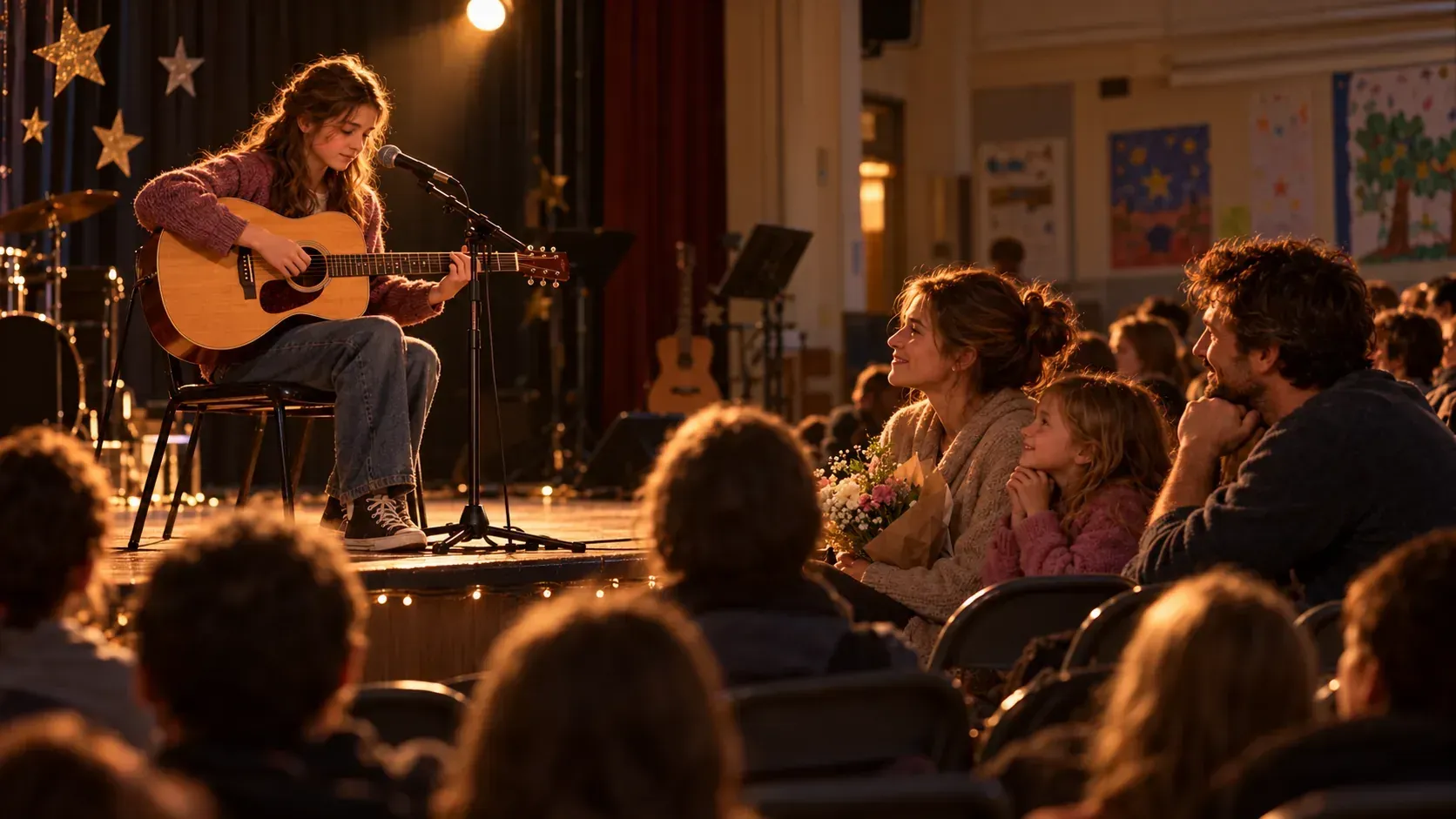
The concert took place on a Thursday evening in June.
Her father came directly from work.
He was wearing the wrong shoes for the occasion and had a small stain on his shirt.
Her mother had brought flowers.
Kit had brought a packet of sweets that she loudly opened during the quietest part of the first performance.
Mara stood backstage with her guitar and a stomach full of butterflies.
Rosie was beside her.
"You're going to be fine."
"What if I forget everything?"
"Then make something up."
"That's terrible advice."
"That's what friends are for."
When Mara walked onto the stage, the lights were brighter than she expected.
She could barely see the audience.
Then she spotted her family.
Her father was leaning forward.
Her mother was smiling.
Kit waved both arms despite having been specifically instructed not to do that.
Mara began playing.
She made two mistakes.
One was small.
The other was spectacular.
But she kept going.
When the song ended, everyone applauded.
She bowed awkwardly and hurried offstage.
Afterward, her father hugged her.
"That was wonderful."
"I played the wrong chord."
"Which one?"
"The one near the end."
He looked thoughtful.
"I liked that one."
She laughed.
Her mother took photographs.
Rosie tried to balance the flowers on her head.
Kit announced that the sweets were finished and they should all go for pizza.
Nobody checked the status of anything that evening.
There were no updates.
No messages.
No new decisions.
But something important had happened.
Mara had played her first concert.
And her parents had been there to hear it.
Year Seven: The Form
The following autumn, Mara received another school form.
Her teacher wanted updated contact information.
Name.
Date of birth.
Emergency contact.
Home address.
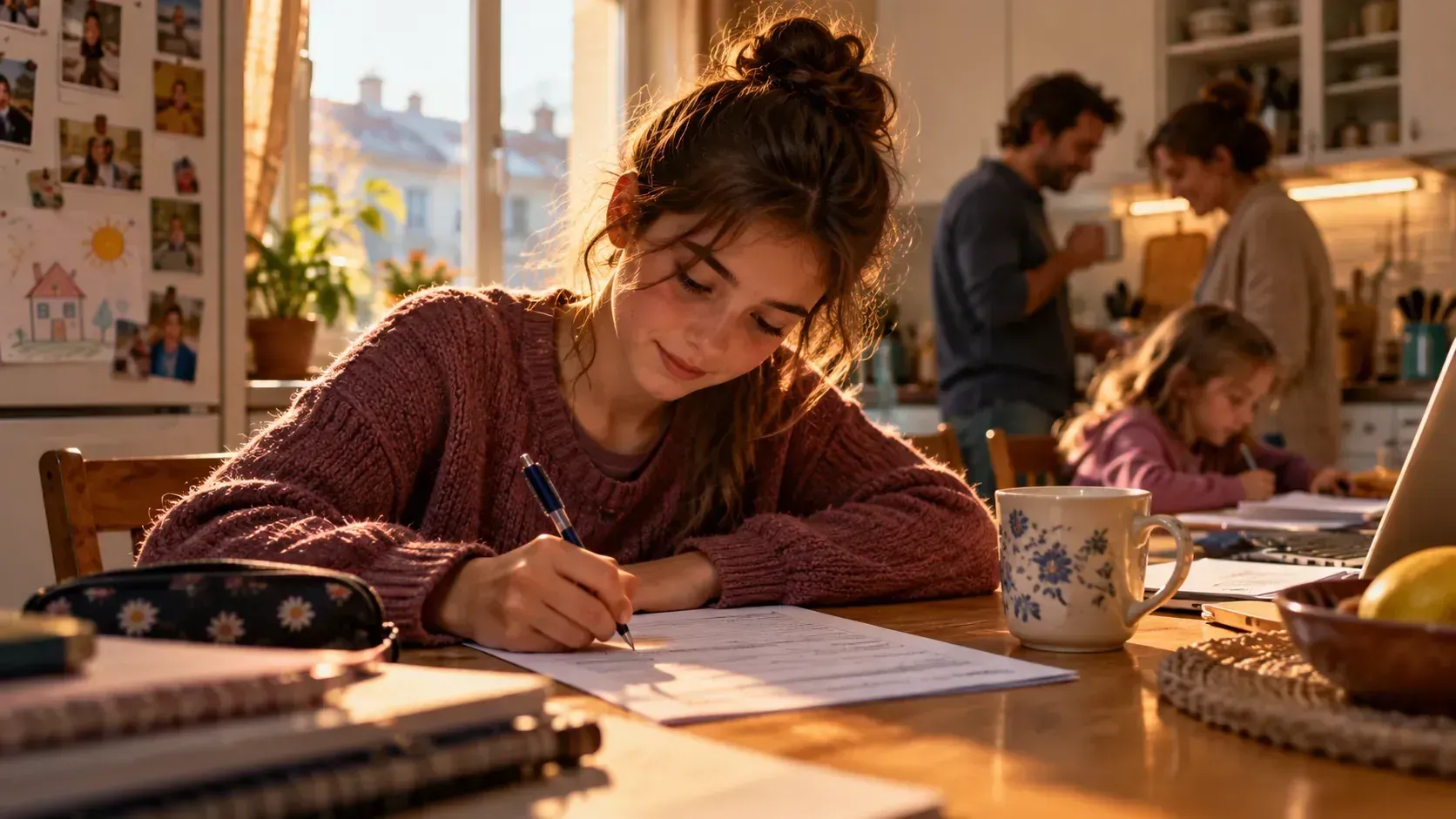
Mara sat at the kitchen table filling it in.
She was fourteen now.
Her handwriting had changed.
She had new friends, new music, and opinions about almost everything.
Kit was eleven and had become the sort of person who borrowed Mara's belongings without asking, then expressed genuine surprise when confronted.
The table was still there.
Its surface had acquired new scratches.
The cardboard under the short leg had been replaced several times.
There was a pale ring where someone had put down a hot saucepan.
Her father's glasses were beside the laptop.
Her mother's shopping list was stuck beneath the pear-shaped refrigerator magnet, which had somehow survived all seven years.
Mara reached the box marked Home Address.
Then she stopped.
She looked at the pencil in her hand.
For years, she'd written that address lightly.
Carefully.
As though it might disappear if she pressed too hard.
She thought about the morning they'd left.
About the car.
The sleeping Kit.
The service-station biscuits.
About the first apartment, the crooked table, the failed birthday cake, the school competition, the bicycle in the courtyard.
She thought about Rosie.
About the concert.
About the seven birthdays she'd celebrated in a place that wasn't supposed to be permanent.
Then she put the pencil down.
She took a pen from the drawer.
And wrote the address in ink.
Her father was making coffee.
He noticed.
"New pen?"
"No."
"Special occasion?"
"Not really."
He looked at the form.
Then at the address.
For a moment he said nothing.
"That's our address," Mara said.
"I know."
"I mean, it is. Right now."
He nodded.
"Yes, it is."
She waited for him to explain that they might move soon.
That they still didn't know.
That everything depended on something happening somewhere else.
But he didn't.
Instead, he asked whether she wanted toast.
"Yes, please."
"With jam?"
"Obviously."
He went back to the kitchen counter.
Mara continued filling in the form.
No Grand Announcement
The message didn't arrive that day.
Nor the next.
There was no dramatic phone call, no sudden celebration, no official announcement that changed their lives.
Somewhere, perhaps, somebody was still looking at their names on a screen.
Maybe the answer would come soon.
Maybe it would take another year.
Maybe the answer would be something nobody wanted.
Her parents continued doing what they had learned to do.
They worked.
They paid the bills.
They made plans.
They worried about money, school, travel and the future.
They checked for updates when there was reason to check.
Sometimes they were disappointed.
Sometimes they were hopeful.
And sometimes they were simply tired of talking about it.
But the family had changed.
Kit was no longer a little girl asleep against a car window.
Mara had become tall enough to reach the top shelf without standing on a chair.
The streets that once seemed unfamiliar had become the streets they knew best.
The apartment had held seven years of their lives.
Seven years nobody had planned.
Seven years they couldn't return or replace.
On the morning after Mara filled in the form, the family was late.
Kit couldn't find her school shoes.
Her father was looking for his keys.
Her mother had forgotten where she'd put the bread.
Mara was trying to finish breakfast while searching for a homework sheet that had definitely been on the table the night before.
Then Kit shouted from the hallway.
"Found them!"
"Where?" her father called.
"In my bag!"
"Why were your shoes in your bag?"
"I don't know!"
Mara laughed.
Her mother shook her head.
The toaster clicked.
Outside, the day was beginning.
Someone was starting a car.
Someone was walking a dog.
The lift was making its usual dreadful noise.
Their father finally found his keys.
Their mother handed them their bags.
They hurried downstairs together, still arguing about the shoes.
The laptop remained closed on the kitchen table.
The answer could wait until they came home.
The morning couldn't.
About IT NEVER STOPPED
Some families move to a new place knowing exactly what comes next. Others begin again with only a few belongings, uncertain plans and the hope that an important answer will eventually arrive.
The years between those moments can be difficult to describe.
From the outside, they might look like a period of waiting.
From the inside, they contain entire childhoods.
Schools and friendships. Work and bills. Birthdays, ordinary dinners, new habits, unfamiliar streets that gradually become familiar.
IT NEVER STOPPED by LORQAI explores the life that continues while a family waits for the future to reveal itself.
This fictional story follows that experience through a child's changing understanding of home.
The question at its heart is simple:
When does a temporary life become the life you've actually lived?
Perhaps there isn't a single moment.
Perhaps there is only a day when you realize you no longer need to write your address in pencil.
An original AI-assisted fictional story inspired by IT NEVER STOPPED by LORQAI. The characters and events are fictional and do not represent a documented account of the artist's personal life.
LORQAI — Music Beyond Boundaries.