Music / LORQAI
NOT THE HERO — The Person Who Stayed Until the Finish
A LORQAI song from OUT OF ORDER, IN TUNE, accompanied by “The Person Who Stayed Until the Finish,” an original fictional story inspired by the track.
Listen to NOT THE HERO by LORQAI from OUT OF ORDER, IN TUNE, and read “The Person Who Stayed Until the Finish,” an original fictional story inspired by the song.
At the finish line
The yellow paint hadn't dried when I put the cardboard sign in the back of the car.
I had made it on the kitchen floor that morning, using the back of a box from a new desk chair. The letters leaned uphill, despite my best efforts with a ruler. There was a thumbprint beside the last one. I told myself that handmade signs were supposed to look like this.
I also had a plastic bag of oranges, a dry coat that wasn't mine, and a speech I'd been rehearsing for most of the drive.
June hadn't asked for any of those things. She'd asked me to come.
A plan in blue
When she'd told me she was entering the charity run, I had behaved as though I'd been appointed her coach.
I sent her a video about warming up. Another about choosing shoes. Then a training schedule, color-coded in blue: short runs, longer walks, rest days, a box to tick every Sunday. I made a second version when she didn't answer the first.
She replied to the second one with a photograph of her trainers sitting beside the front door.
They look very motivated, she wrote.
I'd known June for sixteen years. We met because we were the only two people at a friend's birthday party willing to help carry chairs downstairs. She could make an argument funny without making the person on the other side feel small. She remembered which bus my father took to his appointments. She once spent an entire Saturday helping me move, then refused the takeaway pizza I'd ordered because she'd already brought sandwiches.
None of that explained why leaving her flat had become difficult lately. She didn't give me an explanation, and I didn't know how to ask without making it sound like an examination.
Sometimes we made plans and she canceled an hour before. Sometimes she answered my messages a day later with a question about my haircut or an absurd photograph she'd found online. I filled the gaps with suggestions. I liked suggestions. They made a problem look as if it had edges.
One evening I called and told her that a little routine might help.
“Maybe,” she said.
I kept talking. She let me. Eventually she said she had to go and put the kettle on.
I heard the quiet click of her phone disconnecting and wondered why I was so bad at helping someone I'd known for so long.
One message
Three days before the run, a message arrived while I was at work.
Could you meet me when I'm through?
I read it twice. She hadn't asked whether her pace was improving or what to eat beforehand. She hadn't requested a lift to the start. She wanted me at the end.
Of course, I wrote.
Then, because I couldn't quite stop myself, I sent her a map of the finish area and a recommendation about taking a spare layer in case it rained.
She answered with a single thumbs-up.
On Sunday I bought oranges at a supermarket near the course. I wasn't sure why. My mother used to bring them to school sports days, cutting the skins into quarters so we could eat them without getting juice all over our shirts. June hadn't asked for oranges either, but a bag of them seemed less embarrassing than my speech.
The speech, in case she struggled, would tell her that the time didn't matter. That entering was brave. That setbacks weren't failures. Every sentence was technically kind and sounded terrible out loud.
At the last traffic light I caught my reflection in the mirror. I'd cut my own hair the night before, and the left side stood noticeably higher than the right. I decided to keep my coat collar up.
Forty minutes after eight
Rain began as the volunteers were taking down the first barrier by the supermarket wall.
The crowd had mostly gone. A woman in a fluorescent jacket was rolling up a length of plastic tape. Beyond her, the sports hall clock showed twenty-five past eight. I stood under the edge of an awning with June's coat, my wet cardboard and the oranges getting heavy in their bag.
I checked my phone. No message.
A volunteer glanced at the sign. “Waiting for somebody?”
“Yes.”
“There's still a few out.”
I had been about to ask her how long the finish would stay open. Instead I thanked her and stepped back so she could carry a metal barrier past me.
At forty minutes past eight, June came around the final corner.
Her race number was peeling off one side of her shirt. She was walking, and so was the runner some distance behind her. I started to raise the sign. The wet cardboard sagged over my hands.
June saw me, then the sign, and laughed so suddenly she had to stop and catch her breath.
“Please,” she said, “put that thing down.”
“I made it myself.”
“I can tell.”
I lowered it. She crossed what was left of the finish line, accepted a cup of water from the volunteer, and bent with her hands on her knees for a moment. No photographer was waiting. Somebody behind the sports hall was loading folding tables into a van.
I held out the coat.
“You're soaking,” I said.
“So are you.” She took one look at me and narrowed her eyes. “What happened to your hair?”
“An unfortunate misunderstanding with some scissors.”
“Both sides?”
“Only one side. I'm hoping you won't notice the other.”
She laughed again. It wasn't a victory speech or a lesson about persistence. It was the laugh I knew, interrupted by the need to breathe.
The long way to the bus
The clock above the sports hall disappeared behind us. June drank the rest of her water. I opened the bag of oranges and offered her one. She rolled it in her palm, looking at its slightly dented skin.
“You brought provisions?”
“I prepared for a small expedition.”
“That's what you do.”
I waited for a compliment to follow. It didn't. She didn't seem unkind. She simply peeled off a strip of orange skin and dropped it into the paper bag I'd brought for rubbish.
I could have asked how far she'd run, whether she'd taken walking breaks, or if she wanted to try again next month. A dozen questions presented themselves in neat order, each one useful to a person who wanted the day to mean something measurable.
Instead I asked, “Do you want to head straight home?”
“Can we take the long way?”
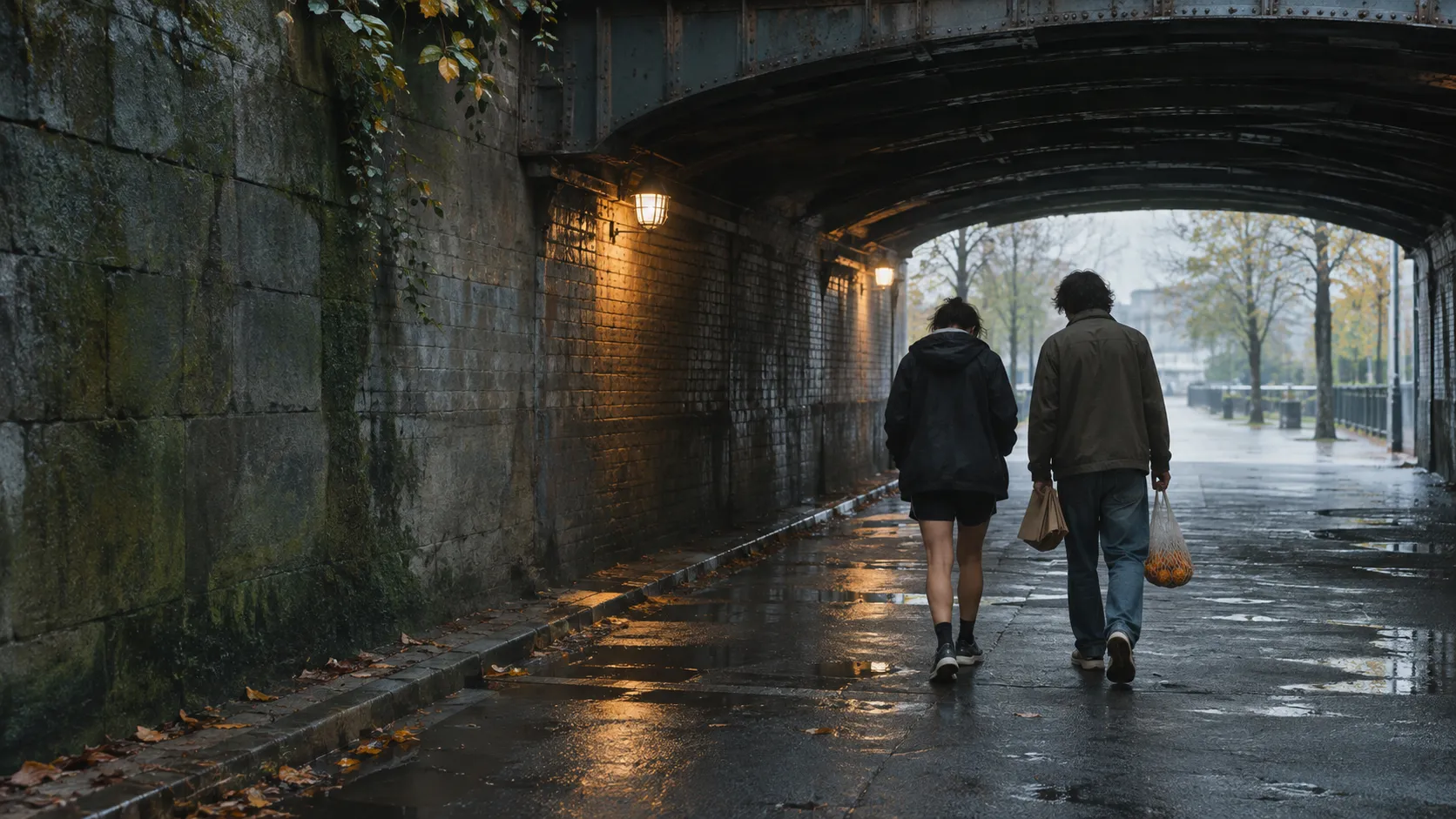
The quickest route to the bus stop followed the main road. The longer one passed beneath an old railway underpass, then crossed a small park. It was badly lit even in daylight, but the rain had thinned, and we had time.
We walked together. June kept the orange in one hand and her coat unfastened. I carried the sign face down so the paint wouldn't smear against my trousers. Water ran from the bridge joints in steady little streams.
Halfway through the underpass she stopped.
“Can I tell you something without you giving me a plan?” she asked.
I felt the first plan forming before she'd finished the question.
“Yes,” I said, and put my phone into my pocket.
What the race was for
“The run wasn't really about getting fit,” she said.
“I wondered.”
“No, you didn't. You sent me diagrams.”
She said it lightly, but I winced because it was true.
We stood just beyond the deepest part of the underpass. A passing bicycle sent a crescent of water over the road. In the shallow puddles, the lamps overhead looked much longer than they were.
“Some mornings I put my shoes on and stand by the door,” June said. “I can see the pavement from the window. I know the shops are open. And I still can't make myself go down the stairs.”
I didn't answer.
“I thought if I signed up for something on a particular day, I'd have to leave. And then I was afraid I'd wake up and not manage even that.”
“Did you think about not coming?”
“Right up until I left.” She looked down at the orange. “I wasn't trying to beat anybody. I wanted to get outside and reach somewhere I'd said I would.”
The speech I'd rehearsed in the car began to sound ridiculous. The time doesn't matter. Of course it didn't, not in the way I'd imagined. I'd been measuring the wrong thing.
“I didn't need another answer,” she said. “I just needed somebody to be there when I was done.”
I watched a drop of rain fall from the bridge and break the reflection of a light in two.
“I came,” I said.
“I know.”
I wanted to apologize for the videos and the spreadsheets and every time I'd treated a silence as a request for instructions. I did say I was sorry for talking too much. She nodded, but she didn't make the moment into a ceremony.
After a while she said, “The blue chart was quite beautiful, actually.”
“Thank you.”
“I particularly liked the ten-mile week when I couldn't get to the postbox.”
“I may have been optimistic.”
“A little.”
We started walking again. The rain made a soft noise on the leaves beside the path. I matched her pace without thinking about whether it was fast enough.
The name on the sign
By the bus stop the cardboard had gone limp. June asked to see it. I handed it over and waited while she turned it toward the light from the timetable case.
She stared for a second, then began laughing so hard that she had to lean against the shelter.
“You've spelled my name completely wrong.”
I looked over her shoulder. In enormous yellow letters, the sign said GO JANE.
June's name, which I had known for sixteen years, was still June.
“I was concentrating on the spacing,” I said.
“You found space for somebody else.”
“I can fix that.”
“Please don't. Jane's had a very good morning.”
A bus appeared at the far end of the road. June folded the sign in half, carefully, so the painted sides wouldn't stick. I took her coat while she found her ticket, and she put the last two orange segments into the paper bag for later.
There was still a damp patch down the back of her shirt. Tomorrow might be difficult. The next week might be difficult too. I couldn't turn those facts into a training schedule that would make them disappear.
When the bus stopped, she didn't hurry. She offered me one of the orange segments, which I ate standing in the rain.
“Same time next Sunday?” I asked.
“Maybe,” she said. “We could just have coffee.”
“Coffee sounds good.”
She stepped onto the bus. I stayed by the shelter with the folded sign and watched until she found a seat. When she looked back, I raised one hand—not the sign.
She waved before the doors closed.
About the Song
- Released
- Album
- OUT OF ORDER, IN TUNE