Music / LORQAI
OUT OF ORDER, IN TUNE — The Song That Was Supposed to Come Last
An original short story inspired by LORQAI’s “OUT OF ORDER, IN TUNE,” the final song on the album of the same name.
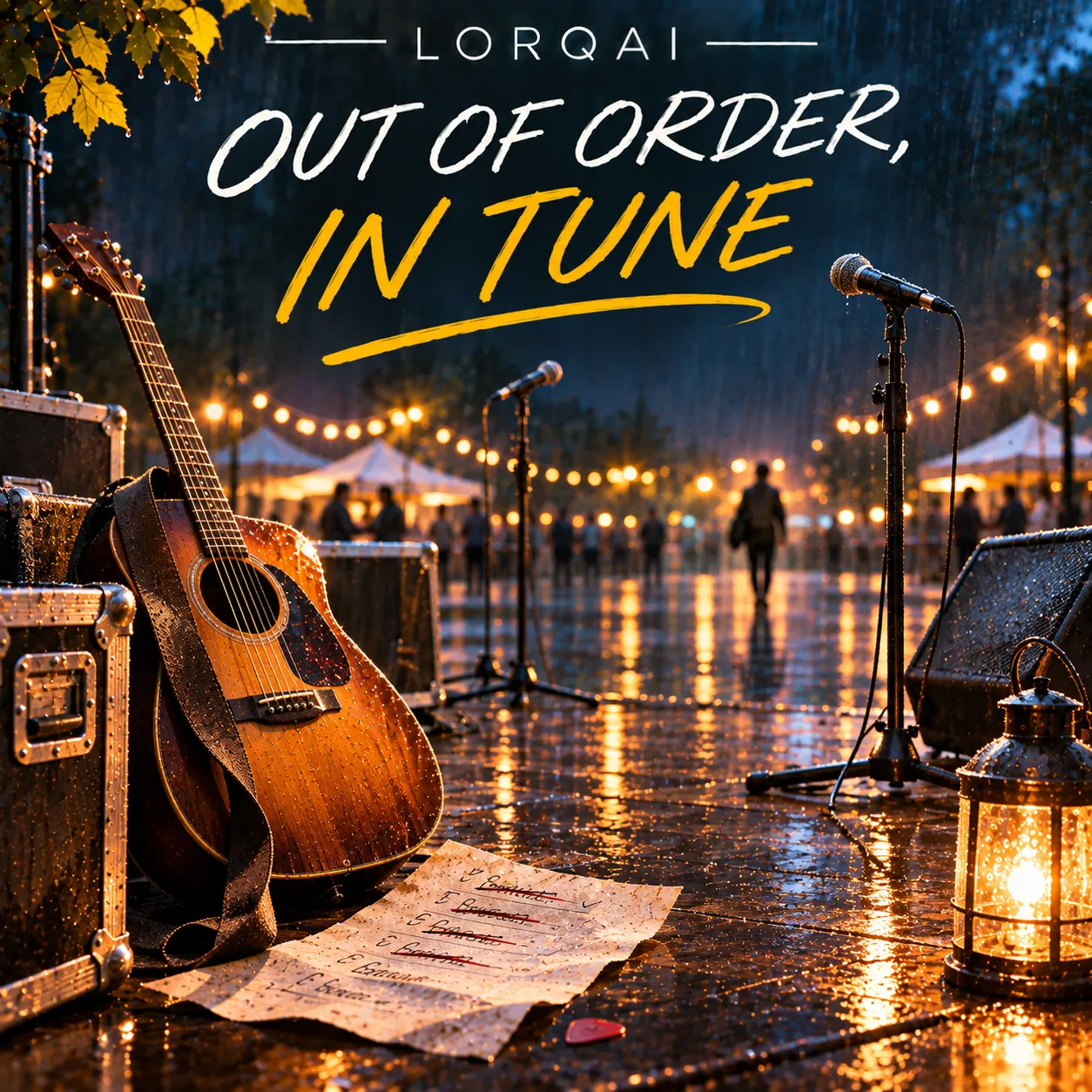
The title track OUT OF ORDER, IN TUNE inspires an original LORQAI story: when the speakers fail at a market-square concert, the musicians start with the song meant to close the evening.
Introduction
I had written the nine songs in blue marker, with an arrow beside every change of instrument.
The list was taped to the stand at the edge of the stage. I had left a little space before the opening number, where we were supposed to wait one beat after the guitar figure before the drums came in. That pause mattered to me. We'd practiced it so often that I could feel the length of it in my wrist.
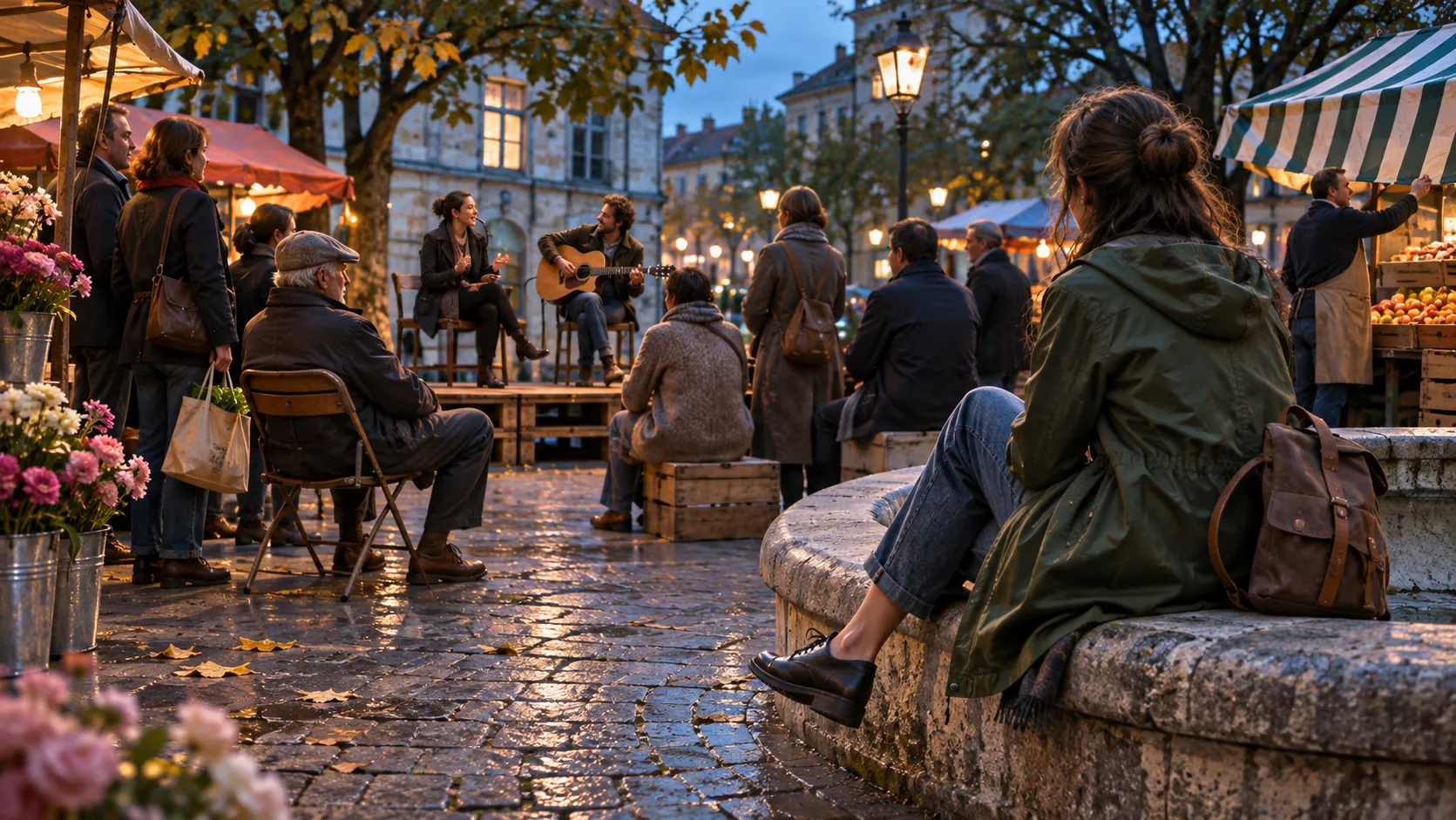
At seven, the town market was still open. A man was weighing late apples beneath a striped awning. Two children were arguing about a paper windmill. Somewhere behind the stalls, someone was dragging a crate over uneven stones. We had been given a modest platform, two microphones and a pair of speakers. It was hardly a concert hall, but I liked the arrangement: a place for each thing, a beginning, a middle and an ending.
Then my partner raised his hand to count us in, and the speakers clicked and died.
The space after the click
For a moment I thought the silence was ours—the deliberate one I'd marked on the page.
Then I saw the man at the sound desk. He had both hands lifted away from the controls, palms out, with an expression that said he was already as surprised as we were.
I leaned toward my microphone.
“Can you hear me?”
The market heard nothing through the speakers. A woman near the front cupped her ear. A few people at the back drifted toward the vegetable stalls. The man at the sound desk checked a cable, then another. The small light on his panel stayed dark.
My partner, Eli, looked at me. He was still holding the electric guitar we'd meant to open with. His thumb rested on the string where the four-note figure should have begun.
“We could wait,” I said.
“We could.”
I glanced at my list. Nine songs. A carefully measured set. An ending we'd worked hard to earn. I could already imagine striking them off one by one, not because they were finished, but because the evening had run out of time.
Eli lowered the electric guitar onto its stand and knelt beside an old case behind the monitors. He released the two tarnished catches.
“Or,” he said, lifting out his acoustic, “we could begin at the other end.”
I looked at the last title on the page.
“That one's supposed to finish the show.”
“I know.”
There was no plan in his face. I found this unnerving. He was not usually careless; he was simply able to begin before all the answers had arrived.
The sound man called from below the stage that he needed a little time.
Eli sat on the front edge of the platform and played the first four notes softly, without asking anyone for permission. The old guitar sounded thin at first. Then the wood under his arm began to give the notes a shape I recognized.
I went and sat beside him.
Nine titles in blue
We had spent weeks arguing gently about the order of the songs.
I wanted the set to make sense even to a stranger arriving halfway through. The fast song should come after the quiet one. The duet needed room to breathe. The ending should gather everything we'd played before without pretending that one grand chord could explain it all.
Eli listened to these rules and rarely disagreed. Then, at rehearsal, he would move a song two places down and ask what happened if we tried it there. Sometimes he was wrong. Sometimes I knew he was right and resented the extra work of admitting it.
The written list was my compromise with uncertainty. I couldn't make the market attentive or the weather kind, but I could know what came next.
Now the stalls were closing in different directions and we were beginning with the last song.
“Do you remember the second verse?” I whispered.
“Most of it.”
“That isn't reassuring.”
“No. But it's accurate.”
He began again. This time I sang the opening line. There was no microphone to soften the rough edge of my voice. Eli answered me, and I heard his breath before his words. We had rehearsed for the speakers to carry the sound outward. Instead, people would have to come closer if they wanted to listen.
A few did.
A couple carrying shopping bags stopped at the front. An older man pulled a folding chair nearer. A vendor set down a box of paper cups without going back to his stall. Nobody applauded our decision to continue. They just made a small space in their evening for us.
That was harder, and more generous, than applause would have been.
The girl by the fountain
The fountain stood at the far side of the square. It had been switched off for repairs, leaving a shallow stone basin and a rim broad enough to sit on. A girl in a green raincoat sat there with her heels against the wall. She seemed to be waiting for someone; now and then she glanced toward the market gates.
I noticed her because she was tapping one shoe against the stone.
At first it had no relation to our music. Then Eli shifted his guitar rhythm to follow the tap. The girl stopped, listening. When he returned to the original figure, she began again, a little more confidently.
The next phrase should have belonged to Eli. He entered too soon, lost the line and looked at me with that blankness musicians know—the terrible instant when a word you have sung a hundred times disappears.
He could not hear himself through a monitor. Neither could I. We were hearing each other directly, almost too clearly.
I gave him the missing word as part of my own line. He caught it and continued. In the next phrase I misplaced the beat, and he waited for me instead of pulling ahead.
The song wobbled. It did not break.
The girl kept tapping. Someone near the fruit stall began clapping on the offbeat. It was not quite the handclap we'd rehearsed, but it occupied the same little gap between the notes. Eli smiled without looking up.
I had been counting the people who left. Now, for the first time, I noticed the people who stayed.
How to play without a ceiling
After the first song, we didn't stop.
We shifted the remaining titles as the market changed around us. We played a quick one while the sellers folded their awnings, then a slower one when the last of the children went home. For one song, Eli let me carry the melody alone. For another, he found the bass line on the low strings of the acoustic, where it sounded less polished but warmer.
Between songs we moved the chairs. We asked those at the back if they could hear. When they said no, we invited them closer instead of playing louder. The sound man kept working, moving carefully around cables on the dark platform. We thanked him each time he said he was still trying.
Once, during a quiet passage, a stallholder began dragging a shutter across its rail. The noise swallowed half a verse. I stopped singing, furious for a second at the interruption.
Eli kept his place with his foot. When the shutter had settled, he gave me the phrase again.
The vendor looked apologetic. I shook my head to tell him it was all right. He nodded and stood listening until the song ended.
It occurred to me that my idea of a perfect concert required the square to stop being a square. No shutters, no children, no engines, no one arriving late with bags of apples. The audience would be allowed to listen only if nothing else in their lives made a sound.
But this was where we had come to play.
By the time the evening cooled, we had worked our way through almost everything. There were missed entrances and a chord Eli changed because my voice landed somewhere he hadn't expected. In one song a little silence opened where the drums should have been. We left it there.
I couldn't have reproduced the performance exactly if someone had asked me to. I didn't want to.
Nine fifteen
At a quarter past nine, the panel at the sound desk came back to life.
A green light appeared. The man checked the microphones and lifted one toward us.
“It's working,” he called. “Do you want to start again from the top?”
I looked at the blue list. The first song was the only one left. Its arrow still pointed toward a space for silence, as though the last two hours hadn't happened.
The easy answer was yes. We could give the audience what we'd promised, in the order we'd promised it. Nobody would have to explain why we'd begun at the end.
But the people nearest the platform had gathered in a loose half-circle. The older man had moved his chair beside the couple with shopping bags. The vendor with the paper cups was sitting on an upturned crate. The girl in the green coat was closer now, on the dry edge of the fountain, still finding our beat with her heel.
They had listened to a concert that wasn't supposed to exist.
I peeled the list off the stand. The tape resisted, then released with a little tearing sound. Eli took the paper from me and folded it once, down the middle, leaving the nine titles on the inside.
“Keep the speakers low,” I told the sound man. “We have one more.”
He turned a dial and nodded.
For the first time all night, the microphone carried my voice into the square. It was startling. I could hear myself from a distance, small and clear. The sound was useful, but it wasn't the thing that had kept us together.
Eli caught my eye. He waited.
This time I let him begin without checking the page.
The first song at last
Our opening number was supposed to be precise. Four muted notes, one handclap slightly off the beat, drums arriving only after the space between them. I'd insisted on that space because it made the chorus feel as if it were stepping into a room that had been cleared for it.
There were still no drums.
Eli played the four notes on the old acoustic. I answered with a clap. The girl at the fountain found the next pulse with her shoe. When the chorus arrived, I sang toward Eli rather than toward the speakers, and he sang back.
It was recognizably the song we had written. It was not the performance we had planned.
The final chord turned in a direction I hadn't practiced. Eli had slipped a different note beneath it, leaving me room to resolve the phrase on my own. For an instant I didn't know whether to follow him.
Then I did.
When the song ended, the applause was modest and close. It came from hands belonging to people we could actually see. The couple lifted their shopping bags. The older man folded his chair. The sound man gave a small bow from behind his desk, still wearing the look of someone who had survived an inconvenient night.
I put my hand on Eli's shoulder.
“You changed the ending.”
“You followed.”
“I nearly didn't.”
“I know.”
We laughed, because both things were true.
What left the square
By half past ten, the stalls were dark. The last strings of lights had been switched off, and the sound man was winding the cables back into careful circles. We carried the chairs to their stack. Eli closed the old guitar case, pausing to straighten the handle before lifting it.
My blue list was still in his pocket. It had served no practical purpose for most of the evening. I asked if he wanted to throw it away.
“No,” he said. “You spent a long time making it.”
He was right. I'd worked hard on that order. I would probably make another list for our next show. The mistake hadn't been writing it down. The mistake would have been believing the paper knew more about the evening than the people in it.
The market gate stood open for the last few customers. The girl in the green raincoat went through it with an adult carrying a folded umbrella. She walked a few steps ahead, her shoes making almost no sound on the dry stones.
Then she began to whistle.
It was not the whole tune, and not perfectly in key. She took a breath in the wrong place and started the four notes again, changing the last one without realizing it.
Eli heard her. So did I.
Neither of us called out to correct her.
We stood beside the empty stage until she disappeared around the corner, carrying the music in a version that belonged to her.
About the Song
- Released
- Album
- OUT OF ORDER, IN TUNE