Music / LORQAI
ROOMS WITHOUT DOORS — Every Door Leads Back to You
A journey through four imagined rooms explores how love, memory and a returning melody can make home feel less like a place and more like a person.

The rooms we never really leave
What if the most important rooms in our lives never had doors? A childhood bedroom, a first apartment, a kitchen where the family gathered, a place where someone said something that changed everything: we leave these spaces in the ordinary way, yet parts of us continue to live inside them. Sometimes the building is still standing. Sometimes it has been demolished, repainted, or transformed beyond recognition. Memory keeps a different floor plan.
A familiar melody can take us back without warning. So can the smell of rain on a summer pavement, the angle of late-afternoon sunlight, or a voice heard across a crowded room. For a moment, two places exist at once: the one where we stand, and the one we thought we had left behind. We cannot touch the past, but we can feel its atmosphere returning.
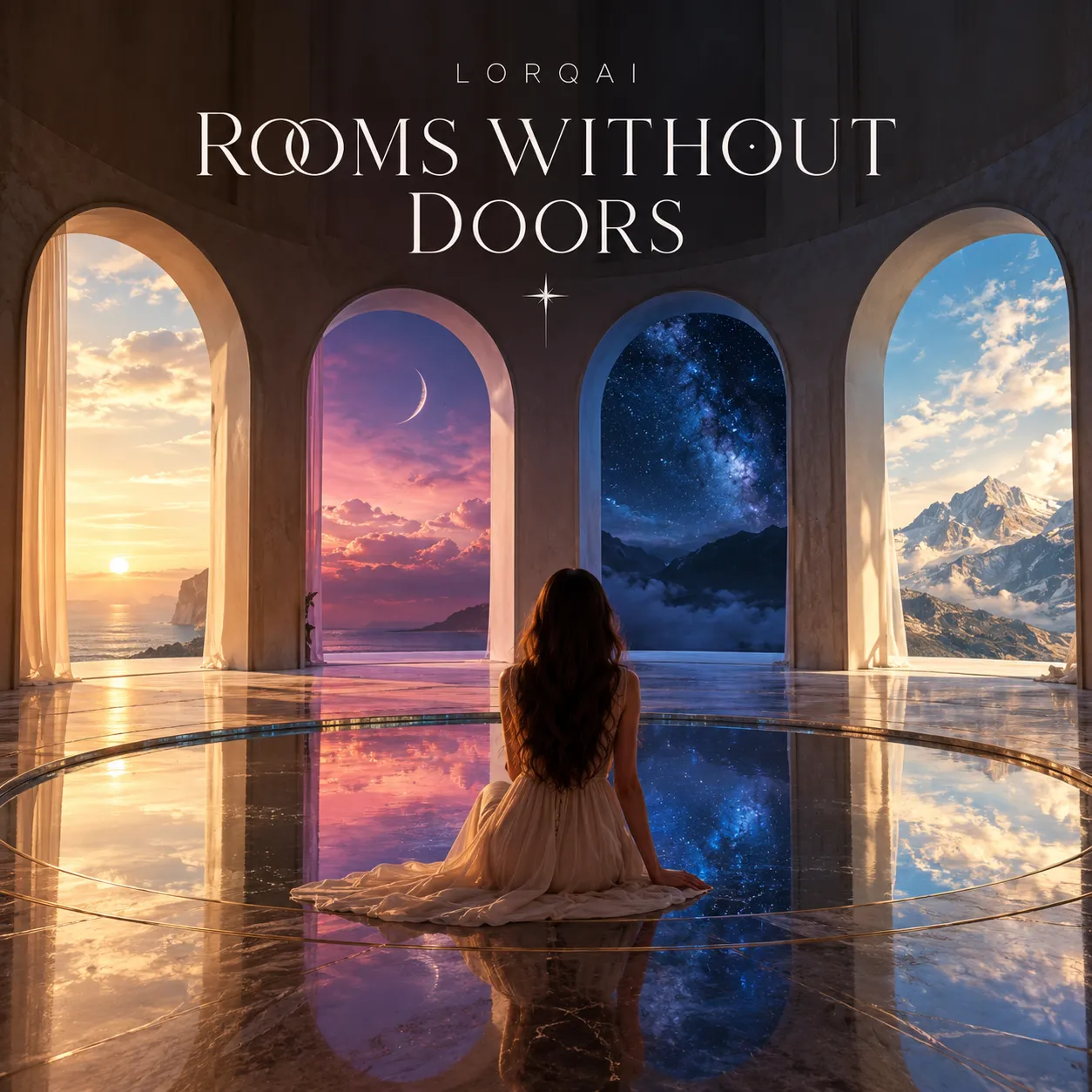
That is the world of ROOMS WITHOUT DOORS, an original song by LORQAI. It imagines a journey through changing rooms and changing skies, held together by a melody that keeps finding its way back. The rooms are places, but they are also stages of a life. And the person addressed by the song may be the only constant in a landscape that refuses to stay still.
The First Room — A song we almost remember
The journey begins in a room without a name. Light slips through a window. There is no sign to explain where we are, no map on the wall, no obvious reason the visitor has arrived. The place is unfamiliar, yet nothing about it feels entirely strange. Then a melody appears: a tune the listener seems to know without remembering when they first heard it.
We all know a version of this experience. A song plays in a shop, and suddenly we remember a person we have not seen in years. An ordinary street becomes a street from another decade. An old feeling returns before we can attach it to a date. Music does not ask permission to open these rooms. It simply begins, and memory follows.
In the first room, the walls appear to shift as the melody continues. The window looks out onto another view; familiar proportions become new ones. Yet the tune survives the transformation. That is the first quiet promise of the story: even when surroundings change, recognition may still be possible.
The comfort is not really in the room itself. It is in finding something—or someone—that makes the unfamiliar feel inhabited. A familiar voice in a crowd can do that. So can a small gesture, a shared joke, or the knowledge that another person understands what we are trying to say before we finish speaking.
The Second Room — Everything gold cannot hold
The next room is filled with gold. Perhaps its walls are warm with sunlight; perhaps the colour exists only in the way a memory has been polished by time. Years later, an ordinary afternoon can glow with a beauty no one noticed while it was happening. A cramped apartment becomes the place where everything began. A late-night conversation becomes one of the most important conversations of a life.
The furniture might have been cheap. The curtains might never have matched. Maybe everyone was tired, worried about money, or making plans that would eventually change. None of that prevents the room from becoming precious. We remember who sat on the floor laughing, whose coat hung by the door, who reached across the table and took our hand.
But gold is not the same as permanence. The second room also contains what we could not hold on to. Children grow. People move. Houses are sold. The routines we assumed would last forever quietly disappear. Even a happy period of life becomes, eventually, something we tell stories about. We can be grateful for it and miss it at the same time.
The recurring melody is different here. We can imagine it lifted a little higher, transformed by the warmth and ache of the room. It is still recognisable. Love often behaves that way: the early excitement of a connection may become patience, ordinary kindness, private humour, and the ability to remain alongside someone when life gets difficult. The sound changes, but a familiar pattern stays beneath it.
The Third Room — When rain changes the view
Then another room opens onto rain. The golden afternoon is gone. Outside, an unfamiliar city stretches beneath a grey sky. Water runs down the windows; the streets look empty, and the world that once seemed easy to navigate has become difficult to recognise.
Almost everyone knows this room, although it looks different for each of us. It can be the first night in a new city, the day after a farewell, the beginning of a job we are not sure we can do, or a period when every part of daily life seems to be changing at once. Some transitions arrive with excitement. Others arrive with grief. Many carry both feelings together.
There are moments when change makes us question whether we have left our old selves behind. We try to learn new streets, new habits, new rules. The landmarks that once helped us understand who we were are suddenly far away. Even happiness can feel temporary when everything around it is uncertain.
But through the sound of rain comes the same melody. It does not stop the storm or offer an answer to every question. That would be too easy, and it would make the image less honest. Instead, the music provides a point of recognition. There is still something that belongs to the traveller, something the weather cannot erase. A connection that survives discomfort can become more reassuring than one that has never been tested.
The third room is not the end of trouble. It is the moment we realise that uncertainty does not have to mean complete disconnection. Sometimes the most important thing another person can offer is not a solution. It is the feeling that we do not have to face the changing world alone.
The Fourth Room — The one the song leaves for us
There is a small mystery at the centre of ROOMS WITHOUT DOORS. The story gives us three rooms in detail: the unnamed beginning, the golden memory, and the rain-soaked world of change. Then the bridge introduces the idea of four rooms and four skies. Four? Where is the one we have not been shown?
Perhaps the fourth room is the future: a life not yet lived, a home not yet found, a conversation that will matter more than we can imagine. Perhaps it holds everything we have not had the courage to say. Or perhaps it is simply the part of the story that belongs to the listener rather than to its narrator.
I like another possibility, too. What if the fourth room is not a place at all? What if it is a person? Someone who can make an unfamiliar city feel like home, who can turn an unremarkable afternoon into a memory worth protecting, or whose presence matters more than the view through any window.
A room usually contains us. A person can make us feel contained in another sense: understood, welcomed, held in mind even when we are apart. That feeling can travel. It can be carried across cities and years, into beautiful places and difficult ones alike.
Leaving the fourth room undescribed is therefore not necessarily an omission. It may be the most generous choice the story makes. Everyone arrives with a different past, a different hope, and a different face in mind. No two listeners need to open the same imaginary door.
How can every door lead back to someone?
The title presents a contradiction. These are rooms without doors, yet the song's central line insists: "Every door leads back to you." If the rooms have no doors, how can a door lead anywhere?
The answer may be that the journey was never architectural. We do not move from one chapter of life to another by turning a handle. We move because time passes, circumstances change, and memory connects things that appear far apart. One version of ourselves becomes another without a clean threshold between them.
A door can also be a decision, a chance encounter, or a familiar melody heard at exactly the right moment. It may open outward into an unknown future, yet remind us of the same enduring relationship. The words need not mean that we always return to the same address. They can mean that, wherever we go, certain people remain part of our sense of direction.
One melody, four different meanings
A recurring musical phrase is an elegant way to tell a story about memory. The melody does not have to explain what has happened; it simply returns. After the first room, it sounds like recognition. After the golden room, it can sound like tenderness mixed with loss. In the rain, it offers steadiness. By the time the fourth room is imagined, the familiar notes carry all those earlier associations.
This is why a song heard at different times in our lives can feel like a different song. Its notes may remain unchanged while the listener changes. We bring to it the places we have known, the things we have lost, and the people we still hope to see. The music becomes a meeting place between the present and everything that came before.
In ROOMS WITHOUT DOORS, the returning chorus becomes the thread running through each room. The image is simple, but the emotional direction keeps expanding: we begin by looking for a way through unfamiliar spaces and end by recognising what, or who, has been with us all along.
The Last Room — Where the movement stops
At the end of the imagined journey, the changing rooms grow still. There is no grand revelation, no dramatic opening of a final door, no promise that every difficult chapter will be erased. The familiar melody is simply allowed to rest.
Perhaps this is the quietest idea in the whole piece: the thing we were searching for was not necessarily lost. It might have travelled with us in the way we remember, the way we speak, and the way we recognise a particular person as home. We could cross a thousand rooms and discover that belonging was never confined to any of their walls.
Home is sometimes a building, and there is nothing wrong with loving a particular place. But it can also be a voice, a shared memory, a presence beside us on an unfamiliar street. It can be the person who notices that we have gone quiet, or the one whose laughter makes a room feel different the instant they enter it.
That is what makes the final return moving. The journey does not deny change. It lets change happen and still leaves room for connection. The world may change its tune a thousand times. Some melodies continue to lead us toward the same person.
The music behind the story
ROOMS WITHOUT DOORS is an original AI-assisted song by LORQAI about love, memory, change, and finding a sense of home. Its shifting rooms offer a visual language for emotions that are difficult to define directly. The repeated melody provides continuity while the imagined surroundings move from light to gold to rain and, finally, toward an unwritten fourth space.
This interpretation is intentionally open. The fourth room does not have to stand for the future, and the person at the centre of the song does not have to mean the same thing to every listener. A song can suggest one journey and still leave space for many others. That is part of its appeal.
You can listen through the music links accompanying this article. And if you return to the piece later, after your own life has changed a little, perhaps one of its rooms will sound different.
If you could return to one room
Imagine your life as a house filled with rooms. Each contains a different year, a different version of you, a conversation you still remember, or an ordinary day you did not know would become important. Somewhere in that house, a familiar melody is playing.
If you could step into just one of those rooms again, which would you choose—and who would you hope to find there?