Music / LORQAI
THE CITY AT HALF VOLUME — Three Notes Before Dawn
An original short story inspired by LORQAI’s “THE CITY AT HALF VOLUME,” from the album OUT OF ORDER, IN TUNE.
An original LORQAI short story inspired by THE CITY AT HALF VOLUME: after a night shift, three notes and a street cleaner’s broom turn a quiet crossing into an unexpected exchange.
Introduction
At seventeen minutes past three, the scanner made its last beep of the night.
I knew the time because I had been watching the minute hand on the warehouse clock creep toward the end of my shift. At three-fourteen, a crate of small parcels had arrived at the wrong gate. At three-sixteen, somebody found the missing pallet label stuck to the sole of a boot. Then came the beep, neat and final, from the scanner in my hand.
I peeled a strip of blue packing tape from my sleeve and dropped it into the bin. The loading key went on its hook. Behind me, the freight gate rolled down with a long metallic sigh. A thousand parcels were going east before breakfast. For once, so was I.
The night supervisor called goodbye from behind a stack of empty cages. I waved without turning. We were friendly in the way night-shift people sometimes are: we knew who took milk in their tea, who could unstick the printer, who had a sore shoulder, and almost nothing about what happened after we went home.
Outside, the air was cold enough to make my face feel newly washed.
The walking music
I had a playlist for the journey home. It was forty-six minutes long, the time it took to leave the freight yard, cross the station road, walk past the shops and reach my flat if I didn't stop. I had arranged it so carefully that I could tell how late I was by the song in my ears. A bright one for the industrial road. Something with a steady bass line for the bridge. A softer final track for the stairs.
I put my headphones on before the yard gate, as I always did.
The music did its job. It covered the rattle of empty carts behind the fence and the hum of the refrigeration units. It made the first stretch of road seem shorter. I passed a petrol station with its shutters down and a bakery whose extractor fan sent warm air into the street. I smelled bread without hearing the machinery making it.
At the station crossing, the final song ended.
I stopped beside the button and reached into my pocket for my phone. The screen offered to play the list again. I had pressed that option so many times I could have done it without looking.
Instead I watched a raindrop travel down the cracked plastic housing of the crossing button. It met another drop, grew heavier and fell.
The street was quiet, but not silent.
I put the phone away without pressing anything.
Things that had been there all along
A bus approached the empty stop across the road and knelt slightly as it braked, though no one was waiting. The driver opened the doors, checked the shelter, and closed them again. The engine gave a soft, tired breath before he drove off.
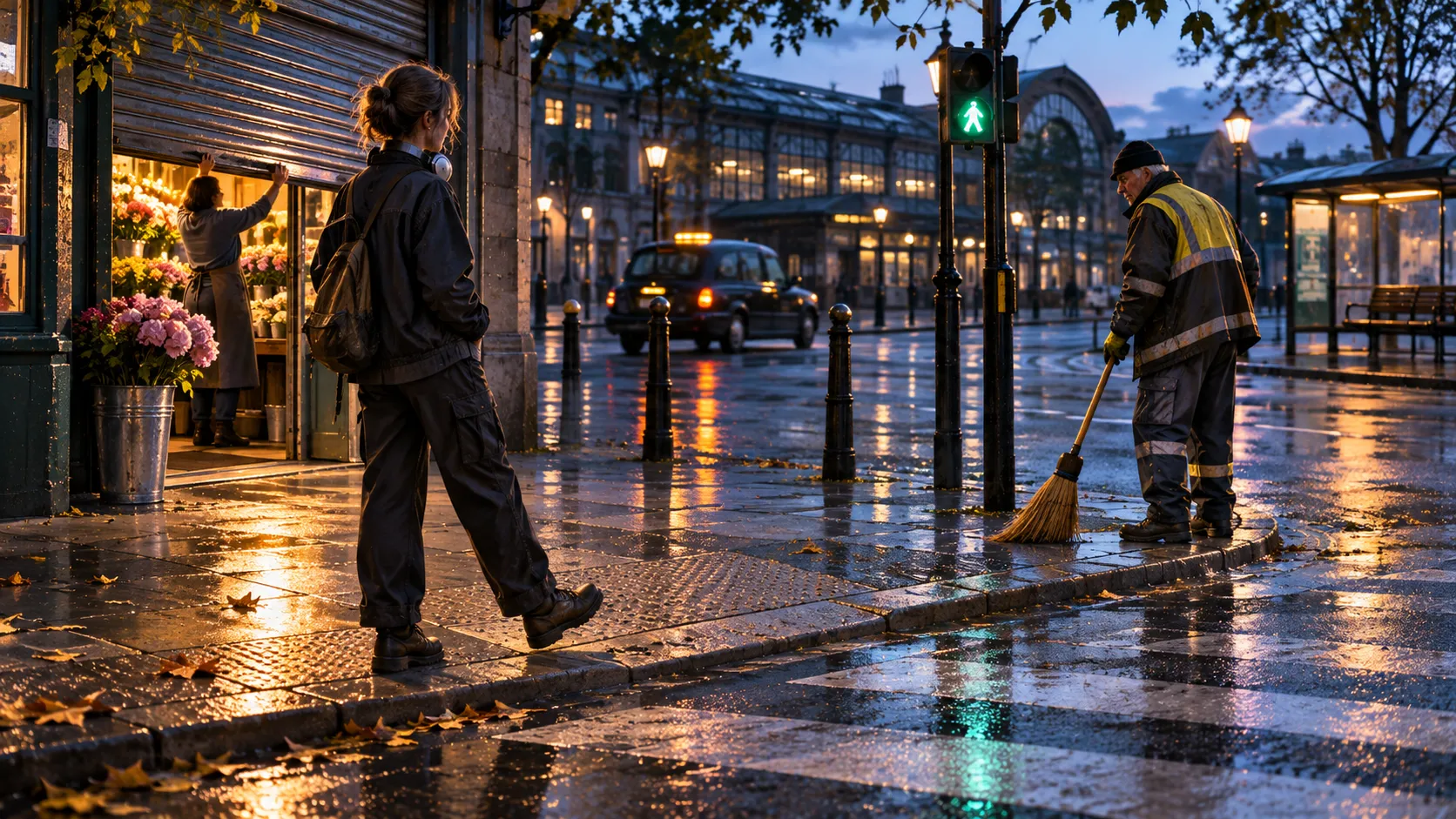
At the florist's, a woman lifted the metal shutter an inch, stopped to adjust her grip, then lifted it another inch. Each movement scraped against the guide rail. Inside the shop, one lamp came on, turning the buckets of wrapped stems into shadows on the window.
Near the bus stop, a man in a dark coat swept wet leaves toward a drain. He wore the collar high against his chin. The broom made a dry, stubborn sound even though the pavement was damp: shff, shff, pause. A taxi waited at the light with its orange indicator ticking. Somewhere behind me a delivery trolley rolled over a broken paving slab and bumped twice.
I had passed these people before. The florist was usually a moving shape behind half-open glass. The man with the broom was a coat and a flash of reflective tape. The taxi light was one more point of orange on a route I barely noticed.
With the headphones quiet, the details began to separate.
It was not that the city had become beautiful in some new way. The bins still smelled unpleasant. The pavement still had a loose stone that tipped under your foot. A discarded receipt had glued itself to a puddle beside the kerb. But the street was busy with the kind of work that rarely earns an audience.
At the warehouse I'd spent eight hours sending anonymous boxes toward other people's doors. Now, walking home, I could see how many hands were needed before those doors opened in the morning.
The crossing light stayed red. I didn't mind.
A little time between lights
I had begun wearing headphones every night after a particularly loud week the previous winter. There had been roadworks beside the freight yard, a broken alarm in the loading bay, and a drill that seemed to start every time I tried to think. Someone suggested noise-cancelling headphones. I bought a pair with my next wages and felt grateful for the sudden private space they made.
Soon I used them even on quiet nights. They were a useful signal to the world and, I suppose, to me. My shift was over. Nothing else could ask anything of me until I reached my own front door.
But that private space had a strange cost. I no longer knew when the bakery opened or why the pavement outside the florist was wet every morning. I passed the city as if it were a photograph laid behind the music.
The crossing button clicked beneath my thumb. I had pressed it without remembering to do so.
On the opposite pavement, the sweeper pushed the last leaves out of the gutter. He stopped, took a short breath and leaned on the handle. From the florist's doorway came the sound of a metal bucket set on stone.
The pedestrian signal changed.
Three clear notes chimed above the traffic, small enough to vanish beneath an engine. I knew that sound. I must have heard it hundreds of times, even through the headphones. Tonight, with nothing playing over it, I could hear the space between the notes.
I waited for the last one to die away.
The answer
The sweeper looked up at the signal. Then, as he shifted his broom to the other hand, he tapped the handle against the kerb.
Three quick knocks.
He hadn't played a tune exactly. The rhythm wasn't perfect; the second knock came a little early. But it had the same shape as the crossing chime, a small answer offered to a machine that couldn't know it had been addressed.
I smiled before I meant to.
The man saw me. For an instant I worried that smiling at a stranger at nearly four in the morning might seem rude, or strange, or like an invitation to explain myself. So I looked down at my shoes.
The rubber toe of one was resting against a raised seam in the pavement. I gave it three soft taps: one, two, three.
He grinned. Not a big grin. More the expression of somebody recognizing a joke nobody had actually told.
The traffic light stayed green. Neither of us hurried.
Then he pushed the broom forward again, and I crossed the road. We didn't speak. We didn't exchange names. I couldn't have told you, later, what color his eyes were or whether he had watched me reach the far pavement. He had a street to clean, and I had a bed waiting for me.
That was enough.
Behind me, the florist's shutter lifted another few inches. A taxi turned the corner. My shoes made their own soft rhythm on the wet ground, not quite in step with anything, but no longer separate from it.
The last part of the walk
I went the usual way. Nothing about the route had changed, although I kept noticing where it bent and widened.
The windows above the bakery were not all dark. One showed a kettle steaming on a sill. Another was lit by a television I could not see clearly. A small kitchen window stood open just enough for the edge of a curtain to move. I wondered how many people were already beginning their day and how many, like me, were ending it.
At the bridge, my phone buzzed. A message from the warehouse group said that somebody had finally found the label for the misdirected crate. Underneath it, a colleague had replied with a photograph of a blue strip of tape stuck to a boot.
I almost laughed aloud. I typed a small answer and put the phone back in my pocket.
Usually I would have started another playlist by now. I still liked the music. I would like it again tomorrow. I had no intention of becoming the sort of person who talked solemnly about discovering the miracle of ordinary sounds.
I simply didn't want to cover these ones yet.
Past the bridge a delivery bicycle rattled over a drain cover. From a courtyard came the double clink of bottles being set into a crate. A woman pulled up the sleeve of her coat and checked a watch before unlocking a side door. I heard each sound for only a moment, then let it go.
It was nearly four when I reached my building.
The open window
The stairwell smelled of old paint and somebody's late supper. I climbed to the third floor, letting my hand trail along the cold banister. At my door I took off the headphones and placed them on the narrow shelf beside the keys. A faint mark on my hair showed where the band had been.
I filled a glass of water. I washed the small line of packing dust from my wrist. My shoes stood together near the mat, their soles leaving two damp half-moons on the floor.
Then I opened the window.
The street below was not empty. A bus waited at the corner, its engine turning gently. Someone rolled a bin toward the pavement. Farther away, a shutter scraped and stopped. Dawn had not quite arrived, but the sky beyond the roofs was no longer black.
The bus let out a long sigh as it pulled away.
I thought of the crossing: three notes, three broom taps, the awkward little reply from my shoes. Nobody on the street would remember that exchange by breakfast. It had not changed my work, my hours or the distance between the freight yard and home.
I was grateful for it anyway.
I closed the window halfway against the cold and left the other half open. The room settled around me. I was alone, and for once the city did not sound like something happening on the other side of a wall.
Somewhere below, another set of footsteps began.
About the Song
- Released
- Album
- OUT OF ORDER, IN TUNE