
Music / LORQAI
THE LAST PEACH — The Last Thing Left on the Table
A LORQAI song from OUT OF ORDER, IN TUNE, accompanied by “The Last Thing Left on the Table,” an original fictional story inspired by the track.
Listen to THE LAST PEACH by LORQAI from OUT OF ORDER, IN TUNE, and read “The Last Thing Left on the Table,” an original fictional story inspired by the song.
The moving van
The moving van disappeared down the hill at twenty past four.
I know the time because the kitchen clock was the last thing we'd taken off the wall, and I kept looking at the pale square it had left behind. Twenty-two years of sunlight had darkened the paint around it. The clock's outline was almost perfectly white, as if some earlier version of the room had been waiting there all along.
The van was taking the last furniture to Mum's new place. She had gone ahead that morning. We'd promised her we would finish the kitchen, lock up, and bring the keys tomorrow.
My sister stood by the back door with a roll of packing tape in one hand. She had been doing this all day without seeming to get any closer to finished.
“There's still the cupboard above the sink,” I said.
“I know.”
It had become the phrase we used instead of almost everything else.
Two columns
When we'd started clearing the house, I'd made a list on my phone: keep, donate, throw away. It seemed sensible. Mum had already chosen what she wanted in the new apartment. The rest was a question of boxes and a hired van, or so I'd thought.
My sister had written her own list in a notebook. It wasn't divided by objects. It said things like phone the clinic, check the new prescription, find Mum's blue cardigan, ask whether the lift works on Sundays.
I'd looked at it once and said, “Those aren't moving jobs.”
“They are to me.”
We'd been polite after that. Polite enough to make every cupboard door sound louder when we closed it.
I'd driven down for the move, paid the company, organized the timing and brought more cardboard boxes than we needed. I had spreadsheets. I had receipts. When the driver asked where to place the last chair, I answered before my sister could.
She hadn't argued. She'd simply walked the chair into the kitchen herself.
Now, with the van gone, it struck me that I had spent the entire day talking about what needed doing, while she had been talking about who would still need help when it was done.
Tuesdays
A stack of old tea towels lay on the counter. I folded them into a box while my sister wiped a shelf that was already clean.
“She has an appointment next Tuesday,” she said.
“I thought the new place was closer.”
“It is. She still needs a lift.”
“I can book a car for her.”
My sister put the cloth down.
“I've driven her every Tuesday for nearly two years,” she said. “It's not just the driving.”
I knew about the appointments. Of course I did. I had paid several of the bills that followed them. Each time Mum called to say she'd been to the clinic, I asked whether everything was covered. Sometimes I transferred money before she asked.
“I sent the money,” I said.
“I know you did.”
There was no accusation in her voice. Somehow that made it harder to stand there.
I wanted to explain that I had a life somewhere else, that I couldn't leave it every week, that paying for things had been the form of help I could offer. All of it was true. I could already hear how thin it would sound if I said it as a defense.
My sister returned to the shelf.
For years we'd reported the same family life to each other in different units. I could tell you how much the bills had cost. She could tell you whether Mum had eaten before the appointment, which road made her carsick, and why she always said she was fine just before admitting she was tired.
Neither report was false. Neither was complete.
What the birds missed
I took the empty box outside to flatten it. The garden looked smaller without the table and chairs. On the far side, the peach tree held a few leaves and one fruit near the end of a high branch.
I remembered climbing that tree, though I couldn't remember the last time I'd looked properly at it.
My sister came through the door, pushed up her sleeves and reached for the fruit. She twisted it carefully, once, then again. When she turned around, there was a peach in her open palm, dusty gold on one side and red on the other.
“Last one,” she said. “The birds missed it.”
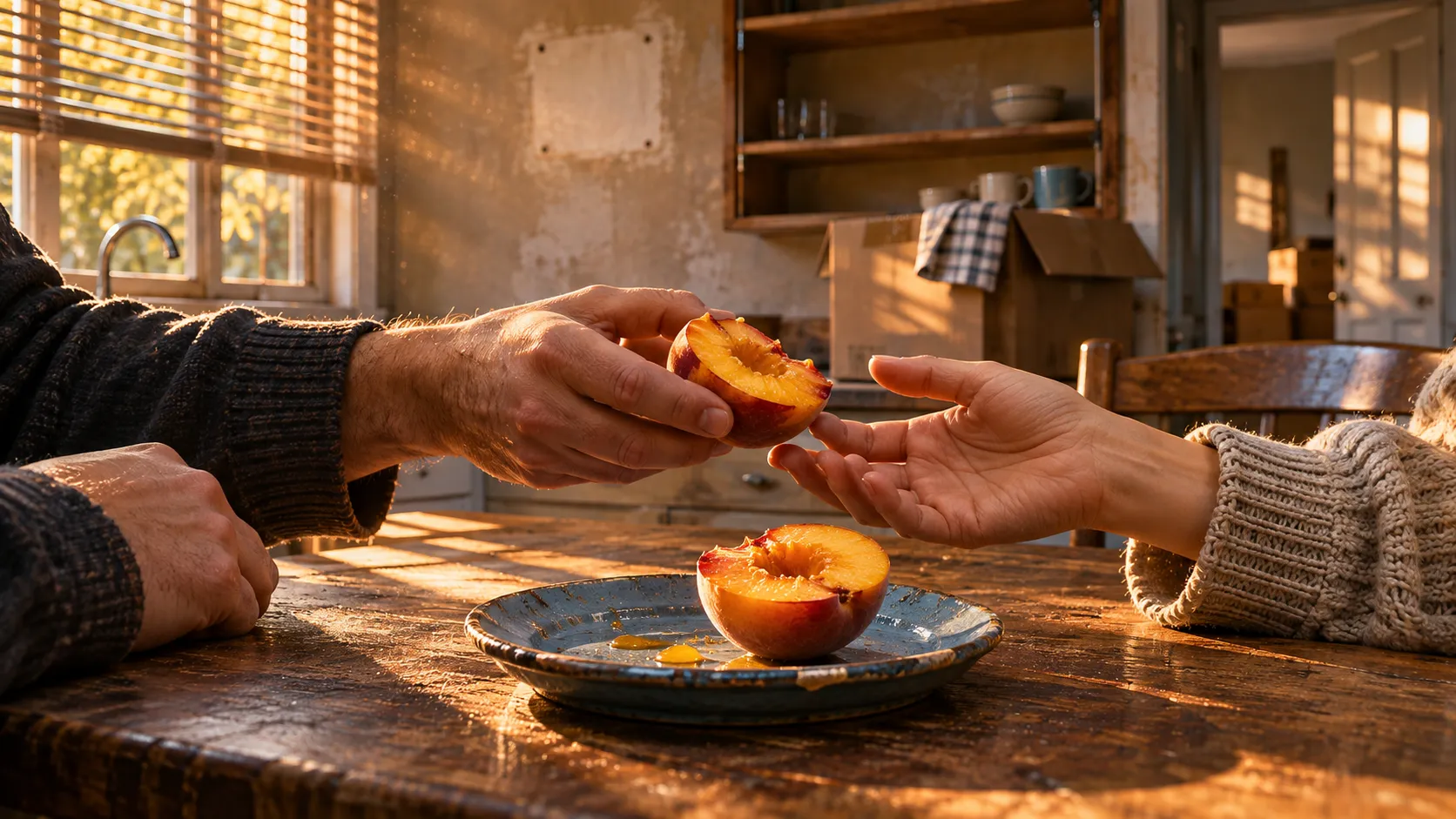
She set it on a chipped blue plate, the only plate left unpacked, and pulled the second kitchen chair away from the wall.
I glanced at the cupboard above the sink.
“Come on,” she said. “Five minutes.”
We sat down without taking our coats off. The room smelled faintly of cardboard, wood polish and the cool air that had come in through the garden door.
I had expected the peach to be the first thing she put in a box. Instead, it sat between us as the sun shifted across the table.
“We've been dividing everything,” she said. “Even the days.”
I wanted to ask what she meant, but I knew enough to wait.
The branch
“Do you remember the branch we broke?” she asked.
I did.
We had been children, trying to reach fruit that wasn't ripe. I'd climbed where Mum told us not to climb. A branch cracked under my shoe, and I'd jumped down so quickly that I scraped both knees. When Mum saw the damage, I blamed the wind.
My sister told her it must have been the rain.
For years I'd remembered that as proof of how good she was at looking after people. She always knew what needed saying; I always found a way to be somewhere else when it had to be said.
“You covered for me,” I said.
“Yes.”
“You didn't have to.”
She looked at the peach, not at me.
“I hated being the good one,” she said. “You got to leave.”
I felt myself reaching for the old explanation. I'd left because of work, because there had been a chance and I'd taken it, because she had seemed happy here. There were a dozen reasonable sentences waiting, all beginning with because.
“I thought you wanted to stay,” I said.
She looked up.
“You never asked me.”
There wasn't much to do with that sentence. I could not go back and ask the question twenty years earlier. I could not make Tuesdays disappear from the calendar, or replace them with receipts. Even if I apologized perfectly, she would still have to take Mum next week unless we worked something out.
“I didn't,” I said.
My sister nodded once. We sat with that for a while.
Then she reached for the knife we'd used to open a box of cutlery.
The softer side
The peach was a little too ripe. It gave way unevenly under the blade, and juice ran across the blue glaze. My sister separated the halves, looked at them, and slid the softer one toward me.
As children, I'd always wanted the better-looking piece. She remembered that. So did I. Neither of us mentioned it.
I took a bite. The fruit was warm from the garden and slightly bruised where she'd cut it. Outside, a bird landed on the rail and flew off again.
“I can do Tuesdays next month,” I said. “Not all of them. Two, maybe. If I move things around.”
“You don't have to make a promise right now.”
“I know.”
“And we still need to talk about the rest.”
“I know that too.”
We didn't draw up a new schedule. We didn't decide who had been right. The cupboard above the sink remained full of mismatched cups, and the keys were still on the counter beside the folded tape.
But neither of us stood up.
The sun moved down the blinds and across the table. By the time it reached the empty blue plate, we'd finished the peach and begun, at last, to talk without keeping score.
About the Song
- Released
- Album
- OUT OF ORDER, IN TUNE